SDR Outsourcing for Biotech Companies: When It Fits
SDR outsourcing for life science sellers: which parts of the job can go outside, what FDA research use only guidance means for the brief, and when it is the wrong play.
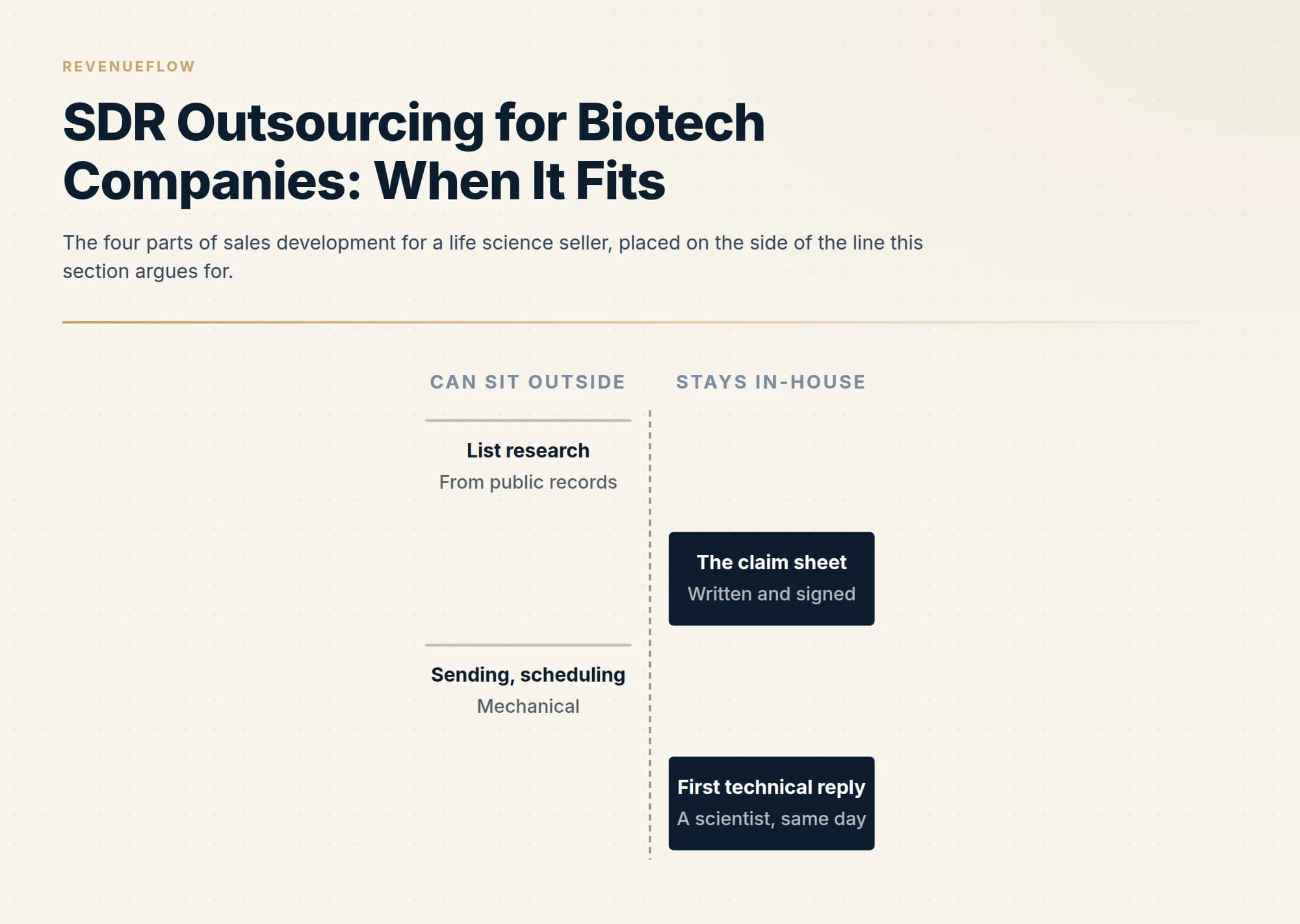
SDR outsourcing fits a life science tools company when list research and sending go outside while the claim sheet and the first technical reply stay with an in-house scientist. For a product labeled research use only, FDA guidance treats statements made on the manufacturer's behalf as evidence of intended use, so the brief must limit claims and exclude non-research laboratories.
Key takeaways
- Sales development for a life science seller is four jobs: list research and sending can sit outside, while the claim sheet and the first technical reply stay in-house.
- FDA guidance issued on November 25, 2013 says evidence of intended use can include how a device is sold and distributed by or on behalf of the manufacturer.
- The same guidance gives routine sales calls to clinical laboratories that do not perform research as an example that may conflict with a research use only label.
- Judge an outside team first on the share of researched accounts a scientist marks right, because meetings lag behind the experimental clock in this market.
Reviewed and updated September 18, 2026
A company that makes a plate reader hires an outsourced sales development team in January. By March the team has sent nine hundred emails to people with research in their title and booked four meetings. Two of the four open with a question about dynamic range that the rep cannot answer, and one is with a hospital laboratory that does no research at all. Nothing went wrong with the vendor. The company handed over a job without deciding which parts of it could leave the building.
This guide is for life science companies that sell instruments, reagents, software or services to laboratories and are deciding whether to outsource sales development. It does not re-describe the market: how laboratory purchases form around an experiment, a grant or a financing round is in biotech lead generation. It does not re-describe the arrangements on sale either: the four shapes of outsourced team are in SDR outsourcing, and what vendors publish about price is in SDR outsourcing companies. This page is about the decision in between, for this buyer.
Split the job before you buy any of it
Sales development in this market is four jobs, and they do not all need a scientist.
List research is reading public records. The National Institutes of Health describes its RePORTER tool as a way "to search a repository of NIH-funded research projects and access publications and patents resulting from NIH funding." A careful person with a written rubric can learn to read an award record, a methods section or a conference programme, and an outside team can do that work well. It is slow, it is checkable, and it does not require anyone to speak for your product.
Sending and scheduling are mechanical. They can sit outside.
The claim sheet cannot. What the message says your product does, to whom, and with what evidence is a scientific statement, and for some products it is a regulated one, which the next section covers. Somebody in-house with a technical background writes it and signs it.
The first technical reply cannot sit outside either. In this market a positive reply is often a question: about sensitivity, sample type, compatibility with an existing workflow. The reader is testing whether a conversation would be worth an hour. If that answer comes from a generalist it ends the thread, and if it comes two days late the experiment has moved on. The reply has to reach a named scientist on your side the same day.
An arrangement that respects that line can work. An arrangement that hands all four parts to the vendor is the one in the opening paragraph.
When the product is research use only, the brief is a regulated document
Some products in this market carry a label that limits what may be said about them. The FDA's guidance on in vitro diagnostic products labeled for research use only or investigational use only, issued on November 25, 2013 and marked as containing non-binding recommendations, explains how the agency reads a manufacturer's intent. It says evidence of intended use can include "how the device is sold and distributed by or on behalf of the manufacturer."
The words on behalf of are the ones that matter for outsourcing. The guidance lists examples of evidence that would appear to conflict with a research use only label, and two of them describe sales development exactly. One is "Written or verbal statements in any labeling, advertising, or promotion of the IVD product by or on behalf of the manufacturer" that suggest a clinical diagnostic use. The other is "Solicitation of business from clinical laboratories", with the example of a sales force that "makes routine calls to clinical laboratories that do not perform research or clinical studies".
An outside team writes and speaks on your behalf. If your product carries that label, the brief you give them needs two things that an ordinary brief does not: a list of statements the team may make, with nothing clinical in it, and an exclusion of laboratories that do no research. The hospital laboratory in the opening paragraph would be an ordinary targeting mistake elsewhere. For this product class it is also the FDA's own example. Read the guidance with your regulatory lead before an outside team sends anything. This page is not legal or regulatory advice, and the guidance concerns in vitro diagnostic products, so it does not reach every reagent or instrument.
Email has its own federal rule whoever sends it. The FTC's CAN-SPAM guide says "The law makes no exception for business-to-business email", and a vendor sending in your name is sending your email.
Brief the team like a new lab member
A product sheet is the wrong brief for this market. The right one reads like the onboarding a new technician would get.
Start with the rubric. Write down what makes an account worth a message in terms an outsider can check against a public record: an award in a named research area that started in the last six months, a methods section that names a competing platform, a conference abstract on a technique your product serves. Then calibrate. Have the outside team research twenty accounts, have one of your scientists mark each one right or wrong, and repeat until the two agree. Expect more than one round. It is cheap quality control.
Add a glossary of the twenty terms a rep will meet in replies, with one sentence each, so that a reply can be recognised as technical and routed, and so that nobody improvises.
Set the routing rule in writing: which replies go to which scientist, by when, and who covers holidays. Agree what counts as a meeting before anything is sent. Our own definition of a qualified meeting is set against criteria agreed in writing before launch, and the argument for doing it that way is in what a qualified meeting has to mean.
Measure the handoffs, because the meetings come late
This market runs on an experimental clock, so meetings lag. Judging an outside team on meetings in the first sixty days tells you little. Judge the stages you can see.
Share a scientist marks right on audit
One per person, per campaign
Same day, to a named scientist
Against criteria agreed in writing
The first stage is the one to watch. If a scientist audits a sample of researched accounts each week and the share marked right holds up, the team has learned the rubric. If it drifts, no amount of sending will rescue the campaign.
We send one message per person per campaign and do not follow it with a reminder. A vendor whose plan depends on a sequence of bumps to a working scientist is proposing the behaviour this audience is quickest to filter. A later approach belongs to a new reason, such as a new award, a new paper or the next meeting.
A reason to write, from the calendar and the public record
The conference calendar gives an outside team something concrete to work towards. The American Association for Cancer Research lists its 2027 Annual Meeting for April 2 to 7, 2027 at the Orange County Convention Center in Orlando. The Biotechnology Innovation Organization's convention page says "Save the date: June 7-10, 2027" and names Philadelphia. A campaign built around a meeting at one of those events has a date, a place and a natural ask.
Three illustrative openers follow. They name no real recipient and promise no result, and the research areas and product details inside them are invented for illustration.
The first illustrative opener is for a principal investigator with a new award found in the public grant record.
Your new award on tumour organoid drug response starts this autumn. Our imaging plates were designed for organoid work at that scale. One of our application scientists can send you protocol notes if that would help while you are still planning.
The second illustrative opener is for a core facility director before a conference.
You will be in Orlando for the cancer research meeting in April and so will our application team. If single-cell sample prep is still the bottleneck in your facility, we would like twenty minutes at the meeting to show you a run. If it is not, ignore this.
The third illustrative opener is for a head of process development at a commercial biotech before the industry convention.
Your team is hiring for downstream purification, which usually means a platform decision is near. We will be in Philadelphia in June with data from a process at your scale. A scientist from our side, and not a salesperson, would take the meeting.
Each of those could be researched and sent by an outside team. Each reply would go to a scientist.
When outsourcing sales development is the wrong play for a biotech company
It is the wrong play when nobody in-house can answer a technical reply within a day. The outside team will create conversations your side cannot hold, and each one costs you a scientist's goodwill.
It is the wrong play when the order is small and goes through a catalogue. A consumable ordered through a distributor's portal by a bench scientist cannot repay a staffed seat, and the distributor relationship described in the biotech guide above is the better investment.
It is the wrong play when you cannot control what is said. If the product is labeled research use only and you are not prepared to write the claim sheet and the exclusion list, and audit against them, do not put a third party between you and the customer.
It is the wrong play when the market is a few hundred laboratories. A list that small can be written to by a founder or an application scientist personally, with better results than any outside team will get, and cold email for biotech covers how technical to make those messages.
It is the wrong play as a way to find out what to say. An outside team amplifies a message that already works with scientists. It cannot discover one.
Where it fits, outsourcing in this market means renting research capacity and sending discipline while keeping the science at home. If you would like to see what a rubric, a researched list and one message would look like for your product, you can see what a first campaign would look like.
The FDA guidance, the NIH, AACR and BIO pages and the FTC guide were read on their own sites on 18 September 2026; the FDA guidance was read from the agency's PDF. Conference dates change; check the linked pages. We could not retrieve ClinicalTrials.gov's description of itself in a readable form on that day, so this page does not describe it. Nothing here is legal or regulatory advice.
Sources: FDA, Distribution of In Vitro Diagnostic Products Labeled for Research Use Only or Investigational Use Only, NIH RePORT, FAQs, AACR Annual Meeting 2027, BIO International Convention, FTC, CAN-SPAM Act compliance guide
Frequently asked questions.
Frequently asked questions- Should a biotech company outsource its SDR function?
- It can, if it outsources the right parts. Reading public grant records, methods sections and conference programmes to build a list is work an outside team can do against a written rubric, and so is sending. What the message claims, and the answer to the first technical reply, should stay with an in-house scientist, because a generalist's answer ends the conversation.
- What should a brief to an outsourced SDR team include for a life science product?
- A rubric for which accounts are worth a message, checkable against public records; a list of laboratories never to contact; a claim sheet of statements the team may make; and a routing rule that sends every technical reply to a named scientist the same day. Add a glossary of terms a rep will meet in replies, and calibrate on twenty accounts before anything is sent.
- Does FDA guidance affect how an outsourced team can sell research use only products?
- The FDA's 2013 guidance on in vitro diagnostic products labeled for research use only says evidence of intended use can include how a device is sold and distributed by or on behalf of the manufacturer, including written or verbal promotional statements and solicitation of clinical laboratories that do no research. An outside team acts on your behalf, so involve your regulatory lead. This is not legal advice.
- When is SDR outsourcing the wrong choice for a life science company?
- When nobody in-house can answer a technical reply within a day, when the product is a low-value consumable ordered through a distributor's catalogue, when you cannot control and audit what is said about a research use only product, when the whole market is a few hundred laboratories, or when you are hoping an outside team will discover the message for you.
About the author.

B2B cold email experts helping companies generate qualified leads through done-for-you outreach campaigns.
RevenueFlow Team
Explore more.
Ready to scale your outreach?
We build GTM engines that book real meetings. See the receipts.
Related articles.
LinkedIn Outreach for Automotive Companies: Who It Reaches
LinkedIn outreach into automotive, split by buyer: what it can open at manufacturers, parts suppliers and dealer groups, and the cases where it is the wrong channel.
LinkedIn Outreach for Ecommerce Companies: Who Is Reachable
LinkedIn outreach to ecommerce brands: why the storefront address reaches support, what Shopify's partner agreement says about contacting merchants, and who is reachable.
Outbound Sales for Property Management Companies: Winning Owners
Outbound for property management companies that want owner clients: three audiences, the calling, texting and email rules for each, licensing, and agent referrals.
LinkedIn Outreach for Logistics Companies: Finding Shippers
LinkedIn outreach for brokers, forwarders and 3PLs: why the industry filter returns competitors, how to find shippers by function, and what goes in one checkable message.
Outbound Sales for Higher Education Vendors: Which Door to Use
Outbound for higher education vendors, built on universities' own purchasing policies: three doors, the ask that fits each one, and a dated accessibility review.
Outbound Sales for Food and Beverage Companies: Who to Reach
Outbound sales for food and beverage brands: the four buyers behind a yes, the public show calendar, what a message may claim, and when outbound is the wrong play.