Biotech Lead Generation: Decided at Experiment Design
Laboratory purchases are settled at the bench when a protocol is planned, and the money behind them arrives on dates that awards and financing rounds make public.
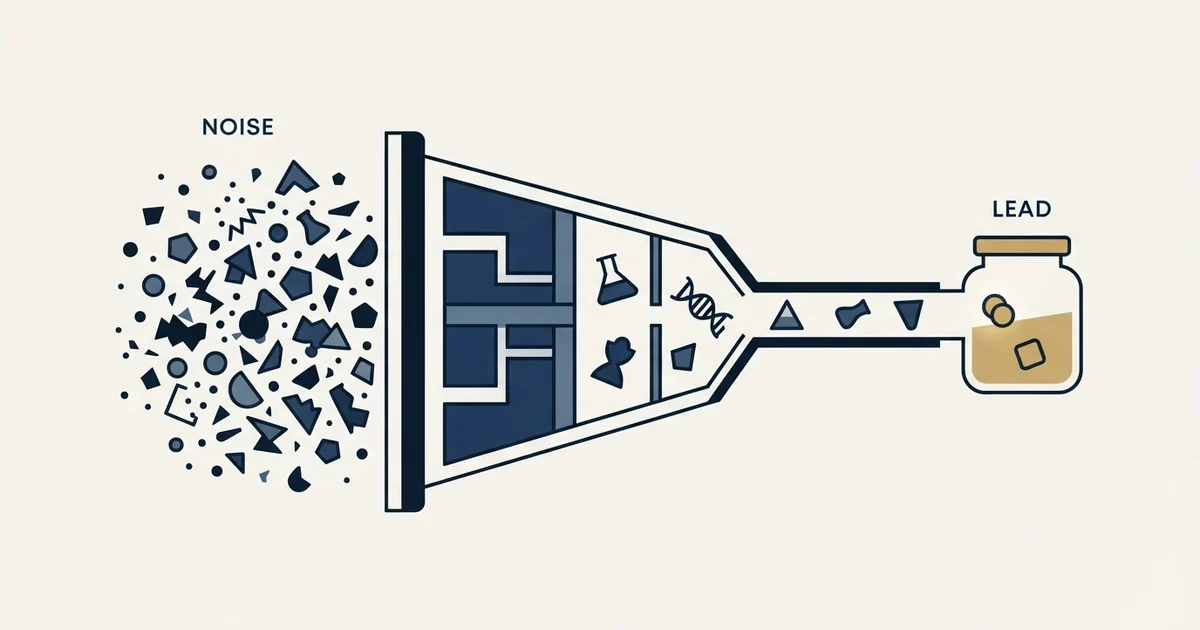
Biotech lead generation works off programmes rather than firmographics. Grant awards, trial registrations, job postings and published methods sections make funding, timing and incumbent methods observable. The choice is made at the bench when an experiment is designed, and it closes once the protocol is fixed.
Key takeaways
- Life sciences is a third market alongside medical devices and healthcare providers: the person who chooses is usually the person who will use it, and institutional purchasing transacts rather than decides.
- Funding arrives on dated, largely public terms. Grant awards publish value, duration and research programme; a financing round's stated purpose says more about upcoming spend than its size does.
- Published papers name methods, kits and suppliers in their materials sections, which makes the literature a direct read on the incumbent a displacement message would have to overcome.
- The decision window opens during protocol planning and closes when the protocol is fixed, because a mid-project change invalidates comparability with work already done.
Reviewed and updated September 1, 2026
A reagents company builds a list of every biotech in a region above twenty employees, finds a head of research at each, and sends a well-written message about assay reproducibility. Two people reply. Six months later a sales rep at a conference discovers that four of the silent accounts had switched suppliers in that exact category during the quarter the campaign ran, and that in every case the decision was made by a bench scientist designing a new experiment, at a moment nobody outside the lab could see.
Selling into life sciences has a rhythm that most B2B playbooks do not model. The purchase is attached to an experiment, the money is attached to an award or a round, and both have dates that are frequently public.
This is a third market, not a variant of two others
Two adjacent markets get conflated with this one, and the buying structures are genuinely different.
Selling a medical device into a hospital runs through clinicians who want the product and a value analysis committee that decides whether the institution buys it, with clinical evidence as the qualifying asset. That is covered in medical device lead generation.
Selling into providers, payers and health systems runs through administrators, procurement and long institutional cycles, which is the subject of healthcare lead generation.
Where healthcare sales run through institutional procurement, regulated finance shows a parallel split between compliance gated institutional deals and ordinary B2B buying, a distinction explored in fintech lead generation strategy.
Selling instruments, reagents, consumables, lab software or research services into biotech and academic laboratories is neither. The person who chooses is usually the person who will use it, the money is project-shaped rather than budget-shaped, and the institution's purchasing function is a transaction layer rather than a decision layer. Treating this market as a slightly technical version of either of the others produces messages aimed at people who were never going to decide.
The money has a shape, and the shape is public
Two funding regimes dominate, and an account belongs firmly to one of them.
Academic and translational laboratories run on grants. The award has a value, a start date, a duration and usually a stated research programme, and much of that is published in grant award databases as a matter of policy. A laboratory that has just been awarded funding for work in your area is a buyer with money, a mandate and a start date, all of which you can read before writing.
Commercial biotechs run on financing rounds. A round buys a specific milestone, most often a data readout or a regulatory submission, and the spending that follows is whatever is required to reach it. The stated purpose of a round is therefore more informative than its size, because it tells you which capabilities the company is about to build and which it will keep outsourcing.
Both regimes create the same useful property. The money arrives on a date, is committed to a purpose, and expires. That is a far better targeting substrate than company size, and it is the substrate most lists in this market ignore.
- Award value, dates and research programme frequently published
- Principal investigator initiates and effectively decides
- Institutional purchasing transacts, often via catalogue distributors
- Spending clusters early in an award and again before it lapses
- Publication record names the methods already in use
- Round size public, stated purpose more informative than size
- Head of platform, research or process development decides
- Purchasing is internal and light until scale-up
- Spending is shaped by the milestone the round bought
- Trial registrations and job postings reveal the programme
The initiator is a scientist, and the scientist is not on most lists

The instinct is to target the most senior research title available. In a laboratory that inverts the order in which the purchase actually forms.
A method gets chosen when an experiment is designed. The person designing it is a principal investigator, a postdoctoral researcher or a senior scientist, and their choice of reagent, instrument or service is usually settled before anyone with a budget title hears about it. By the time a director of research is involved, the decision is a requisition.
The senior title matters in two specific places, and it is worth knowing which. Capital equipment above an institutional threshold becomes a committee decision, frequently involving a core facility that will host the instrument and charge other groups to use it. And at a commercial biotech moving from research into process development or manufacturing, platform decisions become company decisions with real switching cost, which is exactly when a senior owner appears.
That gives two distinct motions rather than one. For consumables and methods, write to the bench. For platforms and capital, write to the person who owns the programme, and expect a committee.
Signals that are readable, and better than firmographics
This market publishes its intentions more thoroughly than any other in B2B, because publication is the professional currency.
Papers name methods, kits, instruments and suppliers in their materials sections, which makes the published record a direct read on what a laboratory currently uses and therefore on what a displacement message would have to overcome. A group that has just published using a competing method is not a good target this month and may be an excellent one when the follow-on work starts.
Grant awards name the programme and the period. Trial registrations name the phase, the design and frequently the sites, which for anyone selling services into clinical development is the single richest source available. Conference posters and abstracts surface work a year before it appears in a journal. Job postings name platforms and assays in their requirements, in the same way security postings name security tools.
A list built from those sources is small, current and specific enough that the message can name the actual work. A list built from company size and sector is none of those things, and in a market where the reader is a working scientist, vagueness is disqualifying on the first line.
The distributor sits between you and the order
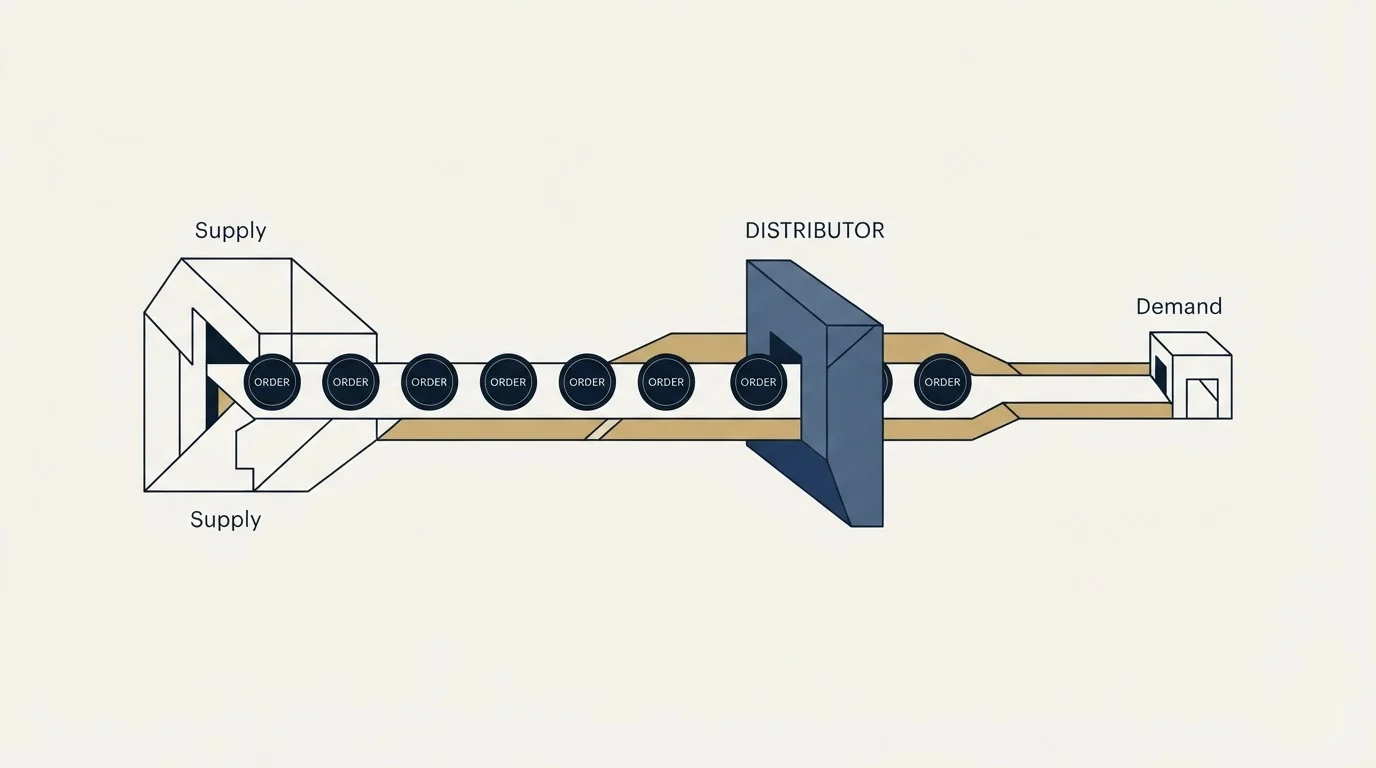
For consumables, reagents and smaller instruments, a large share of laboratory purchasing runs through catalogue distributors and institutional supply agreements. A scientist who has decided to use your product frequently orders it through a portal that only lists approved suppliers.
Two consequences for lead generation. The first is that being unavailable through the account's supply route can lose a decision you had already won, and it is worth knowing before targeting an institution rather than after. The second is that the distributor relationship is itself a channel to be sold to, with a completely different message about catalogue placement, margin and demand.
For services, contract research and manufacturing organisations play a similar intermediary role. A biotech that outsources a function is not a prospect for a tool that does that function, and is an excellent prospect for a better version of the outsourced service. Reading which functions an account runs internally and which it outsources is a targeting question that job postings answer directly.
Seen from the sales organisation, B2B sales for biotech companies is this same map worked from the other end: which institutions buy direct, which route through a distributor, and who on the field team owns each.
- Step 1Experiment designed
A scientist chooses a method. Reagent, kit, instrument and service decisions are effectively made here.
- Step 2Feasibility and cost
Checked against the award or programme budget. Alternatives compared on data rather than on positioning.
- Step 3Requisition
A budget holder approves what has already been chosen. This is where a title-first campaign arrives.
- Step 4Order routing
Placed through institutional purchasing or a catalogue distributor, which decides whether you are orderable at all.
Cycle length, and the window that closes for a year
The cycle in this market is not a sales cycle, it is an experimental one. A decision window opens when a project is being planned and closes when the protocol is fixed, because changing a reagent or a platform midway invalidates comparability with work already done.
That produces a pattern worth planning around explicitly. Outreach that arrives during planning has a real chance. Outreach that arrives two months later is competing against a sunk methodological commitment and will lose regardless of product quality, and the honest response is to note the account and return when the next programme starts rather than to argue.
It also means the strongest accounts are the ones about to start something: a new award, a new hire into a technique, a new trial registration, a facility expansion. Those are all observable, which is what makes this market tractable despite the long intervals.
Reply behaviour reads faster than any of it, and the biotech cold email benchmarks give a reference point for the top of the funnel before the experimental clock applies.
Message and cadence

Once the list carries the programme, the message writes itself in a way that most markets do not allow. Naming the technique, the application and the specific constraint a scientist is working against is both possible and expected, and generic value language reads as evidence that the sender does not understand the work. The execution detail, including how technical to go and what a scientist will forgive, is covered in cold email for biotech.
Whether any of that work can be handed to an outside team is weighed in SDR outsourcing for biotech companies.
Our operating rule is one message per campaign, with no bumps and no thread replies. In this market that is easier to live with than in most, because the signal supply is unusually rich. A new publication, a new award, a phase change in a registered trial, a first hire into a technique: each of those is a genuine new reason to write and therefore a new campaign, rather than the same message with a different subject line arriving under the one that was ignored.
- Yes: Every account tagged as grant-funded laboratory or financing-backed company, with separate campaigns
- Yes: Programme recorded per account from an award, registration, posting or publication rather than from sector alone
- Depends: Current method read from the published record where one exists
- Yes: Bench initiators and programme owners mapped as distinct targets with distinct asks
- Yes: Order routing checked so an account cannot decide for you and then fail to place the order
- Yes: Qualification criteria for a real opportunity agreed in writing before launch
What to take away
Life sciences lead generation rewards research in the literal sense. The money is project-shaped and its dates are public, the initiator is the person at the bench rather than the person with the title, the published record names the incumbent method, and the decision window is set by an experimental calendar that no amount of persistence reopens.
Build the list from awards, registrations, postings and publications, then write to the person designing the work. The lead generation channels comparison covers where each channel earns its place once the list is right. To see that segmentation applied to your own category before committing a quarter of sending to it, look at what a first campaign would target.
Frequently asked questions.
Frequently asked questions- Who actually chooses a reagent or instrument in a lab?
- For consumables and methods, the scientist designing the experiment: a principal investigator, postdoctoral researcher or senior scientist. A budget holder approves a requisition for something already chosen. Senior owners genuinely decide in two cases only, capital equipment above an institutional threshold, and platform choices at a company moving from research into process development.
- What signals are worth building a biotech list from?
- The ones this market publishes as professional practice. Grant award records give value, duration and programme. Trial registrations give phase, design and sites. Job postings name platforms and assays in their requirements. Conference abstracts surface work a year before publication, and papers name the methods and suppliers already in use.
- Why did outreach to a lab get no reply when they were clearly buying?
- Timing more often than targeting. Method decisions are settled while a protocol is being planned and become effectively fixed once work begins, because changing a reagent midway breaks comparability with data already collected. A message arriving after that point argues against a sunk methodological commitment, and product quality does not reopen it.
- Do distributors matter for selling into laboratories?
- They decide whether a won decision becomes an order. A large share of laboratory purchasing runs through catalogue distributors and institutional supply agreements, and a scientist ordering through an approved-supplier portal cannot buy from a company that is not listed. Check the account's order routing before targeting the institution rather than after.
About the author.

Ben Carden is CRO at RevenueFlow, which builds and operates outbound revenue engines for B2B companies. Previously at Gartner Enterprise. Studied at London School of Economics.
Ben Carden · CRO
Connect on LinkedIn →Explore more.
Ready to scale your outreach?
We build GTM engines that book real meetings. See the receipts.
Related articles.
Two Agencies, One Target List: Who Owns Which Accounts
Two outbound suppliers on one market will contact the same companies unless the buyer splits it first. How to cut the list, run the exclusion feed and check the overlap.
HR Lead Generation: The Renewal Clock and Who Signs
An HR buyer who agrees with every word still cannot act outside their own renewal window. Which triggers are observable, and who signs.
IT Lead Generation: The Buyer Runs Your Playbook
Technology buyers evaluate outbound for a living, and their purchases carry a security review nobody in your meeting owns. Which triggers are real.
Booking Conference Meetings Before You Arrive
The meetings you hold at an event were booked weeks earlier. The attendee list is the part of the standard method most likely to waste that time.
B2B Database: What to Test Before You Pay
Total record count is the number every vendor leads with and the one that predicts least. The test that replaces it takes a day and settles the purchase.
5 ABM Campaign Examples and How Each One Is Built
Five worked account-based campaign examples, each built on the same five fields: account set, tier, plays in order, owner and handoff, and the exit condition.