Biotech Cold Email Benchmarks: 2026 Performance Data
Industry benchmark data for biotechnology sector cold email campaigns, covering research-stage companies, clinical-stage firms, and commercial biotech with performance metrics by segment.
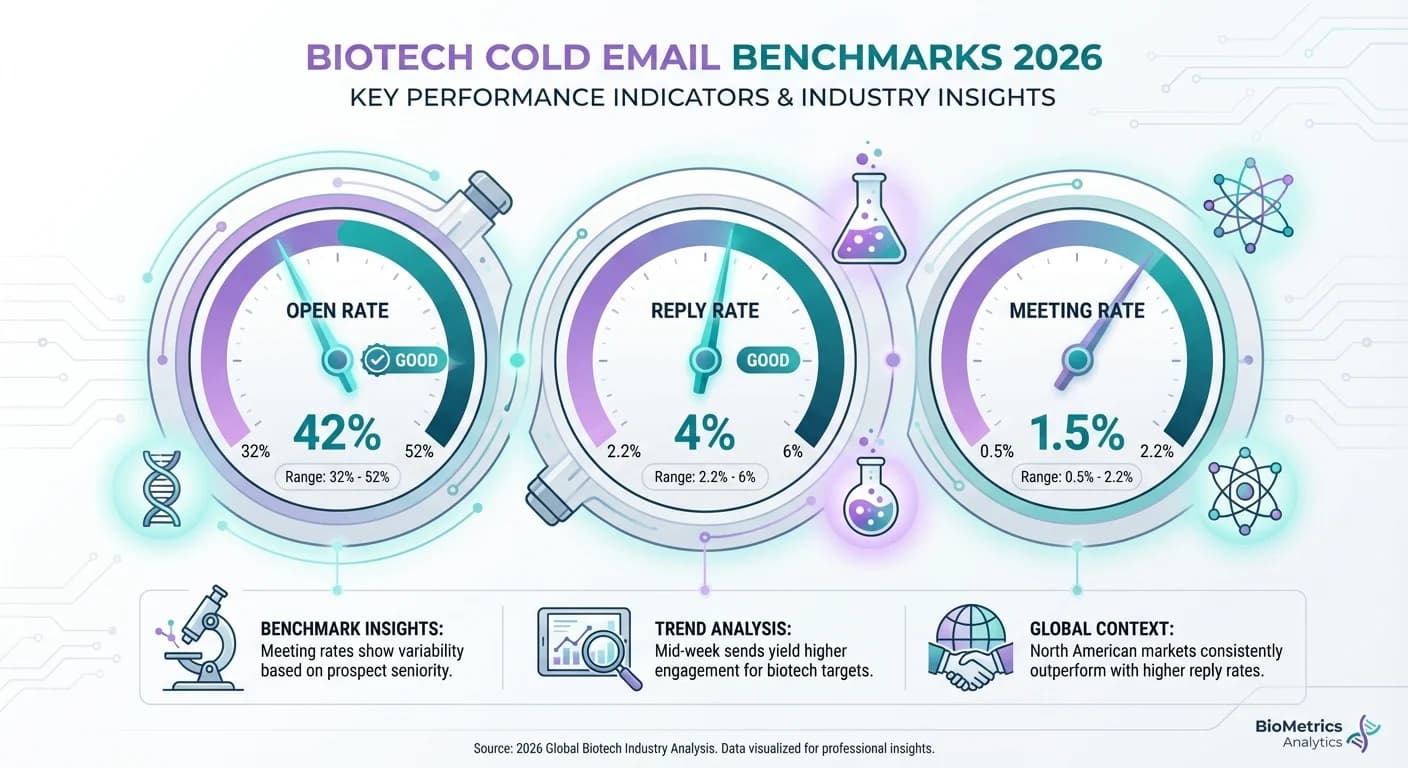
Biotech cold email benchmarks vary significantly by company stage and persona. Average overall metrics are 32-42% open rates, 2.2-4% reply rates, and 0.5-1.2% meeting rates. Preclinical companies respond best (3.5-6.5% reply rates), while commercial biotech shows lower engagement (2-3.5% reply rates). Business development contacts achieve 4-7% reply rates (the highest of all personas) while regulatory affairs yields 2-3.5%. Research scientists at 3.5-6.5% significantly outperform executive leadership.
Key takeaways
- Preclinical and discovery stage biotech companies deliver the highest reply rates at 3.5-6.5%, nearly double the rates for commercial biotech at 2-3.5%.
- Business development professionals generate 4-7% reply rates, the highest engagement of any biotech buyer persona measured.
- Research scientists and directors achieve 3.5-6.5% reply rates with meeting booking rates of 1-2.8%, making them among the most accessible biotech decision-makers.
- Average biotech cold email performance sits at 32-42% open rates, 2.2-4% reply rates, and 0.5-1.2% meeting booking rates across all segments.
- Regulatory affairs contacts produce the lowest engagement at 2-3.5% reply rates and 0.5-1.2% meeting rates, reflecting their conservative approach to vendor selection.
Reviewed and updated September 5, 2026
The biotechnology industry combines cutting-edge science with complex regulatory requirements and extended development timelines. Cold email campaigns targeting biotech companies must navigate scientific credibility requirements, varied company stages, and highly specialized buyer needs.
This benchmark report provides comprehensive performance data for cold email campaigns targeting biotechnology companies. The metrics cover various segments, buyer personas, and deal sizes to help you evaluate and optimize your outreach strategy.
Methodology and Data Sources
The benchmarks presented here represent industry-standard performance ranges compiled from publicly available research, industry publications, and commonly cited B2B outreach metrics. Individual campaign results vary based on targeting precision, message quality, scientific credibility, and market conditions.
Use these figures as directional guidance for evaluating your biotech industry cold email performance.
Biotech Industry Cold Email Overview
The biotechnology industry encompasses research-stage startups, clinical-stage companies, commercial biotech firms, and life science tools providers. B2B cold email campaigns in this space typically target scientific leadership, research operations, procurement teams, and business development professionals.
Overall Biotech Industry Benchmarks:
| Metric | Below Average | Average | Good | Excellent |
|---|---|---|---|---|
| Open Rate | Under 32% | 32-42% | 42-52% | 52%+ |
| Reply Rate | Under 2.2% | 2.2-4% | 4-6% | 6%+ |
| Positive Reply Rate | Under 1% | 1-2% | 2-3.5% | 3.5%+ |
| Meeting Rate | Under 0.5% | 0.5-1.2% | 1.2-2.2% | 2.2%+ |
Biotech buyers value scientific rigor and peer credibility. Messaging that demonstrates deep scientific understanding, relevant publications, and peer validation performs best.
Benchmarks by Company Stage

Biotech company performance varies dramatically by development stage.
Preclinical and Discovery Stage
Early-stage companies focus on research and proof-of-concept work.
Typical Performance Ranges:
- Open rates: 38-55%
- Reply rates: 3.5-6.5%
- Positive reply rates: 1.8-3.8%
- Meeting booking rates: 1-2.8%
Preclinical companies often have smaller teams and more accessible decision-makers. They may be more receptive to innovative solutions that accelerate research.
Clinical Stage (Phase 1-2)
Early clinical companies balance research with regulatory requirements.
Typical Performance Ranges:
- Open rates: 35-50%
- Reply rates: 3-5.5%
- Positive reply rates: 1.5-3%
- Meeting booking rates: 0.8-2.2%
Clinical-stage companies face increasing operational complexity and regulatory scrutiny.
Late Clinical Stage (Phase 3)
Late-stage clinical companies focus on trial execution and commercial preparation.
Typical Performance Ranges:
- Open rates: 32-45%
- Reply rates: 2.5-4.5%
- Positive reply rates: 1.2-2.5%
- Meeting booking rates: 0.6-1.8%
Phase 3 companies have more established processes and vendor relationships.
Commercial Biotech
Commercial companies have approved products and established operations.
Typical Performance Ranges:
- Open rates: 28-40%
- Reply rates: 2-3.5%
- Positive reply rates: 0.9-1.8%
- Meeting booking rates: 0.5-1.2%
Commercial biotech companies have more formal procurement processes and established vendor relationships.
Life Sciences Tools and Services
Tools companies sell to research and clinical operations across biotech.
Typical Performance Ranges:
- Open rates: 35-48%
- Reply rates: 2.8-5%
- Positive reply rates: 1.4-2.8%
- Meeting booking rates: 0.8-2%
Tools buyers appreciate innovation, efficiency improvements, and scientific validation.
Benchmarks by Buyer Persona
Response rates vary significantly based on the role and scientific focus of your target contact.
Scientific Leadership (CSO, VP R&D)
Chief scientific officers and R&D leaders drive scientific strategy.
Typical Performance Ranges:
- Open rates: 35-50%
- Reply rates: 2.8-5%
- Positive reply rates: 1.4-2.8%
- Meeting booking rates: 0.8-2%
Scientific leaders respond well to peer-reviewed evidence, publications, and scientific presentations.
Research Scientists and Directors
Lab directors, principal scientists, and research managers lead specific programs.
Typical Performance Ranges:
- Open rates: 38-55%
- Reply rates: 3.5-6.5%
- Positive reply rates: 1.8-3.8%
- Meeting booking rates: 1-2.8%
Research scientists are often the most accessible biotech buyers and respond to innovative solutions that solve specific research challenges.
Clinical Operations
Clinical operations directors and trial managers oversee clinical studies.
Typical Performance Ranges:
- Open rates: 32-45%
- Reply rates: 2.5-4.5%
- Positive reply rates: 1.2-2.5%
- Meeting booking rates: 0.7-1.8%
Clinical ops focuses on trial efficiency, regulatory compliance, and patient recruitment.
Regulatory Affairs
Regulatory directors and CMC leaders navigate FDA and EMA requirements.
Typical Performance Ranges:
- Open rates: 28-40%
- Reply rates: 2-3.5%
- Positive reply rates: 0.9-1.8%
- Meeting booking rates: 0.5-1.2%
Regulatory contacts are conservative and require proven compliance track records.
Business Development
BD leaders and alliance managers seek partnerships and technologies.
Typical Performance Ranges:
- Open rates: 42-58%
- Reply rates: 4-7%
- Positive reply rates: 2-4%
- Meeting booking rates: 1.2-3%
BD professionals are often the most receptive to cold outreach and actively seek new opportunities.
Procurement and Operations
Procurement managers and operations directors manage vendor relationships.
Typical Performance Ranges:
- Open rates: 34-48%
- Reply rates: 2.5-4.5%
- Positive reply rates: 1.2-2.5%
- Meeting booking rates: 0.7-1.8%
Procurement contacts appreciate clear pricing, service level commitments, and vendor stability.
Executive Leadership
CEOs and presidents make strategic company decisions.
Typical Performance Ranges:
- Open rates: 30-42%
- Reply rates: 2-3.5%
- Positive reply rates: 0.9-1.8%
- Meeting booking rates: 0.5-1.2%
Executive engagement in biotech often requires scientific credibility alongside business value.
Benchmarks by Therapeutic Area
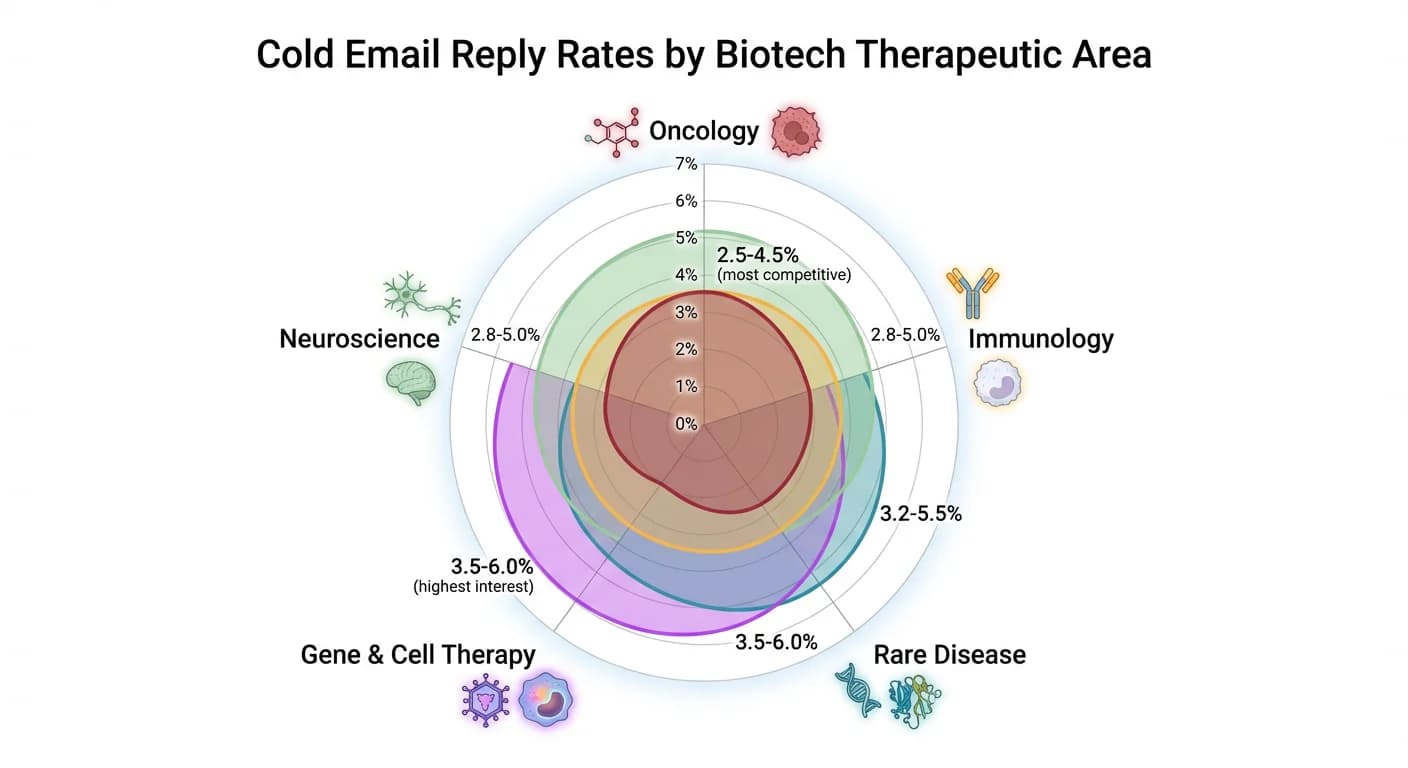
Different therapeutic focuses show varying response patterns.
Oncology
Oncology is the most competitive therapeutic area in biotech.
Typical Performance Ranges:
- Open rates: 32-45%
- Reply rates: 2.5-4.5%
- Positive reply rates: 1.2-2.5%
- Meeting booking rates: 0.7-1.8%
Oncology companies receive high volumes of vendor outreach, making differentiation essential.
Immunology and Inflammation
Immunology encompasses autoimmune diseases and inflammation research.
Typical Performance Ranges:
- Open rates: 35-48%
- Reply rates: 2.8-5%
- Positive reply rates: 1.4-2.8%
- Meeting booking rates: 0.8-2%
Rare Disease and Orphan Drugs
Rare disease companies often have specialized needs and smaller patient populations.
Typical Performance Ranges:
- Open rates: 38-52%
- Reply rates: 3.2-5.5%
- Positive reply rates: 1.6-3%
- Meeting booking rates: 0.9-2.2%
Rare disease companies may be more accessible and receptive to specialized solutions.
Gene and Cell Therapy
Advanced therapies require specialized manufacturing and delivery approaches.
Typical Performance Ranges:
- Open rates: 40-55%
- Reply rates: 3.5-6%
- Positive reply rates: 1.8-3.5%
- Meeting booking rates: 1-2.5%
Gene and cell therapy companies are often actively seeking innovative solutions for complex manufacturing challenges.
Neuroscience
CNS drug development faces unique challenges in clinical translation.
Typical Performance Ranges:
- Open rates: 34-48%
- Reply rates: 2.8-5%
- Positive reply rates: 1.4-2.8%
- Meeting booking rates: 0.8-2%
Deal Size Impact on Performance
Average contract value influences campaign performance in biotech.
$10K-$75K annually
$75K-$350K annually
$350K-$1.5M annually
$1.5M+ annually
Small Biotech Solutions ($10K-$75K annually)
Lower-value solutions can target research teams directly.
Typical Performance Ranges:
- Open rates: 40-55%
- Reply rates: 4-7%
- Meeting booking rates: 1.2-3%
- Average sales cycle: 30-90 days
Mid-Market Solutions ($75K-$350K annually)
Mid-market deals require multiple stakeholders and scientific validation.
Typical Performance Ranges:
- Open rates: 35-48%
- Reply rates: 2.8-5%
- Meeting booking rates: 0.8-2%
- Average sales cycle: 60-180 days
Enterprise Solutions ($350K-$1.5M annually)
Enterprise deals involve formal procurement and extensive evaluation.
Typical Performance Ranges:
- Open rates: 30-42%
- Reply rates: 2.2-4%
- Meeting booking rates: 0.6-1.5%
- Average sales cycle: 120-365 days
Strategic Partnerships ($1.5M+ annually)
Major partnerships require executive sponsorship and scientific due diligence.
Typical Performance Ranges:
- Open rates: 26-38%
- Reply rates: 1.8-3.2%
- Meeting booking rates: 0.4-1%
- Average sales cycle: 180-450 days
What Top Performers Do Differently

Biotech-focused campaigns that achieve top-quartile results share common characteristics.
Scientific Credibility
Top performers demonstrate genuine scientific expertise:
- References to relevant publications and research
- Understanding of therapeutic mechanisms
- Knowledge of regulatory requirements
- Familiarity with industry-specific challenges
Peer Validation
Biotech buyers rely heavily on peer recommendations:
- Scientific advisory board endorsements
- Published case studies and research
- Conference presentations and posters
- Key opinion leader relationships
Stage-Appropriate Messaging
Successful campaigns tailor messaging to company stage:
- Discovery: Research acceleration and innovation
- Clinical: Regulatory compliance and trial efficiency
- Commercial: Scale, reliability, and cost-effectiveness
Long-Term Relationship Approach
Biotech relationships often develop over multiple funding cycles:
- Build relationships before active needs arise
- Provide scientific value through content and insight
- Maintain consistent outreach through company transitions
- Leverage scientific conferences and industry events
Improving Below-Average Performance
If your biotech cold email metrics fall below industry benchmarks, focus on these areas.
For Below-Average Open Rates
Subject line optimization for biotech:
- Reference specific therapeutic areas or technologies
- Keep subjects under 50 characters
- Test company name or pipeline personalization
- Avoid overtly commercial language
Sender credibility:
- Use scientifically credible sender identities
- Include relevant scientific background in signatures
- Build domain reputation through gradual scaling
For Below-Average Reply Rates
Messaging improvements:
- Lead with scientific relevance and peer validation
- Include relevant publications or case studies
- Keep initial emails under 100 words
- Reference company-specific programs or technologies
Targeting refinements:
- Narrow focus to specific therapeutic areas
- Add company stage and pipeline filters
- Target companies around funding events or milestones
For Below-Average Meeting Rates
Conversion optimization:
- Respond to positive replies within 2 hours
- Offer specific meeting times
- Include scientific agenda for conversation
- Provide easy rescheduling options
Tracking and Measurement
Accurate measurement enables ongoing improvement.
Essential Metrics to Track
- Open rates (acknowledging privacy limitations)
- Reply rates (total and positive)
- Meeting booking rates
- Scientific evaluation progression
- Pipeline value by therapeutic area
- Win rates and deal sizes
Segmentation Recommendations
Segment performance data by:
- Company stage (preclinical, clinical, commercial)
- Therapeutic area
- Buyer persona
- Company size and funding stage
- Geographic region
Performance Review Cadence
Review performance against benchmarks monthly. Given longer biotech evaluation cycles, evaluate pipeline and conversion metrics quarterly with 6-12 month lookback periods.
Next Steps
Understanding where your biotech cold email performance falls relative to industry benchmarks is the first step toward improvement. Systematic optimization of targeting, messaging, and scientific credibility can move metrics from below-average to excellent over 3-6 months.
If your internal resources lack biotech-specific expertise or you want to accelerate results, specialized cold email partners with life sciences industry experience can bring proven approaches and relevant scientific connections.
Get your free campaign strategy to see how your biotech cold email metrics compare to industry benchmarks and identify specific opportunities for improvement.
Related Reading
Frequently asked questions.
Frequently asked questions- What are good cold email metrics for biotech companies?
- Good biotech cold email performance ranges are 42-52% open rates, 4-6% reply rates, and 1.2-2.2% meeting booking rates. Excellent performance exceeds 52% opens, 6% replies, and 2.2% meetings. These benchmarks are higher than commercial biotech but vary significantly by company stage, with preclinical firms responding better than late-stage companies.
- Which biotech company stage responds best to cold email?
- Preclinical and discovery stage biotech companies respond best, with reply rates of 3.5-6.5% and meeting rates of 1-2.8%. These early-stage companies have smaller teams, more accessible decision-makers, and greater receptiveness to innovative solutions. In contrast, commercial biotech shows the lowest engagement at 2-3.5% reply rates due to established vendor relationships and formal procurement processes.
- Who should I target with biotech cold emails?
- Business development professionals deliver the highest reply rates at 4-7% with meeting rates of 1.2-3%, making them the most receptive biotech contacts. Research scientists and directors also perform well at 3.5-6.5% reply rates. Regulatory affairs yields the lowest engagement at 2-3.5% replies. Scientific leadership (CSOs, VP R&D) falls in the middle at 2.8-5% replies but requires peer-reviewed evidence and publications.
- How do biotech cold email benchmarks differ from other industries?
- Biotech cold email benchmarks of 32-42% average open rates and 2.2-4% reply rates reflect the industry's emphasis on scientific credibility and longer sales cycles. The wide performance variation by company stage (from 3.5-6.5% replies for preclinical to 2-3.5% for commercial) is more pronounced than most B2B sectors. Biotech buyers prioritize peer validation, relevant publications, and demonstrated scientific understanding over typical B2B value propositions.
About the author.

Hosun Chung is COO at RevenueFlow, which builds and operates outbound revenue engines for B2B companies. Previously at Gleacher Shacklock LLP. Studied at London School of Economics.
Hosun Chung · COO
Connect on LinkedIn →Explore more.
Ready to scale your outreach?
We build GTM engines that book real meetings. See the receipts.
Related articles.
Cold Email Conversion Benchmarks: 2026 Performance Data
Complete benchmark data for cold email conversion rates from reply to meeting to opportunity. Learn what drives conversions and how to optimize your full funnel.
Education Cold Email Benchmarks: 2026 Performance Data
Industry benchmark data for education cold email campaigns, including open rates, reply rates, and conversion metrics for companies targeting K-12 schools, higher education, and corporate training organizations.
Automotive Cold Email Benchmarks: 2026 Performance Data
Industry benchmark data for automotive sector cold email campaigns, covering OEMs, suppliers, dealerships, and automotive technology with performance metrics by segment and buyer role.
Real Estate Cold Email Benchmarks: 2026 Performance Data
Comprehensive benchmark data for real estate cold email campaigns, including open rates, reply rates, and conversion metrics for companies targeting brokerages, property managers, developers, and real estate investors.
Fintech Cold Email Benchmarks: 2026 Performance Data
Comprehensive benchmark data for fintech cold email campaigns, including open rates, reply rates, and conversion metrics specific to financial technology companies targeting banks, financial institutions, and businesses.
Media Cold Email Benchmarks: 2026 Performance Data
Comprehensive benchmark data for media and entertainment industry cold email campaigns, covering publishers, streaming platforms, advertising, and content creators.