Real Estate Cold Email Benchmarks: 2026 Performance Data
Comprehensive benchmark data for real estate cold email campaigns, including open rates, reply rates, and conversion metrics for companies targeting brokerages, property managers, developers, and real estate investors.
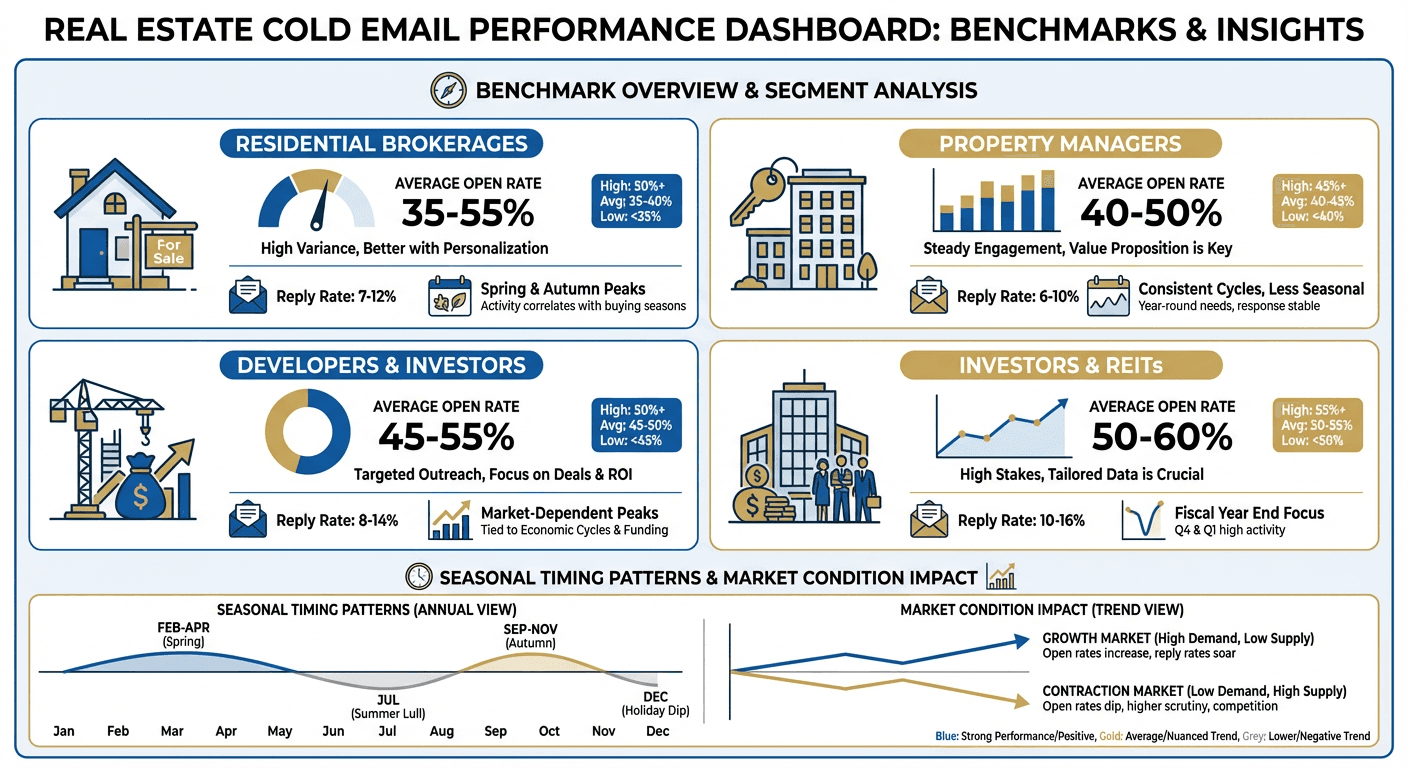
Real estate cold email campaigns average 35-45% open rates, 2.5-4.5% reply rates, and 1-2.5% meeting booking rates across the industry. Independent agents and brokers achieve the highest performance (48-62% opens, 5.5-9% replies) because they directly control purchasing decisions. Marketing and lead generation services see the strongest engagement with 45-58% open rates and 2-4% meeting rates, while institutional investors and REITs show the lowest response at 28-40% opens.
Key takeaways
- Independent agents and brokers achieve 48-62% open rates and 5.5-9% reply rates, significantly outperforming institutional investors who see 28-40% opens and 1.5-3.5% replies.
- Marketing and lead generation services consistently show the highest engagement in real estate with 45-58% open rates and 2-4% meeting booking rates.
- Real estate CRM and transaction management solutions achieve 42-55% open rates and 1.5-3.5% meeting booking rates when targeting agents or brokerages.
- Property management software averages 38-50% open rates and 1.3-3% meeting rates when targeting property management companies.
- Excellent performance in real estate cold email is defined as 55%+ open rates, 7%+ reply rates, and 4%+ meeting booking rates.
Reviewed and updated August 28, 2026
The real estate industry offers significant opportunities for B2B companies selling technology, services, and solutions to brokerages, property management companies, developers, and institutional investors. Cold email remains an effective channel for reaching these decision-makers, though performance varies significantly across real estate segments.
This benchmark report provides real estate-specific data to help companies evaluate their cold email performance. The metrics represent typical performance ranges observed across companies selling into the real estate vertical.
Methodology Note
Real estate encompasses diverse segments from residential brokerages to commercial developers to institutional investors, each with distinct characteristics. The benchmarks here are compiled from industry research and commonly observed performance ranges. Your results will vary based on your specific target segment, product offering, and market conditions.
Key Real Estate Cold Email Metrics
Real estate professionals are typically highly accessible via email and accustomed to receiving sales outreach. This creates both opportunities and challenges for cold email campaigns.
Average
Average
Average
Average
Bar widths are equal here because these stage values are not a single comparable measure.
Open Rates
Open rates in real estate tend to be above average for B2B cold email, reflecting the industry's relationship-oriented culture and openness to vendor communications.
Real Estate Industry Benchmarks:
- Below average: Under 35%
- Average: 35-45%
- Good: 45-55%
- Excellent: 55%+
By Real Estate Segment:
| Segment | Typical Open Rate Range |
|---|---|
| Independent Agents/Brokers | 45-60% |
| Residential Brokerages | 40-55% |
| Property Management Companies | 38-52% |
| Commercial Brokerages | 35-48% |
| Real Estate Developers | 32-45% |
| Institutional Investors/REITs | 28-40% |
Independent agents and residential brokerages show the highest open rates because they actively monitor email for lead and client communications. Institutional investors have more corporate email infrastructure and gatekeeping.
Open rates such as these depend heavily on inbox reputation, a factor explored in the best email warmup tools for real estate.
Reply Rates
Real estate professionals are generally responsive to relevant outreach, though reply rates vary based on timing and market conditions.
Real Estate Industry Benchmarks:
- Below average: Under 2.5%
- Average: 2.5-4.5%
- Good: 4.5-7%
- Excellent: 7%+
By Real Estate Segment:
| Segment | Typical Reply Rate Range |
|---|---|
| Independent Agents/Brokers | 5-9% |
| Residential Brokerages | 4-7% |
| Property Management Companies | 3.5-6% |
| Commercial Brokerages | 3-5.5% |
| Real Estate Developers | 2.5-4.5% |
| Institutional Investors/REITs | 1.5-3.5% |
Positive Reply Rates
Real estate professionals often engage in brief exchanges before committing to meetings, making positive reply classification important.
Real Estate Industry Benchmarks:
- Below average: Under 1.5%
- Average: 1.5-3%
- Good: 3-5%
- Excellent: 5%+
Meeting Booking Rates
Converting real estate interest to scheduled meetings is generally straightforward once initial engagement is established.
Real Estate Industry Benchmarks:
- Below average: Under 1%
- Average: 1-2.5%
- Good: 2.5-4%
- Excellent: 4%+
By Real Estate Segment:
| Segment | Typical Meeting Rate Range |
|---|---|
| Independent Agents/Brokers | 2.5-5% |
| Residential Brokerages | 2-4% |
| Property Management Companies | 1.5-3.5% |
| Commercial Brokerages | 1.2-3% |
| Real Estate Developers | 1-2.5% |
| Institutional Investors/REITs | 0.5-1.5% |
Benchmarks by Real Estate Product Category

Performance varies based on your product type and its value proposition to real estate professionals.
Real Estate CRM and Transaction Management
Software platforms for managing contacts, transactions, and client relationships.
Typical Performance Ranges:
- Open rates: 42-55%
- Reply rates: 4-7%
- Positive reply rates: 2-4%
- Meeting booking rates: 1.5-3.5%
CRM solutions see strong engagement, particularly when targeting agents or brokerages without established systems.
Marketing and Lead Generation Services
Marketing automation, lead generation, and advertising services for real estate professionals.
Typical Performance Ranges:
- Open rates: 45-58%
- Reply rates: 5-8%
- Positive reply rates: 2.5-5%
- Meeting booking rates: 2-4%
Marketing services consistently show high engagement because lead generation is a primary concern for most real estate professionals.
Property Management Software
Platforms for managing rental properties, tenant relations, and maintenance.
Typical Performance Ranges:
- Open rates: 38-50%
- Reply rates: 3.5-6%
- Positive reply rates: 1.8-3.5%
- Meeting booking rates: 1.3-3%
Valuation and Analytics Tools
Property valuation, market analysis, and data analytics platforms.
Typical Performance Ranges:
- Open rates: 35-48%
- Reply rates: 3-5.5%
- Positive reply rates: 1.5-3%
- Meeting booking rates: 1-2.5%
Construction and Development Services
Services and technology for real estate development and construction projects.
Typical Performance Ranges:
- Open rates: 32-45%
- Reply rates: 2.5-4.5%
- Positive reply rates: 1.2-2.8%
- Meeting booking rates: 0.8-2%
Investment and Capital Services
Investment platforms, financing services, and capital market solutions.
Typical Performance Ranges:
- Open rates: 30-42%
- Reply rates: 2-4%
- Positive reply rates: 1-2.5%
- Meeting booking rates: 0.6-1.8%
Benchmarks by Target Persona
Real estate organizations involve various decision-makers with different responsibilities and priorities.
Individual Agents and Brokers
Typical Performance Ranges:
- Open rates: 48-62%
- Reply rates: 5.5-9%
- Positive reply rates: 3-6%
- Meeting booking rates: 2.5-5%
Individual agents are highly responsive because they control their own technology and service decisions with minimal gatekeeping.
Brokerage Owners and Managing Brokers
Typical Performance Ranges:
- Open rates: 42-55%
- Reply rates: 4-7%
- Positive reply rates: 2-4%
- Meeting booking rates: 1.5-3.5%
Brokerage leadership makes decisions affecting entire organizations, making them valuable but slightly harder to engage.
Property Managers and Operations Leaders
Typical Performance Ranges:
- Open rates: 38-50%
- Reply rates: 3.5-6%
- Positive reply rates: 1.8-3.5%
- Meeting booking rates: 1.2-2.8%
Development and Investment Executives
Typical Performance Ranges:
- Open rates: 30-42%
- Reply rates: 2-4%
- Positive reply rates: 1-2.5%
- Meeting booking rates: 0.6-1.8%
Development and investment executives are more corporate in their approach and typically have more gatekeeping.
Marketing and Operations Directors
Typical Performance Ranges:
- Open rates: 40-52%
- Reply rates: 3.5-6%
- Positive reply rates: 1.8-3.5%
- Meeting booking rates: 1.3-3%
Market Condition Impact on Performance
Real estate cold email performance is significantly influenced by market conditions.
Strong Market Conditions (High Transaction Volume)
During active markets, real estate professionals are busy with transactions but also more receptive to tools that improve efficiency.
Typical Performance Adjustments:
- Open rates: +5-10% above baseline
- Reply rates: Variable (busy schedules may reduce response time)
- Meeting rates: May decrease as professionals prioritize active deals
Slow Market Conditions (Low Transaction Volume)
During slower markets, professionals have more time for vendor evaluation but may be more cautious about spending.
Typical Performance Adjustments:
- Open rates: Stable or slightly lower
- Reply rates: +10-20% above baseline (more time available)
- Meeting rates: Higher for cost-saving solutions
Interest Rate Environment
Interest rate changes significantly impact real estate activity and buyer receptivity:
- Rising rates: Stronger engagement for refinancing and cost optimization solutions
- Stable or falling rates: Higher engagement for growth and expansion tools
Seasonal Patterns in Real Estate Outreach
Real estate cold email performance follows predictable seasonal patterns.
Optimal Timing Windows
Best Performing Periods:
- January-February: New year planning and technology evaluation
- Late March-May: Spring market preparation
- September-October: Fall market activity and year-end planning
Challenging Periods:
- December: Holiday slowdown and year-end closing
- July-August: Vacation schedules (varies by market)
- Major holiday weeks throughout the year
Day and Time Considerations
Typical Best Performing Times:
- Tuesday through Thursday consistently outperform other days
- Early morning sends (7-9 AM) before property showings begin
- Evening sends (6-8 PM) after daily activities conclude
- Avoid weekend sends for most real estate segments (agents may be showing properties)
What Top Performers Do Differently

Companies achieving top-quartile performance in real estate cold email share common characteristics.
Market-Specific Personalization
Top performers reference specific market conditions, recent transactions, or local developments that demonstrate understanding of the recipient's business environment.
Results and ROI Focus
Real estate professionals are highly results-oriented. Successful campaigns lead with specific outcomes: transactions closed, time saved, revenue generated, or costs reduced.
Peer Validation
Real estate is a relationship-driven industry where peer recommendations carry significant weight. Top performers reference recognizable brokerages, agents, or industry figures using their solutions.
Timing Alignment
Successful campaigns align with industry cycles, market conditions, and the recipient's likely priorities based on their role and segment.
Multi-Channel Coordination
Top performers coordinate cold email with other channels (social media, industry events, referrals) to build familiarity before and after email outreach.
- Yes: Market-Specific Personalization
- Yes: Results and ROI Focus
- Yes: Peer Validation
- Yes: Timing Alignment
- Yes: Multi-Channel Coordination
Improving Your Real Estate Cold Email Performance
If your metrics fall below these benchmarks, focus on these high-impact areas.
For Below-Average Open Rates
Subject Line Optimization for Real Estate:
- Reference specific markets, transactions, or industry developments
- Use results-focused language (listings, closings, commissions)
- Include personalization with recipient name or company
- Avoid generic marketing language that feels impersonal
List Quality Considerations:
- Real estate email data changes frequently as agents move between brokerages
- Verify data freshness, particularly for agent-level targeting
- Segment by production level, specialty, or market focus
For Below-Average Reply Rates
Messaging Adjustments:
- Lead with specific results achieved for similar professionals
- Reference their market conditions or recent activity
- Keep messages brief and conversational
- Include clear, low-friction call to action
Targeting Refinements:
- Segment by transaction volume or production level
- Consider market conditions in their geographic area
- Align messaging with their specific role and responsibilities
For Below-Average Meeting Rates
Response Handling:
- Respond quickly (real estate professionals work on fast timelines)
- Offer flexible meeting formats (phone, video, brief intro call)
- Provide specific time slots rather than open availability
- Include social proof from similar professionals
When Silence Is A Timing Signal:
- Real estate professionals may intend to respond but get distracted by deals, so no reply usually means the deal calendar is wrong rather than the offer
- Note the market timing or seasonal factors that change their priorities
- Reach them again in a separate campaign built on that timing, not as a second message under the first
Compliance Considerations
Cold email to real estate professionals should comply with applicable regulations.
CAN-SPAM Compliance
Standard email marketing regulations apply:
- Clear sender identification
- Accurate subject lines
- Functional unsubscribe mechanism
- Physical address inclusion
Real Estate Licensing Considerations
If your product or service involves referrals, lead sharing, or commission arrangements, ensure compliance with real estate licensing regulations in applicable states.
Do Not Call Considerations
While email is separate from telephone regulations, be aware that some real estate professionals may expect similar opt-out courtesies.
Benchmarking Your Performance

To effectively benchmark your real estate cold email campaigns:
Segment Your Data
Break down performance by:
- Real estate segment (residential, commercial, property management, etc.)
- Organization size and transaction volume
- Target persona and role
- Geographic market and conditions
- Product category if you offer multiple solutions
Track Full Funnel Metrics
Beyond initial response rates, track:
- Time from first reply to scheduled meeting
- Demo to trial or purchase conversion
- Customer lifetime value by acquisition source
- Referral generation from cold email acquired customers
Account for Market Cycles
Real estate performance varies significantly with market conditions. Normalize your benchmarks against market activity levels when evaluating long-term trends.
The Path Forward
Real estate cold email offers strong engagement potential compared to many B2B verticals. The relationship-oriented nature of the industry and accessible decision-makers create favorable conditions for outreach.
Success requires understanding the specific needs, priorities, and timing considerations of your target segment within real estate. Generic B2B approaches underperform industry-specific messaging significantly.
If your current performance falls below these benchmarks, consider whether your team has the real estate market knowledge to optimize effectively. Our done-for-you cold email campaigns combine deep industry expertise with proven outreach methodologies to help companies achieve above-benchmark results in real estate.
Get your free campaign strategy to see how your real estate cold email metrics compare to industry benchmarks and identify specific opportunities for improvement.
Related Reading
Frequently asked questions.
Frequently asked questions- What are good open rates for cold emails to real estate professionals?
- Good open rates for real estate cold email range from 45-55%, with excellent performance at 55% or higher. The industry average is 35-45%. Independent agents and residential brokerages achieve the highest open rates (45-60%) because they actively monitor email for leads and client communications, while institutional investors show lower rates (28-40%) due to corporate email gatekeeping.
- Which real estate segment responds best to cold email?
- Independent agents and brokers respond best to cold email with 48-62% open rates, 5.5-9% reply rates, and 2.5-5% meeting booking rates. They outperform all other segments because they directly control their own technology and service decisions without corporate gatekeeping. Residential brokerages are the second-most responsive segment with 40-55% open rates and 4-7% reply rates.
- What reply rates should I expect from real estate cold email campaigns?
- Average reply rates for real estate cold email are 2.5-4.5%, with good performance at 4.5-7% and excellent at 7% or higher. Independent agents and brokers achieve the highest reply rates at 5-9%, while institutional investors and REITs show the lowest at 1.5-3.5%. Real estate professionals are generally responsive to relevant outreach, though timing and market conditions significantly impact results.
- What types of products get the best response from real estate professionals?
- Marketing and lead generation services achieve the strongest engagement with 45-58% open rates, 5-8% reply rates, and 2-4% meeting booking rates because lead generation is a primary concern for most real estate professionals. Real estate CRM and transaction management solutions also perform well with 42-55% open rates and 1.5-3.5% meeting rates, particularly when targeting agents or brokerages without established systems.
- What meeting booking rates are typical for real estate cold email?
- Average meeting booking rates for real estate cold email are 1-2.5%, with good performance at 2.5-4% and excellent at 4% or higher. Independent agents and brokers achieve the highest meeting rates at 2.5-5%, while institutional investors show the lowest at 0.5-1.5%. Converting real estate interest to scheduled meetings is generally straightforward once initial engagement is established.
About the author.

Hosun Chung is COO at RevenueFlow, which builds and operates outbound revenue engines for B2B companies. Previously at Gleacher Shacklock LLP. Studied at London School of Economics.
Hosun Chung · COO
Connect on LinkedIn →Explore more.
Ready to scale your outreach?
We build GTM engines that book real meetings. See the receipts.
Related articles.
Real Estate Cold Email Reply Rate Benchmarks (2026)
No vendor publishes a real estate cold email benchmark. Here are the published reply-rate tiers that do apply, and how to read your own results.
Cold Email Conversion Benchmarks: 2026 Performance Data
Complete benchmark data for cold email conversion rates from reply to meeting to opportunity. Learn what drives conversions and how to optimize your full funnel.
Education Cold Email Benchmarks: 2026 Performance Data
Industry benchmark data for education cold email campaigns, including open rates, reply rates, and conversion metrics for companies targeting K-12 schools, higher education, and corporate training organizations.
Automotive Cold Email Benchmarks: 2026 Performance Data
Industry benchmark data for automotive sector cold email campaigns, covering OEMs, suppliers, dealerships, and automotive technology with performance metrics by segment and buyer role.
Fintech Cold Email Benchmarks: 2026 Performance Data
Comprehensive benchmark data for fintech cold email campaigns, including open rates, reply rates, and conversion metrics specific to financial technology companies targeting banks, financial institutions, and businesses.
Media Cold Email Benchmarks: 2026 Performance Data
Comprehensive benchmark data for media and entertainment industry cold email campaigns, covering publishers, streaming platforms, advertising, and content creators.