Cold Email Conversion Benchmarks: 2026 Performance Data
Complete benchmark data for cold email conversion rates from reply to meeting to opportunity. Learn what drives conversions and how to optimize your full funnel.
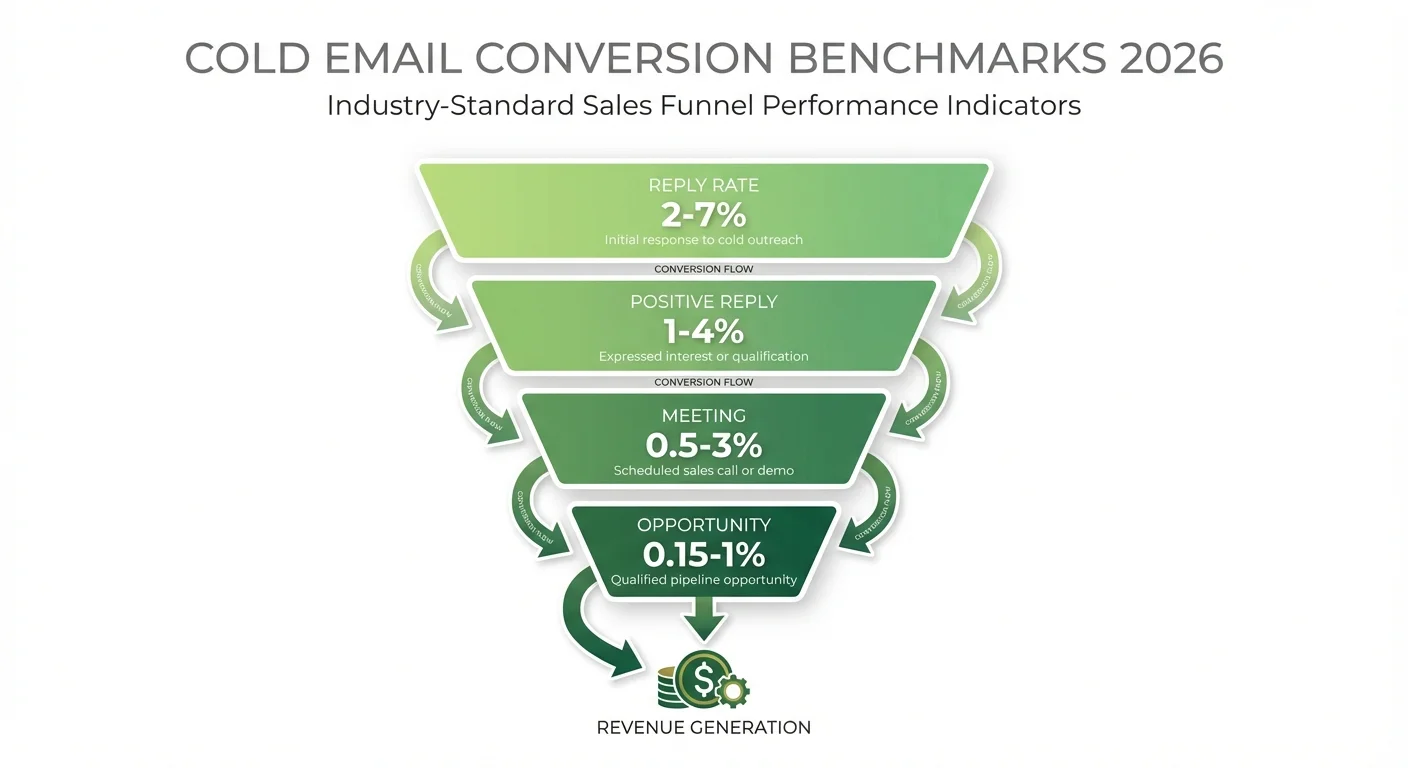
Average B2B cold email conversion benchmarks are 2-4% reply rate, 0.5-1.5% meeting rate, and 0.15-0.5% opportunity rate. Enterprise segments see lower rates (1.5-3% reply, 0.3-1% meeting) than SMB (3-5.5% reply, 1-2.5% meeting). Stage-to-stage, 35-50% of replies are positive, 40-55% of positive replies convert to meetings, and 20-35% of meetings create opportunities. Responding within 1 hour drives 70-80% meeting conversion from positive replies.
Key takeaways
- Average B2B cold email campaigns achieve 2-4% reply rates, 0.5-1.5% meeting rates, and 0.15-0.5% opportunity rates across all segments.
- Responding to positive replies within 1 hour produces 70-80% meeting conversion, declining to 30-40% after 24 hours.
- Professional services industries achieve the highest reply rates at 3.5-6.5%, while government and legal average 1.5-3%.
- In well-targeted campaigns, 45-60% of replies are positive interest, with negative reply rates above 40% indicating targeting problems.
- SMB segments show higher conversion at every funnel stage compared to enterprise, with SMB reply rates of 3-5.5% versus enterprise at 1.5-3%.
Reviewed and updated September 5, 2026
Conversion benchmarks measure how effectively cold email campaigns move prospects through your sales funnel. While open and reply rates indicate initial engagement, conversion metrics reveal how well that engagement translates into business outcomes.
This benchmark report provides comprehensive conversion data across the full cold email funnel, from first reply to closed opportunity. Understanding these benchmarks helps you identify bottlenecks and optimize your entire outreach process.
Methodology and Definitions
Funnel Stage Definitions
Reply Rate: Percentage of contacted prospects who respond (any response) Positive Reply Rate: Percentage who express interest or request more information Meeting Rate: Percentage who schedule a discovery call or demo Opportunity Rate: Percentage who become qualified pipeline opportunities Win Rate: Percentage of opportunities that close as customers
Calculation Methods
All rates in this report use "emails delivered" as the denominator unless otherwise specified. This provides comparable metrics across campaigns with varying deliverability.
Data Sources
The benchmarks represent industry-standard performance ranges compiled from publicly available research, industry publications, and commonly cited B2B outreach metrics.
Full Funnel Conversion Benchmarks
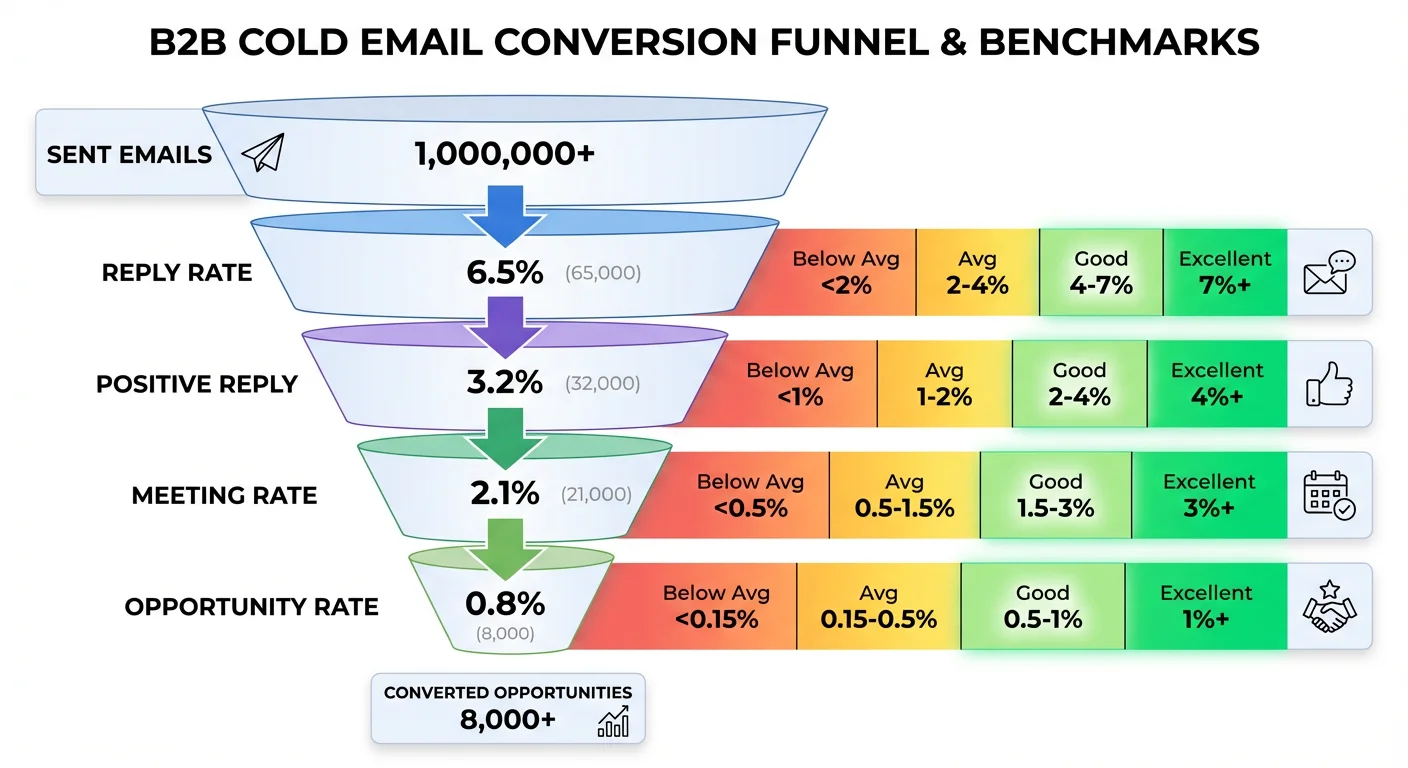
Understanding the typical conversion ratios at each funnel stage helps you diagnose performance issues.
Overall B2B Cold Email Funnel
Typical Funnel Performance:
| Stage | Below Average | Average | Good | Excellent |
|---|---|---|---|---|
| Reply Rate | Under 2% | 2-4% | 4-7% | 7%+ |
| Positive Reply Rate | Under 1% | 1-2% | 2-4% | 4%+ |
| Meeting Rate | Under 0.5% | 0.5-1.5% | 1.5-3% | 3%+ |
| Opportunity Rate | Under 0.15% | 0.15-0.5% | 0.5-1% | 1%+ |
Stage-to-Stage Conversion Ratios
Reply to Positive Reply:
- Below average: Under 35%
- Average: 35-50%
- Good: 50-65%
- Excellent: 65%+
High negative reply rates indicate targeting or messaging issues.
Positive Reply to Meeting:
- Below average: Under 40%
- Average: 40-55%
- Good: 55-70%
- Excellent: 70%+
Drop-off here often indicates slow response time or poor follow-up.
Meeting to Opportunity:
- Below average: Under 20%
- Average: 20-35%
- Good: 35-50%
- Excellent: 50%+
Low conversion here suggests qualification issues or poor meeting execution.
Opportunity to Close:
- Below average: Under 15%
- Average: 15-25%
- Good: 25-40%
- Excellent: 40%+
This varies significantly by deal size and industry.
Reply Rate Benchmarks
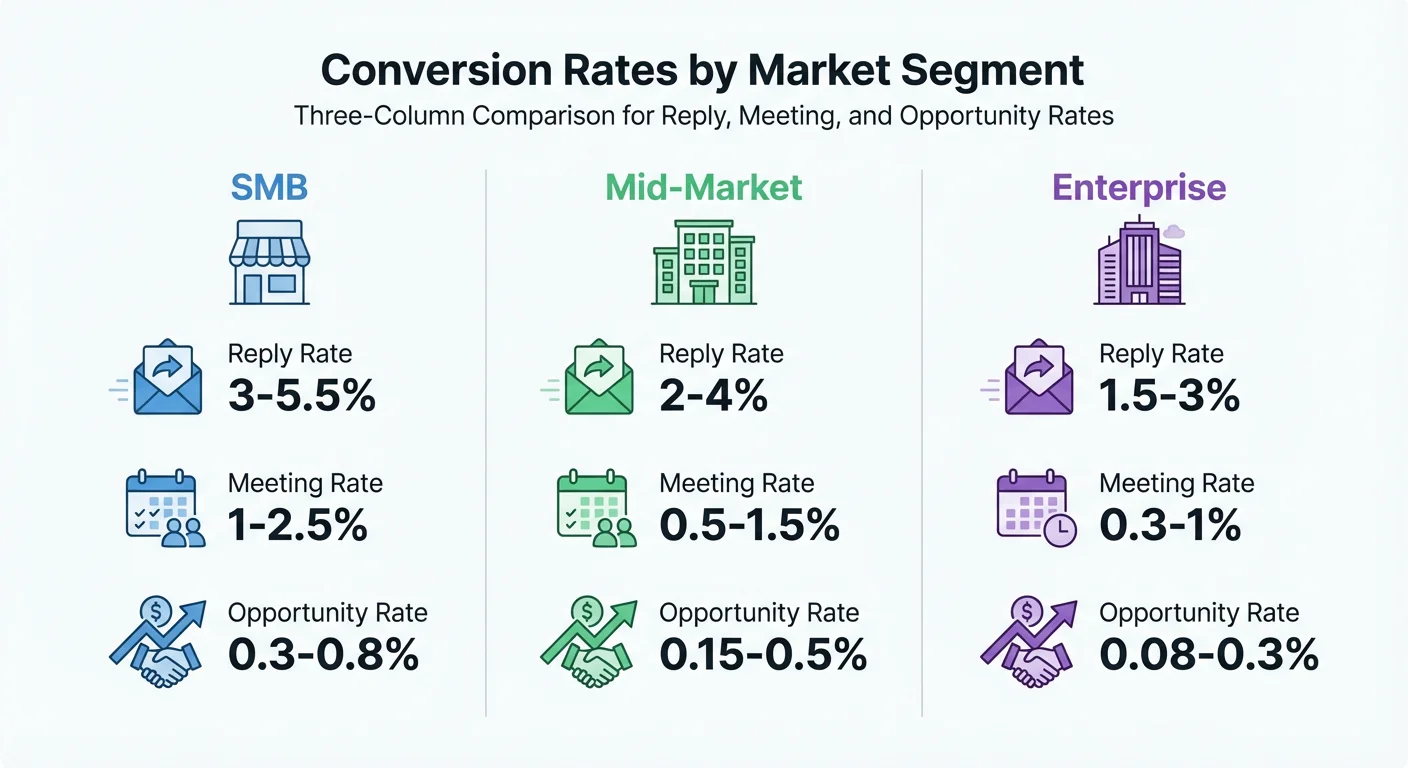
Reply rates are the most meaningful initial engagement metric for cold email.
Overall Reply Rate Benchmarks
| Segment | Below Average | Average | Good | Excellent |
|---|---|---|---|---|
| SMB | Under 3% | 3-5.5% | 5.5-8% | 8%+ |
| Mid-Market | Under 2% | 2-4% | 4-6% | 6%+ |
| Enterprise | Under 1.5% | 1.5-3% | 3-5% | 5%+ |
Reply Rate by Industry
Higher Reply Rate Industries:
- Professional services: 3.5-6.5%
- Marketing and advertising: 3-6%
- Software and SaaS: 2.5-5.5%
Average Reply Rate Industries:
- Healthcare: 2-4%
- Financial services: 1.8-3.5%
- Manufacturing: 2-4%
Lower Reply Rate Industries:
- Government: 1.5-3%
- Legal: 1.5-3%
- Aerospace and defense: 1.2-2.5%
Positive vs. Negative Reply Distribution
In well-targeted campaigns:
- Positive replies: 45-60% of total replies
- Negative/opt-out: 25-35% of total replies
- Neutral/unclear: 10-20% of total replies
High negative reply rates (over 40%) suggest targeting or messaging problems.
Meeting Booking Benchmarks
Meeting booking rates measure conversion from outreach to scheduled conversations.
Overall Meeting Rate Benchmarks
| Segment | Below Average | Average | Good | Excellent |
|---|---|---|---|---|
| SMB | Under 1% | 1-2.5% | 2.5-4% | 4%+ |
| Mid-Market | Under 0.5% | 0.5-1.5% | 1.5-2.5% | 2.5%+ |
| Enterprise | Under 0.3% | 0.3-1% | 1-1.8% | 1.8%+ |
Meeting Rate by Buyer Persona
Higher Meeting Rate Personas:
- Sales leadership: 1.5-3.5%
- Marketing leadership: 1.2-3%
- Business development: 1.5-3.5%
Average Meeting Rate Personas:
- Operations: 0.8-2%
- Finance: 0.7-1.8%
- HR: 0.9-2.2%
Lower Meeting Rate Personas:
- C-suite: 0.4-1.2%
- Engineering/technical: 0.5-1.5%
- Legal/compliance: 0.3-1%
Positive Reply to Meeting Conversion
This stage-to-stage metric reveals follow-up effectiveness:
Benchmark ranges:
- Below average: Under 40%
- Average: 40-55%
- Good: 55-70%
- Excellent: 70%+
Common Meeting Booking Bottlenecks
Slow response time:
- Responding within 1 hour: 70-80% meeting rate from positive replies
- Responding within 24 hours: 50-60% meeting rate
- Responding after 24 hours: 30-40% meeting rate
Poor follow-up persistence:
- 1-2 follow-ups: 40-50% conversion
- 3-4 follow-ups: 55-65% conversion
- 5-6 follow-ups: 60-70% conversion
Scheduling friction:
- Open-ended "when works for you": Lower conversion
- Specific times offered: Higher conversion
- Direct calendar links: Highest conversion (when appropriate)
Opportunity Creation Benchmarks
Opportunity rates measure how well meetings convert to qualified pipeline.
Overall Opportunity Rate Benchmarks
| Segment | Below Average | Average | Good | Excellent |
|---|---|---|---|---|
| SMB | Under 0.3% | 0.3-0.8% | 0.8-1.5% | 1.5%+ |
| Mid-Market | Under 0.15% | 0.15-0.5% | 0.5-1% | 1%+ |
| Enterprise | Under 0.08% | 0.08-0.3% | 0.3-0.6% | 0.6%+ |
Meeting to Opportunity Conversion
This critical stage-to-stage metric reveals qualification alignment:
Benchmark ranges:
- Below average: Under 20%
- Average: 20-35%
- Good: 35-50%
- Excellent: 50%+
Factors Affecting Meeting-to-Opportunity Conversion
Qualification alignment:
- Well-matched ICP targeting: 40-55% conversion
- Broad targeting: 20-30% conversion
Meeting quality:
- Strong discovery process: 35-50% conversion
- Weak qualification calls: 15-25% conversion
Timing and urgency:
- Active buying cycle: 45-60% conversion
- No active initiative: 15-25% conversion
Win Rate Benchmarks
Win rates from cold-sourced opportunities vary by deal size and sales cycle.
Win Rate by Deal Size
Small deals (under $10K ACV):
- Below average: Under 20%
- Average: 20-30%
- Good: 30-40%
- Excellent: 40%+
Mid-market deals ($10K-$50K ACV):
- Below average: Under 15%
- Average: 15-25%
- Good: 25-35%
- Excellent: 35%+
Enterprise deals ($50K+ ACV):
- Below average: Under 10%
- Average: 10-20%
- Good: 20-30%
- Excellent: 30%+
Cold-Sourced vs. Inbound Win Rates
Cold-sourced opportunities typically show:
- 10-20% lower win rates than inbound leads
- Longer sales cycles (20-40% longer)
- More stakeholders involved in decisions
This is expected and should be factored into pipeline and revenue projections.
Conversion Rate Optimization
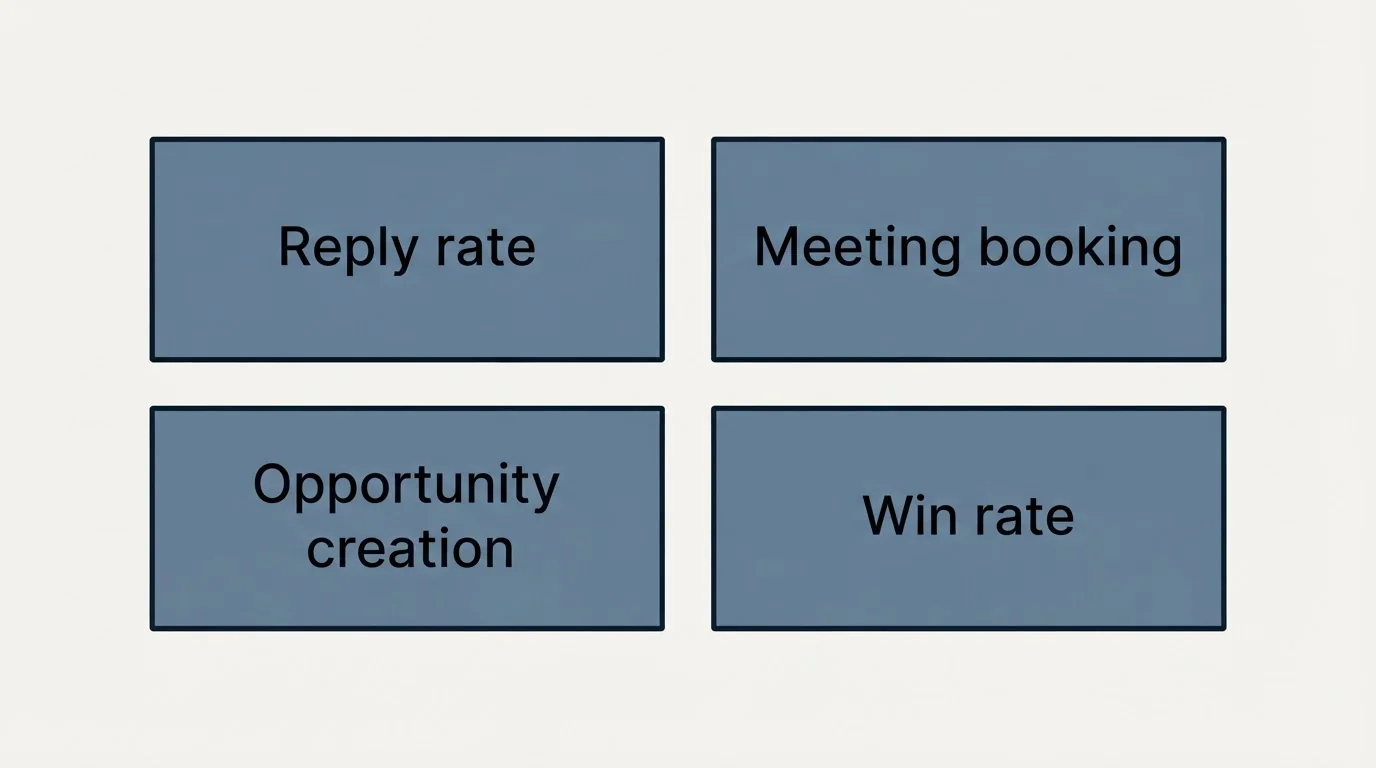
Understanding what drives conversions at each stage enables focused improvement.
Reply Rate Optimization
High-impact factors:
- Subject line relevance and personalization
- Opening line specificity
- Clear, relevant value proposition
- Appropriate ask and CTA
Testing priorities:
- Subject line A/B tests
- Opening line variations
- Value proposition angles
- Email length and format
Meeting Booking Optimization
High-impact factors:
- Response speed to positive replies
- Follow-up persistence and cadence
- Scheduling convenience
- Meeting value proposition
Best practices:
- Respond within 1 hour during business hours
- Offer 3-4 specific times
- Include brief meeting agenda
- Send calendar invites immediately
Opportunity Creation Optimization
High-impact factors:
- Discovery call quality and structure
- Qualification criteria clarity
- Pain point alignment
- Decision-maker identification
Best practices:
- Use structured discovery frameworks
- Identify compelling events and timelines
- Confirm budget and authority
- Establish clear next steps
Win Rate Optimization
High-impact factors:
- Opportunity qualification rigor
- Sales process execution
- Competitive positioning
- Stakeholder management
Best practices:
- Strengthen qualification criteria
- Multi-thread stakeholder engagement
- Develop competitive differentiation
- Shorten sales cycles where possible
Industry-Specific Conversion Benchmarks
Different industries show varying conversion patterns.
Technology and Software
Typical conversion funnel:
- Reply rate: 3-5.5%
- Meeting rate: 1.2-2.8%
- Opportunity rate: 0.4-1%
- Typical win rate: 20-30%
Financial Services
Typical conversion funnel:
- Reply rate: 1.8-3.5%
- Meeting rate: 0.5-1.5%
- Opportunity rate: 0.2-0.6%
- Typical win rate: 15-25%
Healthcare
Typical conversion funnel:
- Reply rate: 2-4%
- Meeting rate: 0.6-1.8%
- Opportunity rate: 0.2-0.7%
- Typical win rate: 18-28%
Professional Services
Typical conversion funnel:
- Reply rate: 3.5-6.5%
- Meeting rate: 1.5-3.5%
- Opportunity rate: 0.5-1.5%
- Typical win rate: 25-40%
Manufacturing
Typical conversion funnel:
- Reply rate: 2-4%
- Meeting rate: 0.7-2%
- Opportunity rate: 0.25-0.8%
- Typical win rate: 20-32%
Diagnosing Conversion Issues
Use funnel analysis to identify specific bottlenecks.
Low Reply Rates
Potential causes:
- Poor list quality or targeting
- Weak subject lines
- Generic or irrelevant messaging
- Deliverability issues
- Wrong timing
Diagnostic questions:
- Are emails reaching inboxes?
- Are subject lines being tested?
- Is messaging personalized and relevant?
- Is timing appropriate for the audience?
Low Positive Reply Ratio
Potential causes:
- Targeting misalignment with offer
- Unclear or weak value proposition
- Pushy or aggressive tone
- Lack of credibility signals
Diagnostic questions:
- Do replies indicate interest mismatch?
- Is the value proposition clear?
- Does the tone match the audience?
- Are trust signals present?
Low Meeting Booking Rates
Potential causes:
- Slow response to positive replies
- Poor follow-up persistence
- Scheduling friction
- Unclear meeting value
Diagnostic questions:
- What is average response time?
- How many follow-ups are sent?
- How easy is scheduling?
- Is meeting value articulated?
Low Opportunity Creation Rates
Potential causes:
- Poor discovery call execution
- Qualification criteria mismatch
- Weak pain point alignment
- Timing misalignment
Diagnostic questions:
- Is discovery structured effectively?
- Are qualification criteria appropriate?
- Are pain points being uncovered?
- Is buying timeline established?
Measuring and Tracking Conversions
Accurate conversion tracking requires proper infrastructure.
Essential Tracking Setup
CRM integration:
- Track lead source accurately
- Capture sequence and campaign data
- Record stage progression dates
- Measure time between stages
Attribution accuracy:
- Use consistent tagging
- Track multi-touch journeys
- Account for offline conversions
- Reconcile data sources
Reporting Cadence
Weekly review:
- Reply rates and response quality
- Meeting booking progress
- Pipeline movement
Monthly analysis:
- Full funnel conversion rates
- Stage-to-stage trends
- Cohort performance
Quarterly deep dive:
- Win rate analysis
- Revenue attribution
- Benchmark comparison
Next Steps
Understanding where your conversion rates fall relative to industry benchmarks at each funnel stage is essential for targeted improvement. Focus optimization efforts on the stages showing the largest gap between your performance and benchmarks.
If multiple stages underperform, prioritize top-of-funnel issues first, as improvements there compound throughout the funnel.
Get your free campaign strategy to see how your conversion rates compare to industry benchmarks and identify specific opportunities for improvement at each funnel stage.
Related Reading
Frequently asked questions.
Frequently asked questions- What is a good cold email reply rate?
- A good cold email reply rate ranges from 4-7%, with 7%+ being excellent and 2-4% considered average. Reply rates vary by segment, with SMB campaigns typically achieving 5.5-8% at the good level while enterprise campaigns see 3-5%. Below 2% is considered below average across all segments.
- What percentage of cold email replies convert to meetings?
- 40-55% of positive replies convert to meetings on average, with 55-70% considered good and 70%+ excellent. Overall meeting rates from initial outreach range from 0.5-1.5% average across all emails delivered. Response time is critical: replying within 1 hour yields 70-80% meeting conversion, dropping to 30-40% after 24 hours.
- How many cold email meetings should turn into opportunities?
- 20-35% of cold email meetings convert to qualified opportunities on average, with 35-50% considered good performance. This translates to overall opportunity rates of 0.15-0.5% from initial emails delivered. Low conversion at this stage typically indicates qualification issues during prospecting or poor discovery meeting execution.
- Why is my positive reply rate low compared to total replies?
- In well-targeted campaigns, 45-60% of total replies should be positive interest. If your positive reply rate is under 35% of total replies, or negative replies exceed 40%, this indicates targeting or messaging problems. High negative reply rates signal you're reaching the wrong prospects or your value proposition isn't resonating with your intended audience.
About the author.

Hosun Chung is COO at RevenueFlow, which builds and operates outbound revenue engines for B2B companies. Previously at Gleacher Shacklock LLP. Studied at London School of Economics.
Hosun Chung · COO
Connect on LinkedIn →Explore more.
Ready to scale your outreach?
We build GTM engines that book real meetings. See the receipts.
Related articles.
Education Cold Email Benchmarks: 2026 Performance Data
Industry benchmark data for education cold email campaigns, including open rates, reply rates, and conversion metrics for companies targeting K-12 schools, higher education, and corporate training organizations.
Automotive Cold Email Benchmarks: 2026 Performance Data
Industry benchmark data for automotive sector cold email campaigns, covering OEMs, suppliers, dealerships, and automotive technology with performance metrics by segment and buyer role.
Real Estate Cold Email Benchmarks: 2026 Performance Data
Comprehensive benchmark data for real estate cold email campaigns, including open rates, reply rates, and conversion metrics for companies targeting brokerages, property managers, developers, and real estate investors.
Fintech Cold Email Benchmarks: 2026 Performance Data
Comprehensive benchmark data for fintech cold email campaigns, including open rates, reply rates, and conversion metrics specific to financial technology companies targeting banks, financial institutions, and businesses.
Media Cold Email Benchmarks: 2026 Performance Data
Comprehensive benchmark data for media and entertainment industry cold email campaigns, covering publishers, streaming platforms, advertising, and content creators.
Ecommerce Cold Email Benchmarks: 2026 Performance Data
Comprehensive benchmark data for ecommerce cold email campaigns, including open rates, reply rates, and conversion metrics for companies targeting online retailers, D2C brands, and marketplace sellers.