Fintech Cold Email Benchmarks: 2026 Performance Data
Comprehensive benchmark data for fintech cold email campaigns, including open rates, reply rates, and conversion metrics specific to financial technology companies targeting banks, financial institutions, and businesses.
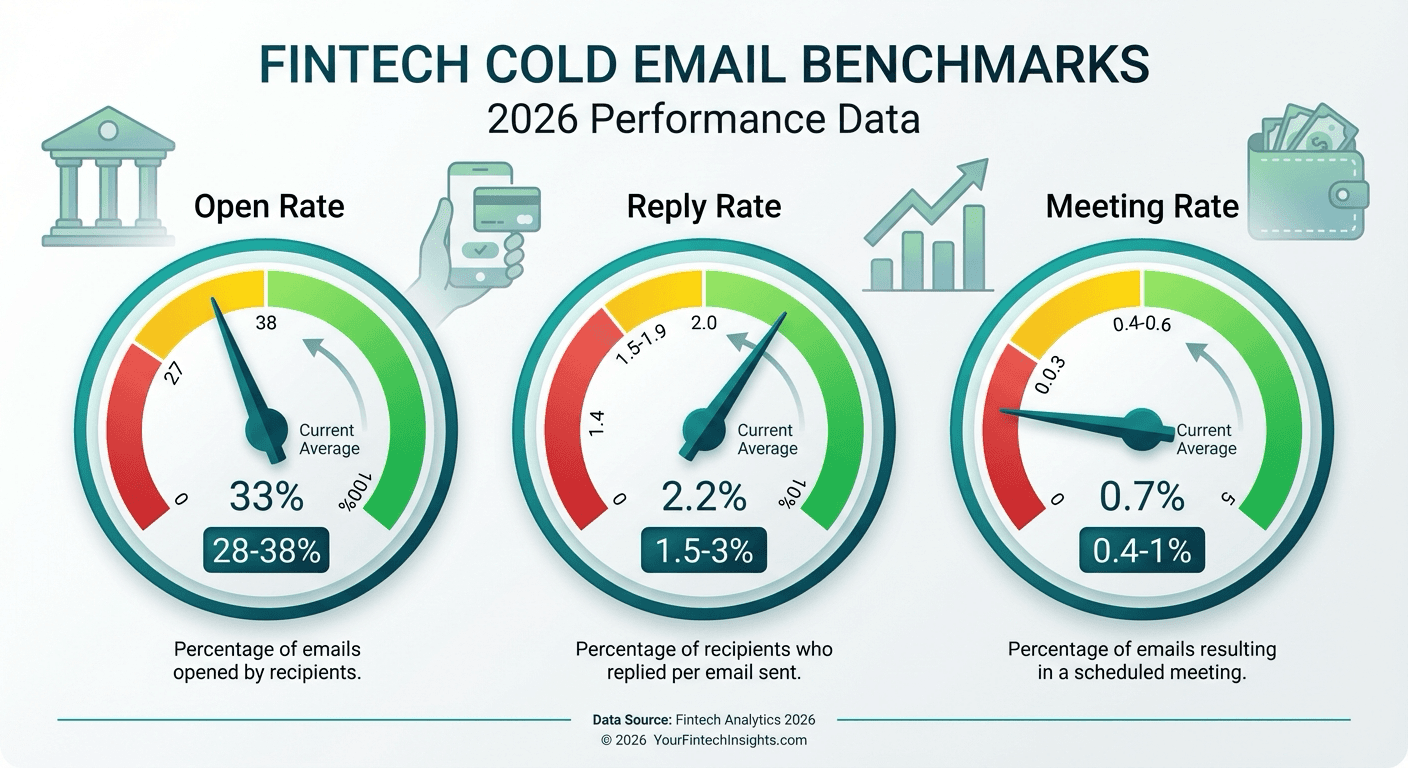
Fintech cold email campaigns average 28-38% open rates, 1.5-3% reply rates, and 0.4-1% meeting booking rates. RegTech solutions perform best (3-5.5% reply rates), while credit unions show the highest institutional responsiveness (3-5.5% replies, 0.8-2.2% meetings). Performance varies significantly by fintech category and target institution type, with regional banks and credit unions consistently outperforming large institutions and hedge funds.
Key takeaways
- Credit unions deliver the highest fintech cold email performance across all metrics, with reply rates of 3-5.5% and meeting booking rates of 0.8-2.2%, significantly above industry averages.
- RegTech solutions achieve the strongest reply rates in fintech at 3-5.5%, driven by urgent compliance needs and regulatory pressures facing financial institutions.
- Fintech open rates (28-38% average) run lower than general B2B benchmarks due to stricter email filtering at financial institutions and heightened security protocols.
- Hedge funds and private equity firms show the lowest engagement with fintech cold email, posting reply rates of just 1-2.5% and meeting rates of 0.3-0.9%.
- Financial services buyers frequently request additional information before committing to meetings, creating a distinct positive reply category between initial response and meeting booking.
Reviewed and updated August 22, 2026
Cold email remains one of the most effective channels for fintech companies to reach decision-makers at banks, credit unions, wealth management firms, and enterprise finance departments. However, the financial services industry presents unique challenges that significantly impact campaign performance.
This benchmark report provides industry-specific data to help fintech companies evaluate their cold email performance and identify opportunities for improvement. The metrics presented here are compiled from industry research, published studies, and commonly observed performance ranges in the financial technology space.
Methodology Note
The benchmarks in this report represent typical performance ranges observed across fintech companies rather than data from a single controlled study. Financial technology encompasses a broad spectrum of products and services, from payment processing and lending platforms to regulatory compliance tools and investment management software. Your specific results will vary based on your product category, target market, and competitive positioning.
Which institutions belong in that target market, and which public registry names each of them, is worked through in sales prospecting for fintech companies.
Use these benchmarks as directional guidance to understand where your campaigns stand relative to typical industry performance.
Key Fintech Cold Email Metrics
Financial services buyers exhibit distinct behaviors that differentiate fintech benchmarks from general B2B metrics. Compliance concerns, longer evaluation cycles, and multiple stakeholder involvement all influence response patterns.
Average
Average
Average
Average
Bar widths are equal here because these stage values are not a single comparable measure.
Open Rates
Open rates in fintech tend to be slightly lower than general B2B averages due to stricter corporate email filters at financial institutions and heightened security awareness among recipients.
Fintech Industry Benchmarks:
- Below average: Under 28%
- Average: 28-38%
- Good: 38-48%
- Excellent: 48%+
By Target Institution Type:
| Institution Type | Typical Open Rate Range |
|---|---|
| Regional Banks | 32-45% |
| Credit Unions | 38-50% |
| Insurance Companies | 28-40% |
| Wealth Management | 35-48% |
| Enterprise Finance Depts | 30-42% |
| Hedge Funds/PE | 25-38% |
Credit unions and regional banks typically show higher open rates due to smaller IT departments with less aggressive spam filtering. Large financial institutions and hedge funds maintain stricter email security protocols.
Reply Rates

Reply rates in fintech campaigns are influenced by the conservative nature of financial services decision-makers and lengthy compliance review processes.
Fintech Industry Benchmarks:
- Below average: Under 1.5%
- Average: 1.5-3%
- Good: 3-5%
- Excellent: 5%+
By Target Institution Type:
| Institution Type | Typical Reply Rate Range |
|---|---|
| Regional Banks | 2-4.5% |
| Credit Unions | 3-5.5% |
| Insurance Companies | 1.5-3.5% |
| Wealth Management | 2.5-4.5% |
| Enterprise Finance Depts | 2-4% |
| Hedge Funds/PE | 1-2.5% |
Credit unions consistently show the highest reply rates among financial institutions, likely due to their community-focused culture and openness to technology partnerships that help them compete with larger banks.
Positive Reply Rates
Positive replies in fintech require distinguishing between genuine interest and compliance-driven information requests.
Fintech Industry Benchmarks:
- Below average: Under 0.8%
- Average: 0.8-1.8%
- Good: 1.8-3%
- Excellent: 3%+
Financial services buyers often request additional information before committing to meetings, which can be categorized as positive engagement even if not an immediate meeting request.
Meeting Booking Rates
Converting positive responses to scheduled meetings involves navigating multiple stakeholders and compliance considerations.
Fintech Industry Benchmarks:
- Below average: Under 0.4%
- Average: 0.4-1%
- Good: 1-2%
- Excellent: 2%+
By Target Institution Type:
| Institution Type | Typical Meeting Rate Range |
|---|---|
| Regional Banks | 0.6-1.8% |
| Credit Unions | 0.8-2.2% |
| Insurance Companies | 0.4-1.2% |
| Wealth Management | 0.6-1.6% |
| Enterprise Finance Depts | 0.5-1.4% |
| Hedge Funds/PE | 0.3-0.9% |
Benchmarks by Fintech Category
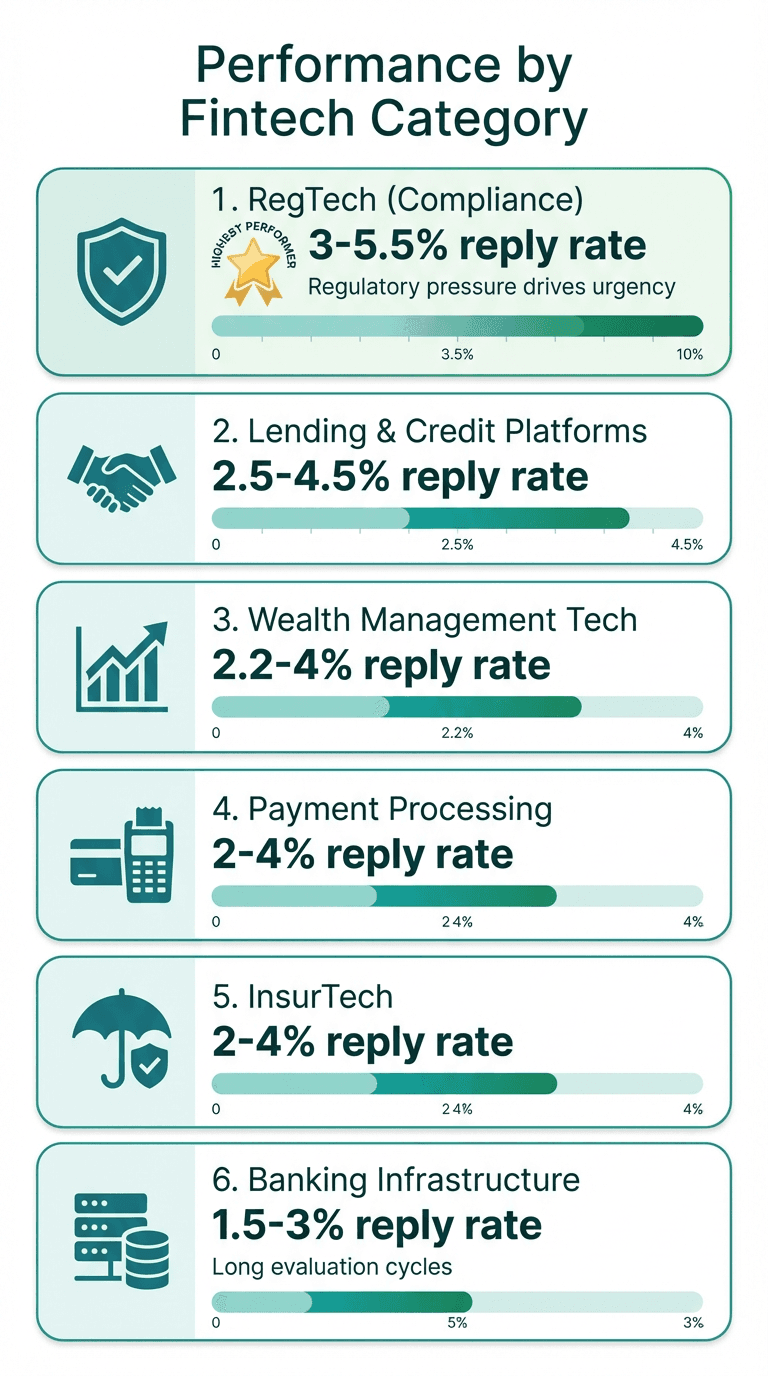
Performance varies significantly based on your specific product category and the urgency of the problem you solve.
Payment Processing Solutions
Payment technology companies targeting merchants, banks, or enterprises see varied performance based on market saturation and competitive intensity.
Typical Performance Ranges:
- Open rates: 30-42%
- Reply rates: 2-4%
- Positive reply rates: 1-2.5%
- Meeting booking rates: 0.6-1.5%
The payments space is highly competitive, which can suppress response rates. Differentiation through specific use cases or underserved segments is critical.
Lending and Credit Platforms
Companies offering lending technology, credit decisioning, or loan origination solutions.
Typical Performance Ranges:
- Open rates: 32-45%
- Reply rates: 2.5-4.5%
- Positive reply rates: 1.2-2.8%
- Meeting booking rates: 0.7-1.8%
Lending technology sees relatively strong engagement, particularly when targeting institutions looking to modernize legacy systems or expand into new lending categories.
Regulatory Compliance (RegTech)
Compliance and regulatory technology solutions addressing KYC, AML, fraud prevention, and reporting requirements.
Typical Performance Ranges:
- Open rates: 35-48%
- Reply rates: 3-5.5%
- Positive reply rates: 1.5-3.5%
- Meeting booking rates: 0.9-2.2%
RegTech consistently performs above average in fintech cold email due to regulatory pressure driving urgency. Compliance officers actively seek solutions to address evolving requirements.
Wealth Management Technology
Investment management platforms, robo-advisors, and portfolio management tools.
Typical Performance Ranges:
- Open rates: 33-45%
- Reply rates: 2.2-4%
- Positive reply rates: 1.1-2.5%
- Meeting booking rates: 0.6-1.5%
Banking Infrastructure
Core banking systems, digital banking platforms, and banking-as-a-service providers.
Typical Performance Ranges:
- Open rates: 28-40%
- Reply rates: 1.5-3%
- Positive reply rates: 0.8-1.8%
- Meeting booking rates: 0.4-1%
Core banking decisions involve extensive evaluation processes and multiple stakeholders, resulting in longer response times and lower initial engagement rates.
Insurance Technology (InsurTech)
Technology solutions for insurance carriers, brokers, and agencies.
Typical Performance Ranges:
- Open rates: 30-42%
- Reply rates: 2-4%
- Positive reply rates: 1-2.2%
- Meeting booking rates: 0.5-1.3%
Benchmarks by Target Persona
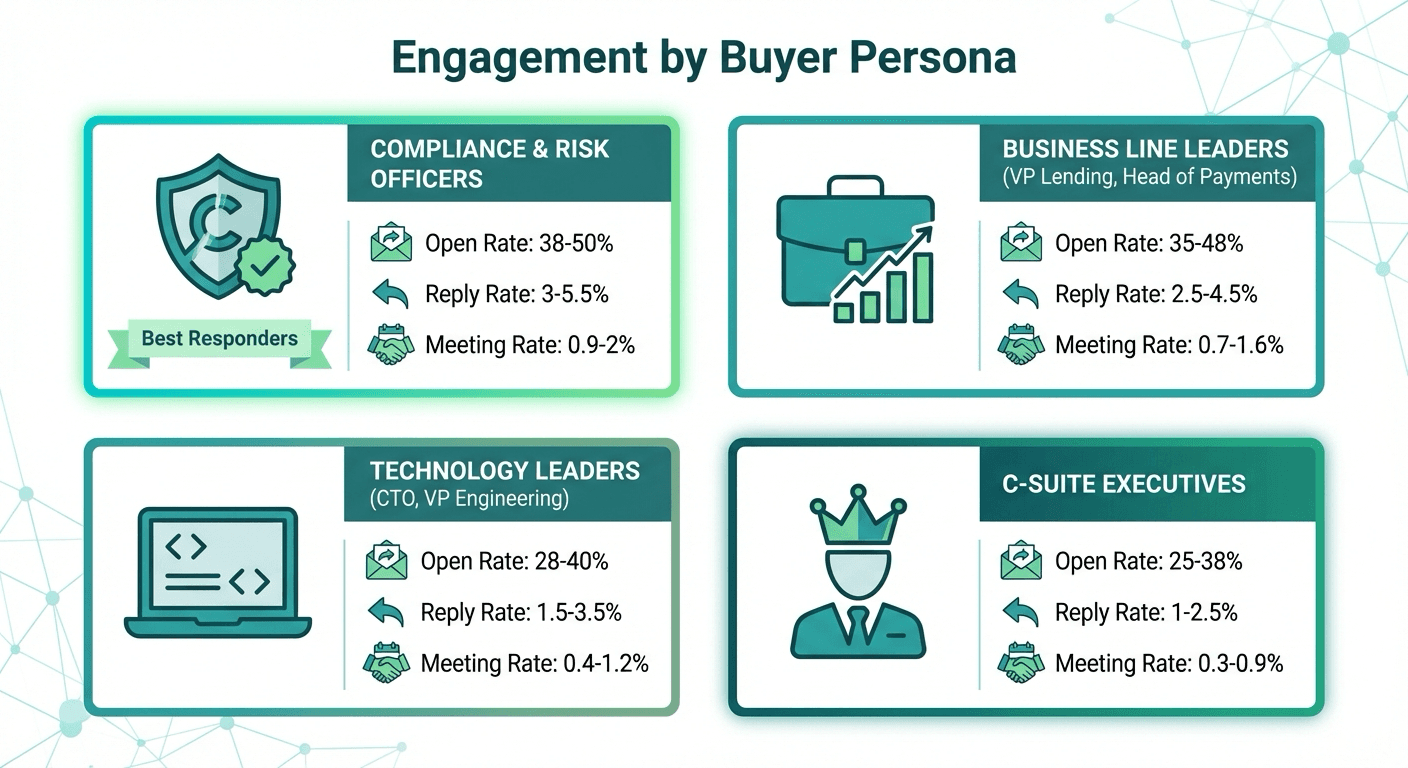
The specific role you target within financial institutions significantly impacts campaign performance.
Technology Leaders (CTO, VP Engineering, IT Directors)
Typical Performance Ranges:
- Open rates: 28-40%
- Reply rates: 1.5-3.5%
- Positive reply rates: 0.8-2%
- Meeting booking rates: 0.4-1.2%
Technology leaders in financial services are often focused on security and integration considerations. Technical depth in your messaging improves engagement.
Business Line Leaders (VP Lending, Head of Payments, etc.)
Typical Performance Ranges:
- Open rates: 35-48%
- Reply rates: 2.5-4.5%
- Positive reply rates: 1.3-2.8%
- Meeting booking rates: 0.7-1.6%
Business line leaders respond well to revenue impact and operational efficiency messaging.
Compliance and Risk Officers
Typical Performance Ranges:
- Open rates: 38-50%
- Reply rates: 3-5.5%
- Positive reply rates: 1.5-3.5%
- Meeting booking rates: 0.9-2%
Compliance officers are actively monitoring for solutions that address regulatory requirements. Timely outreach aligned with regulatory changes performs particularly well.
C-Suite Executives (CEO, CFO, COO)
Typical Performance Ranges:
- Open rates: 25-38%
- Reply rates: 1-2.5%
- Positive reply rates: 0.5-1.5%
- Meeting booking rates: 0.3-0.9%
Executive engagement in financial services requires strategic messaging focused on competitive advantage and market positioning rather than tactical feature discussions.
Seasonal and Timing Considerations
Fintech cold email performance exhibits notable seasonal patterns tied to financial services calendars.
Optimal Timing Windows
Best Performing Periods:
- January-February: Budget allocation season drives technology evaluation
- April-May: Post-Q1 planning often includes technology investments
- September-October: Q4 budget utilization before fiscal year end
Challenging Periods:
- December: Holiday slowdowns and year-end closing
- June-August: Summer vacation schedules reduce response rates
- Quarter-end weeks: Financial close activities take priority
Day and Time Optimization
Typical Best Performing Times:
- Tuesday through Thursday consistently outperform Monday and Friday
- Mid-morning sends (9-11 AM recipient time) show highest engagement
- Avoid sending during market hours to trading-focused contacts
What Top Performers Do Differently
Fintech companies achieving top-quartile performance (5%+ reply rates, 2%+ meeting rates) share common characteristics.
Deep Regulatory Awareness
Top performers demonstrate understanding of specific regulatory requirements affecting their target institutions. References to relevant regulations, compliance deadlines, and industry-specific challenges establish credibility.
Institution-Specific Research
Rather than generic financial services messaging, top performers reference specific details about target institutions:
- Recent merger or acquisition activity
- New product launches or market expansions
- Leadership changes or strategic announcements
- Technology investment signals from earnings calls or press releases
Security and Compliance Positioning
Leading fintech companies address security and compliance concerns proactively in their outreach rather than treating them as objections to overcome later. Certifications, audits, and security frameworks are highlighted early.
Multi-Stakeholder Approach
Given the committee-based decision-making in financial services, top performers engage multiple stakeholders within target organizations simultaneously, including technology, business, compliance, and procurement contacts.
- Yes: Deep Regulatory Awareness
- Yes: Institution-Specific Research
- Yes: Security and Compliance Positioning
- Yes: Multi-Stakeholder Approach
Improving Your Fintech Cold Email Performance
If your metrics fall below these benchmarks, focus on these high-impact areas.
For Below-Average Open Rates
Subject Line Optimization for Financial Services:
- Reference specific regulatory requirements or compliance topics
- Mention relevant industry events or changes
- Use institution-specific details when available
- Avoid spam trigger words common in financial services filtering
Sender Reputation in Financial Services:
- Financial institutions use stricter email filtering
- Dedicated domains with proper authentication are essential
- Volume ramping must be more gradual than other industries
- Monitor deliverability to specific financial institution domains
For Below-Average Reply Rates
Messaging Adjustments:
- Lead with regulatory or compliance implications
- Reference specific challenges facing their institution type
- Include relevant certifications and security credentials
- Keep initial outreach focused on problem awareness, not product features
Targeting Refinements:
- Segment by institution type and size
- Prioritize institutions showing technology investment signals
- Consider regional vs. national institution differences
- Align with regulatory change timelines
For Below-Average Meeting Rates
Response Handling:
- Acknowledge the need for compliance review in your follow-up
- Provide information sheets designed for internal circulation
- Offer flexible meeting formats (15-minute intro vs. full demo)
- Include relevant case studies from similar institution types
Scheduling Optimization:
- Offer specific times rather than open-ended availability
- Provide meeting agendas that address compliance stakeholder needs
- Include security questionnaire responses proactively
- Allow for asynchronous information sharing before live meetings
Compliance Considerations for Fintech Outreach
Cold email to financial institutions requires attention to regulatory requirements.
CAN-SPAM and GDPR Compliance
All cold email campaigns must comply with applicable email regulations. Financial services-specific considerations include:
- Clear identification of sender and purpose
- Accurate subject lines without misleading claims
- Functional unsubscribe mechanisms
- Proper handling of personal data
Industry-Specific Regulations
Depending on your product category, additional regulations may apply:
- Financial promotion rules for investment-related products
- Licensing requirements that affect marketing claims
- Fair lending considerations for credit-related outreach
Consult with legal counsel to ensure your outreach complies with all applicable regulations.
Benchmarking Your Performance
To effectively benchmark your fintech cold email campaigns:
Segment Your Data
Break down performance by:
- Institution type (banks, credit unions, insurance, etc.)
- Institution size (assets under management, employee count)
- Target persona (technology, business, compliance)
- Product category if you offer multiple solutions
- Geographic region
Track Full Funnel Metrics
Beyond initial response rates, track:
- Time from first reply to scheduled meeting
- Number of touchpoints to meeting conversion
- Stakeholder involvement in evaluation process
- Pipeline value generated per campaign
- Conversion rate through sales cycle
Account for Sales Cycle Length
Fintech sales cycles typically range from 6-18 months for significant technology decisions. Short-term metrics may not capture the full impact of cold email campaigns that generate long-term pipeline.
The Path Forward
Achieving top-quartile performance in fintech cold email requires systematic optimization across targeting, messaging, timing, and follow-up processes. The combination of strict compliance requirements, complex buying processes, and multiple stakeholders makes financial services one of the more challenging verticals for cold outreach.
However, companies that master fintech cold email often enjoy significant advantages: longer customer lifetimes, higher contract values, and strong retention rates once relationships are established.
If your current performance falls below these benchmarks, consider whether your team has the specialized knowledge and resources to drive the necessary improvements. Our done-for-you cold email campaigns combine deep fintech expertise with proven outreach methodologies to help financial technology companies achieve above-benchmark results.
Get your free campaign strategy to see how your fintech cold email metrics compare to industry benchmarks and identify specific opportunities for improvement.
Related Reading
Frequently asked questions.
Frequently asked questions- What is a good reply rate for fintech cold email campaigns?
- A good fintech cold email reply rate ranges from 3-5%, with anything above 5% considered excellent. The average fintech reply rate is 1.5-3%, notably influenced by the conservative nature of financial services decision-makers and lengthy compliance processes. RegTech solutions typically achieve the highest reply rates at 3-5.5%, while payment processing faces more competitive pressure with 2-4% replies.
- Which financial institutions respond best to cold email outreach?
- Credit unions respond best to fintech cold email, with reply rates of 3-5.5% and meeting booking rates of 0.8-2.2%. Regional banks also perform well (2-4.5% reply rate, 0.6-1.8% meetings). These institutions show higher engagement due to community-focused cultures, smaller IT departments with less aggressive spam filtering, and openness to technology partnerships. Conversely, hedge funds and large financial institutions maintain stricter protocols and show the lowest engagement.
- How do fintech cold email open rates compare to general B2B?
- Fintech cold email open rates run slightly lower than general B2B averages, with 28-38% considered average performance compared to broader B2B benchmarks. This difference stems from stricter corporate email filters at financial institutions and heightened security awareness among recipients. Excellent fintech open rates exceed 48%, with credit unions (38-50%) and wealth management firms (35-48%) showing the strongest open performance among institution types.
- What meeting booking rates should fintech companies expect from cold email?
- Fintech companies should expect 0.4-1% average meeting booking rates from cold email campaigns, with 1-2% considered good and above 2% excellent. Credit unions deliver the best conversion at 0.8-2.2%, while hedge funds show the lowest at 0.3-0.9%. The financial services buying process involves multiple stakeholders and compliance considerations, creating a longer path from positive reply to scheduled meeting compared to other B2B sectors.
About the author.

Hosun Chung is COO at RevenueFlow, which builds and operates outbound revenue engines for B2B companies. Previously at Gleacher Shacklock LLP. Studied at London School of Economics.
Hosun Chung · COO
Connect on LinkedIn →Explore more.
Ready to scale your outreach?
We build GTM engines that book real meetings. See the receipts.
Related articles.
Cold Email Conversion Benchmarks: 2026 Performance Data
Complete benchmark data for cold email conversion rates from reply to meeting to opportunity. Learn what drives conversions and how to optimize your full funnel.
Education Cold Email Benchmarks: 2026 Performance Data
Industry benchmark data for education cold email campaigns, including open rates, reply rates, and conversion metrics for companies targeting K-12 schools, higher education, and corporate training organizations.
Automotive Cold Email Benchmarks: 2026 Performance Data
Industry benchmark data for automotive sector cold email campaigns, covering OEMs, suppliers, dealerships, and automotive technology with performance metrics by segment and buyer role.
Real Estate Cold Email Benchmarks: 2026 Performance Data
Comprehensive benchmark data for real estate cold email campaigns, including open rates, reply rates, and conversion metrics for companies targeting brokerages, property managers, developers, and real estate investors.
Media Cold Email Benchmarks: 2026 Performance Data
Comprehensive benchmark data for media and entertainment industry cold email campaigns, covering publishers, streaming platforms, advertising, and content creators.
Ecommerce Cold Email Benchmarks: 2026 Performance Data
Comprehensive benchmark data for ecommerce cold email campaigns, including open rates, reply rates, and conversion metrics for companies targeting online retailers, D2C brands, and marketplace sellers.