Automotive Cold Email Benchmarks: 2026 Performance Data
Industry benchmark data for automotive sector cold email campaigns, covering OEMs, suppliers, dealerships, and automotive technology with performance metrics by segment and buyer role.
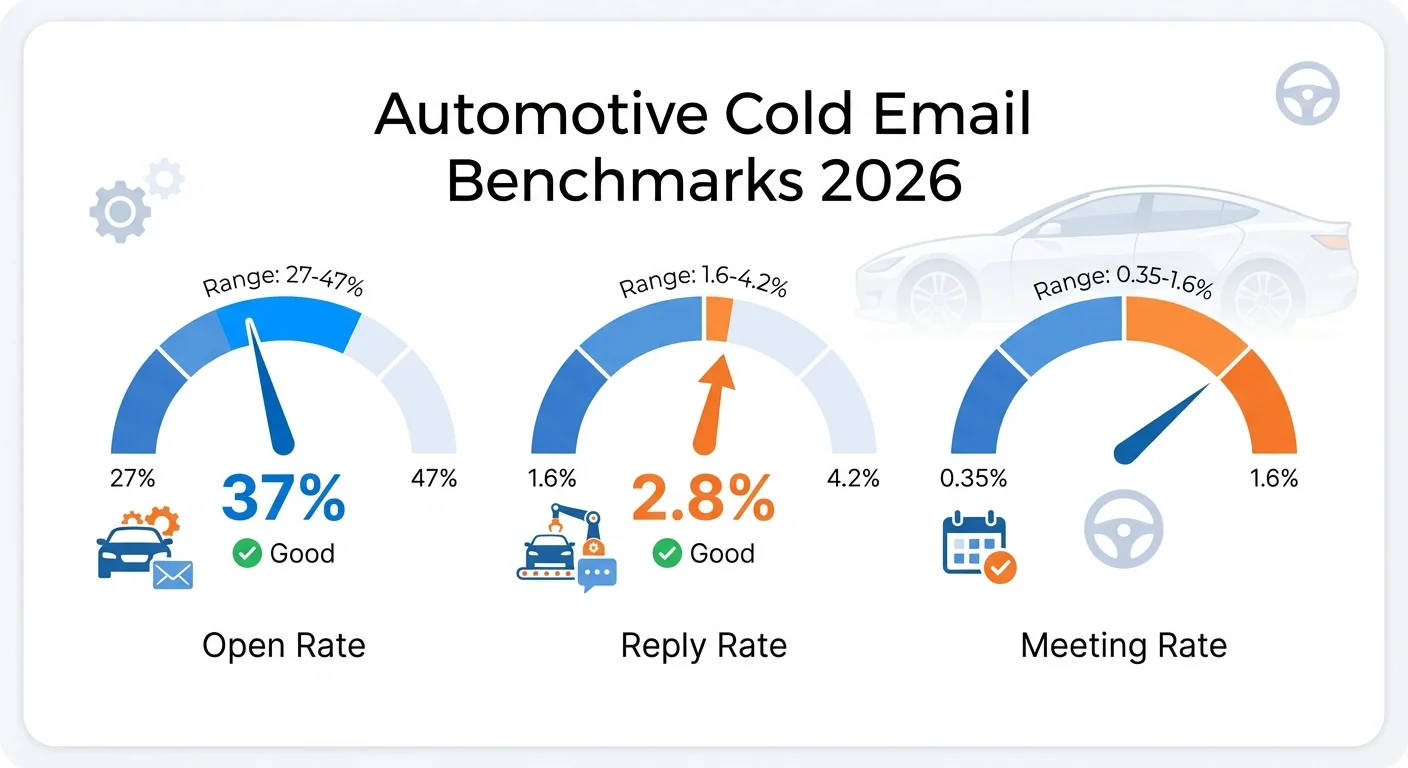
Average automotive cold email campaigns achieve 27-37% open rates, 1.6-2.8% reply rates, and 0.35-0.9% meeting rates in 2026. Performance varies significantly by segment: OEMs respond at 1.4-2.6% (lowest), while automotive technology companies respond at 3.5-6% (highest). Tier 1 suppliers achieve 2-3.5% reply rates, dealership groups reach 3-5.5%, and aftermarket companies hit 3.2-5.5%. Lower-tier suppliers and newer automotive technology segments consistently outperform traditional OEM supply chains by 50-100% across all metrics.
Key takeaways
- Automotive industry cold emails average 27-37% open rates, 1.6-2.8% reply rates, and 0.35-0.9% meeting booking rates across all segments.
- Automotive technology companies achieve the highest reply rates at 3.5-6%, while OEMs respond at only 1.4-2.6%.
- Dealership groups respond 2-3x faster than OEMs, with meeting rates of 0.9-2.2% compared to OEM rates of 0.3-0.8%.
- Tier 2 and Tier 3 suppliers show 2.5-4.5% reply rates, significantly outperforming Tier 1 suppliers at 2-3.5%.
- Procurement and supply chain buyers achieve 2.2-4% reply rates, making them more accessible than engineering contacts at 1.8-3.2%.
Reviewed and updated September 5, 2026
The automotive industry operates with complex supply chain relationships, rigorous quality requirements, and extended development cycles. Cold email campaigns targeting automotive companies must navigate established OEM-supplier relationships, lengthy qualification processes, and highly specialized technical requirements.
This benchmark report provides comprehensive performance data for cold email campaigns targeting automotive companies. The metrics cover various segments, buyer personas, and deal sizes to help you evaluate and optimize your outreach strategy.
Methodology and Data Sources
The benchmarks presented here represent industry-standard performance ranges compiled from publicly available research, industry publications, and commonly cited B2B outreach metrics. Individual campaign results vary based on targeting precision, message quality, timing, and market conditions.
Use these figures as directional guidance for evaluating your automotive industry cold email performance.
Automotive Industry Cold Email Overview
The automotive industry encompasses original equipment manufacturers (OEMs), tier suppliers, dealership groups, aftermarket companies, and automotive technology providers. B2B cold email campaigns in this space typically target procurement, engineering, operations, and technology decision-makers.
Whether those same people can be reached on LinkedIn, and which of them can buy on a conversation at all, is covered in LinkedIn outreach for automotive companies.
Overall Automotive Industry Benchmarks:
| Metric | Below Average | Average | Good | Excellent |
|---|---|---|---|---|
| Open Rate | Under 27% | 27-37% | 37-47% | 47%+ |
| Reply Rate | Under 1.6% | 1.6-2.8% | 2.8-4.2% | 4.2%+ |
| Positive Reply Rate | Under 0.7% | 0.7-1.4% | 1.4-2.2% | 2.2%+ |
| Meeting Rate | Under 0.35% | 0.35-0.9% | 0.9-1.6% | 1.6%+ |
Automotive buyers tend to be process-oriented and risk-averse given the quality and safety requirements of their industry. Messaging that demonstrates quality credentials, industry experience, and proven reliability performs best.
Benchmarks by Automotive Segment
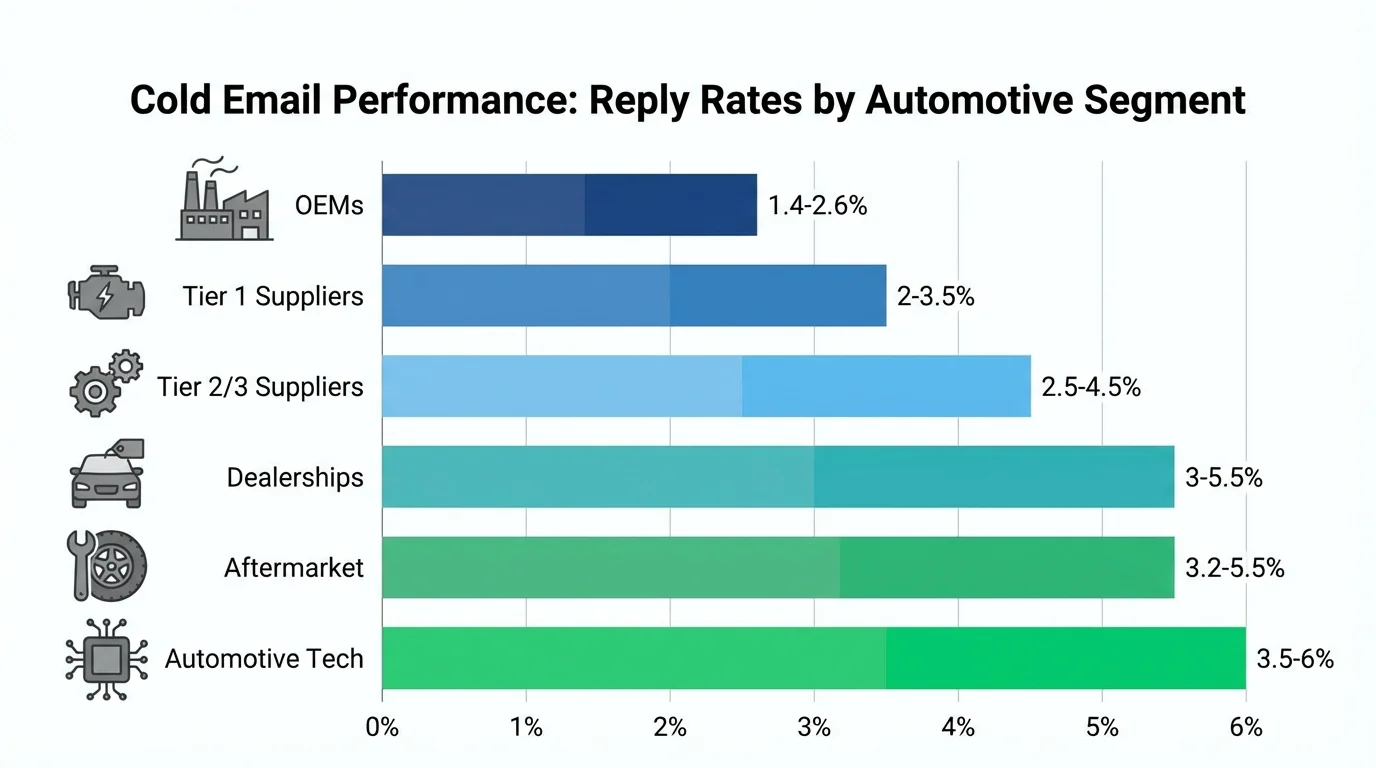
Different automotive segments exhibit distinct response patterns based on supply chain position, competitive dynamics, and technology priorities.
Original Equipment Manufacturers (OEMs)
OEMs have complex organizational structures and established supplier relationships.
Typical Performance Ranges:
- Open rates: 25-38%
- Reply rates: 1.4-2.6%
- Positive reply rates: 0.6-1.3%
- Meeting booking rates: 0.3-0.8%
OEMs receive high volumes of vendor outreach and have formal procurement processes. Successful supplier qualification often requires years of relationship building.
Tier 1 Suppliers
Tier 1 suppliers work directly with OEMs and have substantial purchasing authority.
Typical Performance Ranges:
- Open rates: 30-42%
- Reply rates: 2-3.5%
- Positive reply rates: 0.9-1.8%
- Meeting booking rates: 0.5-1.2%
Tier 1 suppliers balance OEM requirements with their own innovation agendas.
Tier 2 and Tier 3 Suppliers
Lower-tier suppliers often have more accessible decision-making processes.
Typical Performance Ranges:
- Open rates: 34-48%
- Reply rates: 2.5-4.5%
- Positive reply rates: 1.2-2.5%
- Meeting booking rates: 0.7-1.8%
Smaller suppliers may be more receptive to new vendor relationships and innovative solutions.
Dealership Groups
Automotive dealers focus on retail operations and customer experience.
Typical Performance Ranges:
- Open rates: 36-50%
- Reply rates: 3-5.5%
- Positive reply rates: 1.5-3%
- Meeting booking rates: 0.9-2.2%
Dealership buyers often have faster decision cycles and focus on immediate operational impact.
Aftermarket and Parts
Aftermarket companies operate with different dynamics than OEM supply chains.
Typical Performance Ranges:
- Open rates: 38-52%
- Reply rates: 3.2-5.5%
- Positive reply rates: 1.6-3%
- Meeting booking rates: 1-2.5%
Aftermarket buyers are often more transactional and responsive to competitive pricing and availability messaging.
Automotive Technology
EV technology, autonomous systems, and connected vehicle companies blend automotive and tech cultures.
Typical Performance Ranges:
- Open rates: 40-55%
- Reply rates: 3.5-6%
- Positive reply rates: 1.8-3.5%
- Meeting booking rates: 1.2-2.8%
Automotive tech companies often have startup cultures with faster decision-making and higher innovation orientation.
Benchmarks by Buyer Persona
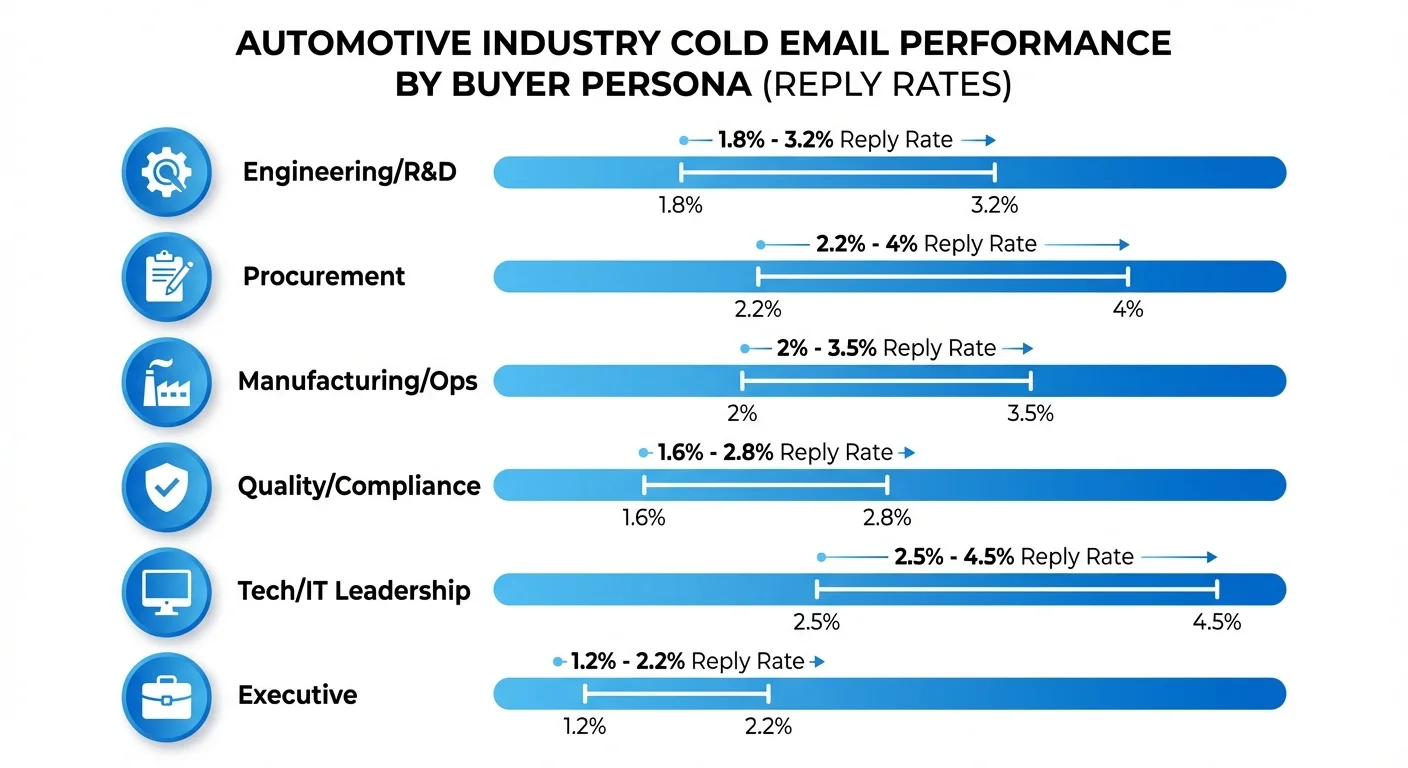
Response rates vary significantly based on the role and function of your target contact.
Engineering and R&D
Chief engineers, R&D directors, and engineering managers evaluate technical solutions.
Typical Performance Ranges:
- Open rates: 28-40%
- Reply rates: 1.8-3.2%
- Positive reply rates: 0.8-1.6%
- Meeting booking rates: 0.4-1%
Engineering buyers require detailed technical specifications and proven quality records.
Procurement and Supply Chain
Procurement managers, commodity buyers, and supply chain directors manage vendor relationships.
Typical Performance Ranges:
- Open rates: 32-45%
- Reply rates: 2.2-4%
- Positive reply rates: 1-2%
- Meeting booking rates: 0.6-1.5%
Procurement contacts follow structured evaluation processes and require competitive positioning.
Manufacturing and Operations
Plant managers, operations directors, and manufacturing engineers focus on production efficiency.
Typical Performance Ranges:
- Open rates: 30-42%
- Reply rates: 2-3.5%
- Positive reply rates: 0.9-1.8%
- Meeting booking rates: 0.5-1.2%
Manufacturing contacts appreciate proven operational improvements and implementation support.
Quality and Compliance
Quality directors, compliance managers, and testing engineers ensure product quality.
Typical Performance Ranges:
- Open rates: 28-40%
- Reply rates: 1.6-2.8%
- Positive reply rates: 0.7-1.4%
- Meeting booking rates: 0.35-0.9%
Quality contacts are risk-averse and require extensive documentation and certification.
Technology and IT Leadership
CIOs, IT directors, and digital transformation leaders drive technology initiatives.
Typical Performance Ranges:
- Open rates: 34-48%
- Reply rates: 2.5-4.5%
- Positive reply rates: 1.2-2.5%
- Meeting booking rates: 0.7-1.8%
Technology leaders balance innovation with legacy system constraints and security requirements.
Executive Leadership
CEOs, presidents, and general managers make strategic decisions.
Typical Performance Ranges:
- Open rates: 24-35%
- Reply rates: 1.2-2.2%
- Positive reply rates: 0.5-1.1%
- Meeting booking rates: 0.25-0.7%
Executive engagement requires strategic messaging connecting to major company initiatives.
Benchmarks by Deal Size
Average contract value significantly influences campaign performance.
$20K-$100K annually
$100K-$500K annually
$500K-$2M annually
$2M+ annually
Small Automotive Solutions ($20K-$100K annually)
Lower-value solutions may target operational teams directly.
Typical Performance Ranges:
- Open rates: 36-50%
- Reply rates: 2.8-5%
- Meeting booking rates: 0.9-2.2%
- Average sales cycle: 60-120 days
Mid-Market Solutions ($100K-$500K annually)
Mid-market deals require multiple stakeholders and engineering validation.
Typical Performance Ranges:
- Open rates: 30-42%
- Reply rates: 2-3.5%
- Meeting booking rates: 0.5-1.5%
- Average sales cycle: 120-240 days
Enterprise Solutions ($500K-$2M annually)
Enterprise deals involve formal procurement and extensive qualification.
Typical Performance Ranges:
- Open rates: 26-38%
- Reply rates: 1.6-2.8%
- Meeting booking rates: 0.4-1%
- Average sales cycle: 240-450 days
Strategic Partnerships ($2M+ annually)
Major OEM relationships require extensive qualification and executive sponsorship.
Typical Performance Ranges:
- Open rates: 22-32%
- Reply rates: 1.2-2%
- Meeting booking rates: 0.2-0.6%
- Average sales cycle: 365-730 days
Quality and Certification Impact
The automotive industry places exceptional emphasis on quality and certification.
Quality Certifications
Campaigns that reference relevant certifications perform significantly better:
- IATF 16949 certification (essential for many OEM relationships)
- ISO 9001 quality management
- ISO 14001 environmental management
- Industry-specific testing certifications
Supplier Qualification Requirements
Understanding qualification processes improves outreach effectiveness:
- PPAP (Production Part Approval Process)
- APQP (Advanced Product Quality Planning)
- Supplier audits and site visits
- Financial and capability assessments
Traceability and Documentation
Automotive buyers require comprehensive documentation:
- Material traceability
- Process documentation
- Quality records and history
- Change management processes
EV and Electrification Impact
The shift toward electric vehicles is creating new opportunities and changing buying dynamics.
EV-Focused Campaigns
Outreach focused on electrification often shows elevated performance:
- Open rates: 38-52%
- Reply rates: 3-5.5%
- Positive reply rates: 1.5-3%
- Meeting booking rates: 0.9-2.2%
Traditional vs. EV Messaging
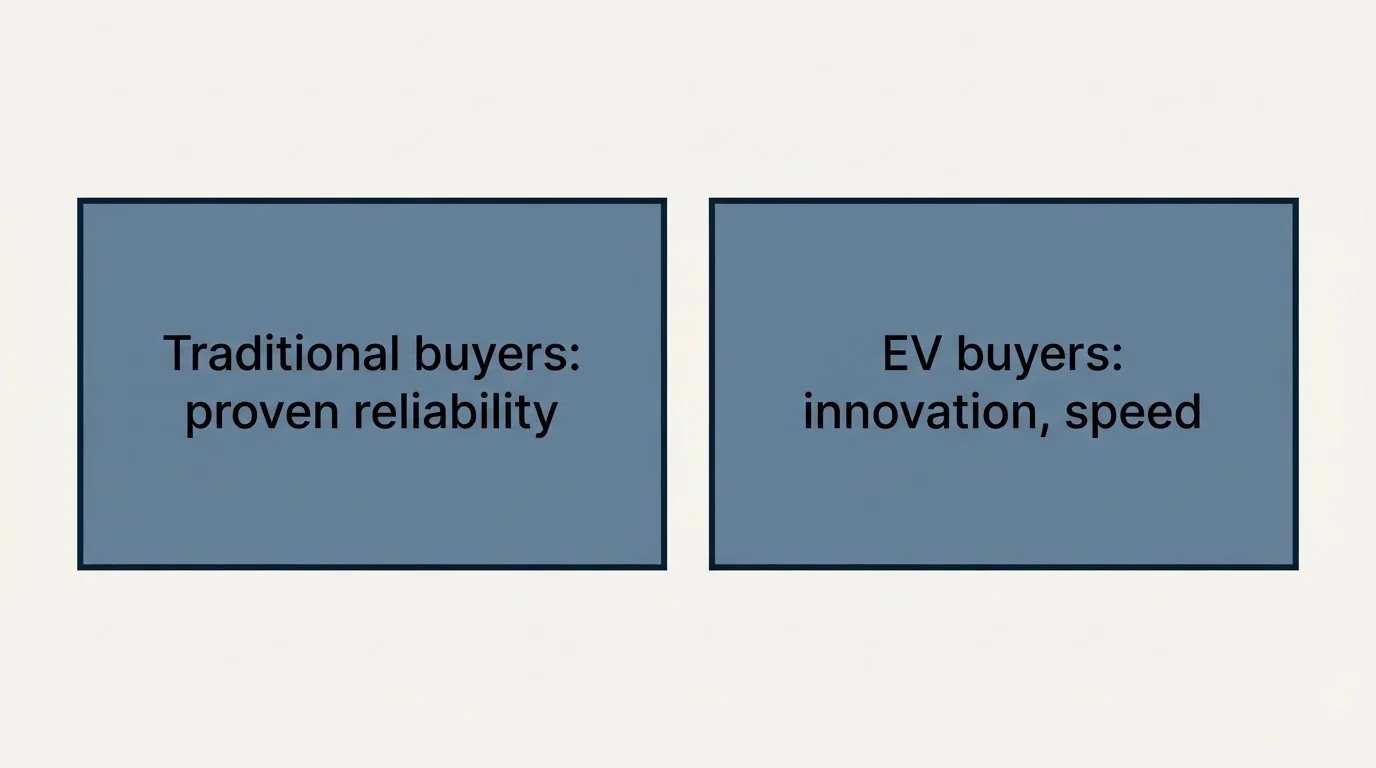
Consider separate approaches for traditional and EV-focused buyers:
- Traditional: Emphasize proven reliability and quality track record
- EV: Emphasize innovation, speed, and flexibility
What Top Performers Do Differently
Automotive-focused campaigns that achieve top-quartile results share common characteristics.
Industry-Specific Expertise
Top performers demonstrate genuine automotive industry knowledge:
- Accurate use of industry terminology
- Understanding of OEM requirements and processes
- Knowledge of quality standards and certifications
- Familiarity with industry trends and challenges
Quality Focus
Successful campaigns emphasize quality credentials:
- Relevant certifications and accreditations
- Quality metrics and track record
- Process capability documentation
- Reference accounts and case studies
Long-Term Relationship Approach
Automotive relationships develop over extended periods. Top performers:
- Build relationships before active opportunities
- Provide value through industry insight
- Maintain patient, consistent outreach
- Leverage industry events and associations
Technical Credibility
Automotive buyers respect technical expertise:
- Detailed technical specifications
- Engineering capability documentation
- Testing and validation data
- Problem-solving case studies
Improving Below-Average Performance
If your automotive cold email metrics fall below industry benchmarks, focus on these areas.
For Below-Average Open Rates
Subject line optimization for automotive:
- Reference specific automotive applications or challenges
- Keep subjects under 45 characters
- Test company name personalization
- Avoid generic marketing language
Sender credibility:
- Use professionally credible sender identities
- Include relevant industry experience
- Build domain reputation gradually
For Below-Average Reply Rates
Messaging improvements:
- Lead with quality and reliability credentials
- Include relevant OEM or industry references
- Keep initial emails under 100 words
- Reference company-specific context
Targeting refinements:
- Narrow focus to specific automotive segments
- Add technology and application filters
- Target companies in development or sourcing phases
For Below-Average Meeting Rates
Conversion optimization:
- Respond to positive replies within 2 hours
- Offer specific meeting times
- Include technical preview for conversation
- Provide easy rescheduling options
Tracking and Measurement
Accurate measurement enables ongoing improvement.
Essential Metrics to Track
- Open rates (acknowledging privacy limitations)
- Reply rates (total and positive)
- Meeting booking rates
- Qualification process progression
- Pipeline value by segment
- Win rates and deal sizes
Segmentation Recommendations
Segment performance data by:
- Automotive segment (OEM, Tier 1, dealers, etc.)
- Company size and OEM relationships
- Buyer persona
- Technology focus area
- Geographic region
Performance Review Cadence
Review performance against benchmarks monthly. Given longer automotive qualification cycles, evaluate pipeline and conversion metrics quarterly with 6-12 month lookback periods.
Next Steps
Understanding where your automotive cold email performance falls relative to industry benchmarks is the first step toward improvement. Systematic optimization of targeting, messaging, and quality credibility can move metrics from below-average to excellent over 6-12 months.
If your internal resources lack automotive-specific expertise or you want to accelerate results, specialized cold email partners with automotive industry experience can bring proven approaches and relevant connections.
Get your free campaign strategy to see how your automotive cold email metrics compare to industry benchmarks and identify specific opportunities for improvement.
Related Reading
Frequently asked questions.
Frequently asked questions- What are good cold email open and reply rates for automotive industry campaigns?
- Good automotive cold email campaigns achieve 37-47% open rates and 2.8-4.2% reply rates. Average performance sits at 27-37% opens and 1.6-2.8% replies, while excellent campaigns exceed 47% opens and 4.2% replies. Meeting booking rates considered good range from 0.9-1.6%, with average performance at 0.35-0.9%. These benchmarks apply across OEMs, suppliers, dealerships, and automotive technology companies.
- Which automotive companies respond best to cold email outreach?
- Automotive technology companies respond best with 3.5-6% reply rates and 1.2-2.8% meeting rates. Aftermarket and parts companies achieve 3.2-5.5% reply rates, followed by dealership groups at 3-5.5%. Tier 2 and Tier 3 suppliers respond at 2.5-4.5%, while Tier 1 suppliers reach 2-3.5%. OEMs have the lowest response at 1.4-2.6% due to complex organizational structures, established supplier relationships, and formal procurement processes that require years of qualification.
- Do tier 1 or lower-tier automotive suppliers respond better to cold emails?
- Lower-tier suppliers respond significantly better than Tier 1 suppliers. Tier 2 and Tier 3 suppliers achieve 2.5-4.5% reply rates and 0.7-1.8% meeting rates, compared to Tier 1 suppliers at 2-3.5% replies and 0.5-1.2% meetings. Smaller suppliers have more accessible decision-making processes and are more receptive to new vendor relationships. Tier 1 suppliers balance OEM requirements with their own innovation agendas, creating more complex and slower purchasing processes.
- What reply rates should I expect when targeting automotive procurement versus engineering?
- Procurement and supply chain contacts achieve 2.2-4% reply rates and 0.6-1.5% meeting rates, outperforming engineering and R&D at 1.8-3.2% replies and 0.4-1% meetings. Procurement follows structured evaluation processes and responds to competitive positioning, while engineering buyers require detailed technical specifications and proven quality records. Manufacturing and operations contacts fall between these at 2-3.5% reply rates, focusing on proven operational improvements and implementation support.
About the author.

Hosun Chung is COO at RevenueFlow, which builds and operates outbound revenue engines for B2B companies. Previously at Gleacher Shacklock LLP. Studied at London School of Economics.
Hosun Chung · COO
Connect on LinkedIn →Explore more.
Ready to scale your outreach?
We build GTM engines that book real meetings. See the receipts.
Related articles.
Cold Email Conversion Benchmarks: 2026 Performance Data
Complete benchmark data for cold email conversion rates from reply to meeting to opportunity. Learn what drives conversions and how to optimize your full funnel.
Education Cold Email Benchmarks: 2026 Performance Data
Industry benchmark data for education cold email campaigns, including open rates, reply rates, and conversion metrics for companies targeting K-12 schools, higher education, and corporate training organizations.
Real Estate Cold Email Benchmarks: 2026 Performance Data
Comprehensive benchmark data for real estate cold email campaigns, including open rates, reply rates, and conversion metrics for companies targeting brokerages, property managers, developers, and real estate investors.
Fintech Cold Email Benchmarks: 2026 Performance Data
Comprehensive benchmark data for fintech cold email campaigns, including open rates, reply rates, and conversion metrics specific to financial technology companies targeting banks, financial institutions, and businesses.
Media Cold Email Benchmarks: 2026 Performance Data
Comprehensive benchmark data for media and entertainment industry cold email campaigns, covering publishers, streaming platforms, advertising, and content creators.
Ecommerce Cold Email Benchmarks: 2026 Performance Data
Comprehensive benchmark data for ecommerce cold email campaigns, including open rates, reply rates, and conversion metrics for companies targeting online retailers, D2C brands, and marketplace sellers.