Retail Cold Email Benchmarks: 2026 Performance Data
Comprehensive benchmark data for retail industry cold email campaigns, including open rates, reply rates, and conversion metrics across different retail segments and buyer personas.
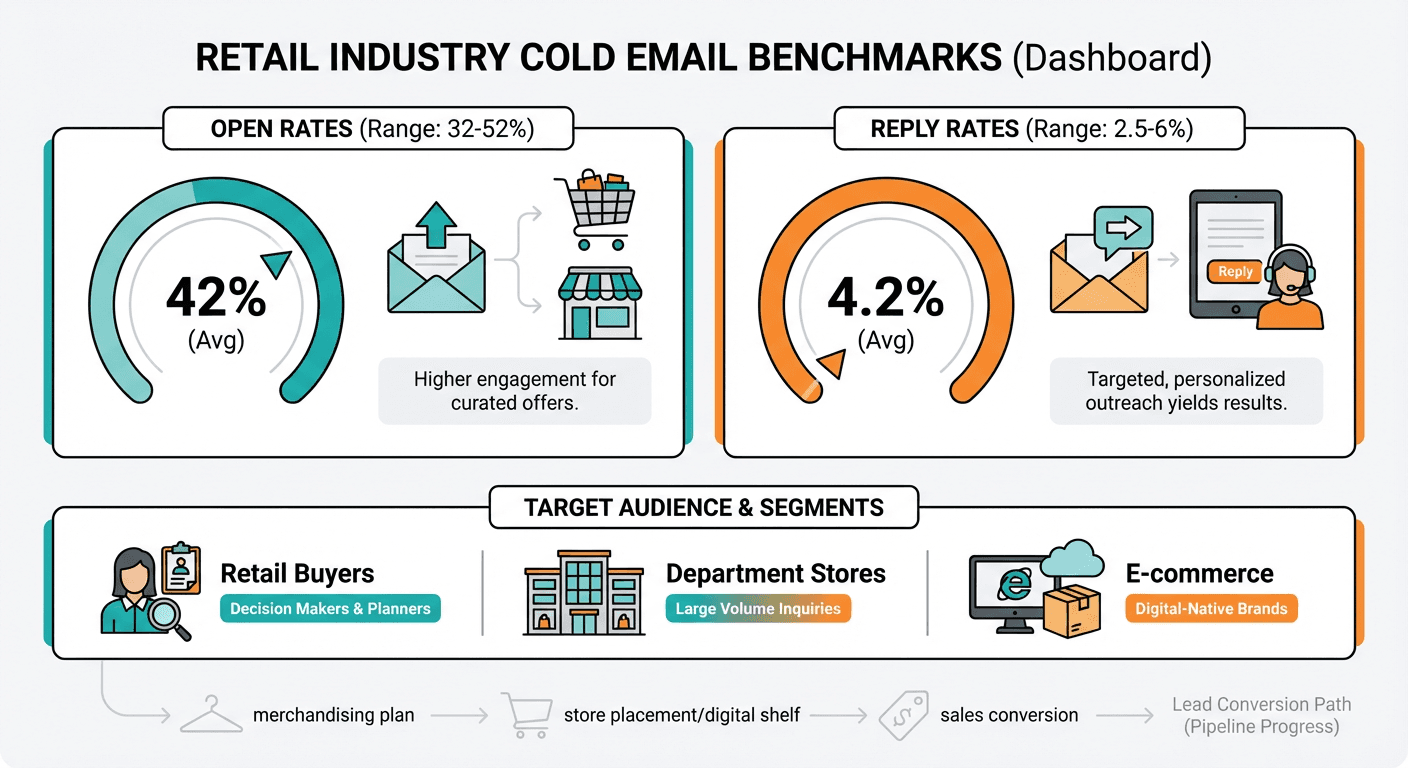
Retail cold email campaigns average 32-42% open rates, 2.5-4% reply rates, and 0.6-1.5% meeting booking rates across the industry. E-commerce and specialty retailers perform best (42-55% open rates, 4-7% reply rates), while department stores see lower engagement (30-42% open rates, 2-4% reply rates). Merchandising and buying teams respond most actively with 3.5-6.5% reply rates, significantly outperforming other personas.
Key takeaways
- E-commerce retailers deliver the highest cold email performance with 42-55% open rates and 4-7% reply rates, outperforming all other retail segments.
- Merchandising and buying teams achieve 3.5-6.5% reply rates, making them the most responsive persona in retail B2B outreach.
- Department stores and mass retailers show the lowest engagement with 30-42% open rates and 0.5-1.5% meeting booking rates due to high vendor outreach volumes.
- Specialty retailers demonstrate 38-52% open rates and 1.8-3.5% positive reply rates, reflecting their higher receptiveness to innovation.
- Grocery chains operate on thin margins and respond best to operational efficiency messaging, achieving 2.8-5% reply rates when properly targeted.
Reviewed and updated August 28, 2026
Cold email outreach in the retail industry presents unique challenges and opportunities. With rapidly evolving consumer preferences, seasonal buying patterns, and complex supply chain relationships, retail B2B campaigns require specialized approaches to achieve strong performance.
This benchmark report provides comprehensive performance data for cold email campaigns targeting retail companies. The metrics cover various retail segments, buyer personas, and deal sizes to help you evaluate and improve your outreach efforts.
Average
Average
Average
Average
Bar widths are equal here because these stage values are not a single comparable measure.
Methodology and Data Sources
The benchmarks in this report represent industry-standard performance ranges compiled from publicly available research, industry publications, and commonly cited performance metrics in B2B retail outreach. Individual results vary based on factors including list quality, message relevance, timing, and market conditions.
These figures serve as directional guidance rather than guaranteed outcomes. Your specific results will depend on your targeting precision, messaging quality, and overall campaign execution.
Retail Industry Cold Email Overview
The retail industry encompasses a diverse range of businesses, from specialty boutiques to major department store chains and everything in between. B2B cold email campaigns in this space typically target buyers, merchandising managers, operations directors, and technology decision-makers.
Overall Retail Industry Benchmarks:
| Metric | Below Average | Average | Good | Excellent |
|---|---|---|---|---|
| Open Rate | Under 32% | 32-42% | 42-52% | 52%+ |
| Reply Rate | Under 2.5% | 2.5-4% | 4-6% | 6%+ |
| Positive Reply Rate | Under 1.2% | 1.2-2.2% | 2.2-3.5% | 3.5%+ |
| Meeting Rate | Under 0.6% | 0.6-1.5% | 1.5-2.5% | 2.5%+ |
Retail buyers tend to be highly practical and focused on immediate operational needs. Messaging that clearly articulates ROI, efficiency gains, or competitive advantages performs best in this sector.
Benchmarks by Retail Segment

Different retail segments exhibit distinct response patterns based on their operational priorities, technology adoption rates, and competitive pressures.
Grocery and Supermarket Chains
Grocery retailers operate on thin margins and prioritize operational efficiency above most other considerations.
Typical Performance Ranges:
- Open rates: 35-48%
- Reply rates: 2.8-5%
- Positive reply rates: 1.4-2.8%
- Meeting booking rates: 0.8-2%
Grocery chain decision-makers respond well to messages about inventory management, supply chain optimization, and labor efficiency. Timing campaigns around seasonal planning cycles (typically 3-6 months before major holidays) improves response rates.
Department Stores and Mass Retailers
Large retailers have complex organizational structures with multiple decision-makers and longer evaluation cycles.
Typical Performance Ranges:
- Open rates: 30-42%
- Reply rates: 2-4%
- Positive reply rates: 1-2%
- Meeting booking rates: 0.5-1.5%
These organizations receive high volumes of vendor outreach, making differentiation essential. Account-based approaches that engage multiple stakeholders simultaneously tend to outperform single-threaded campaigns.
Specialty Retail
Specialty retailers (apparel, electronics, home goods, etc.) often have more agile decision-making processes and higher technology adoption rates.
Typical Performance Ranges:
- Open rates: 38-52%
- Reply rates: 3.5-6%
- Positive reply rates: 1.8-3.5%
- Meeting booking rates: 1.2-2.8%
Specialty retailers are often more receptive to innovation and new vendor relationships. Messages that reference their specific product category and competitive landscape perform particularly well.
E-commerce and Online Retail
Pure-play e-commerce companies typically have younger workforces and higher digital sophistication.
Typical Performance Ranges:
- Open rates: 42-55%
- Reply rates: 4-7%
- Positive reply rates: 2-4%
- Meeting booking rates: 1.5-3.5%
E-commerce buyers are highly data-driven and respond well to quantified value propositions. They often prefer digital communication channels and shorter sales cycles.
Convenience Stores and Quick-Service Retail
Convenience retailers prioritize speed and simplicity in vendor relationships.
Typical Performance Ranges:
- Open rates: 33-45%
- Reply rates: 2.5-4.5%
- Positive reply rates: 1.2-2.5%
- Meeting booking rates: 0.7-1.8%
Benchmarks by Buyer Persona
Response rates vary significantly based on the role and responsibilities of your target contact.
Merchandising and Buying Teams
Category managers, buyers, and merchandising directors control product selection and vendor relationships.
Typical Performance Ranges:
- Open rates: 38-52%
- Reply rates: 3.5-6.5%
- Positive reply rates: 1.8-3.5%
- Meeting booking rates: 1.2-3%
These buyers are constantly evaluating new products and vendors, making them receptive to relevant outreach. They respond best to product-focused messaging that demonstrates category expertise.
Operations and Supply Chain
Operations directors, supply chain managers, and logistics coordinators focus on efficiency and cost reduction.
Typical Performance Ranges:
- Open rates: 35-48%
- Reply rates: 2.8-5%
- Positive reply rates: 1.4-2.8%
- Meeting booking rates: 0.9-2.2%
Operations contacts appreciate specific, quantified impact statements. Messages that reference their current technology stack or specific operational challenges perform well.
Store Operations and Field Leadership
District managers, regional directors, and store operations leaders manage day-to-day retail execution.
Typical Performance Ranges:
- Open rates: 32-45%
- Reply rates: 2.2-4%
- Positive reply rates: 1-2%
- Meeting booking rates: 0.6-1.5%
These contacts are often mobile and time-constrained. Shorter emails with clear, immediate value propositions work best.
Technology and IT Leadership
CIOs, IT directors, and technology managers evaluate retail technology solutions.
Typical Performance Ranges:
- Open rates: 30-42%
- Reply rates: 2-3.5%
- Positive reply rates: 0.8-1.8%
- Meeting booking rates: 0.5-1.2%
Technology buyers in retail are often skeptical of sales outreach and prefer peer recommendations. Technical case studies and integration-focused messaging improve engagement.
C-Suite and Executive Leadership
CEOs, CFOs, and Chief Merchants make strategic vendor and technology decisions.
Typical Performance Ranges:
- Open rates: 28-40%
- Reply rates: 1.5-3%
- Positive reply rates: 0.6-1.5%
- Meeting booking rates: 0.4-1%
Executive contacts receive high volumes of outreach. Personalized, research-driven messages that reference specific company initiatives or challenges are essential for engagement.
Benchmarks by Deal Size
Average contract value significantly influences campaign performance and appropriate tactics.
Small Retail Solutions ($5K-$25K annually)
Lower-value solutions typically have shorter sales cycles and transactional buying processes.
Typical Performance Ranges:
- Open rates: 40-52%
- Reply rates: 4-7%
- Meeting booking rates: 1.5-3.5%
- Average sales cycle: 21-60 days
Higher volumes are acceptable for lower-value solutions. Emphasize quick wins and easy implementation.
Mid-Market Solutions ($25K-$100K annually)
Mid-market deals require more stakeholder involvement and longer evaluation periods.
Typical Performance Ranges:
- Open rates: 36-48%
- Reply rates: 3-5.5%
- Meeting booking rates: 1-2.5%
- Average sales cycle: 45-120 days
Enterprise Retail Solutions ($100K-$500K annually)
Enterprise deals involve complex procurement processes and multiple decision-makers.
Typical Performance Ranges:
- Open rates: 32-44%
- Reply rates: 2.2-4%
- Meeting booking rates: 0.7-1.8%
- Average sales cycle: 90-240 days
Account-based strategies with multi-threaded outreach are essential at this level.
Strategic Partnerships ($500K+ annually)
Large strategic deals require sustained relationship building and extensive stakeholder management.
Typical Performance Ranges:
- Open rates: 28-40%
- Reply rates: 1.5-3%
- Meeting booking rates: 0.4-1.2%
- Average sales cycle: 180-365 days
Seasonal Considerations

Retail cold email performance varies significantly throughout the year due to seasonal business patterns.
Peak Avoidance Periods
Avoid heavy outreach during these periods when retail buyers are focused on execution:
- November through early January (holiday selling season)
- Back-to-school season (July-August for many retailers)
- Major sale events (Black Friday week, major promotional periods)
Optimal Outreach Windows
These periods typically show above-average response rates:
- January through February (post-holiday planning)
- April through May (mid-year strategic reviews)
- September through early October (holiday preparation planning)
Response rates during optimal windows often exceed baseline metrics by 20-35%.
What Top Performers Do Differently
Retail-focused campaigns that achieve top-quartile results share common characteristics.
The same characteristics decide whether LinkedIn lead generation for retailers produces a reply, because a retail buyer reads a connection request against the same calendar and the same research.
Deep Industry Knowledge
Top performers demonstrate genuine understanding of retail-specific challenges, terminology, and priorities. This includes:
- References to current retail trends and challenges
- Understanding of seasonal business patterns
- Knowledge of retail technology ecosystems
- Familiarity with common operational metrics
Retailer-Specific Research
High-performing campaigns include specific research on each target company:
- Recent news or announcements
- Expansion or remodeling activity
- Technology investments or transitions
- Competitive positioning and challenges
Category Expertise
For product-focused outreach, demonstrating category expertise significantly improves response rates:
- Category-specific market trends
- Competitive product landscape
- Consumer behavior insights
- Margin and performance benchmarks
Timing Alignment
Top performers align outreach with retail planning cycles:
- Budget planning periods (varies by company, often Q3-Q4)
- Category reviews and line evaluations
- Technology refresh cycles
- Strategic planning seasons
Improving Below-Average Performance

If your retail cold email metrics fall below industry benchmarks, focus on these high-impact areas.
For Below-Average Open Rates
Subject line optimization for retail:
- Reference specific retail challenges or opportunities
- Keep subjects under 50 characters
- Test retailer name personalization
- Use retail-specific terminology appropriately
Sender reputation:
- Warm new domains gradually (start with 50-75 daily sends)
- Monitor bounce rates closely (keep under 2.5%)
- Use retail-appropriate sender names
For Below-Average Reply Rates
Messaging improvements:
- Lead with retail-relevant pain points
- Include quantified ROI examples from similar retailers
- Keep initial emails under 100 words
- Reference specific company or category details
Targeting refinements:
- Narrow focus to specific retail segments
- Add company size and technology filters
- Target companies showing growth or change signals
For Below-Average Meeting Rates
Conversion optimization:
- Respond to positive replies within 1-2 hours
- Offer specific meeting times (not open calendars)
- Include brief value preview for the meeting
- Follow up persistently but appropriately
Tracking and Measurement
Accurate measurement is essential for ongoing improvement.
Essential Metrics to Track
- Open rates (acknowledging privacy limitations)
- Reply rates (total and positive)
- Meeting booking rates
- Opportunity creation rates
- Pipeline value generated
- Customer acquisition cost
Segmentation Recommendations
Segment performance data by:
- Retail segment (grocery, specialty, etc.)
- Company size (by revenue and store count)
- Buyer persona
- Geographic region
- Campaign type and messaging approach
Benchmark Comparison Cadence
Review performance against benchmarks monthly and look for trends over 3-6 month periods rather than reacting to short-term variations.
Next Steps
Understanding where your retail cold email performance falls relative to industry benchmarks is the first step toward improvement. Systematic optimization of targeting, messaging, and timing can move metrics from below-average to good or excellent over 3-6 months of focused effort.
If your internal resources are stretched or you want to accelerate results, specialized cold email partners can bring retail industry expertise and proven playbooks to your outreach efforts.
Get your free campaign strategy to see how your retail cold email metrics compare to industry benchmarks and identify specific opportunities for improvement.
Related Reading
Frequently asked questions.
Frequently asked questions- What is a good cold email reply rate for retail industry outreach?
- A good reply rate for retail cold email campaigns is 4-6%, with 2.2-3.5% positive replies. Average performance falls at 2.5-4% total replies and 1.2-2.2% positive replies, while excellent campaigns achieve 6%+ reply rates. E-commerce and specialty retail segments typically perform at the higher end of these ranges, while department stores trend lower.
- Which retail segment responds best to cold email outreach?
- E-commerce and online retail companies respond best to cold email with 42-55% open rates, 4-7% reply rates, and 1.5-3.5% meeting booking rates. These pure-play digital retailers have younger workforces, higher digital sophistication, and are highly data-driven. Specialty retailers rank second with 38-52% open rates and 3.5-6% reply rates, while department stores show the lowest engagement.
- What cold email open rate should I expect when targeting retail buyers?
- Retail industry cold email open rates average 32-42%, with good performance at 42-52% and excellent campaigns exceeding 52%. Specific segments vary: e-commerce achieves 42-55%, specialty retail reaches 38-52%, grocery chains hit 35-48%, while department stores see 30-42%. Merchandising and buying teams specifically deliver the highest persona-level open rates at 38-52%.
- Which retail buyer personas are most responsive to cold email?
- Merchandising and buying teams are the most responsive retail persona with 3.5-6.5% reply rates, 1.8-3.5% positive replies, and 1.2-3% meeting booking rates. They constantly evaluate new vendors and products, making them receptive to relevant outreach. Operations and supply chain contacts rank second with 2.8-5% reply rates, while store operations and field leadership show the lowest engagement at 2.2-4% reply rates.
- How do retail cold email benchmarks compare to other B2B industries?
- Retail cold email open rates of 32-42% fall within typical B2B ranges, but the industry shows distinct patterns. E-commerce retailers' 42-55% open rates exceed most B2B sectors due to digital sophistication, while department stores' 30-42% rates reflect high vendor competition. Reply rates of 2.5-4% align with B2B averages, though merchandising teams' 3.5-6.5% responses indicate higher receptiveness than typical B2B decision-makers.
About the author.

Hosun Chung is COO at RevenueFlow, which builds and operates outbound revenue engines for B2B companies. Previously at Gleacher Shacklock LLP. Studied at London School of Economics.
Hosun Chung · COO
Connect on LinkedIn →Explore more.
Ready to scale your outreach?
We build GTM engines that book real meetings. See the receipts.
Related articles.
Cold Email Conversion Benchmarks: 2026 Performance Data
Complete benchmark data for cold email conversion rates from reply to meeting to opportunity. Learn what drives conversions and how to optimize your full funnel.
Education Cold Email Benchmarks: 2026 Performance Data
Industry benchmark data for education cold email campaigns, including open rates, reply rates, and conversion metrics for companies targeting K-12 schools, higher education, and corporate training organizations.
Automotive Cold Email Benchmarks: 2026 Performance Data
Industry benchmark data for automotive sector cold email campaigns, covering OEMs, suppliers, dealerships, and automotive technology with performance metrics by segment and buyer role.
Real Estate Cold Email Benchmarks: 2026 Performance Data
Comprehensive benchmark data for real estate cold email campaigns, including open rates, reply rates, and conversion metrics for companies targeting brokerages, property managers, developers, and real estate investors.
Fintech Cold Email Benchmarks: 2026 Performance Data
Comprehensive benchmark data for fintech cold email campaigns, including open rates, reply rates, and conversion metrics specific to financial technology companies targeting banks, financial institutions, and businesses.
Media Cold Email Benchmarks: 2026 Performance Data
Comprehensive benchmark data for media and entertainment industry cold email campaigns, covering publishers, streaming platforms, advertising, and content creators.