Booking Conference Meetings Before You Arrive
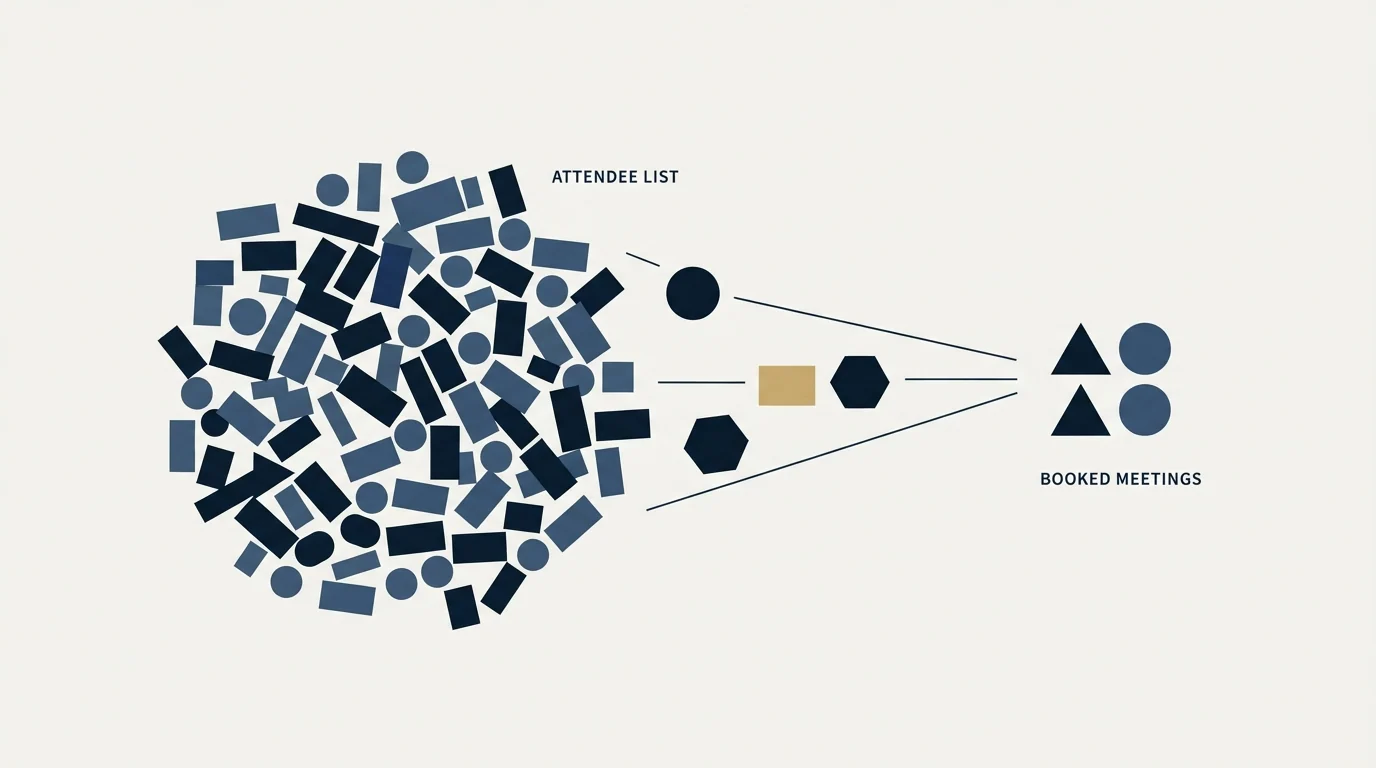
The meetings you hold at an event were booked weeks earlier. The attendee list is the part of the standard method most likely to waste that time.
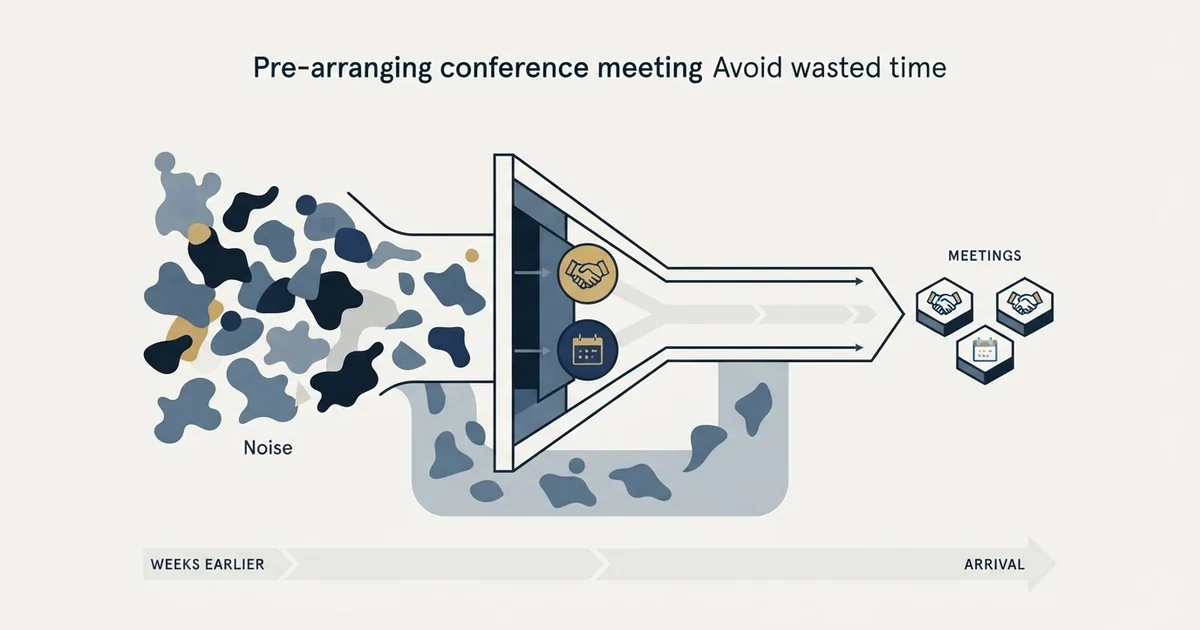
Meetings at a conference are booked in the weeks beforehand, not on the floor. Public attendee lists mostly do not exist, so the audience is your whole enumerated customer profile rather than a scraped subset: say you are going and ask for a specific slot. Speaker rosters and sponsor directories are real surfaces, and each supports a different truthful claim.
Key takeaways
- Registration and attendee pages are lead-capture forms rather than directories, so a week spent hunting for an attendee list usually ends with a partial one and less time to use it.
- A speaker roster names an individual who is committed to attending, while a sponsor directory names only a company, so a message claiming the reader is attending is a guess on the second surface.
- For an enumerable market the event is a reason to write rather than a source of people, because a scraped attendee list is a subset of a profile you already hold and can contact today.
- The event date makes the reason specific, verifiable and expiring, which is exactly what a single message needs to work with nothing scheduled behind it.
Reviewed and updated October 1, 2026
The stand is paid for, the flights are booked, and three weeks out somebody asks who the team is actually meeting there. The honest answer is nobody yet, and the plan is to talk to whoever walks past. That plan produces a badge scanner full of contacts and a debrief that cannot name a single opportunity, and it is the default at most companies that attend events at all.
Meetings held at a conference are made before anyone arrives. The floor is where they happen, not where they are agreed, and the work that decides the number is a campaign run in the weeks before the doors open.
The attendee list is the part that usually fails
The commercial version of the question is whether you can obtain an event attendee list by buying it from the organiser or from a data seller. Treat a purchased list as a claim about coverage that nobody will stand behind, since the seller cannot show how it was assembled and the organiser rarely licenses one at all, and price it against the three surfaces below, which cost nothing and support a claim you can defend.
Almost every published method for this starts the same way: get the attendee list, filter it to your ideal customer profile, and write to the people on it. That instruction assumes an artefact which mostly does not exist.
Public true-attendee lists are rare. Registration and attendee pages are lead-capture forms rather than directories, and where a list does exist it is usually behind a sponsorship tier, an app login, or a paid data product built by inference. Teams routinely spend a week hunting for a list, find a partial one, and arrive at the outreach stage with less time and a worse audience than they started with.
Three surfaces do exist reliably, and the useful discipline is that each one supports a different truthful claim. Confusing them is how an event campaign ends up asserting something it cannot support.
- Published on the agenda or speakers page
- Names an individual who is committed to being there
- Supports: you are speaking at this event
- Small, and skewed toward people who are being sold to constantly
- Published on the sponsors or exhibitors page
- Names a company, not a person who will attend
- Supports: your company is sponsoring this event
- Never supports: you are attending
- Some satellite events publish or expose a guest list
- Names individuals who intend to be in the city
- Supports: you are going to that side event
- Carries no contact details, so the address still has to be resolved
Two practical notes on the first two. Check the speaker page's markup as well as its rendered grid, since detail nodes for speakers the grid does not display can sit in the same document, and a scrape reading only the visible cards returns a small roster rather than a partial one. And an exhibitor directory is the wrong audience whenever the client sells into the category rather than alongside it: at a trade show the exhibitors are suppliers and the buyers are the visitors, so for a vendor selling to that category the exhibitor list is the competitive set.
The play that works better than hunting for the list
Teams who want to build a targeted list from conference attendee data usually start by trying to obtain the list, which is the step that fails, and the play below reaches the same people without it.
For any company whose ideal customer profile is enumerable, and most are, the audience for an event campaign is the whole held profile rather than the event's attendee list.
The reasoning is arithmetic. An attendee list, even a perfect one, is a subset of a market you already hold and can write to today. Assembling it costs money and delay in order to make the audience smaller. The event is not a source of new people; it is a reason to write to the people you already have.
So the campaign says that you are going, and asks whether the recipient wants to meet there. The recipient does not have to be attending for the message to be honest, and nothing in it claims they are. A prospect who is not going frequently replies to say so and takes a call instead, which is a conversation the campaign would not otherwise have had.
That inverts the usual sequence in a way worth being explicit about. The event is being used as the reason for writing rather than as the source of the list, and the reason is unusually good: it is specific, it is dated, it is verifiable by the recipient, and it expires. Those four properties are what a single message needs in order to work without anything scheduled behind it.
- Step 1Confirm somebody is genuinely going
A named person who will be there and has capacity to take meetings. If nobody is attending, the campaign is a different campaign and has to say so.
- Step 2Take the whole held profile as the audience
Everyone in the ideal customer profile, including people who did not reply to earlier campaigns, since this is a genuinely new premise rather than a reminder.
- Step 3Add the cheap public surfaces
Speaker roster and sponsor directory, scraped in an afternoon, used to write provenance-matched copy for those specific rows rather than to replace the audience.
- Step 4Send while there is still diary
Ask for a slot at a point where the recipient's event calendar is not yet full. The window closes on its own and the campaign ends with it.
- Step 5Hold the meetings, then screen the floor
Booked conversations are the output. Badge scans are an unscreened list that gets treated like any other purchased list afterwards.
The honesty constraint, which is not optional
The related ask is how to make prospects expect you at the event rather than arriving cold, and the honesty constraint below is what separates warm awareness from a claim that does not survive the first conversation.

Every attendance claim in the copy has to be true. That sounds obvious and it is the rule the category breaks most often.
The specific failure is the message that implies you will be at an event you have not committed to, books meetings on that basis, and converts them to video calls afterwards. It is a planned deception rather than a schedule change, it is off the table here regardless of what it does to a reply rate, and it is the reason event outreach has the reputation it has among people who receive a lot of it.
The related failure is asserting something about the recipient. A sponsor directory names a company, so a message saying that you saw they are sponsoring is true and a message saying that you saw they are attending is a guess. On a channel where the whole value of the reason is that the reader can check it, a guess that fails the check costs more than a generic message would have.
A trip that genuinely changes is a different matter entirely. Plans move, and a booked meeting that has to become a call is handled by telling the person, by name, before the event.
What the ask should be
The ask is a specific slot, not an open invitation, and it is smaller than the ask in an ordinary campaign because the venue does most of the work.
Fifteen or twenty minutes somewhere quiet, on a named day, is a request a stranger can evaluate in one line. Coffee on Tuesday morning is easier to accept than a meeting, because the recipient is already going to be in that building with gaps in their day, and the marginal cost of saying yes is close to nothing. That is the whole reason event asks convert better than the same offer sent in an ordinary week.
Two things damage it. Asking them to book through a link converts a small favour into an errand, and a link is also the part of an event message most likely to read as automated. And attaching the pitch to the ask spends the advantage: the reason to meet at an event is the event, and a paragraph explaining your product before the ask turns a light request into an ordinary sales email that happens to mention a conference.
What happens to the people who do not reply
Teams that ask how to manage attendee lists and follow ups after an event are usually describing a tracking problem and a doctrine problem at once. The tracking half is ordinary: record who registered, who was met and what was agreed. The follow up half is settled by the campaign itself ending on the date, so anyone met is in a conversation and anyone not met is a candidate for the next campaign with its own reason to exist.

Silence is the ordinary outcome on any cold campaign, and it is not a reason to send the same message again.
Our own practice is one message per campaign, built on one premise, sent once. An event run is therefore several campaigns across the weeks beforehand, each one standing on its own reason: the announcement that you are going, a session or a theme on the agenda that is genuinely relevant to a segment, the last-week version with a concrete slot attached.
The distinction matters more than it sounds. A second message on the same premise lands underneath a message somebody already read and declined, which is the population most likely to complain, and the cost of that complaint lands on the sending domain across everything else it carries. The full argument, including what the position costs us, is in why we stopped using follow-ups.
The event supplies a natural end to all of it. The date arrives, the reason expires, and the campaign stops rather than decaying into a nurture sequence nobody decided to start.
A structure for a team that currently has none
The most common version of this problem is not a bad process but the absence of one. The team goes, hopes to find people, and the outcome depends on footfall.
- Yes: A named person owns pre-event booking, with time in their calendar for it
- Yes: The audience is the held profile, decided before anyone hunts for a list
- Yes: Someone from the company is genuinely attending and can take meetings
- Yes: Suppression is loaded before the first send, including existing customers and live deals
- Yes: A target number of booked meetings is written down before the stand is paid for
- No: The meeting count is decided by who walks past the stand
- No: The follow-up approach is designed after everyone has flown home
The number written down in the fifth row is what turns the whole exercise into a decision rather than a habit. Divide the fully loaded cost of attending, including the selling days everyone loses to travel, by the meetings you expect to hold, and compare that figure against what the same budget produces in a channel you already run. The cost per meeting is set before you arrive works through that arithmetic and through what happens to the scanned list afterwards, which is the half of the event that this page deliberately does not cover.
Where this fits against everything else
An event is a dated reason to write, which puts it in the same family as any other trigger rather than in a category of its own. The wider set of trigger events worth writing on covers what to do when the next conference is months away, and building lists from dated signals rather than static filters is the general discipline underneath both. For the message itself, templates that use an event as the reason for writing carry the pre-event and post-event shapes.
One caution about how the results read afterwards. Event campaigns lift reply rate on a finite list, which is genuinely valuable and is also the reason they flatter themselves: the same people, written to with a better reason, answer more often. That is a fact about the reason rather than about the event, and it is worth remembering when the question is whether to buy the stand again.
The short version
The meetings happen because they were booked in the weeks before, and the attendee list is the part of the standard method most likely to waste that time. Public attendee lists mostly do not exist. Speaker rosters, sponsor directories and public side-event lists do, and each supports a different truthful claim.
For an enumerable market, write to the whole profile rather than to a scraped subset of it, say that you are going, and ask for a specific slot. Keep every attendance claim true, including the ones about the recipient. Send once per premise and let the date end the campaign rather than sending reminders into it.
Then put a target number and a named owner against it before the stand is paid for, so the decision to go again is made on meetings held rather than on how the show felt. If the same budget would produce more conversations in a channel that answers in days, see what a first campaign produces.
Frequently asked questions.
Frequently asked questions- How do you get a conference attendee list?
- Usually you do not. Registration and attendee pages are lead-capture forms, and where a list exists it sits behind a sponsorship tier, an app login or a paid product built by inference. The surfaces that reliably exist are the speaker roster, the sponsor and exhibitor directory, and sometimes a public side-event guest list.
- Who should you write to before an event?
- For most companies, the whole enumerated ideal customer profile rather than a scraped attendee list. The event is the reason for writing, not the source of the names, and an attendee list is a smaller subset of a market you already hold. Add the speaker roster and sponsor directory on top for provenance-matched copy on those specific rows.
- What should the pre-event ask be?
- A specific slot on a named day, kept short. Fifteen or twenty minutes somewhere quiet is easy to accept because the recipient will already be in the building with gaps in their day, so the marginal cost of saying yes is close to nothing. Attaching a product pitch to the ask spends that advantage.
- How far ahead should you start?
- Early enough that the recipient still has diary to give you, which is the constraint rather than a fixed number of weeks. Event calendars fill from both ends as the date approaches, so an ask arriving late is competing with commitments already made. The reason also expires on the day, which ends the campaign rather than leaving it running.
About the author.

Ben Carden is CRO at RevenueFlow, which builds and operates outbound revenue engines for B2B companies. Previously at Gartner Enterprise. Studied at London School of Economics.
Ben Carden · CRO
Connect on LinkedIn →Explore more.
Ready to scale your outreach?
We build GTM engines that book real meetings. See the receipts.
Related articles.
Two Agencies, One Target List: Who Owns Which Accounts
Two outbound suppliers on one market will contact the same companies unless the buyer splits it first. How to cut the list, run the exclusion feed and check the overlap.
HR Lead Generation: The Renewal Clock and Who Signs
An HR buyer who agrees with every word still cannot act outside their own renewal window. Which triggers are observable, and who signs.
IT Lead Generation: The Buyer Runs Your Playbook
Technology buyers evaluate outbound for a living, and their purchases carry a security review nobody in your meeting owns. Which triggers are real.
B2B Database: What to Test Before You Pay
Total record count is the number every vendor leads with and the one that predicts least. The test that replaces it takes a day and settles the purchase.
5 ABM Campaign Examples and How Each One Is Built
Five worked account-based campaign examples, each built on the same five fields: account set, tier, plays in order, owner and handoff, and the exit condition.
Warm Lead: What Made It Warm, and When It Expires
Warmth is a property of evidence rather than of a person. Store the action and its date, because a temperature column cannot be turned back into the event behind it.