Conference Lead Generation: Cost Per Meeting Is Set Early
Events get funded on a total and judged on a scan count. The number that decides whether to return is fully loaded cost divided by qualified meetings held.
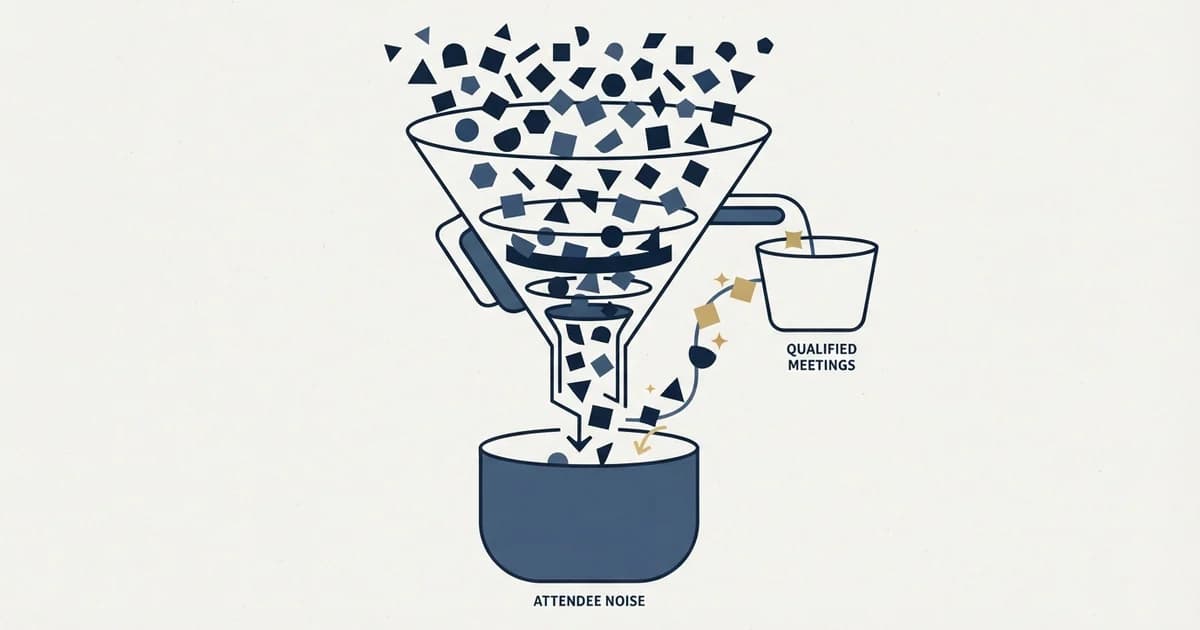
Conference lead generation is judged on fully loaded cost divided by qualified meetings actually held, not on badge scans. The meeting count is decided by working the published attendee list before the event and by screening and writing to the scanned list once afterwards, rather than at the stand.
Key takeaways
- Fully loaded cost includes travel, stand build, shipping and the selling days lost by everyone attending, which is regularly more than double the stand or ticket price.
- Badge scans are not a denominator. The only figure that supports a decision is meetings held with people who match the criteria you would apply to any other source.
- Published attendee, exhibitor and speaker lists are a dated buying signal available before the event, which is what lets meetings be booked into the diary in advance.
- Badge data is transcribed and unscreened, so screen it against your criteria and verify it before sending, or a good show becomes a bounce problem on your sending domain.
Reviewed and updated September 2, 2026
The stand cost twenty-two thousand. Two people flew out for three days, the badge scanner collected four hundred and eleven contacts, and the debrief called it a strong show. Six weeks later the pipeline review can find two opportunities that trace back to it, one of which had already been on the outbound list before anyone booked the booth.
Nobody in that story did anything wrong. The problem is that the event was funded on a total, judged on a scan count, and never divided by the only number that decides whether to go again. Conference lead generation is an arithmetic exercise wearing a logistics costume, and the arithmetic is usually done once, badly, in the week after the show.
Event marketing is the wider discipline this sits inside, and almost everything published under that name is written for the person organising the event rather than for the person trying to buy pipeline from one, which is why the arithmetic below is the part a B2B team actually needs.
The number the decision actually turns on
The complaint that cold email cannot scale to fill event attendance is usually correct and usually the wrong target, because filling seats and booking meetings at the event are different purchases and only the second one is priced by the arithmetic here.
The measure that settles whether an event earns its place is cost per booked meeting with someone who fits your criteria, calculated on the fully loaded cost of attending.
That is also the honest answer to event ROI, and the reason measuring event ROI as revenue divided by cost produces a figure nobody can audit: revenue arrives across a window long enough to contain everything else you did, while cost per qualified meeting held divides cleanly and can be set against the same budget spent in another channel.
Fully loaded is doing real work in that sentence. The stand or ticket price is the number that gets budgeted, and it is regularly less than half the true figure once travel, accommodation, shipping, stand build, giveaways and the selling days lost by everyone who went are counted. A two-person team out for three days plus a travel day has spent eight selling days, and those days had an expected output that the event has to beat.
The denominator needs the same discipline. Scans are not meetings. Conversations at a stand are not meetings. The only denominator that supports a decision is the count of meetings that actually took place with people who match the criteria you would have applied to any other source.
Collected at the stand over three days
After the list is screened the way any other list would be
A single message on the event as the reason for writing
The only denominator the cost divides by
Run the division on those invented figures against an invented fully loaded cost of thirty thousand and the event produced meetings at two and a half thousand each. That number is not automatically bad. It is only meaningful next to what the same thirty thousand produces in the channel you would otherwise have spent it in, and most teams have never computed both sides.
Why the booth is not where the number is decided
The scan count is a function of footfall, stand position and how aggressively the team collects. The meeting count is a function of who was on the list before anyone flew out, and what happened in the ten days after everyone flew home. Those are two different jobs, and the second one is chronically under-resourced because it happens when the event is emotionally over.
The strongest version of an event motion treats the event as a targeting signal rather than as a venue. Attendee, exhibitor and speaker lists are published for most conferences, and they are a list of companies who have just spent money to be in a room about the problem you solve. That is a better qualifying signal than most firmographic filters produce, and it is available before the show rather than after it. Building lists from dated signals rather than static filters is the same discipline applied to a different source.
Using a conference for prospecting is therefore a list decision rather than a travel decision, and the list exists before anyone books a flight.
Building that list ahead of time means choosing a data source, and a licensed person dataset priced for builders sits in a different category from a prospecting seat.
Event lead capture is the name the software category gives the scanning step, and naming it does not move the arithmetic: the capture is the cheap half and the screening that follows it is what turns a scanned file into a list worth writing to.
Booked meetings at events are made in advance, by writing to named people on that published list with a specific reason to meet at a specific time. The stand then becomes the place where scheduled conversations happen, and the scans become a secondary output rather than the primary one.
Prospect diaries around a show fill weeks in advance, which is what makes the pre-event window the constraint: a message sent the week before arrives at a calendar that is already spent.
- Step 1Before
Work the published attendee, exhibitor and speaker lists. Book meetings into the diary while there is still diary to book
- Step 2During
Hold the meetings that were booked. Collect scans, but treat them as an unscreened list rather than as leads
- Step 3After
Screen the scanned list against your criteria, then write once, with the event as the reason. Not a sequence
- Step 4Then decide
Divide fully loaded cost by qualified meetings held, and compare against the same spend in another channel
Trade show lead generation is the same problem with worse data

Trade show lead capture is sold as a tooling question, and the category is full of scanners, apps and integrations that promise to get badges into a CRM quickly. Speed of capture is real and it is not the constraint. The constraint is that a scan carries almost no information about intent: it records that a person walked past a stand and was willing to be scanned, which is a population containing genuine buyers, competitors, students, people who wanted the tote bag, and people who wanted to end the conversation politely.
Two habits separate a trade show list that produces meetings from one that produces a bounce rate. The first is capturing one sentence of context at the point of the scan, so the person's own words survive into the message you send afterwards rather than being reconstructed from memory in an airport. The second is screening the whole scanned list against the criteria you would apply to any purchased list before anybody writes to it, because a badge scan is a consent signal about a conversation at a stand, not a fitness signal about a buyer.
That is the correction to the instinct that an event contact is warmer than a cold one. Somebody who held a real conversation at the stand genuinely is, and the warmth belongs to the conversation rather than to the event: it is worth writing down what they said at the point of the scan precisely because that is the part which carries over. A scanned badge with no conversation behind it is a cold contact who happened to be in the building, and treating the whole scanned file as warm is how an event list gets sent unverified into the same infrastructure that carries everything else.
The bounce risk is worth naming plainly. Badge data is transcribed, sometimes from a business card, sometimes by an event contractor, and it arrives with typos, personal addresses and role-generic inboxes in it. Sending an unverified event list into the same infrastructure that carries your ordinary outbound is how a good show damages a sending domain, and what a bounce rate actually costs you is the reason to verify the file before it is loaded rather than after.
Where we differ from standard practice
The standard advice at this point is a multi-step cadence: a message the day after, a second one a few days later, a third referencing the first two. Our documented policy is one message per campaign, no bumps and no thread replies, so the post-event motion we run is a single message, and where an audience does not answer, a later approach is a separate campaign on a genuinely different premise rather than another touch in the same thread.
That constraint is less costly here than it sounds, because an event supplies exactly what a single message needs: a specific, dated, shared reference that the recipient cannot mistake for a template. The reason for writing is real, it is verifiable, and it expires, which is what makes one message enough. The templates that use an event as the reason for writing cover the pre-event and post-event shapes, and the wider set of trigger events worth writing on covers what to do when the next conference is months away.
The reasoning is mechanical rather than stylistic. A repeat message reaches the population that already saw the first one and chose not to answer, which is the population most likely to complain, and the reputation cost lands on the sending domain across every campaign running on it. The whole trade, including what the position costs us, is in why we stopped using follow-ups.
- Yes: The fully loaded cost, including selling days lost by everyone attending
- Yes: Whether the attendee, exhibitor or speaker list is published early enough to work
- Yes: Who owns the pre-event booking, by name, with time allocated
- Yes: Who screens and verifies the scanned list before anything is sent
- Yes: The comparison channel, and what the same spend produces there
- No: Judging the show on scan count
- No: Deciding the follow-up approach after everyone has flown home
One case where the arithmetic does not apply
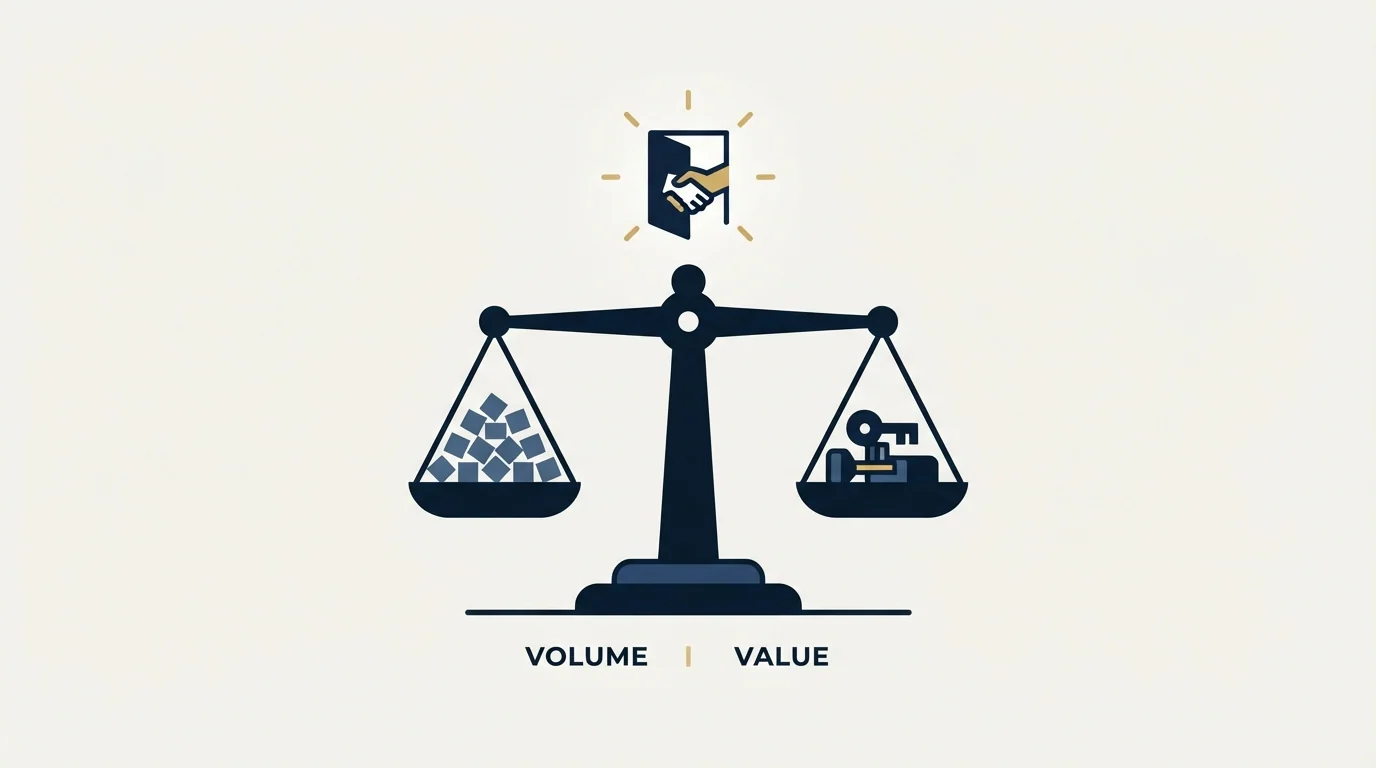
There is an honest exception, and pretending otherwise makes the whole model easy to dismiss. Some events are bought for presence rather than for pipeline: being visible where your category is discussed, being seen by people who will recommend you rather than buy from you, or holding relationships with existing customers who are all in one place for once. Those are real reasons and they do not divide into a meeting count.
The failure is not choosing that reason. The failure is choosing it retroactively, after the cost per meeting came back unflattering, which converts an unfalsifiable justification into a permanent line item. The rule that keeps it honest is to name which of the two you are buying before the invoice is signed, and to accept the consequence: a presence budget is judged on presence and should be sized like a marketing bet, while a pipeline budget is judged on qualified meetings held and should be compared against the alternatives on that basis. A single event can carry both purposes, provided the split is written down in advance and each half is measured on its own terms rather than borrowing the other's evidence when it needs cover.
Events belong in the awkward middle, and that is the honest read
Teams asking how to use existing conference attendee data for outbound are holding an asset with a shelf life, and the arithmetic above is what decides whether working it is worth the cost of doing so properly.
Channels sort usefully by how quickly they tell you anything and how much of the output you control. Cold email, calling and LinkedIn answer in days and let you pick the audience. Content and search answer in quarters and let the audience pick you. Conferences and trade shows sit in an awkward middle, and the reason they get judged badly is that they have low latency in appearance and high latency in reality: a conference produces conversations this week and revenue three quarters later, so it gets funded like outbound and evaluated like outbound, and it fails that test almost every time.
Sorting channels by how fast they answer is the frame that keeps an event from being cut for the wrong reason or defended for the wrong one. The practical consequence for event budgeting is that the comparison window has to be long enough for the event's revenue to arrive, and the same window has to be applied to whatever you are comparing it against.
The short version
Cost per qualified meeting held, on the fully loaded cost of attending, is the number that decides whether to go again. Scans are not the denominator and neither are stand conversations.
The meeting count is set before and after the event rather than at it. Published attendee, exhibitor and speaker lists let you book meetings into the diary in advance, which is what turns a stand from a lead-capture station into a venue for conversations that were already agreed.
Screen and verify the scanned list before anything is sent to it, because badge data is transcribed and unscreened, and treat the post-event approach as a single message on a real, dated reason rather than as a sequence. If the arithmetic says the same budget buys more meetings in a channel that answers in days, see what a first campaign produces.
Frequently asked questions.
Frequently asked questions- How do you measure whether a conference was worth attending?
- Divide the fully loaded cost, including selling days lost, by the number of qualified meetings actually held, then compare that figure against what the same spend produces in the channel you would otherwise have used. Scan counts and stand conversations are activity measures and they move whether or not the event produced anything.
- When should the outreach around an event happen?
- Before it, mostly. Attendee, exhibitor and speaker lists are usually published early enough to write to named people and book meetings while there is still diary available. After the event, screen the scanned list first, then write once with the event as the reason, which is a real and dated reference rather than a template.
- What about post-event follow-up sequences?
- RevenueFlow policy is one message per campaign, with no bumps and no thread replies, so the post-event motion is a single message. An event supplies exactly what one message needs: a specific shared reference the recipient cannot mistake for a template. A later approach is a separate campaign on a different premise.
- Is trade show lead capture different from conference lead generation?
- The tooling differs and the problem does not. A badge scan records that somebody walked past a stand and agreed to be scanned, which is a population containing buyers, competitors, students and people being polite. Capturing one sentence of context at the scan, then screening the file, is what separates meetings from bounces.
About the author.

B2B cold email experts helping companies generate qualified leads through done-for-you outreach campaigns.
RevenueFlow Team
Explore more.
Ready to scale your outreach?
We build GTM engines that book real meetings. See the receipts.
Related articles.
LinkedIn Outreach for Utilities: Selling to the Sector
How a vendor selling to utilities uses LinkedIn next to a published sourcing process: the three ownership models, the registration gate and what a message may ask.
SDR Outsourcing for Agriculture Companies
Whether an outside sales development team can work for a company selling into agriculture: who already covers the account, which weeks exist, and the show rule.
SDR Outsourcing for Ecommerce Software Companies
Whether bought meetings can work for a company selling software to merchants: the app store as distribution, the billing model, the data rule and the agency.
LinkedIn Outreach for Marketing Agencies
How a marketing agency wins its own clients on LinkedIn: the published agency search process, the platform rules aimed at how agencies work, and the expert buyer.
Lead Generation for Air Compressor Distributors
A compressor is bought once and its air is paid for over years. Where the accounts are published, what the buyer is told to ask, and the rule in the plant.
Appointment Setting for Manufacturers: Who a Setter May Call
For the manufacturer hiring a setter: the ranked titles to hand over, the rep and distributor map that decides which accounts may be called, and the meeting types.