Lead Generation for Air Compressor Distributors
A compressor is bought once and its air is paid for over years. Where the accounts are published, what the buyer is told to ask, and the rule in the plant.
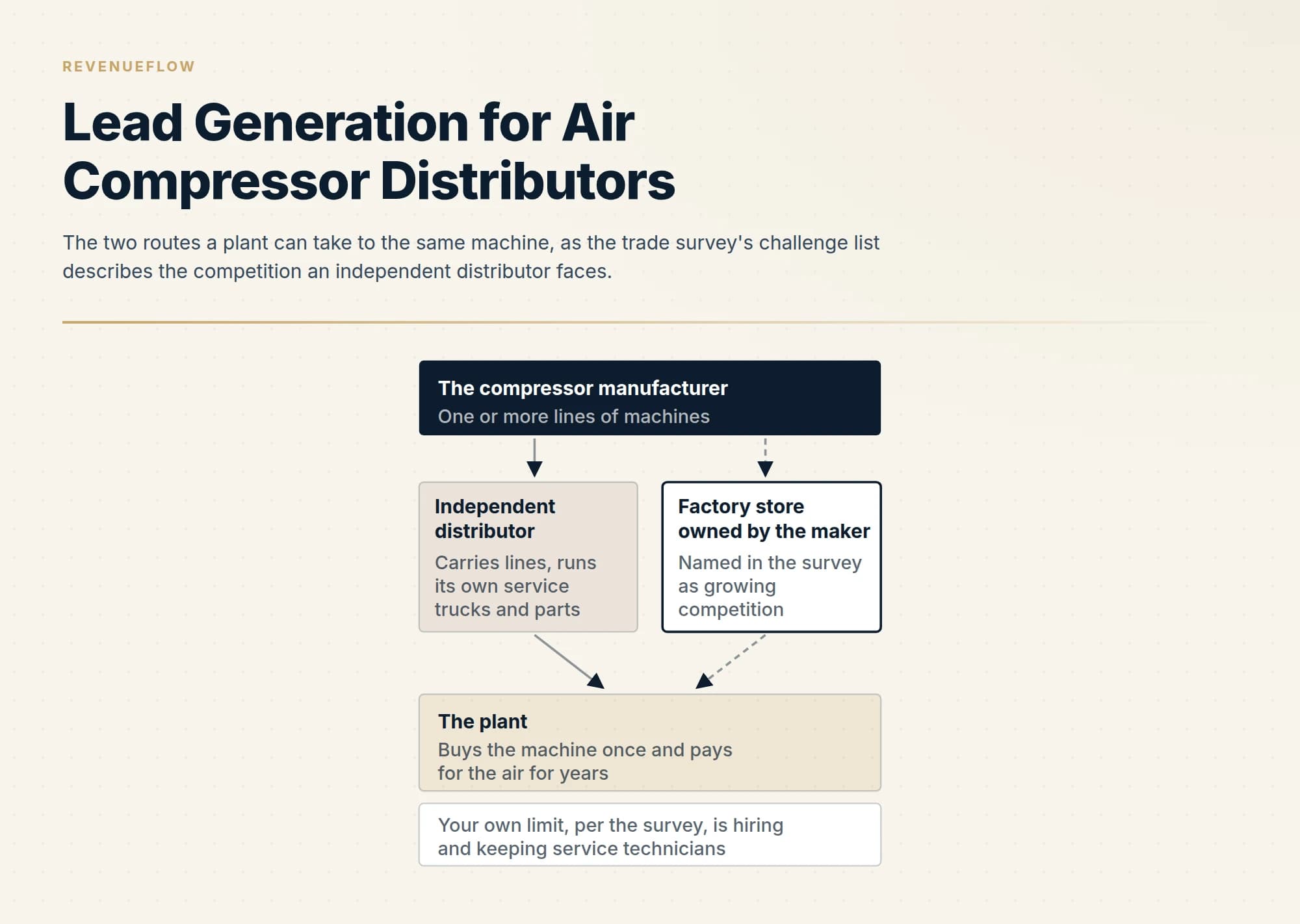
Lead generation for air compressor distributors means finding plants where energy is already a watched cost. The federal industrial assessment programme publishes both the account profile and the reason to call, the institute's verified data sheets make the comparison checkable, and the air receiver rule describes the service agreement a plant already needs.
Key takeaways
- The Compressed Air and Gas Institute states that energy is the most expensive component of the total cost of compressed air, typically costing several times more over a machine's life than its purchase price.
- The Department of Energy's industrial assessment programme publishes its eligibility conditions, which read as a target account definition, and its implementation grants run on a rolling basis with quarterly reviews.
- A trade survey of 1,951 subscribers at independent compressed air companies, answered by 89 of them in spring 2026, names hiring and keeping service technicians as the biggest challenge and factory store competition third.
- The buyer's own trade press publishes the four criteria it is told to judge a distributor on, including whether the distributor is truly independent, so an outreach message can answer them before they are asked.
Reviewed and updated September 21, 2026
An air compressor distributor sells a machine once and sells the air for twenty years, and the trade's own standards body says so in one sentence. The Compressed Air and Gas Institute, describing why it runs a third party testing programme at all, writes: "The most expensive component in the total cost of compressed air is energy. Over the life span of a typical compressor or dryer, energy typically costs several times more than the purchase price of the compressor" (CAGI, Performance Verification, read 21 September 2026). Every good lead in this business is a plant that has worked that out, or is about to.
This page is for the owner, general manager or sales director of an independent compressed air sales and service company, the kind of firm that carries one or two lines, runs its own service trucks and competes with a manufacturer's own factory store. What lead generation is and how a programme is run is on our b2b lead generation page. What follows is the part that only applies here: who is on the published lists, what a plant is told to ask you before it buys, the rule that sits inside your service agreement, and what the trade's own survey says your competitors are worried about.
What the trade's own survey says about this business
Compressed Air Best Practices magazine ran a reader survey for its twentieth anniversary issue and published the method with the results. Senior editor Troy Dreier writes that the magazine "surveyed 1,951 Compressed Air Best Practices Magazine subscribers who work for independent compressed air system sales and service companies in the United States", that the "survey was conducted over the last week of March and the first week of April 2026", and that "89 subscribers responded, representing nearly 5% of the surveyed group" (Compressed Air Best Practices, 2026 Compressed Air Distributor Sales Survey, 27 May 2026). Read it as that magazine's readers rather than as the industry, because that is what it is.
Two findings shape outreach. The first is who answered: the survey names job titles of "territory sales engineers, directors of sales and general managers", and reports that "Over two-thirds of respondents work at companies with 50 or fewer employees". The person who reads your message often owns the business.
The second is the challenge ranking. The survey reports "the biggest headache for respondents is hiring and retaining qualified service technicians", followed by "lower market pricing for lubricated rotary screw air compressors, increased competition from OEM air compressor factory stores, hiring and retaining qualified sales engineers and investment confidence levels from the customer base". The constraint is people, not demand, and the structural threat is the manufacturer selling direct.
The trade also has a body. The Association of Independent Compressor Distributors states its mission as being "the vehicle for members to share ideas, discuss business methods, and develop solutions to industry problems" and "To provide a forum for communication between industry manufacturers and members" (AICD, About Us, read 21 September 2026). Its annual show is the one date the whole distributor population meets: the magazine reports that the association "held its annual trade show in Orlando, FL, in April 2026", and quotes board member Sal Calvo, owner of Compressed AIR USA, saying "Each year, the relationships and synergies keep growing and growing. The AICD is very proud to celebrate our 40th year" (Compressed Air Best Practices, The 2026 AICD Show Report, 10 June 2026).
The account profile somebody else already published
Most verticals make you invent a target definition. This one has a public one, written by the United States Department of Energy for another purpose.
The Industrial Training and Assessment Centers programme gives small and medium sized manufacturers a no cost technical assessment carried out by university teams, and publishes exactly who qualifies: a US manufacturer, with yearly energy bills "Greater than $100,000" and "Less than $3,500,000", annual revenue less than $250M, and a site within 150 miles of a centre (ITAC, read 21 September 2026). The same page states that "The ITAC program has conducted 23,176 assessments with 170,295 associated recommendations" and that average recommended yearly savings per assessment is $144,362.
That eligibility box describes a plant that spends real money on energy and is small enough for one person to decide, which is close enough to a compressed air distributor's ideal account to use as a filter. The programme itself creates the reason to call. The site announces that manufacturers which "received an ITAC, Onsite Energy/CHP TAP, or qualified equivalent assessment since 2018 can now apply for grants for implementation of assessment recommendations" at up to half of qualifying project costs, "with a maximum of $300,000 per grant", and that the grant programme "now operates on a rolling basis and applications may be submitted at any time through the year, with quarterly reviews".
| Published condition | What it tells a distributor |
|---|---|
| A United States manufacturer | A plant rather than an office |
| Yearly energy bills above the programme floor and below its ceiling | Energy is already real money to them |
| Annual revenue under the programme ceiling | Small enough that one person decides |
| Within the distance limit of a centre | A finite list within reach of a centre |
| Assessed since the programme's stated year | A written recommendation already exists |
A recommendation the plant has in writing and has not implemented is the most honest reason to make contact this trade offers. You are quoting the plant's own report back to it and offering to do the work.
What the product standard lets you say
Two machines with the same nameplate can cost very different amounts to run, which is why the institute runs a verification programme rather than leaving performance to the brochure. CAGI describes it as "a third-party testing program that validates manufacturers' claims of rotary compressor and refrigerated dryer performance", covering "rotary air compressors (5-200HP) and refrigerated air dryers (50-1000 scfm)", and explains the standard behind it: for displacement compressors "ISO 1217, Displacement Compressors - Acceptance Tests is the recognized performance standard", with CAGI and Pneurop's Simplified Test Codes incorporated as appendices, so that "CAGI members agreed that published performance of their products would be based on the Simplified Test Codes" (CAGI, Performance Verification, read 21 September 2026).
For outreach that means a distributor carrying a participating line has a comparison the buyer can check, and a reason to write that is about the buyer's electricity bill rather than about the distributor.
The rule that already sits in the plant
An outreach message in this trade does not need to teach anyone a regulation, because the plant is already subject to one, and the service side of a distributor's business is how the plant meets it.
The federal rule on air receivers applies, in its own words, "to compressed air receivers, and other equipment used in providing and utilizing compressed air for performing operations such as cleaning, drilling, hoisting, and chipping". It requires that receivers "be so installed that all drains, handholes, and manholes therein are easily accessible" and that "Under no circumstances shall an air receiver be buried underground or located in an inaccessible place"; that "A drain pipe and valve shall be installed at the lowest point of every air receiver to provide for the removal of accumulated oil and water" and that the drain valve "shall be opened and the receiver completely drained frequently"; and that "Every air receiver shall be equipped with an indicating pressure gage (so located as to be readily visible) and with one or more spring-loaded safety valves" (29 CFR 1910.169). New receivers are to be constructed to the edition of the ASME Boiler and Pressure Vessel Code Section VIII that the rule incorporates by reference.
Name it as the plant's obligation, never as legal advice and never as a claim that anyone is out of compliance. A maintenance agreement covering draining, gauge checks and safety valve condition is a service against a duty the buyer already carries.
The rule on the message belongs to the sender. Commercial email under United States law must carry identification as an advertisement, "clear and conspicuous notice of the opportunity" to decline further messages, and "a valid physical postal address of the sender" (15 U.S.C. 7704), with the Federal Trade Commission's rule at 16 CFR Part 316. The same section makes address harvesting from websites by automated means unlawful, which is a reason to build a territory list from named plants rather than from a scrape.
What the buyer is told to ask you
The trade press writes for the plant as well as for the distributor, and one such article is effectively a published objection list. Compressed Air Management's guide to selecting a distributor tells buyers that "Some distributors may not have the capabilities to provide the service you need; they may not carry sufficient inventory and could be locked into a single brand", and sets four criteria: expertise, customer service, services offered and project management (Compressed Air Management, How to Select an Air Compressor Distributor, read 21 September 2026).
Two of its questions are the ones an outreach message should answer before it is asked. On services it tells the buyer to ask: "If they say they do audits, do they define what these projects involve?" On independence it asks: "Are they truly independent, or are they focused on selling services pushed by particular compressor manufacturers?"
Expertise
The guide warns that some distributors may not have the capabilities to provide the service the buyer needs. Name work you have done in their own process.
Customer service
The second of the four criteria the guide sets. Answer it with what your service actually is, and make no claim about results.
Services offered
The guide asks, if they say they do audits, do they define what these projects involve. Say what your audit involves in the message.
Project management
The fourth criterion. The guide also warns that a distributor may be locked into a single brand, which is its independence question.
The calendar, and what we could not source
The association's show ran in Orlando in April 2026 on the magazine's report, so the weeks before it are a reason to write to distributors as peers. The federal grant route is open on a rolling basis with quarterly reviews, which makes it usable at any point in a quarter.
We looked for a published source on when manufacturing plants buy compressed air equipment across a year and did not find one worth citing, so none is given here. Your own service call history by month is the better guide, and it is specific to your territory.
When outbound is the wrong play here
Three cases. A plant locked into a full service agreement with a competitor is not a prospect until the agreement's term is in view, and the first conversation should establish that date rather than argue. An account inside a manufacturer's own factory store territory may be closed to you by the terms of your own line, which is a question for your line agreement before it is a question for a campaign. And a plant with one small reciprocating machine in a maintenance shop is a parts customer, not a system sale.
This is also a trade where the phone and the site visit do the closing. We do not cold call, so the honest description of the written side is this: email and LinkedIn get the first conversation with a named plant engineer, and your service manager does the rest on site. One message per campaign, no bump sequences behind it, and a later approach is a new campaign with a new reason.
Three reasons to write, each from a source above
Three first lines, each tied to one fetched source. None claims a result, names a real person as a recipient or carries contact details.
To a plant engineer at a manufacturer that took a federal assessment. The Department of Energy's assessment programme reports more than 170,000 recommendations across its assessments, and its implementation grants now run on a rolling basis at up to half of project cost. If compressed air was on your report and the work is still open, we can quote the recommendation as written. The figures and the grant terms are the programme's own.
To a maintenance manager buying a replacement machine. The Compressed Air and Gas Institute publishes verified data sheets under ISO 1217 for rotary compressors from five to two hundred horsepower, so two machines can be compared on tested numbers rather than brochures. We can put the data sheets for the two you are weighing side by side. The standard and the programme are the institute's own.
To an operations lead at a plant with older receivers. The federal rule on air receivers requires a drain at the lowest point, a readily visible pressure gauge and spring-loaded safety valves, and that the receiver be drained frequently. A service agreement that covers those checks is what we would want to talk about. The requirement is quoted from the rule.
To: Plant engineer at a small manufacturer with a federal assessment on file
The Department of Energy's assessment programme reports more than 170,000 recommendations across its assessments, and its implementation grants now run on a rolling basis at up to half of project cost. 1
If compressed air was on your report and the work is still open, we can quote the recommendation as written. 2
Postal address and the line to decline further messages in the footer. 3
- 1Two figures from the programme's own page, which the reader can check in a minute.
- 2The ask is the plant's own document, so it is a service rather than a pitch.
- 3The postal address and the notice of the opportunity to decline that the statute requires of commercial email.
The short version
Lead generation for air compressor distributors is the work of finding plants where energy is already a watched line, and of arriving with something the plant can verify. The federal assessment programme publishes the profile and creates the reason. The institute publishes the data sheets that make the comparison checkable. The receiver rule describes the service you already sell. The buyer's own trade press tells you which four questions to answer before they are asked. Your competitors, by their own survey, are short of technicians and worried about the factory store, which is an argument for a written motion that does not consume a service day.
The distribution neighbours of this market are covered elsewhere on the site: the general distributor's version is in cold email for wholesale distribution, the foodservice version in lead generation for food distributors, and the plant side of the same buyer in manufacturing lead generation. Whether a first meeting is worth the hour at all is the question in appointment setting versus lead generation.
The way RevenueFlow runs it: email and LinkedIn, one message per campaign, qualification criteria agreed in writing before the first send, and payment on attended meetings that meet them. If the written side of your territory work is the part you would rather hand over, you can see what a campaign would look like for your territory.
Every page linked above was fetched on 21 September 2026 from the address shown. The survey figures are Compressed Air Best Practices Magazine's own, from its stated sample of its own subscribers, and are not a population estimate. Rules change; confirm them at the source. Nothing here is legal advice.
Sources: CAGI, Performance Verification, CAGI, AICD, About Us, Compressed Air Best Practices, 2026 Compressed Air Distributor Sales Survey, Compressed Air Best Practices, The 2026 AICD Show Report, ITAC, 29 CFR 1910.169, 15 U.S.C. 7704, 16 CFR Part 316, Compressed Air Management, How to Select an Air Compressor Distributor
Frequently asked questions.
Frequently asked questions- Where do air compressor distributors find new industrial accounts?
- From records that name plants rather than from generic business lists. The Department of Energy's industrial assessment programme publishes the profile of the manufacturers it serves, including energy spend bands, a revenue ceiling and a distance limit from a centre, and a plant assessed under it already holds a written recommendation. Trade association rosters and the association's own show cover the peer side.
- What should the first message to a plant engineer say?
- Something the reader can check in a minute. A federal assessment recommendation the plant already holds, a verified performance data sheet for the two machines being compared, or the air receiver duties the plant is already subject to. Avoid claims about results, keep the ask to one conversation, and carry the postal address and opt out line that commercial email requires.
- Does the air receiver rule apply to the distributor or to the plant?
- To the plant that operates the equipment. The federal rule requires an accessible installation, a drain pipe and valve at the lowest point, frequent draining, a readily visible pressure gauge and one or more spring loaded safety valves. A distributor's maintenance agreement is how many plants meet those duties, which is why it is a legitimate subject for outreach rather than legal advice.
- When is outbound the wrong play for a compressor distributor?
- When the plant is inside a competitor's live full service agreement and the term is not in view, when the account sits in a territory your own line agreement closes to you, and when the site is a single small reciprocating machine in a maintenance shop. That last one is a parts customer rather than a system sale, so the reach cost is better spent elsewhere.
About the author.

B2B cold email experts helping companies generate qualified leads through done-for-you outreach campaigns.
RevenueFlow Team
Explore more.
Ready to scale your outreach?
We build GTM engines that book real meetings. See the receipts.
Related articles.
SDR Outsourcing for Agriculture Companies
Whether an outside sales development team can work for a company selling into agriculture: who already covers the account, which weeks exist, and the show rule.
LinkedIn Outreach for Utilities: Selling to the Sector
How a vendor selling to utilities uses LinkedIn next to a published sourcing process: the three ownership models, the registration gate and what a message may ask.
Lead Generation for EHR Vendors: A Replacement Market
Adoption is close to complete, so every deal is a switch. Where the incumbent field is published, which rules shape the pitch and who actually signs.
SDR Outsourcing for Ecommerce Software Companies
Whether bought meetings can work for a company selling software to merchants: the app store as distribution, the billing model, the data rule and the agency.
LinkedIn Outreach for Marketing Agencies
How a marketing agency wins its own clients on LinkedIn: the published agency search process, the platform rules aimed at how agencies work, and the expert buyer.
Lead Generation for Field Service Software Companies
Your market is a set of separately licensed trades, not one industry. Where each can be enumerated, what the credential says, and the rule on calling mobiles.