Lead Generation for Field Service Software Companies
Your market is a set of separately licensed trades, not one industry. Where each can be enumerated, what the credential says, and the rule on calling mobiles.
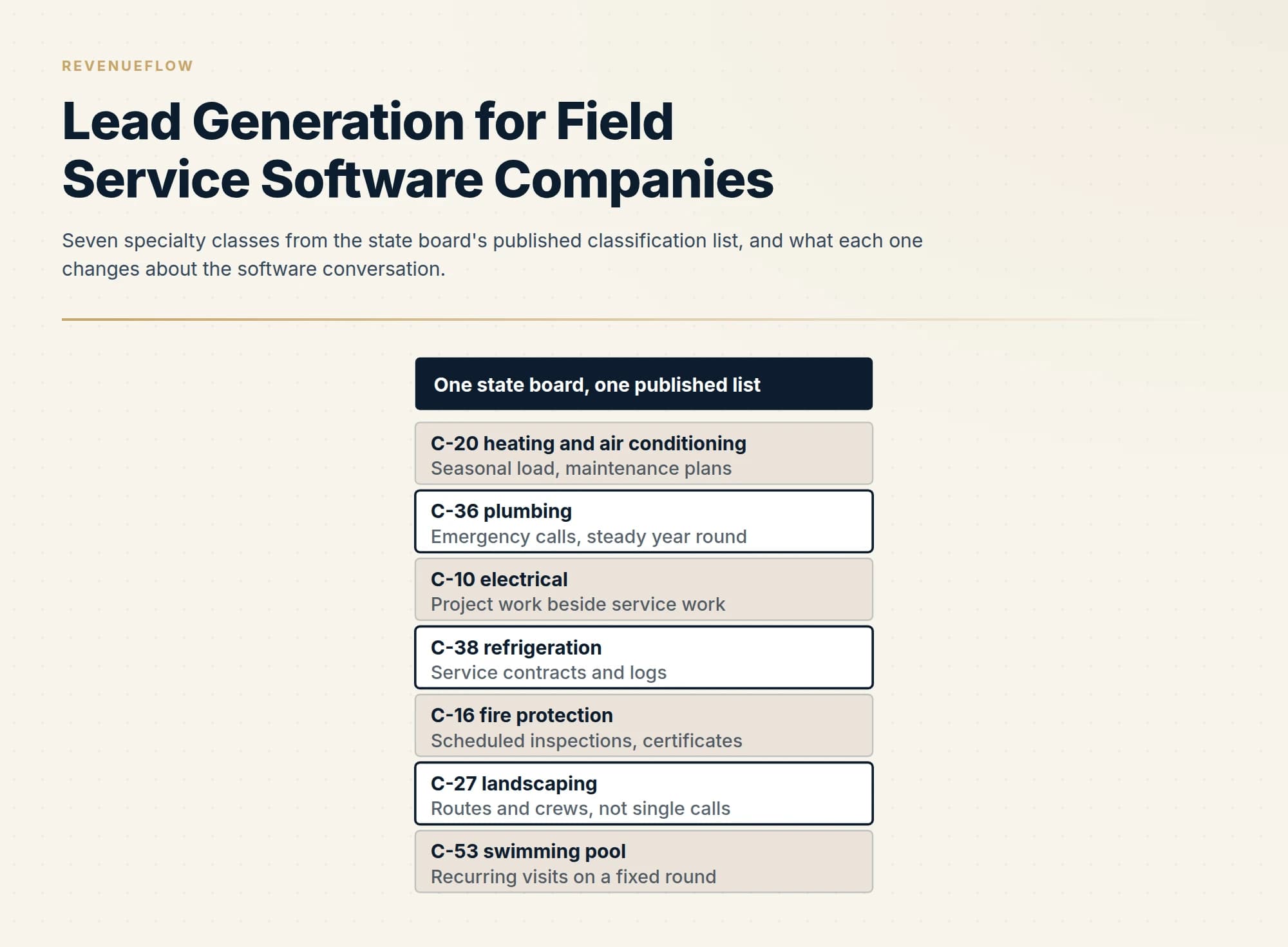
Lead generation for field service software companies is trade by trade work. Where a state licenses contractors by class, the published class list is both the segmentation and the enumeration, each class implying a different conversation. Technician certification and national association membership fill in crew size and buying readiness.
Key takeaways
- A state that licenses contractors by class publishes the market: warm air heating and air conditioning, plumbing, electrical, refrigeration, fire protection, landscaping and swimming pool are separate classes with separate conversations.
- Licensing regimes differ by state and trade, so a trade you cannot enumerate from a register has to be reached through its association and its show, and the list should be described as partial.
- Federal rules require technicians servicing equipment that could release ozone depleting refrigerants to be certified under Core and Types 1, 2 and 3, which is the closest published proxy to a crew size for those trades.
- Because a small contractor's business number is often a mobile, the federal rule on automatic dialing systems and prerecorded voice calls to wireless numbers is the one a dialer aimed at owner operators runs into first.
Reviewed and updated September 21, 2026
A field service software company does not sell into one industry. It sells into a set of trades that happen to share a scheduling problem, and those trades are regulated separately, licensed separately and counted separately. That is the fact that decides whether your target list can be built at all, and it is the first thing a generic lead generation programme gets wrong.
This page is for the head of sales or marketing at a company selling field service management software to contractors: dispatch, work orders, technician scheduling, invoicing from the van. Lead generation in general is on our b2b lead generation page. What follows is what changes when your buyers are licensed tradespeople rather than software teams.
Your addressable market is a set of licence classes
In a state that licenses contractors by trade, the register is the market. California's board publishes its classifications straight out of the statute, which provides that "For the purpose of classification, the contracting business includes any or all of the following branches", and then lists them: a general engineering contractor, a general building contractor, a residential remodelling contractor, and a long list of specialty classes (Contractors State License Board, Licensing Classifications, read 21 September 2026).
Read that list as a segmentation of your own market. The classes a field service platform sells into sit in it by name and number: C-20 for warm-air heating, ventilating and air-conditioning, C-36 for plumbing, C-10 for electrical, C-38 for refrigeration, C-16 for fire protection, C-27 for landscaping and C-53 for swimming pools. Each is a different product conversation, because each class works a different week. Heating and air conditioning carries a seasonal load and sells maintenance plans against it. Plumbing takes emergency calls and runs steady year round. Electrical puts project work beside service work. Refrigeration lives on service contracts and compliance logs. Fire protection is scheduled inspections with certificates attached. Landscaping is routes and crews rather than single calls, and swimming pool work is recurring visits on a fixed round.
Licensing regimes differ by state and by trade, so the same class-based enumeration is not available everywhere. Check each state you sell into before promising a territory plan that assumes it. Where no register exists, reach the trade through its association and its show instead, and say plainly, inside your own team, that the list is partial. A list described as complete when it is not is how a territory target gets set on a number nobody can hit.
The credential that tells you how big the crew is
One trade publishes a technician level credential that a software seller can reason from. Federal rules "under Section 608 of the Clean Air Act require that technicians who maintain, service, repair, or dispose of equipment that could release ozone depleting refrigerants into the atmosphere must be certified", under types the agency lists as Core, Type 1 for small appliances, Type 2 for high pressure and Type 3 for low pressure. The agency adds a detail worth knowing before anyone writes about it: "EPA does not issue certification cards", which are issued by certifying organisations instead (EPA, Section 608 Technician Certification, last updated 3 March 2026).
For a platform priced per technician, that certification is the closest thing this market has to a published seat count for the refrigerant trades, and the type tells you what kind of equipment the crew touches.
| Certification type | What the agency names it for |
|---|---|
| Core | Listed first, ahead of the three equipment types |
| Type 1 | Small appliances |
| Type 2 | High pressure equipment |
| Type 3 | Low pressure equipment |
Who the buyer is, and where they already gather
The trade associations are the other census. The Air Conditioning Contractors of America describes itself as "the only nationwide, non-profit association for professionals that install and maintain HVACR, indoor environment and building performance systems", and puts its scale at "60,000 professionals - over 3,000 company members" to whom it provides "networking opportunities, education, and advocacy services that support their business development interests" (ACCA, About, read 21 September 2026).
A company member of a national association is a contractor investing in the business rather than simply running it, which is the difference between a prospect and a name. Association membership is also a field a list can carry, and unlike most firmographic tags it is published by the organisation itself.
The other gathering is the trade show. The AHR Expo, which bills itself as the event for HVACR, lists its 2027 edition as McCormick Place, Chicago, January 25 to 27 (AHR Expo, read 21 September 2026). The weeks before a show are a reason to write to contractors who will attend, and the weeks after are when a contractor has just seen what the alternative looks like.
We looked for a published source on cross trade buying seasons for field service software and did not find one worth citing, so none is given here. The seasonal read for one trade, heating and air conditioning, is set out in cold email for HVAC companies; the rest of your market does not share that shape, and your own win data by month is a better guide than any generalisation.
The enumeration question, trade by trade
Before a campaign is built, one question decides the method for each trade in the plan.
Two rules, one on your message and one your buyer will raise
The rule on your message is the ordinary one. Commercial email must carry identification as an advertisement, "clear and conspicuous notice of the opportunity" to decline further messages, and "a valid physical postal address of the sender" (15 U.S.C. 7704), with the Federal Trade Commission's rule at 16 CFR Part 316.
The rule that matters more in this market governs the phone, because a small contractor's published business number is very often a mobile. Federal rules say no person or entity may "initiate any telephone call (other than a call made for emergency purposes or is made with the prior express consent of the called party) using an automatic telephone dialing system or an artificial or prerecorded voice" to, among other lines, "any telephone number assigned to a paging service, cellular telephone service, specialized mobile radio service, or other radio common carrier service, or any service for which the called party is charged for the call" (47 CFR 64.1200).
Say what the rule says and link it, without calling any practice compliant. It is also a question your buyer will ask you, because a field service platform that sends appointment reminders to a contractor's customers is sending on the contractor's behalf, and the contractor's own exposure is the reason the question comes up on a demo.
When this is the wrong play
Three cases. A trade you cannot enumerate in a state and cannot reach through an association is a trade to postpone rather than to approximate with a scraped map listing. A contractor under ten technicians may be running on a phone and a notebook and buying nothing this year, which is a segment decision rather than a message problem. And a national roll up that has standardised on a platform across acquired brands is a procurement cycle, not an outbound conversation, until the renewal is in view.
The adjacent market of managed IT service providers, which has the same recurring service shape and a different buyer, is covered in MSP lead generation services. RevenueFlow runs email and LinkedIn: one message per campaign, criteria agreed in writing before the first send, no bumps, and a later approach is a new campaign with a new reason.
Three reasons to write, each from a record
To the owner of a licensed refrigeration contractor. Your licence class is on the state board's register, which is how we built this territory list rather than buying one. The service contract side of that class is what our scheduling and logs were designed around, and twenty minutes would tell you whether that is true. The register and the class list are the board's own.
To an operations manager at an association member company. Your firm is a company member of the national contractors association, which usually means the business is being built rather than just run. What we would want to know is which part of dispatch is costing you technician hours this season. The membership category is the association's own.
To a contractor before the trade show. The industry's expo is in Chicago in late January, and every platform in this market will be on that floor. If you would rather see one properly than six briefly, we can do it the week before. The dates are the organiser's own.
The line
The industry's expo is in Chicago in late January, and every platform in this market will be on that floor.
What it rests on
A date published by the organiser, which the reader can check and probably already has in the diary.
The line
If you would rather see one properly than six briefly, we can do it the week before.
What it rests on
The ask trades on the reader's own scarce attention at the show rather than on a claim about the product.
The footer
Postal address and the line to decline further messages.
What it rests on
The postal address and notice of the opportunity to decline that commercial email must carry.
The short version
Lead generation for field service software companies is trade by trade work, not industry work. Where a state licenses by class, the class list is your segmentation and your enumeration at once, and each class implies a different conversation. The refrigerant technician certification is the closest thing to a published seat count for the trades it covers. The national association publishes its own company membership, which is a better readiness signal than most bought firmographics. The expo gives you a date. And the rule on calling mobile numbers is worth understanding before a dialer is pointed at a list of owner operators.
The single trade version of the writing problem is in cold email for HVAC companies; the maintenance and facilities buyer, who buys a neighbouring product, is in cold email for maintenance; and what an agency actually delivers for a small software company is examined in lead generation companies for small business.
The way RevenueFlow runs it: email and LinkedIn, one message per campaign, qualification criteria agreed in writing before the first send, and payment on attended meetings that meet them. If the list work and the sending are the parts you would rather hand over, you can see what a campaign would look like for your market.
The board's classification page, the federal certification page, the association page, the expo site and the rules were fetched on 21 September 2026 from the addresses linked. The association's figures are its own description of its membership. Licensing differs by state and by trade; confirm each one at its own board. Rules change; confirm them at the source. Nothing here is legal advice.
Sources: Contractors State License Board, Licensing Classifications, EPA, Section 608 Technician Certification, ACCA, About, AHR Expo, 15 U.S.C. 7704, 16 CFR Part 316, 47 CFR 64.1200
Frequently asked questions.
Frequently asked questions- How does a field service software company build a contractor list?
- From state licence registers where the trade is licensed by class, since the class is both the segment and the enumeration. Add association company membership, which the associations publish themselves and which signals a business being invested in rather than simply run. For a trade with no published register, reach it through its association and its show and say the list is partial.
- Are all the trades that use field service software licensed?
- No, and this is the planning question rather than a detail. Licensing differs by state and by trade, so the same class based enumeration is not available everywhere. Check each state you sell into before promising a territory plan that assumes a register exists, and treat an unenumerable trade as one requiring a different method.
- What does refrigerant technician certification tell a software seller?
- Federal rules require technicians who maintain, service, repair or dispose of equipment that could release ozone depleting refrigerants to be certified, under types covering small appliances, high pressure and low pressure equipment. For a platform priced per technician that is a published proxy for seat count, and the type indicates what equipment the crew works on.
- Which rule applies to calling contractors on their mobiles?
- The federal rule prohibiting calls using an automatic telephone dialing system or an artificial or prerecorded voice, without prior express consent, to numbers assigned to cellular and similar services. Small contractors often publish a mobile as the business line, so a dialer aimed at owner operators meets this first. State the rule, link it, and never call a practice compliant.
About the author.

B2B cold email experts helping companies generate qualified leads through done-for-you outreach campaigns.
RevenueFlow Team
Explore more.
Ready to scale your outreach?
We build GTM engines that book real meetings. See the receipts.
Related articles.
Lead Generation for EHR Vendors: A Replacement Market
Adoption is close to complete, so every deal is a switch. Where the incumbent field is published, which rules shape the pitch and who actually signs.
Lead Generation for Air Compressor Distributors
A compressor is bought once and its air is paid for over years. Where the accounts are published, what the buyer is told to ask, and the rule in the plant.
B2B Lead Lists for POS Companies: Two Products, One Phrase
Three things are sold under this phrase and only one is a list. What a merchant row must carry, which public record holds each field, and what to verify.
B2B Lead Lists for Collection Agencies: Fields and Sources
What a creditor prospect list needs for a collection agency: the fields that matter, the FDIC, NCUA, CMS and court sources behind them, and the rules that apply.
Cold Calling for Consulting Firms: The Partner's Hour
Cold calling for a consulting firm: who it dials and who picks up, why partner-led economics argue against the phone, the client's fiscal year, and when to skip it.
Cold Calling for Chemical Companies: Who Picks Up
A chemical cold call rarely arrives first. It reaches a formulator who has already been comparing suppliers on a screen, for one of three published reasons.