Lead Generation Companies for Small Business: The Arithmetic
Tooling costs tens of dollars a month, so it is never the reason outbound is out of reach. The published vendor floors, and the calculation that decides the channel.
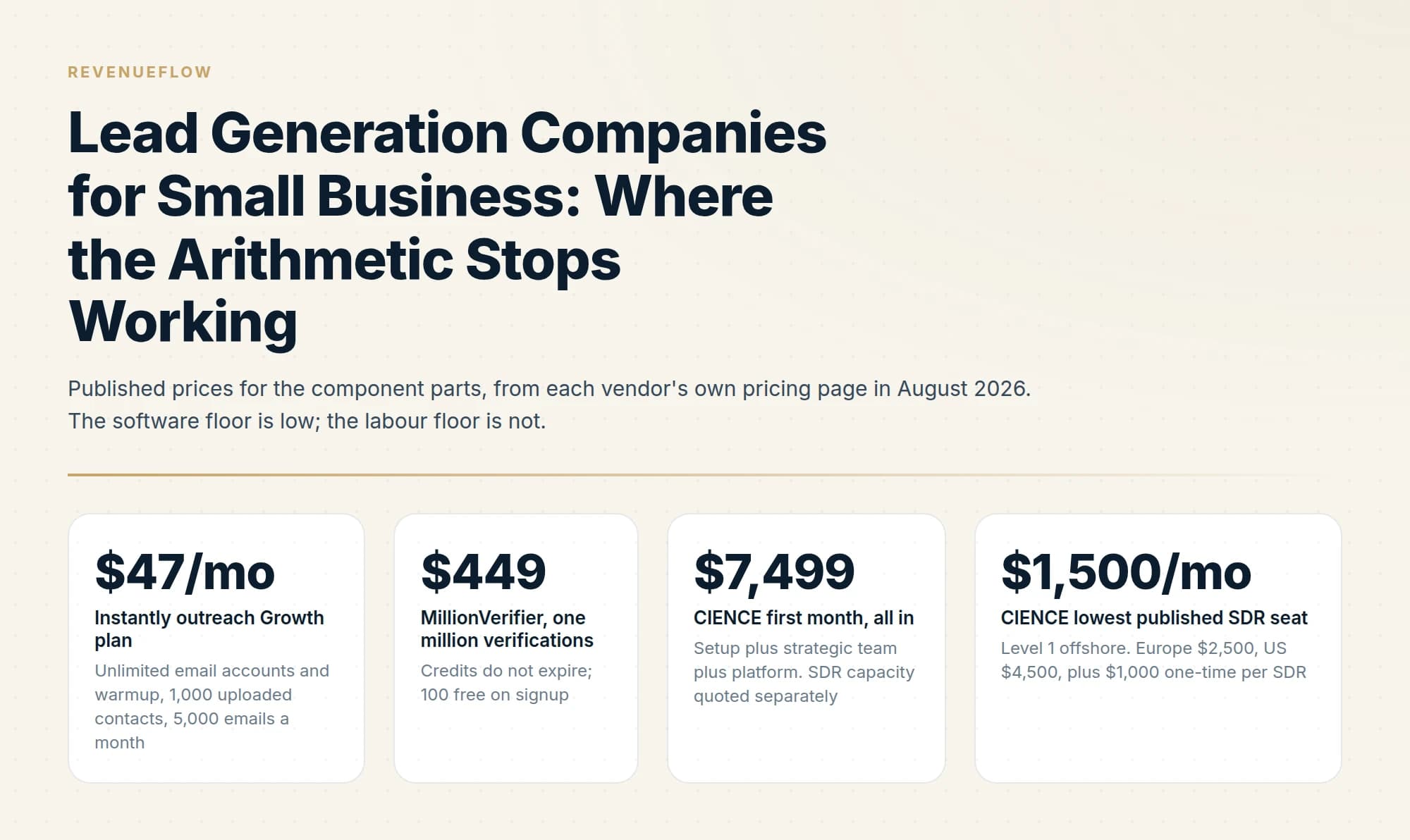
Lead generation tooling is cheap: a sending platform runs from $47 a month and a million email verifications cost $449. Agency minimums are the price of a person, with CIENCE listing $7,499 for a first month before any SDR seat. Decide by calculating the most a meeting can be worth to you.
Key takeaways
- The software floor is low. Instantly's outreach plan is $47 a month and MillionVerifier sells a million verifications for $449, so tooling is not the constraint that puts outbound out of reach.
- Vendor minimums price a person, not a platform. CIENCE publishes $7,499 for a first month before SDR capacity, with its cheapest listed seat at $1,500 a month offshore plus $1,000 one-time recruitment.
- Retainers ask a small business to finance a ramp from a budget with no slack, which is what produces the month-three cancellation. Per-outcome pricing moves that financing to the vendor.
- Run the ceiling calculation first: gross profit per deal times close rate from a first meeting, divided by your payback multiple. If the ceiling is below market rates, raise price before shopping for a cheaper vendor.
Reviewed and updated September 1, 2026
CIENCE publishes its entry cost openly: a one-time GTM setup sprint at $5,000, a strategic team at $2,000 a month and the graph8 platform licence at $499 a month, which the page adds up to $7,499 for the first month with SDR capacity quoted separately on top. A ten-person company with a $2,000 monthly marketing budget reads that and concludes outbound is not for them.
The conclusion is often right. The reasoning usually is not, and getting the reasoning right changes what you do next.
The tooling is not what stops you
The intuitive story is that outbound has a high fixed cost base: domains, mailboxes, data, verification, a sending platform. Buy the components at their published prices and that story falls apart almost immediately.
Instantly's outreach Growth plan is $47 a month and includes unlimited email accounts, unlimited warmup, 1,000 uploaded contacts and 5,000 emails a month. Its bundled Starter tier, which adds credits and lead database access, is $94 a month, or $85 a month billed annually. MillionVerifier sells one million verifications for $449, with credits that do not expire and 100 free to start, so verifying a few thousand addresses a month is a rounding error. On top of that sit domain registrations, billed annually per domain, and a mailbox subscription charged per user per month by whichever mailbox provider you use.
The two published components above come to under $100 a month for a small programme, and the mailbox count is the only line that scales with ambition. That is not the binding constraint on a small business, and treating it as one leads people to spend their planning energy on the cheapest possible stack when the stack was never the problem.
Unlimited email accounts and warmup, 1,000 uploaded contacts, 5,000 emails a month
Credits do not expire; 100 free on signup
Setup plus strategic team plus platform. SDR capacity quoted separately
Level 1 offshore. Europe $2,500, US $4,500, plus $1,000 one-time per SDR
What actually costs money is the hours. Somebody has to decide who to target and why, write copy that a stranger would answer, read every reply, book the meetings and then chase the ones that go quiet. That work does not compress below roughly five to ten hours a week for a live campaign, and it is skilled work rather than administrative work. Whether you buy those hours from an agency or take them out of a founder's week, they are the real line item.
Because the hours themselves are the real expense, choosing tools that actually save time matters more than comparing subscription prices.
That is why the vendor floor sits where it does. CIENCE's published SDR capacity starts at $1,500 a month for a level one offshore seat and rises to $4,500 for a US seat at the same level, plus a $1,000 one-time recruitment charge per SDR. Those are the prices of a person, and a person is what you are buying.
What the agency floor is made of

Vendors set their minimums to cover a fixed team cost that exists whether your programme is big or small, and the shape of that minimum matters more than the monthly number.
Belkins runs a distinct small-business tier, described on its plans page as a budget-friendly solution for lean teams delivered through partnering agencies from the Belkins ecosystem, with 30 or more yearly appointments against 100 or more for its Growth tier. Two useful signals sit in that sentence. The economics only work at that size when delivery moves to a partner, and the commitment is expressed as a yearly count, so the unit of purchase is a year rather than a month.
Martal structures the start as a three month pilot campaign followed by a monthly subscription at a flat fee per month, quoted on inquiry. Whatever the monthly figure turns out to be, your real commitment is three times it before you can walk away. SalesHive takes the opposite position, publishing no setup fee, no long-term contract and cancellation on written notice, with the quote set by team model, channel mix and a daily touch volume of 150, 250 or 500 plus.
For a business with slack in the budget, a three month pilot is a reasonable ask given how long ramp genuinely takes. For a business without slack, it is the whole decision, because the pilot has to be funded from money you already needed for something else. The full picture of what sits inside a retainer and what the ranges look like is in the lead generation agency cost guide, and the delivery models those prices attach to are laid out in B2B lead generation services.
Why the retainer shape fits badly at your size
Here is the structural mismatch, and it has nothing to do with any vendor being greedy.
A retainer asks you to pay for effort during a period when there is nothing to show for it. Domains warm, lists get built, the first messages go out at deliberately low volume, replies start arriving weeks in, and the first meetings land after that. Somebody has to finance that stretch. In a company with a marketing budget that has slack in it, financing a ramp is a normal thing to do. In a company where the outbound budget is the entire discretionary spend for the quarter, the ramp is funded by money that was doing something else, and the pressure to see results early is enormous.
That pressure is what actually kills small-business outbound engagements. The programme gets judged at week six on a signal that is not yet real, the buyer concludes it is not working, the retainer is cancelled at month three, and both sides remember it as a failed vendor relationship. The arithmetic never got a chance to be right or wrong.
A per-outcome arrangement moves that financing to the vendor's balance sheet. You pay when a meeting happens, which means the ramp is not your problem and there is no month where you are paying for setup. The trade is that you give up control over how the work is done and you take on a different job entirely: writing and adjudicating the definition of what counts as a meeting. That is a real job, and it is covered properly in pay-per-appointment B2B.
- Somebody has 5 to 10 real hours a week, every week
- That person can write and can read a reply properly
- Tooling runs in the low hundreds a month at published prices
- You keep the domains, the data and everything you learn
- Fails when the hours are notional rather than blocked out
- No setup period funded out of your budget
- The vendor finances domains, data and the weeks before replies
- Your job becomes writing and adjudicating the definition
- Costs more per meeting than a retainer would at volume
- Fails when you cannot describe a good meeting in writing
- Deal value times close rate cannot support a cost per meeting
- Referrals and inbound are cheaper per conversation at your size
- Revisit when price rises or the close rate improves
- Not a permanent verdict, a sequencing decision
- Fails only if you never revisit it
The arithmetic that decides whether to do it at all
Every other question is downstream of one number: the most you can pay for a meeting and still be ahead.
The method has three inputs you already have. Take the gross profit on a typical deal rather than the headline contract value, because gross profit is the money that actually pays for acquisition. Take the share of first meetings that become customers, measured over enough meetings to mean something. Multiply those together and you get the gross profit a single meeting is worth on average. Then decide what multiple of that you are prepared to spend, which is a payback decision rather than a maths one.
Worked as an illustration with round numbers, and these are invented for the demonstration rather than drawn from our engagements or anybody's published data: a business with $6,000 of gross profit per deal that closes one meeting in ten is generating $600 of gross profit per meeting. At a three-times payback target, the ceiling is $200 per meeting. Run the same illustration with $600 of gross profit per deal, which is common in small local services, and the ceiling drops to $20 a meeting, which no human-delivered outbound programme can hit.
Do that calculation before you speak to anybody. If the ceiling lands well below what per-meeting pricing costs in your market, the answer is that cold outbound is the wrong channel at your current deal size, and the useful move is raising price or packaging up rather than shopping for a cheaper vendor. If the ceiling is comfortably above it, you have a budget number to negotiate against instead of a feeling.
That ceiling is also the honest answer to two objections that sound different and are the same objection. The model suits larger companies better is true in the narrow sense that a larger contract value raises the ceiling and therefore tolerates a higher cost per meeting; it is false as a claim about company size, because a small company selling a high-value engagement clears the ceiling comfortably. Where a service does not fit your price point, the ceiling calculation is what shows it, and it shows it before you have spent anything rather than in month three.
- Step 1Gross profit per deal
Not contract value. The money left after delivery cost is what pays for acquisition.
- Step 2Close rate from a first meeting
Measured across enough meetings to be a rate rather than an anecdote.
- Step 3Multiply
That is the average gross profit one first meeting is worth to you.
- Step 4Divide by your payback multiple
A payback decision rather than a maths one. The result is your ceiling per meeting.
Two adjustments make it more honest. Include expansion and renewal revenue if your customers reliably stay, because a first-year-only view understates what a meeting is worth. And use gross profit rather than revenue, since a services business paying out most of a contract in delivery cost has far less room than the top line suggests.
What running it yourself actually involves
If the hours exist, this is frequently the right answer at small scale, and it is worth being concrete about what it means rather than romantic about it.
You need a small number of sending domains separate from your main company domain, mailboxes on them, authentication configured correctly, and a warmup period before real volume. You need a list you built deliberately rather than bought in bulk, verified before sending. You need one message per campaign that says something specific enough that a stranger can tell why it arrived. And you need somebody reading replies daily, because the value of a reply decays fast.
We send one message per campaign and never bump a non-replier inside the same campaign. Re-approaching someone who did not answer means a new campaign with a genuinely different angle, at a later date, and the discipline matters more at small volume than at large volume because a small sending estate cannot absorb the complaints that pestering generates. Answering somebody who did reply, or who booked and then went quiet, is ordinary correspondence and is not the same thing at all.
What you are trading is founder attention, which is the scarcest input in a small business. The honest test is whether the hours are already blocked in a calendar. If they are aspirational, buy the outcome instead. Cold email agency covers what an agency does with those hours and when hiring one is the wrong purchase, and outsourced SDR vs in-house runs the same trade at the point where hiring becomes an option.
The short version

The component prices are published and they are low, so tooling is not what puts outbound out of reach. Labour is, and vendor minimums are the price of a person: CIENCE lists $7,499 for a first month before any SDR seat, and its cheapest published seat is $1,500 a month offshore. Belkins runs its small-business tier through partner agencies at 30 or more appointments a year, and Martal starts with a three month pilot, so the commitment is usually a multiple of the monthly figure.
The retainer shape asks a small business to finance a ramp out of a budget with no slack, which is what causes the month-three cancellation. Per-outcome pricing moves that financing to the vendor and moves your work to the definition. And before any of it, run the ceiling calculation, because it decides whether the channel is available to you at all at your current deal size.
If the arithmetic clears, you can see what a campaign would look like for your market before committing to anything.
Vendor pricing and terms verified against the vendors' own pages in mid-2026. All are subject to change; confirm current terms directly before contracting.
Sources: CIENCE pricing, Belkins plans and pricing, Martal pricing, SalesHive pricing, Instantly pricing, MillionVerifier
Frequently asked questions.
Frequently asked questions- Can a small business afford a lead generation company?
- It depends on deal size rather than on finding a cheaper vendor. Published floors are substantial: CIENCE lists $7,499 for a first month before any SDR seat, and Belkins runs its small-business tier through partner agencies at 30 or more appointments a year. Calculate what one meeting is worth to you before treating any quote as expensive.
- How much does it cost to run cold outbound myself?
- The tooling is modest. Instantly publishes an outreach plan at $47 a month with unlimited email accounts and warmup, MillionVerifier sells a million verifications for $449, with domain registrations and per-user mailbox subscriptions on top. The real cost is five to ten skilled hours a week, every week the campaign is live.
- Why do small business outbound engagements get cancelled so often?
- Because the retainer is judged before the ramp finishes. Domains warm, volume starts low, replies arrive weeks in, and meetings follow after that. A budget with no slack cannot absorb that stretch calmly, so the programme is assessed at week six on a signal that is not yet real and cancelled at month three.
- Should a small business pay a retainer or pay per meeting?
- Pay per meeting when you cannot carry ramp risk, which is the common case at this size. It removes the setup period from your budget and moves financing to the vendor. The trade is that your job becomes writing and adjudicating the definition of a qualifying meeting, and that work cannot be delegated.
About the author.

Ben Carden is CRO at RevenueFlow, which builds and operates outbound revenue engines for B2B companies. Previously at Gartner Enterprise. Studied at London School of Economics.
Ben Carden · CRO
Connect on LinkedIn →Explore more.
Ready to scale your outreach?
We build GTM engines that book real meetings. See the receipts.
Related articles.
5 ABM Campaign Examples and How Each One Is Built
Five worked account-based campaign examples, each built on the same five fields: account set, tier, plays in order, owner and handoff, and the exit condition.
Two Agencies, One Target List: Who Owns Which Accounts
Two outbound suppliers on one market will contact the same companies unless the buyer splits it first. How to cut the list, run the exclusion feed and check the overlap.
IT Lead Generation: The Buyer Runs Your Playbook
Technology buyers evaluate outbound for a living, and their purchases carry a security review nobody in your meeting owns. Which triggers are real.
HR Lead Generation: The Renewal Clock and Who Signs
An HR buyer who agrees with every word still cannot act outside their own renewal window. Which triggers are observable, and who signs.
Last Outbound Agency Did Not Deliver: Locating the Failure
The leads were bad names a symptom and no stage. Four places an outbound engagement fails, the counts that separate them, and what to change in the next purchase.
When Outbound Stops Scaling: What Breaks First
Doubling the budget rarely doubles the meetings. The five constraints that bind in order, the signature each one leaves in the numbers, and what actually buys more.