B2B Lead Lists for POS Companies: Two Products, One Phrase
Three things are sold under this phrase and only one is a list. What a merchant row must carry, which public record holds each field, and what to verify.
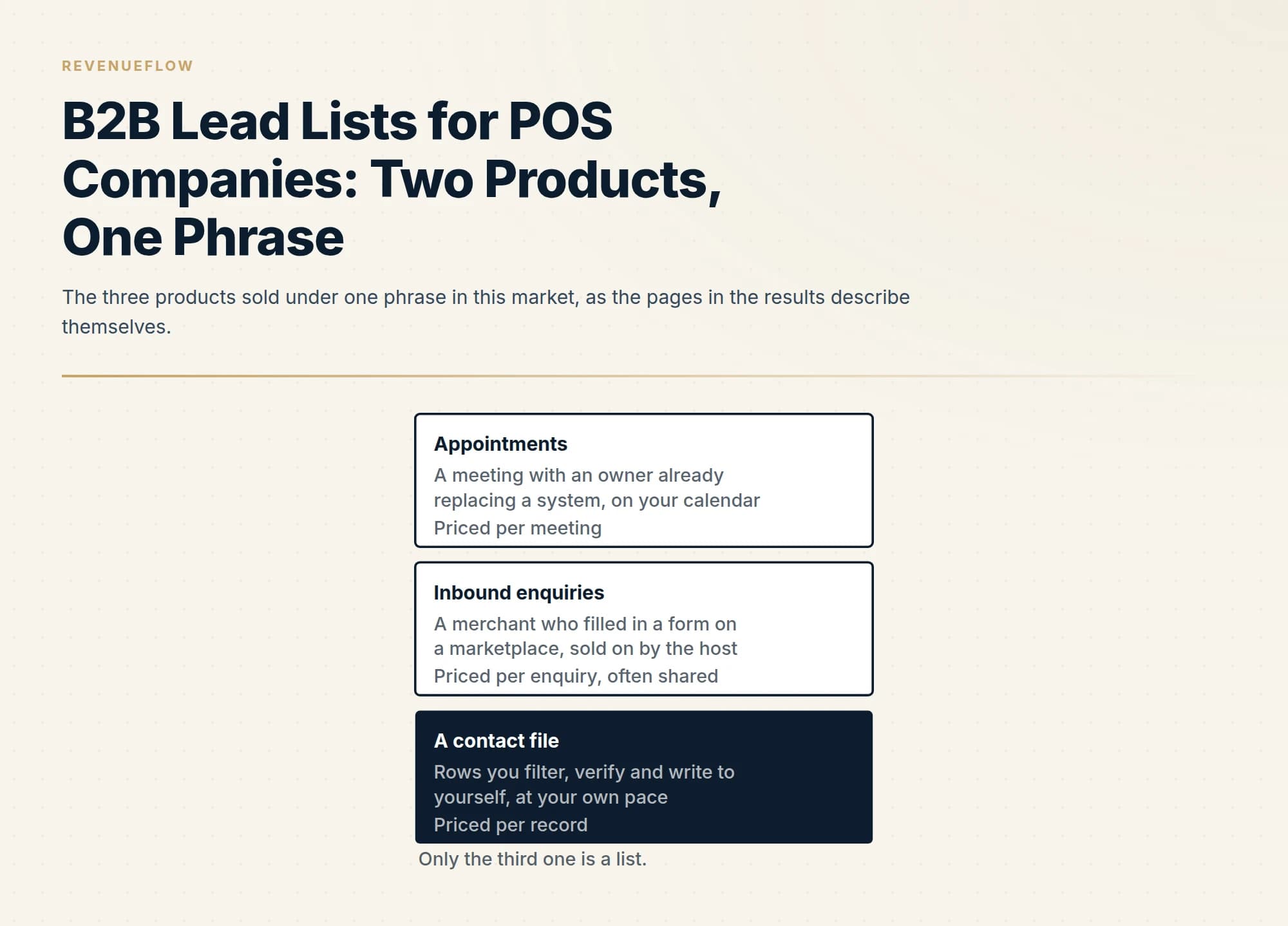
B2B lead lists for POS companies are sold in three forms: booked appointments, inbound enquiries from a marketplace, and a contact file. Only the file is a list. A useful merchant row carries merchant type, territory, site count and the incumbent terminal, which come from state licence data and the payment standards listings.
Key takeaways
- The phrase covers three different products at three different prices, so decide whether you are buying meetings, enquiries or rows before comparing anything.
- State licence data gives merchant type, site address and county in the state's own vocabulary; New York, for example, publishes its licensed retail food stores with an establishment type field.
- The payment standards council publishes approved device, encryption solution and qualified integrator listings, and processors publish their own reseller directories, which together cover the terminal and the channel.
- No public record holds the merchant's processing contract end date, which is the field that decides the quarter, so the first message should ask rather than pitch.
Reviewed and updated September 21, 2026
Search for lead lists in this market and you will be sold three different things under one phrase. A point of sale company that types it is usually shown an appointment service, a pay per enquiry marketplace and a contact file, and only the third is a list. Launch Leads, first in the results for this phrase, is explicit about which one it sells: "Launch Leads puts appointments with owners and operators replacing their point-of-sale straight on your calendar" (Launch Leads, POS Systems Lead Generation, read 21 September 2026). That is a booked meeting, priced per meeting. The marketplaces in the same results sell inbound merchant enquiries, priced per enquiry. Neither is a file of merchants you can filter, and each answers a different question.
This page is for the person at a POS company, or at one of its dealers, who has to decide which of the three to buy and what a merchant row must contain before it is worth sending to. What a lead list is in general is on our lead list glossary page. What follows is the version for merchants.
What a merchant row has to carry
A generic business file gives you a company, an address and a title. None of those tells a POS seller whether the merchant is worth an hour. Four fields do, and each of them lives in a different place.
The first is what kind of merchant this is, in the trade's own vocabulary rather than in a generic industry tag. A quick service restaurant, a full service restaurant with table management, a convenience store with fuel and a specialty retailer with serialised inventory are four different products, and a file that calls them all retail is a file you will re-segment by hand.
The second is the terminal or platform already in place, because this is a replacement market and the incumbent decides the message. The third is the number of sites under one owner, since a multi site operator is a different sale with a different signer. The fourth is the processing relationship, because a merchant inside a term with an early termination fee cannot move whatever they think of your demo.
| Row | State licence data | Standards body listings | Vendor channel directory |
|---|---|---|---|
| Legal entity and site address | Yes | No | No |
| Merchant type in trade vocabulary | Yes | No | Partial |
| County or territory | Yes | No | Partial |
| Terminal or payment platform | No | Yes | Partial |
| Reseller or integrator serving them | No | Yes | Yes |
| Processing contract and its end date | No | No | No |
The last row is the honest one. No public record tells you when a merchant's processing agreement ends. That has to be asked, which is a good reason for a first message that asks rather than pitches.
The records that hold the first three fields
State licence data is the cleanest source of merchants by type and territory, and several states publish it as open data. New York publishes a dataset it describes as "A listing of all retail food stores which are licensed by the Department of Agriculture and Markets", with a column for the establishment type, described as "The establishment type for the licensed entity at this location", and a county column described as "The county in which the licensed entity is physically located" (New York State Open Data, Retail Food Stores, read 21 September 2026). That is a territory list of exactly the merchants a grocery and convenience POS sells to, segmented by the state's own type field rather than by a data vendor's guess. Check what your own states publish under licensing and inspection before you buy a file covering them.
The payment side of the row comes from the standards body. The PCI Security Standards Council publishes program listings that a seller can read directly, among them "Approved PTS Devices", "Point-to-Point Encryption Solutions" and "Qualified Integrator and Resellers", alongside its assessor listings (PCI Security Standards Council, read 21 September 2026). The device listing tells you which terminals are approved and therefore which are plausibly in the field; the integrator and reseller listing is a public directory of the channel that installs them.
The channel has a second public register in the card processors' own directories. Fiserv publishes what it titles the Official Clover Reseller Directory (Fiserv, read 21 September 2026). For a POS company recruiting dealers rather than merchants, that is the list, and it is a different list from the merchant one. Decide which sale you are building for before anyone buys anything.
The rules on the file you buy
Two apply and both have moved recently.
The first governs the people who sold you the file. California requires any business meeting its definition of a data broker to "register with CalPrivacy annually between January 1-31 to report on its activities from the previous calendar year", and publishes the results as the California Data Broker Registry. From 1 January 2026 state residents can use a single platform "to submit one request to all active data brokers, including those on this registry, requesting the deletion of their personal information", and brokers "are required to begin processing these requests on August 1, 2026" (California Privacy Protection Agency, Data Broker Registry, read 21 September 2026). Two practical consequences: you can check whether a vendor selling you Californian records is registered, and a file bought today will decay as deletions are processed, so treat currency as a contract term rather than an assumption.
The second governs your send. Commercial email must carry identification as an advertisement, "clear and conspicuous notice of the opportunity" to decline further messages, and "a valid physical postal address of the sender"; the same section makes it unlawful to send to an address obtained "using an automated means from an Internet website" where the operator said it would not give addresses out (15 U.S.C. 7704), with the Federal Trade Commission's rule at 16 CFR Part 316. A merchant list assembled by scraping a directory that forbids it is a legal question before it is a deliverability one.
Verify before the first send
The order matters, because each step removes rows the next step would waste.
Run the licence match first because a closed business is the most common defect in any merchant file and it costs a send to discover. Collapse duplicates by owner before enrichment, or you will pay twice for the same decision maker. Verify the address and drop role accounts, since a shared inbox at a single site merchant is usually the till rather than the owner. And keep one contact per business: two messages into one small merchant reads as a campaign, not a letter.
When a bought list is the wrong play
Three cases. If your product only fits one narrow merchant type, the file you want is small enough to build from the state records directly and a bought file is mostly waste. If you sell exclusively through dealers, the merchant file belongs to them and the list you should be buying is the channel directory instead. And if you have no way to find out when an incumbent agreement ends, a large file just means a large number of merchants telling you not yet; a smaller file worked properly gets you the dates.
RevenueFlow runs email and LinkedIn, one message per campaign, criteria agreed in writing before the first send, and no bump sequences behind it. In this market the phone and the dealer visit close the deal, which is the trade's reality rather than our motion.
Three reasons to write, each from a record
To the owner of a licensed retail food store. Your store is on the state's retail food store licence file for the county, which is how we build a territory list rather than buying one. We sell the system your category runs on and would rather hear what yours does badly than describe ours. The record is the state's own.
To a merchant on an older approved terminal. The standards council publishes the approved device and point to point encryption listings, so what a terminal supports is a matter of record. If yours predates the encryption solution you want, the upgrade conversation is worth twenty minutes. The listings are the council's own.
To an integrator in the channel directory. You are listed in a processor's public reseller directory, which is how we found you rather than through a bought file. We are adding integrators in this state and the terms are one call. The directory is published by the processor.
To: Owner of a licensed retail food store in the territory
Your store is on the state's retail food store licence file for the county, which is how we build a territory list rather than buying one. 1
We sell the system your category runs on and would rather hear what yours does badly than describe ours. 2
Postal address and the line to decline further messages in the footer. 3
- 1Names the public record, which answers the where did this come from question before it is asked.
- 2Asks for the incumbent's weakness, which is the field no file contains and the only one that qualifies the row.
- 3The postal address and notice of the opportunity to decline that commercial email must carry.
The short version
B2B lead lists for POS companies are worth what their fields are worth. Merchant type, territory and site count come from state licence data. The terminal and the channel come from the standards council listings and the processors' own reseller directories. The processing contract date, which decides whether any of it matters this quarter, comes from asking. Buy from a vendor you can find on a data broker register, verify in the order above, and keep one contact per business.
The merchant acquiring seller's version of the same territory is in sales prospecting for payments companies. The same play in a regulated vertical, where the registry is the whole list, is in b2b lead lists for utilities. Writing to the retail buyer once the list exists is in cold email for retail.
The way RevenueFlow runs it: email and LinkedIn, one message per campaign, qualification criteria agreed in writing before the first send, and payment on attended meetings that meet them. If the building and the sending are the parts you would rather hand over, you can see what a campaign would look like for your territory.
The state dataset, the standards council pages, the processor directory, the privacy agency page and the vendor page were fetched on 21 September 2026 from the addresses linked. Vendor claims are that vendor's own. The Florida licensing portal refused this connection on the day, so no Florida record is cited. Rules change; confirm them at the source. Nothing here is legal advice.
Sources: Launch Leads, POS Systems Lead Generation, New York State Open Data, Retail Food Stores, PCI Security Standards Council, Fiserv, Official Clover Reseller Directory, California Privacy Protection Agency, Data Broker Registry, 15 U.S.C. 7704, 16 CFR Part 316
Frequently asked questions.
Frequently asked questions- What fields make a POS merchant list useful?
- Merchant type in trade vocabulary rather than a generic retail tag, the site address and territory, the number of sites under one owner, and the terminal or platform already installed. A file without the first and the fourth has to be re-segmented and re-researched by hand, which usually costs more than the file did.
- Where does merchant type and territory data come from?
- From state licensing and inspection records, several of which are published as open data. New York publishes a listing of all retail food stores licensed by its Department of Agriculture and Markets, with columns for establishment type and county. Check what your own states publish before buying a commercial file covering the same territory.
- Is it legal to buy a merchant email list?
- Buying a file is not itself prohibited, but two things bind. California requires data brokers to register annually and, since 2026, to process deletion requests submitted through a single state platform, so a file decays. And federal law makes it unlawful to send to addresses harvested by automated means from sites that said they would not share them.
- When should a POS company skip a bought list?
- When the product fits one narrow merchant type, because the target set is small enough to build from state records directly. When you sell only through dealers, because the merchant file belongs to them and the channel directory is your list instead. And when you have no process for learning when an incumbent agreement ends.
About the author.

B2B cold email experts helping companies generate qualified leads through done-for-you outreach campaigns.
RevenueFlow Team
Explore more.
Ready to scale your outreach?
We build GTM engines that book real meetings. See the receipts.
Related articles.
B2B Lead Lists for Aviation Companies: Build or Buy
Aviation is one of the few industries whose accounts are published by its regulator, which changes what is worth buying and what is worth downloading yourself.
Lead Generation for Field Service Software Companies
Your market is a set of separately licensed trades, not one industry. Where each can be enumerated, what the credential says, and the rule on calling mobiles.
B2B Lead Lists for Travel Agencies: Registers and Gaps
The travel trade is written down in state consumer protection registers, not industry directories, and an exemption inside one decides who is missing from your file.
B2B Lead Lists for Collection Agencies: Fields and Sources
What a creditor prospect list needs for a collection agency: the fields that matter, the FDIC, NCUA, CMS and court sources behind them, and the rules that apply.
Cold Calling for Consulting Firms: The Partner's Hour
Cold calling for a consulting firm: who it dials and who picks up, why partner-led economics argue against the phone, the client's fiscal year, and when to skip it.
Cold Calling for Chemical Companies: Who Picks Up
A chemical cold call rarely arrives first. It reaches a formulator who has already been comparing suppliers on a screen, for one of three published reasons.