Sales Prospecting for Payments Companies: Merchant Acquiring
How merchant services sellers prospect: public sales tax permit lists, the contract renewal clock, and what the FTC's record says a rep must never promise.
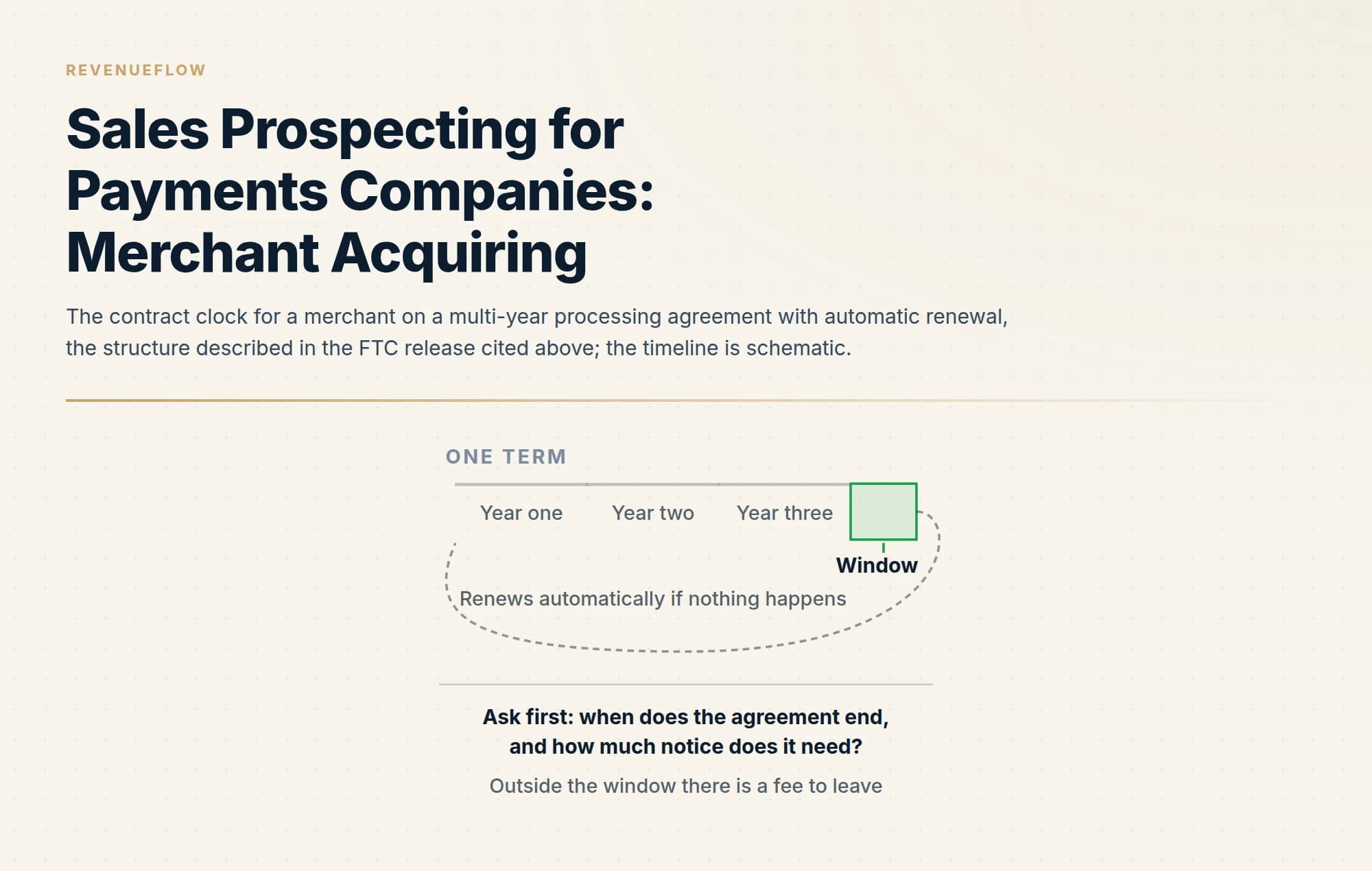
For merchant acquiring sellers, the prospect list is public. State datasets such as the Texas Comptroller's Active Sales Tax Permit Holders enumerate merchants and locations, and new entries are choosing a processor now. Incumbent agreements run for a term and renew automatically, so ask for the end date first, and never make a claim the paperwork does not support.
Key takeaways
- The Texas Comptroller's open data page names datasets including Active Sales Tax Permit Holders, All Permitted Sales Tax Locations, Mixed Beverage Sales Tax Permits and Hotel Tax Permits.
- The FTC's July 29, 2022 release alleges salespeople promised cancellation any time without a fee while the written agreement required a three-year term with a $495 cancellation fee.
- The same FTC release names the payment processor and two of its sales affiliates together, and says the company was required to refund $4.9 million.
- CCSalesPro describes three prospecting models that work for payment processing sales: walking into businesses, phoning to set appointments, and buying leads.
Reviewed and updated September 18, 2026
The payments industry keeps a public record of how not to sell. On July 29, 2022 the Federal Trade Commission announced action against a payment processor and "two of its sales affiliates" for the way they signed up small businesses. One allegation describes a sales conversation every merchant services rep will recognise from the other side of the counter: that salespeople "regularly promise businesses they will be able to cancel services any time or within a trial period without a fee, when the company's standard written agreement requires businesses to sign on to a three-year term with a $495 cancellation fee." The headline on the release says the company was "Required to Refund $4.9 Million" (FTC press release, read 18 September 2026). The shop owner you approach next may have been pitched that way before.
This guide is for one kind of payments company: the merchant acquiring side, meaning independent sales organizations, agents and processors whose reps sell card acceptance to merchants. If your payments company sells software or infrastructure to banks and platforms, that is a different sale with an assessment stage in it, and our fintech lead generation guide is the page for it. The prospecting method itself is on our sales prospecting page. What follows is what merchant acquiring adds: where merchants are enumerated, the contract clock that decides when one can move, what the regulator's record says a seller must never do, how practitioners actually prospect, and when cold prospecting is the wrong play.
Where merchants are enumerated
A business that sells to the public usually has to collect sales tax, and states keep the list of who is permitted to. Texas is a clear example. The Comptroller's open data page lists, among its datasets, "Active Sales Tax Permit Holders", "All Permitted Sales Tax Locations and Local Sales Tax Responsibility", "Mixed Beverage Sales Tax Permits" and "Hotel Tax Permits" (Texas Comptroller open data, read 18 September 2026). For a merchant services seller those four names are a territory plan: a base list of merchants, their second and third locations, and two segments by permit type, mixed beverage and hotel.
| Dataset | Who is on it | Use in prospecting |
|---|---|---|
| Active Sales Tax Permit Holders | Businesses permitted to collect sales tax | The base list of merchants in a territory |
| All Permitted Sales Tax Locations | Each permitted location | Second and third sites of the same owner |
| Mixed Beverage Sales Tax Permits | Holders of mixed beverage permits | A segment by permit type |
| Hotel Tax Permits | Holders of hotel tax permits | A segment by permit type |
Two things make a permit list better than a purchased one. It is the state's own record for its category, because a business needs the permit to collect the tax. And a location that is new on the list this month is a business that is choosing a processor now, or has just chosen one in a hurry. Other states publish equivalents under other names, so look for your own state's tax permit and licence datasets before buying a file. A permit record gives you a business and an address. It does not give you the owner's email or who processes their cards, so expect to do that research per account.
The second enumeration is other people's customers. Point-of-sale and vertical software companies run referral and reseller programmes, and a payments company that serves one vertical well can prospect those software firms as partners. That is a partnership sale with its own diligence, closer to the fintech guide's market than to this one, so it is only flagged here.
The contract clock
The FTC's complaint is also a description of how incumbent contracts in this market have been written. It refers to a three-year term, a cancellation fee, and an enrollment system that, the agency alleges, hid "the fact that agreements would automatically renew". Set the allegations against that one company aside, and the structure is what matters for prospecting: a merchant under a multi-year agreement with a fee to leave and an automatic renewal has a window, and outside that window the honest answer to a good pitch is not yet.
That changes what the first conversation is for. The most useful thing a prospector can learn is the date the current agreement ends and how much notice it requires. A merchant who does not know can find it in the paperwork, and offering to help them find it is a service in itself.
What the regulator's record says a seller must not do
The FTC release lists the conduct it charged, and for a sales manager it reads as a list of lines a rep must not use. The agency alleged that the defendants "pitched businesses with promises of small monthly fees, sometimes as low as zero", and the release adds that "the FTC's complaint alleges that these claims were often false". It alleged savings claims that "did not take into account" later price rises. It alleged that in many instances "the sales are conducted in their native language, the paperwork is only available in English." The proposed order, in the agency's words, prohibits "making any unsubstantiated claims about their products or services, including specific pricing promises."
Two points follow for prospecting. The first is that the claim in an opening line has to be one the paperwork supports, because the gap between the pitch and the paper is exactly what the agency acted on. The second is about who is responsible. The release names the processor and its sales affiliates together, so an outside sales office's pitch was treated as the processor's problem too. The same release notes that the Commission had "proposed new protections for businesses against telemarketing tricks and traps", a sign that calls to small businesses have the regulator's attention. The federal rules on business calls are covered in what cold calling is and which rules apply. This section reports what the FTC's release says and is not legal advice.
We tried to read the card brands' own pages on how agents and third parties must be registered and identified, and could not fetch them from either brand on the day of writing, so those rules are not summarised here. Your sponsoring processor's agent agreement is the document that states them for you.
How practitioners say they prospect
The people who train merchant services agents are frank about the work. James Shepherd of CCSalesPro, in a post dated March 13, 2018, describes "three models of prospecting which work". The first is "Walking into businesses cold turkey", which he calls his preferred model, adding that few people do it because many are afraid to. The second is to "Make phone calls to generate appointments for yourself." The third is lead generation bought from somewhere else, including hiring a telemarketer (CCSalesPro, read 18 September 2026). Beacon Payments, which recruits agents, tells new ones to begin with people they know before any cold approach, and to "Offer to review their current statement" (Beacon Payments, read 18 September 2026).
Those are vendors and trainers inside the industry, so treat them as descriptions of practice, not as evidence of results. Two things in them are worth keeping. The statement review is the vertical's standard next step, because it moves the conversation from a claim to the merchant's own numbers. And the walk-in survives because the owner of a shop is physically there, which is a fact about this buyer that few other markets share.
The objections a rep hears are predictable from everything above. The merchant is under contract, which is a date question. The merchant has heard the savings claim before, which is a trust question the FTC's release explains. And the merchant is busy serving customers, which is a timing question: a shop has quiet hours, and those are the only hours worth using.
Three reasons to write, each from a source above
None names a real person, quotes a rate or claims a result.
The new permit.
Welcome to {{street}}. {{business}} appeared on the state's list of sales tax permit holders this month. If you are still deciding how to take cards, or took the first offer to get the doors open, we can show you the agreement terms to check before you sign or renew anything. {{name}}, {{company}}, agent for {{processor}}.
The source is the state's public dataset, and the offer is about terms, not a price.
The contract date.
Most processing agreements run for a set term and renew automatically unless notice is given. If you can find the end date on yours, we will tell you what the notice clause means, whether or not you ever work with us.
The source is the contract structure described in the FTC's release.
The second location.
The state's list shows a second permitted location for {{business}} at {{address}}. A new site is the one time the card setup has to be decided again anyway. Would a side-by-side of your current terms for both sites be useful?
The source is the locations dataset.
When cold prospecting is the wrong play
It is the wrong play when the offer cannot survive being written down, because the regulator's record shows what happens to pitches that do not match the paper. It is the wrong play as a volume exercise against merchants who are mid-term with a fee to leave; record the date and come back for the window. It is the wrong play for a segment where a software platform controls the payment choice, where the prospect is the platform. And for a new agent with a warm network, the industry's own trainers say to start there first.
It fits a seller with a clean agreement, a territory, a public list of who is new in it, and the patience to ask about dates before prices. RevenueFlow works in writing, by email and LinkedIn, with one message per campaign and no bumps behind it, which suits a market where the prospect has learned to distrust the third call. If you want a permit-based list and a first message built on terms and dates, see what a first campaign looks like.
The short version
For a merchant acquiring seller, the account list is public: state sales tax permit datasets, such as the four the Texas Comptroller names, enumerate every merchant and every location, and new entries are businesses choosing a processor now. Incumbent agreements run for a term and renew automatically, so the first question is the end date. The FTC's 2022 action against a processor and its sales affiliates shows which claims a rep must never make and that the processor answers for its sales offices. Practitioners name walk-ins, calls and bought leads as the working models and the statement review as the standard next step. No rate belongs in an opening line.
FTC, Texas Comptroller and industry pages quoted above were read on 18 September 2026. Datasets, rules and agreements change. Confirm them at the source before relying on them.
Frequently asked questions.
Frequently asked questions- Where can merchant services agents find businesses to prospect?
- In state permit data. The Texas Comptroller's open data page lists Active Sales Tax Permit Holders, All Permitted Sales Tax Locations, Mixed Beverage Sales Tax Permits and Hotel Tax Permits. A business needs a permit to collect sales tax, so these lists enumerate merchants by location, and a newly listed location is a business choosing how to take cards. Other states publish equivalents.
- When is a merchant able to switch payment processors?
- Usually near the end of the agreement term. The FTC's 2022 release on one processor describes a three-year term, a cancellation fee and agreements that renew automatically. A merchant mid-term faces a fee to leave, so the useful first question is when the current agreement ends and how much notice it requires, then return for that window.
- What must a merchant services salesperson never say?
- Anything the paperwork does not support. The FTC alleged that one processor's salespeople promised cancellation any time without a fee against a three-year agreement with a cancellation fee, pitched small monthly fees that were often false, and sold in the owner's native language with English-only paperwork. The proposed order bars unsubstantiated claims, including specific pricing promises.
- Is cold prospecting the best way to sell payment processing?
- It depends on the seller. Industry trainers describe walk-ins, appointment-setting calls and bought leads as the working models, and tell new agents to start with people they know and offer a statement review. Cold prospecting is wrong when the offer cannot be written down, when merchants are mid-term, or when a software platform controls the payment choice.
About the author.

B2B cold email experts helping companies generate qualified leads through done-for-you outreach campaigns.
RevenueFlow Team
Explore more.
Ready to scale your outreach?
We build GTM engines that book real meetings. See the receipts.
Related articles.
Sales Prospecting for Cloud Services: Dated Triggers
How a cloud services company builds a prospect list: co-sell with platform sellers, partner-to-partner routes, and the end-of-support dates Microsoft publishes.
Cold Call Openers: Eleven Lines by Situation, and the Data
Eleven cold call openers sorted by what is true about the call, the four beats every opener has, and what Gong's 2018 opener study actually counted.
B2B Lead Lists for Collection Agencies: Fields and Sources
What a creditor prospect list needs for a collection agency: the fields that matter, the FDIC, NCUA, CMS and court sources behind them, and the rules that apply.
3x3 Research: Three Facts in Three Minutes Before Outreach
3x3 research as Funnel Clarity publishes it: three unique facts in three minutes that the prospect would be surprised you know, the variants, and where it fits.
Outbound Sales for Food and Beverage Companies: Who to Reach
Outbound sales for food and beverage brands: the four buyers behind a yes, the public show calendar, what a message may claim, and when outbound is the wrong play.
Outbound Sales for Higher Education Vendors: Which Door to Use
Outbound for higher education vendors, built on universities' own purchasing policies: three doors, the ask that fits each one, and a dated accessibility review.