Sales Prospecting for Cloud Services: Dated Triggers
How a cloud services company builds a prospect list: co-sell with platform sellers, partner-to-partner routes, and the end-of-support dates Microsoft publishes.
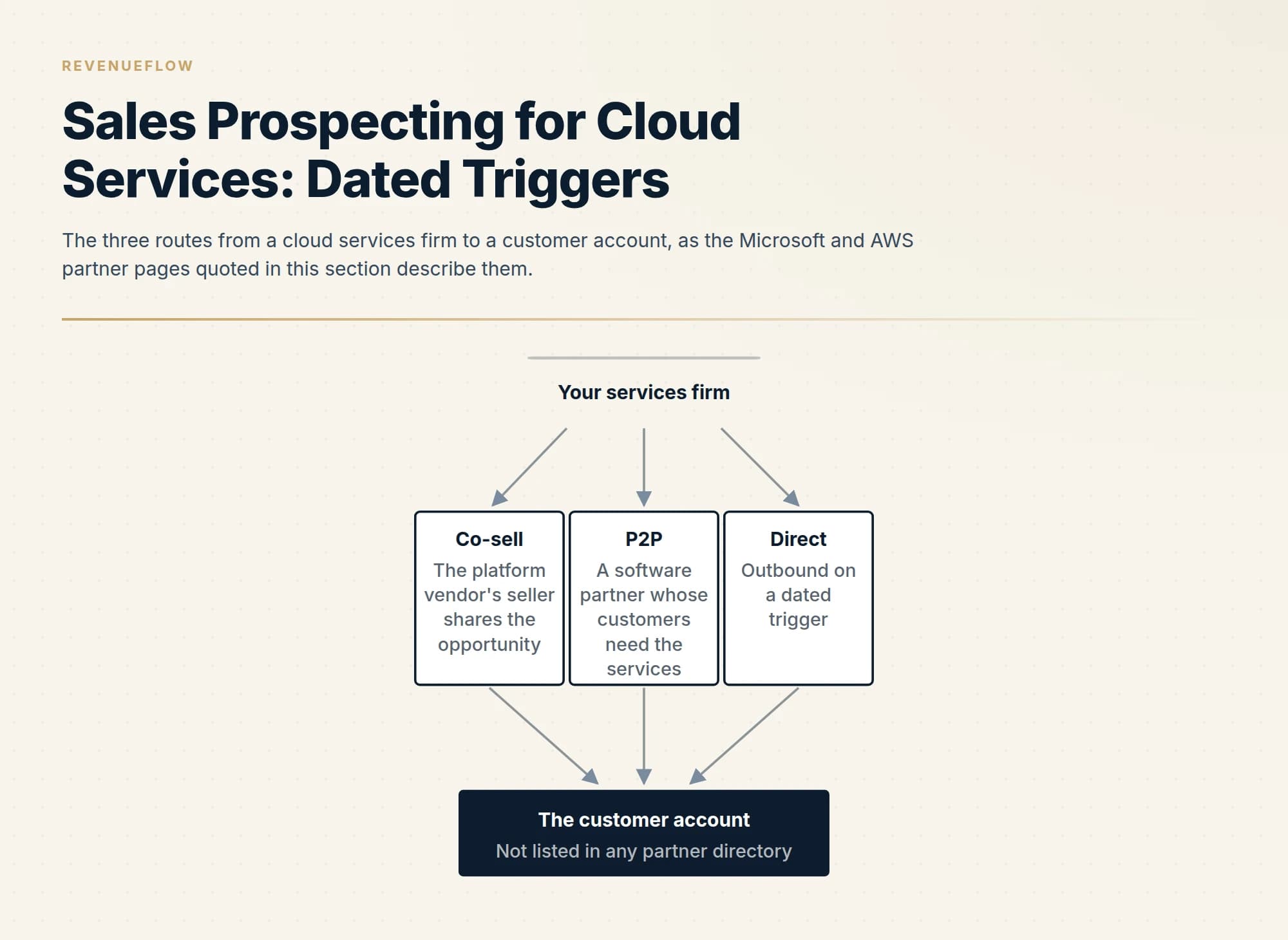
Hyperscaler partner directories list sellers, not customers, so a cloud services company reaches accounts three ways: co-sell with the platform vendor's sales team, partner-to-partner work with software vendors, and direct outbound on a dated trigger. Microsoft publishes those triggers, including Windows Server 2016 end of support on January 12, 2027, after which security updates stop.
Key takeaways
- Microsoft's lifecycle pages list SQL Server 2016 at July 14, 2026, Windows Server 2016 at January 12, 2027 and SQL Server 2017 at October 12, 2027, with no new security updates after end of support.
- Microsoft says both the partner and Microsoft sales teams can identify and share customer opportunities under co-sell, and AWS runs the equivalent as its APN Customer Engagements programme.
- Microsoft tells marketplace publishers that the Cloud Solution Provider programme lets CSP partners sell their products and create bundled solutions, which makes software vendors a partnership prospect list.
- AWS lists re:Invent 2026 for November 30 to December 4 in Las Vegas, a week when buyers and platform sellers are away from their desks.
Reviewed and updated September 18, 2026
On January 12, 2027, Windows Server 2016 reaches end of support. Microsoft's lifecycle page for that year lists it with the consequence spelled out for every product on the list: "there will be no new security updates, non-security updates, free or paid assisted support options or online technical content updates." (Microsoft Lifecycle, products ending support in 2027, read 18 September 2026.) Every company still running it has a dated decision to make, and the vendor has published the date.
This guide is for a cloud services company building a prospect list: a managed cloud provider, a migration consultancy, a hosting firm, a reseller. It is written for the people inside that business. If you sell tools or services to cloud teams, cold email for cloud services addresses your side of the market. The prospecting method itself, from choosing accounts to agreeing what qualified means, is on our sales prospecting page and is not repeated. What follows is what this industry adds: three routes to an account that only exist here, the dated triggers the platform vendors publish, the event calendar, and when cold prospecting is the wrong play.
The partner directory is not your account list
The first instinct in this market is to open a hyperscaler's partner directory. It is worth being clear about what those directories hold. Google describes its Partner Network as a way for customers to "Connect with partners who have the real-world experience and proven skills to make your digital transformation a success" (Google Cloud partners, read 18 September 2026). Amazon Web Services describes the AWS Partner Network as "a global community of organizations that leverage AWS technologies, programs, funding, and tools to build solutions and services for customers", with partners "spanning 198 countries" (AWS partners, read 18 September 2026).
Those are lists of sellers. For a cloud services firm they enumerate your competitors and your possible allies. The customer accounts sit somewhere else: inside the platform vendors' own sales teams, inside other partners' customer bases, and in the population of companies running something with a published end date. Each of those is a route, and each has its own rules.
Three routes to an account that only this industry has
Route one: the platform vendor's seller. Microsoft defines the arrangement on its Partner Center pages: "Co-selling is any collaborative engagement between Microsoft and its partner ecosystem". The mechanics matter for prospecting, because they run in both directions: "Both you and Microsoft sales teams can identify and share customer opportunities in which your solutions might be a good fit." (Microsoft Learn, co-sell overview, read 18 September 2026.) AWS runs the equivalent as the APN Customer Engagements programme, which it says "allows you to securely collaborate and co-sell with Amazon Web Services (AWS)", and which gives a partner "a platform to manage your pipeline of joint opportunities and leads" (AWS ACE, read 18 September 2026).
Read that as a prospector. The platform vendor's field seller already holds the account relationship. A services firm that brings that seller an opportunity is remembered, and AWS says as much in its own benefits list: partners can "Earn discounts for originating new customer opportunities". The work of prospecting here is partly prospecting the seller: knowing which account team covers your territory and giving them a reason to think of you.
Route two: another partner. Microsoft names this category too, Partner to Partner or P2P, and defines it: "Work with another Microsoft partner to actively solve a customer problem." A software company that sells through a marketplace may have no services arm. Microsoft tells those publishers that opting into its Cloud Solution Provider programme "enables CSP partners to sell your products and create bundled solutions for customers", and that the programme reaches "millions of qualified Microsoft customers" (Microsoft Learn, Cloud Solution Provider, read 18 September 2026). So the partner directory does hold one kind of prospect after all: the software vendor whose customers need the migration, integration or managed service you sell. That is a prospect list for a partnership, not for a sale.
Route three: direct, on a dated trigger. This is ordinary outbound, and the next section is about the reason to write.
The dated triggers the platform vendors publish
Our guide to selling to IT buyers makes the point that end-of-support dates are the most underused observable trigger in technology sales. For a cloud services firm they are the core of the calendar, because a product leaving support is a migration project with a deadline. Microsoft's lifecycle pages give the dates. As read on 18 September 2026:
- SQL Server 2016 is on the list of products reaching end of support in 2026, with the date July 14, 2026. That date has passed, which means companies still on it are past the vendor's support date (Microsoft Lifecycle, 2026).
- Windows Server 2016 is listed for January 12, 2027.
- SQL Server 2017 is listed for October 12, 2027.
A date defines a population: every company running that version. It does not tell you who they are. That part is detective work with public evidence. A job posting that asks for experience administering a named version says the version is in production. A vendor's own compatibility notes say which of its customers are tied to an old platform. The test for any such signal is in our B2B prospecting guide, which separates a filter from a signal, and the rule that follows from it applies here: write to the accounts where you have evidence of the version, not to everyone in a size band.
Compliance dates work the same way for a provider that serves regulated small firms, and our guide to MSP lead generation services covers that trigger class with the regulation quoted, so it is not repeated here.
The calendar: events and the quarters behind them
AWS lists its annual conference plainly: "Join us Nov. 30" to "Dec. 4 in Las Vegas", under the title AWS re:Invent 2026 (AWS re:Invent, read 18 September 2026). For a prospector the week itself is a dead zone, since buyers and the platform sellers you co-sell with are all in one city. The weeks before it are when meeting requests for the event land, and the weeks after are when announcements made on stage turn into projects. We could not read dates for Microsoft Ignite or Google Cloud Next from their own pages on the day of writing, so none are given; check the organisers' pages.
The platform vendors' fiscal calendars shape co-sell behaviour, because a field seller near a quarter end has a reason to return a partner's call. We have not quoted those calendars because we did not fetch a vendor page that states them in a form worth citing. Ask the partner manager assigned to you, and record the answer next to each account team.
What the first message looks like
The end-of-support trigger makes for an unusually honest opening, because the fact is public and the consequence is the vendor's own sentence. One version, with invented placeholders and no claim about results:
To: Head of Infrastructure. Subject: Windows Server 2016 after January 12
Your posting for a systems administrator lists Windows Server 2016 among the platforms to support. 1
Microsoft ends support for it on January 12, 2027, after which there are no new security updates. 2
We move workloads like that to the cloud for mid-size firms. Is a plan for those servers already in place, or still open? 3
- 1The evidence of the version comes from the company's own job posting, so the reader can verify it.
- 2The date and the consequence are Microsoft's, from the lifecycle page. Nothing is exaggerated.
- 3One sentence on what the sender does, then a question that can be answered in a line.
Two more reasons to write follow the same pattern. To a software partner found in a marketplace: their customers need the migration or managed service they do not offer, and Microsoft's own page describes partner-to-partner work as a recognised form of co-sell. To a platform vendor's account team: a named customer opportunity you are bringing to them, which is what both co-sell programmes are built to receive.
The channel mix for this buyer leans written. As our IT lead generation guide notes, technology buyers evaluate outbound for a living and recognise an automated sequence from its first line. RevenueFlow's own practice is one message per campaign by email or LinkedIn, and a new campaign only when a new dated trigger appears. This market supplies them on a published schedule.
When cold prospecting is the wrong play
It is the wrong play for a firm whose growth already comes through a marketplace listing or a platform vendor's referrals, where the better use of the same hours is route one: more opportunities shared with the account team. It is the wrong play for a firm with no evidence of what its targets run, because a lifecycle date sent to a company that left that version years ago is noise with a deadline attached. And it is the wrong play in the week of a major platform event.
It fits when you hold a specific migration skill, a dated trigger that creates a population, and evidence of which accounts are in it. If you want a list built on that evidence and a first message written against it, see what a first campaign looks like.
The short version
Hyperscaler partner directories list sellers, so they show a cloud services firm its competitors and its possible partners, not its customers. Accounts are reached by three routes: co-sell with the platform vendor's own sales team, partner-to-partner work with software vendors whose customers need services, and direct outbound. The reason to write is usually a published date. Microsoft lists SQL Server 2016 at July 14, 2026, Windows Server 2016 at January 12, 2027 and SQL Server 2017 at October 12, 2027, and says support, including security updates, stops on those dates. AWS re:Invent 2026 runs November 30 to December 4 in Las Vegas. Find evidence of the version before you write, and send one message.
Microsoft, AWS and Google pages quoted above were read on 18 September 2026. Lifecycle and event dates change. Confirm them on the vendor's own page before relying on them.
Frequently asked questions.
Frequently asked questions- Where do cloud services companies find prospects?
- Not in the hyperscalers' partner directories, which list sellers like you. Accounts are reached through co-sell with the platform vendor's own sales teams, through partner-to-partner work with software vendors whose customers need services, and through direct outbound to companies running a product with a published end-of-support date, identified from evidence such as job postings.
- What trigger events matter for selling cloud migration services?
- Vendor end-of-support dates. As read on 18 September 2026, Microsoft's lifecycle pages list SQL Server 2016 at July 14, 2026, Windows Server 2016 at January 12, 2027 and SQL Server 2017 at October 12, 2027, and say there are no new security updates after end of support. Each date defines a population of companies with a deadline.
- What is co-selling with Microsoft or AWS?
- Microsoft defines co-selling as any collaborative engagement between Microsoft and its partner ecosystem, and says both the partner and Microsoft sales teams can identify and share customer opportunities. AWS's APN Customer Engagements programme lets partners collaborate and co-sell with AWS and manage a pipeline of joint opportunities and leads. Both are routes to accounts the platform seller already covers.
- When is cold prospecting the wrong approach for a cloud services firm?
- When growth already comes through a marketplace listing or platform vendor referrals, because the same hours are better spent sharing opportunities with the account team. It is also wrong without evidence of what a target runs, since a lifecycle date sent to a company that left that version is noise, and during the week of a major platform event.
About the author.

B2B cold email experts helping companies generate qualified leads through done-for-you outreach campaigns.
RevenueFlow Team
Explore more.
Ready to scale your outreach?
We build GTM engines that book real meetings. See the receipts.
Related articles.
3x3 Research: Three Facts in Three Minutes Before Outreach
3x3 research as Funnel Clarity publishes it: three unique facts in three minutes that the prospect would be surprised you know, the variants, and where it fits.
Cold Call Openers: Eleven Lines by Situation, and the Data
Eleven cold call openers sorted by what is true about the call, the four beats every opener has, and what Gong's 2018 opener study actually counted.
B2B Lead Lists for Collection Agencies: Fields and Sources
What a creditor prospect list needs for a collection agency: the fields that matter, the FDIC, NCUA, CMS and court sources behind them, and the rules that apply.
Outbound Sales for Food and Beverage Companies: Who to Reach
Outbound sales for food and beverage brands: the four buyers behind a yes, the public show calendar, what a message may claim, and when outbound is the wrong play.
Outbound Sales for Higher Education Vendors: Which Door to Use
Outbound for higher education vendors, built on universities' own purchasing policies: three doors, the ask that fits each one, and a dated accessibility review.
Cold Calling for Legal Tech Companies: Who Answers at a Firm
What changes when a legal tech company cold calls a law firm: which desks answer, why the billable hour hurts the pitch, the 2027 show dates, and what not to ask.