Sales Prospecting for Broadcasters: The Public File
Every station publishes a record of who asked to buy time on it. Read from the other side, the political file is the most specific prospect list in this trade.
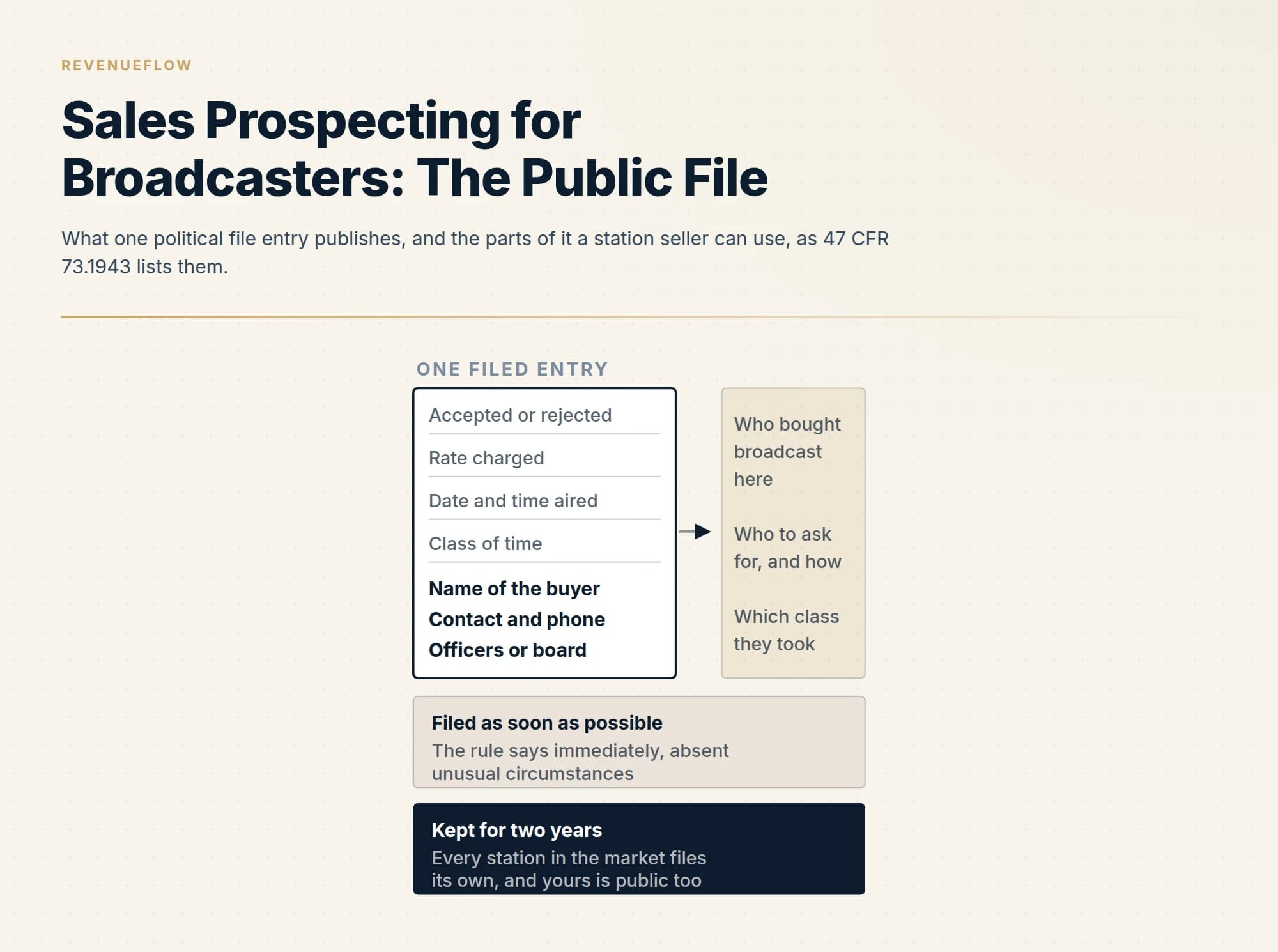
Sales prospecting for broadcasters starts with records the industry is required to publish. Every station's online political file names issue advertisers, a contact and a phone number, and federal candidate filings name committees before they buy. The lowest unit charge windows decide when a new commercial schedule can safely be sold.
Key takeaways
- Federal rule requires each station's political file to record whether a request was accepted, the rate, the date aired, the class of time and, for issue advertising, the buyer's name, a contact name, address and phone and the entity's officers.
- Those records go online as soon as possible, which the rule defines as immediately absent unusual circumstances, and are kept for two years, so the market's broadcast buyers are visible within days.
- Lowest unit charge applies for 45 days before a primary and 60 days before a general election, and inside those windows a candidate pays no more per unit than the station's most favored commercial advertisers.
- Your own file is public too, so a competitor reads it as easily as you read theirs, and the file covers political and issue advertising rather than the whole local market.
Reviewed and updated September 21, 2026
Every commercial radio and television station in the United States publishes, by federal rule, a running record of who asked to buy time on it, at what rate, in what class, and who to contact about it. Broadcasters file that record about themselves. It is also, read from the other direction, the most specific prospecting list this industry has, and every station in your market files one too.
This page is for the account executive or local sales manager at a station or station group who has to find advertisers the station does not already have. The method itself, how prospecting works in any business, is on our sales prospecting page. The strategy question of which of a media company's buyers each seat should sell to is answered in sales strategy for media companies. This is the narrower job: where the names come from, what the calendar does to them, and what the first message can say.
The record every station has to publish
The Federal Communications Commission runs one site for all of it. Its public files service describes its own scope plainly: it provides access to the public inspection file "for the following types of entities: licensed full-service radio and television broadcast stations, Class A television stations, cable television systems" and the satellite providers it also names, and says the file "contains a variety of information about each station's operations and service to its community of license, including information about political time sold or given away by each station" (FCC Public Inspection Files, read 21 September 2026). The same page notes that "certain political programming files have been public for nearly 75 years".
The rule behind it says what a single entry has to contain. A licensee must keep and publish "a complete record of a request to purchase broadcast time" made by or for a candidate, or one that "Communicates a message relating to any political matter of national importance". The record must show "Whether the request to purchase broadcast time is accepted or rejected by the licensee", "The rate charged for the broadcast time", "The date and time on which the communication is aired" and "The class of time that is purchased". For a request that is not from a candidate, it must also show "the name of the person purchasing the time, the name, address, and phone number of a contact person for such person, and a list of the chief executive officers or members of the executive committee or of the board of directors of such person". Records go "in the online political file as soon as possible", which the rule defines as "immediately absent unusual circumstances", and are kept for two years (47 CFR 73.1943).
Read that as a seller rather than as a compliance officer. For issue advertising it is a published list of organisations that spent money on broadcast in your market, with a named contact, a phone number and the officers of the buying entity, filed within days of the request and kept for two years.
Two cautions before anyone builds a territory plan on it. The file covers political and issue advertising, not the car dealer and the furniture store, so it is part of the market rather than the whole of it. And because your own file is equally public, a competitor reads yours with the same ease.
The window that changes what a rate means
A broadcaster's selling year has a constraint no other industry has, and it lands on commercial prospecting as much as on political.
Federal rule sets, "During the 45 days preceding the date of a primary or primary runoff election and during the 60 days preceding the date of a general or special election in which such person is a candidate, the lowest unit charge of the station for the same class and amount of time for the same period". Inside that window "A candidate shall be charged no more per unit than the station charges its most favored commercial advertisers for the same classes and amounts of time for the same periods", and "Any station practices offered to commercial advertisers that enhance the value of advertising spots must be disclosed and made available to candidates on equal terms", including "bonus spots, time-sensitive make goods, preemption priorities". The Commission "recognizes non-premptible, preemptible with notice, immediately preemptible and run-of-schedule as distinct classes of time", and stations "shall not establish a separate, premium-period class of time sold only to candidates" (47 CFR 73.1942).
For a prospector this has three practical consequences. Any commercial deal written inside the window sets a floor that a candidate can claim for the same class. Inventory tightens, so a new commercial advertiser onboarded just before the window may not get the schedule that was sold. And the class vocabulary in the rule is the vocabulary the station already sells in, so a first conversation about preemption is a conversation the buyer's own paperwork will use.
The second public register
Political buyers announce themselves before they buy. Federal candidates and their committees file with the Federal Election Commission, and the agency publishes a browsable candidate directory filtered by election year, office sought and party (FEC, Browse Candidates, read 21 September 2026). For a station in a contested district that is a list of buying entities months before a single spot is placed, and it pairs with the political file to show which of them has already started placing.
What the trade says prospecting is
The industry trains its own sellers on this, and the training describes the same early stage work. The Missouri Broadcasters Association's September 2026 member webinar is billed as focusing on "early-stage sales steps: prospecting, pre-meeting research, and mastering insights to get in the door and build prospect trust and rapport" (Missouri Broadcasters Association, read 21 September 2026). State associations run this calendar all year, and their member sections are where the market's own practice is published.
Marketron, which sells advertising management software to broadcasters, publishes a list of prospecting sources for the same reader. It tells sellers to "Stay Current on New Businesses Opening" through the chamber of commerce, to take note of the coming soon signs in their area and to join social media groups for small businesses in the city; to "Target Companies in Industries Where You've Had Success"; to "Lead with Education When Talking to New Prospects"; and to "Be Transparent About Pricing and Terms", adding that a proposal "should outline exactly the campaign types and costs associated with those" (Marketron Aspire, How Broadcast and Media Sales Pros Can Win New Clients, read 21 September 2026).
The rule on your own message
Nothing above changes what a commercial email has to carry. United States law requires identification as an advertisement, "clear and conspicuous notice of the opportunity" to decline further messages, and "a valid physical postal address of the sender" (15 U.S.C. 7704); the Federal Trade Commission's rule sits at 16 CFR Part 316. The same section makes it unlawful to send to addresses harvested from websites by automated means, which matters here because the contacts in a political file are published for a regulatory purpose and are better treated as a research source that tells you who to look up than as a list to load.
When this is the wrong play
Three cases. A candidate committee is a single cycle buyer with a fixed end date, so treating it as an account to develop is a misreading of what the file shows. A national brand's buy is planned by an agency on the advertiser's calendar and is not the local seller's to win by outreach. And an advertiser already on a competitor's schedule inside a lowest unit charge window is not going to move mid flight, however good the pitch; the file tells you when their flight ends, which is the better date to write.
RevenueFlow does not cold call, and the phone is a large part of how local broadcast is sold, described here as the trade's reality rather than as our motion. The written side is email and LinkedIn: one message per campaign, criteria agreed in writing before the first send, and a later approach is a new campaign with a new reason rather than a bump behind the first.
Three reasons to write, each from a record
To the contact named in an issue advertiser's file entry. Your organisation is named in a political file entry at a station in this market, with the class of time and the date it aired. We sell the same classes and can show what the same weight looks like on our schedule for the rest of the flight. Everything in it is from the published entry.
To the treasurer of a committee that has filed but not yet placed. Your committee appears in the federal candidate filings for this cycle and not yet in any station political file in this market. Before the lowest unit charge window opens, the classes of time and the preemption rules are worth ten minutes so the buy is not decided by what is left. The filings and the rule are both public.
To the owner of a business that has just opened. You opened in the market this month, which is the point at which an advertiser decides who they will hear from again. Our station's schedule and rate card are one conversation, and the campaign types and costs are itemised before anything is booked. The transparency point is the trade's own guidance.
To: Treasurer of a committee that has filed but has not placed
Your committee appears in the federal candidate filings for this cycle and not yet in any station political file in this market. 1
Before the lowest unit charge window opens, the classes of time and the preemption rules are worth ten minutes so the buy is not decided by what is left. 2
Postal address and the line to decline further messages in the footer. 3
- 1Two public records, one federal filing and one station file, both checkable by the reader.
- 2The ask is timed to a rule the buyer will meet anyway, and it promises a conversation rather than a result.
- 3The postal address and the notice of the opportunity to decline that the statute requires.
The short version
Sales prospecting for broadcasters is different from prospecting anywhere else for one reason: the buyers of the product are partly a matter of public record, because the station is required to publish who asked to buy. Work the political files across the market, pair them with the federal candidate filings, add the week's new openings the way the trade's own training says, and time the approach around the lowest unit charge windows rather than into them.
What a supplier writing to station groups sees in reply is a different question, answered in media cold email benchmarks. The adjacent entertainment market is in cold email for entertainment. The one message programme a written motion runs on is in the outbound sales playbook.
The way RevenueFlow runs it: email and LinkedIn, one message per campaign, qualification criteria agreed in writing before the first send, and payment on attended meetings that meet them. If the written side of your market's new business work is the part you would rather hand over, you can see what a campaign would look like for your market.
The rules, the public files service, the candidate directory, the association page and the vendor guidance were fetched on 21 September 2026 from the addresses linked. The FCC's own policy pages refused this connection on the day, so the rules are cited from the Electronic Code of Federal Regulations instead. Rules change; confirm them at the source. Nothing here is legal advice.
Sources: FCC Public Inspection Files, 47 CFR 73.1943, 47 CFR 73.1942, FEC, Browse Candidates, Missouri Broadcasters Association, Marketron Aspire, 15 U.S.C. 7704, 16 CFR Part 316
Frequently asked questions.
Frequently asked questions- Can a station use another station's political file to find advertisers?
- The files are public and the Commission publishes them at one address for every station, cable system and satellite provider. For issue advertising the entries name the buyer, a contact person with an address and phone number and the officers of the purchasing entity. It is part of the market rather than all of it, since it covers political and issue time only.
- What does the lowest unit charge rule mean for commercial prospecting?
- Inside the windows, 45 days before a primary and 60 before a general election, a candidate can claim the rate the station charges its most favored commercial advertisers for the same class and amount of time. A commercial deal written in that period therefore sets a floor, and inventory is tight, so a new advertiser may not get the schedule that was sold.
- Where else do broadcasters find new local advertisers?
- The trade's own guidance names chambers of commerce, signs on new premises and local small business groups, and tells sellers to target industries where the station already has a campaign that worked. State broadcasters associations run member training on the same early sales steps, which is where a seller can see the market's current practice published.
- Is a candidate committee a good account to develop?
- It is a single cycle buyer with a fixed end date, so treating it as a long term account misreads what the record shows. The useful pattern is the reverse: find committees that have filed federally but do not yet appear in any station file, and have the conversation about classes of time before the lowest unit charge window opens.
About the author.

B2B cold email experts helping companies generate qualified leads through done-for-you outreach campaigns.
RevenueFlow Team
Explore more.
Ready to scale your outreach?
We build GTM engines that book real meetings. See the receipts.
Related articles.
Sales Prospecting for SEO Agencies: Four Public Signals
How an SEO agency builds its own prospect list from signals Google documents: the index check, position, core update dates and site moves, under the warning owners read.
Sales Prospecting for Health Systems: The Public Record
Where health systems are written down in public: the Medicare cost report, the facility list a non-profit system files, and the two gates that follow qualification.
Sales Prospecting for Energy Companies: The Regulator's List
Prospecting for a retail energy supplier, broker or efficiency seller: the eligible customer list, the state's choice map, building grades, the triggers and the licence.
Sales Prospecting for Utilities: Read the Filings First
Prospecting utilities from the proceedings that announce their spend: rate cases, resource plans and procurement decisions, who owns each, and the supplier gate.
Sales Prospecting for Consulting Firms: Find the Event
Prospecting for a consulting firm: where triggers are published by practice, who inside the firm reads them, why alumni and referrals come first, when to skip it.
3x3 Research: Three Facts in Three Minutes Before Outreach
3x3 research as Funnel Clarity publishes it: three unique facts in three minutes that the prospect would be surprised you know, the variants, and where it fits.