Sales Strategy for Media Companies: Three Buyers, One Rule
How a publisher, broadcaster or digital media company sells advertising and sponsorship: the three buyers, the inventory, the calendar and the sponsorship rule.
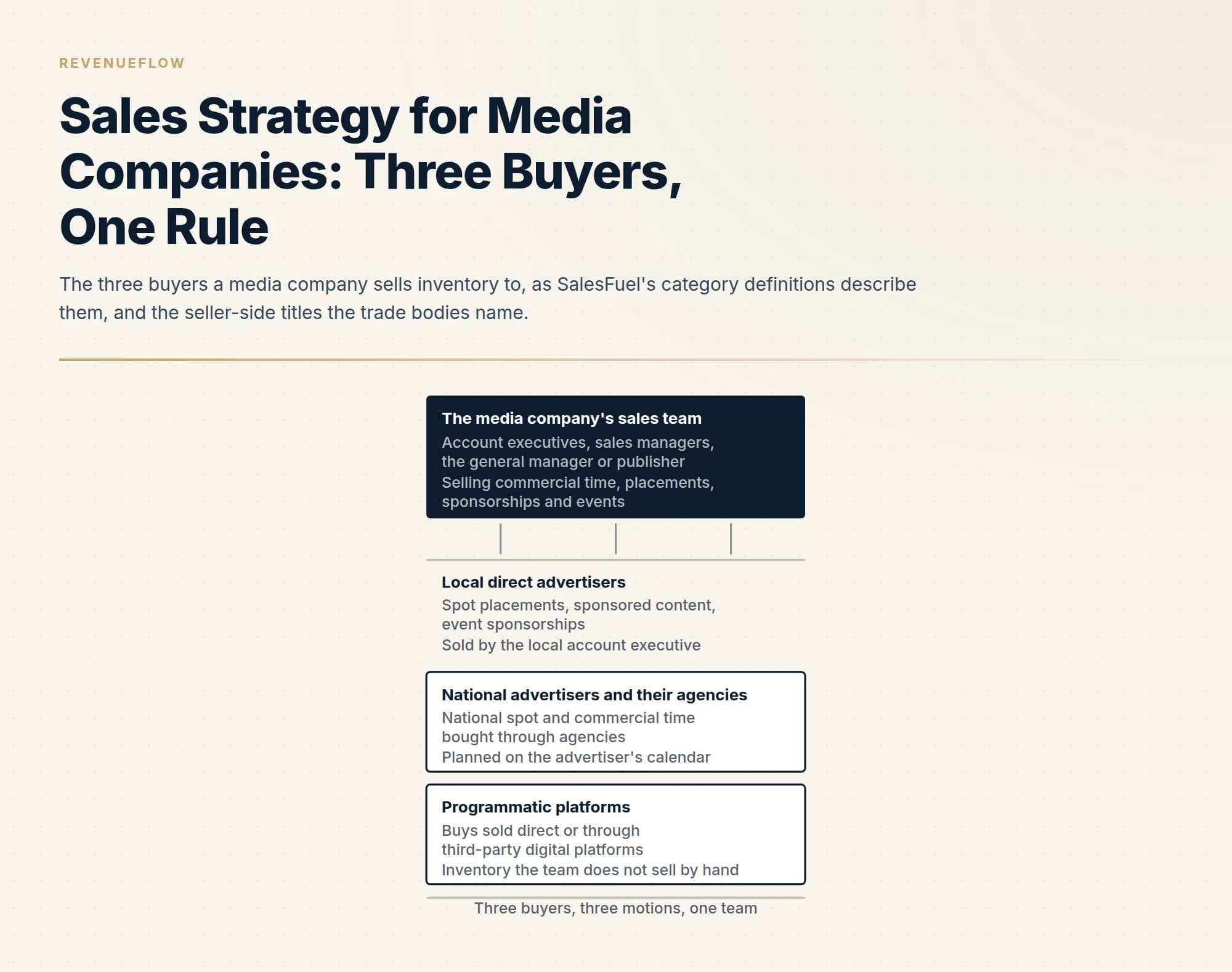
A media company's sales strategy decides which of three buyers each seat sells to, local direct advertisers, national agencies and programmatic platforms, what the rate card carries against the industry's own category definitions, how investment per rep is spent, and how the sponsorship identification rule is built into what the team sells.
Key takeaways
- The IAB and PwC report puts United States digital advertising revenue at nearly 300 billion dollars for 2025, up 13.9 percent, and the IAB raised its 2026 forecast in September 2026.
- SalesFuel's August 2025 survey of 540 media sellers and managers defines each category's inventory, from local spot and event sponsorships to programmatic buys sold through third-party platforms.
- The Center for Sales Strategy's summary has salespeople saying it is harder than ever to get an appointment, and its report carries a section on setting appointments and the sales process.
- 47 CFR 73.1212 makes the broadcast station announce that paid matter is sponsored and by whom, with political candidate ads carrying the sponsor's name at four percent of picture height for four seconds.
Reviewed and updated September 18, 2026
A media company's sales strategy is a strategy for selling advertising and sponsorship, and the people who run that job say it has got harder. The Center for Sales Strategy, a sales training firm whose Media Sales Report surveys media salespeople and their managers, summarises its latest surveys with a quote from its own leadership: salespeople are saying it is "harder than ever to get an appointment" and "more difficult to close business," while also saying they have the resources they need (The Center for Sales Strategy, Quick Take: The Future of Media Sales, read 18 September 2026; the page does not state the number of respondents). The money is still there: the IAB and PwC Internet Advertising Revenue Report for full year 2025, published 16 April 2026 in the report's 30th year, puts United States digital advertising revenue at nearly 300 billion dollars, up 13.9 percent year on year (IAB, Internet Advertising Revenue Report: Full Year 2025).
This page is written for the publisher, the broadcaster, the station group, the podcast network and the digital media company that sells advertising and sponsorship, and for the sales leader deciding how that team is built, paid and pointed. It is not about selling to media companies; that reader is served by the site's cold email guide for media and publishing. Nor is it about pitching journalists, which is a different intent with its own page. Here the reader is the media company, the product is inventory and sponsorship, and the sources are the industry's own surveys, its trade bodies and the rule that governs the product.
Who buys media, and who sells it
The buyer is the advertiser and the agency that plans and buys for it. SalesFuel's State of Media Sales survey, run in August 2025 with BIA Advisory Services and completed by 540 media sellers and managers in the United States, defines each selling category by the advertisers it serves: local television station sales cover "commercial time sold to national and local advertisers, interactive video ads, and digital sponsorships"; local radio covers "local and national spot placements, streaming audio ads, event marketing sponsorships, branded podcasts, station websites, banner ads" and programmatic buys sold direct or through third-party digital platforms; newspapers sell "display ads, classified listings, sponsored content, event marketing sponsorships, and digital placements"; magazines sell print and digital placements including native and programmatic; and digital sales cover search, display, video, in-app, native social and email (SalesFuel, State of Media Sales). Local direct advertisers, national advertisers and their agencies, and the programmatic platforms that buy on their behalf are therefore three different buyers with three different sales motions, and a media company usually sells to all three.
On the selling side the titles are stable. SalesFuel surveys "media sales managers, salespeople and executive leadership"; the Television Bureau of Advertising, the trade body for local broadcast television, runs a TVB University course titled "Your Path to Becoming a Top Account Executive" and an AE Dashboard, and describes its business development work as helping members with "local media marketing solutions across linear, online, and mobile platforms" (TVB, read 18 September 2026). The account executive, the sales manager and the general manager or publisher are the seller-side titles, and the strategy question is how many of each, paid on what, selling which of the three buyers.
Alexander Group, a sales consultancy, frames that question as one of sales investment, in an article by Matt Bartels that opens "Welcome to the media sales crucible." and states that "Traditional methods of monetization (print, television) are under attack" and lists the levers a media company's investment per rep is made of: rep and management compensation, then productivity levers it names as demand stimulation (lead generation), presales support, a deal support team, product specialists, admin and ad ops, training and sales operations, then infrastructure (Alexander Group, Mapping the Future of Media Sales, undated on the page).
What each category of media company sells, in the survey's own definitions
The survey definitions read as a product catalogue: they say what each kind of media company can put on a rate card. Local television sells over-the-air commercial time plus streaming platforms and station-owned digital properties; local radio adds streaming audio and branded podcasts; newspapers and magazines sell print and digital.
| Row | Over the air or print | Digital placements | Streaming or podcasts |
|---|---|---|---|
| Local television station | Yes | Yes | Yes |
| Local radio station | Yes | Yes | Yes |
| Newspaper | Yes | Yes | No |
| Magazine | Yes | Yes | No |
The calendar the buyer runs on
A media company sells on the advertiser's planning calendar and its own revenue calendar, and both are visible in the industry's own publications. The IAB publishes an annual outlook study of United States ad spend, updated in September, whose September 2026 update is described as "an updated view of U.S. ad spend, opportunities, and challenges for the rest of 2026" following a January release, and whose related release is headed "IAB Raises 2026 U.S. Ad Spend Forecast to +12.3% YoY Growth, as Strong First Half Lifts Expectations" (IAB, 2026 Outlook Study: September Update, 10 September 2026; the study's findings sit behind an account wall and are not quoted here). The IAB also runs the NewFronts, which its events page describes as "the industry's leading digital content marketplace" bringing together brands, media companies and agencies around video (IAB, 2026 IAB NewFronts).
For a broadcaster there is a second calendar the rule book creates: political advertising. The sponsorship identification rule requires, for "any television political advertisement concerning candidates for public office," that the sponsor "be identified with letters equal to or greater than four percent of the vertical picture height that air for not less than four seconds" (47 CFR 73.1212(a)(2)(ii)), and TVB keeps a Political section among its sales resources. Election years fill a station's inventory with a buyer whose creative carries a rule of its own.
What the rules require of the seller
Two rules touch the media company's selling, and one of them is about the product rather than the outreach.
The product rule is sponsorship identification. The Federal Communications Commission's rule states: "When a broadcast station transmits any matter for which money, service, or other valuable consideration is either directly or indirectly paid or promised to, or charged or accepted by such station, the station, at the time of the broadcast, shall announce" that the matter is "sponsored, paid for, or furnished" and "By whom or on whose behalf such consideration was supplied," and that "The licensee of each broadcast station shall exercise reasonable diligence to obtain from its employees, and from other persons with whom it deals directly in connection with any matter for broadcast, information to enable such licensee to make the announcement." The rule adds that the term sponsored "shall be deemed to have the same meaning as" the term paid for (47 CFR 73.1212). For a station's sales team the consequence is direct: a sponsorship, a branded segment or a paid mention is a product whose on-air disclosure is the station's obligation, and the account executive who sells it is one of the employees the licensee must get the sponsor information from.
The outreach rule is the ordinary one. The Federal Trade Commission's guide says of the CAN-SPAM Act that it "makes no exception for business-to-business email," puts each separate email in violation at penalties of up to $53,088, and asks of every commercial message accurate header information, a non-deceptive subject line, identification as an advertisement, a valid physical postal address and a clear way to opt out (FTC, CAN-SPAM Act: A Compliance Guide for Business, read 18 September 2026). An account executive's email to a dealership's marketing director offering a package is commercial email. Whether any specific practice is compliant is a question for counsel.
The objections the vertical raises about itself
The objections here are the sellers' own, published by the organisations that survey them.
The first is access. The Center for Sales Strategy's summary has salespeople saying it is "harder than ever to get an appointment," and its report is organised into sections that include "Setting Appointments and Sales Process" alongside sales department, learning and development, enablement, and industry outlook and culture (The Center for Sales Strategy, Media Sales Report hub).
The second is hiring and talent. The same summary reports that 70 percent of managers use sales talent assessments in hiring; the page does not state the number of respondents, so read it as the firm's survey rather than a population estimate.
The third is the core. Alexander Group's questions, "How to drive digital or new product sales, without hurting the core?" and "How fast do I need to move so I don't miss the boat and fall behind?" are the objection a station group's own leadership raises to any strategy that moves account executives off spot sales, and its account of media companies spinning broadcast businesses off from digital and publishing is the structural version of the same worry.
Channel reality for this play, and when a motion is the wrong one
Media companies sell in three motions. Local direct is the account executive's motion: the local advertiser buying spot time, sponsored content and events, which is what TVB's AE Dashboard supports. National is the agency motion: commercial time and spot placements bought by agencies for national advertisers, planned on the advertiser's calendar. Programmatic is the platform motion: SalesFuel's radio definition counts programmatic buys sold direct or through third-party digital platforms, which is inventory a team does not sell by hand.
A written outreach motion, email and LinkedIn to local and regional advertisers and to agency planners, is legitimate in this vertical and is the half RevenueFlow runs. The phone is a large part of how local media is sold, according to the industry's own training bodies, and it is described here as the vertical's reality rather than as our motion, since RevenueFlow does not cold-call.
Three cases make a motion the wrong one. A national buy is the wrong target for a local account executive's outreach, because the agency plans it on the advertiser's calendar and buys it through channels the local seller does not control. Programmatic inventory is the wrong thing to sell by hand, because the survey's own definition puts it on platforms. And a sponsorship or branded segment is the wrong product to sell without the sponsorship identification worked into the creative, because the rule makes the announcement the station's obligation at the time of broadcast, not the advertiser's.
Three openers, each grounded in a page the buyer can check
Three sample first lines an account executive could send, each tied to one fetched source. They promise nothing about results, name nobody real and carry no contact details.
To the marketing director of a regional advertiser. The IAB and PwC put United States digital advertising revenue at nearly 300 billion dollars for 2025, up 13.9 percent, and the IAB raised its 2026 forecast in September. Our station's digital properties and streaming inventory sit next to the spot schedule you already know; a fifteen minute conversation about how the two are packaged is the ask. The figures are the trade body's own and dated.
To the media planner at an agency buying a regional campaign. SalesFuel's 2025 State of Media Sales survey counts radio inventory as spot placements, streaming audio, branded podcasts and event sponsorships together, and that is how our stations package it for agency buys. If the plan you are building has an audio line, we would like to show you the package before it is locked. The definition is quoted from the survey and the ask is timed to the plan.
To a political campaign's media buyer in an election year. The FCC's sponsorship identification rule requires a television political advertisement to carry the sponsor's name in letters at least four percent of the picture height for at least four seconds. Our political sales desk builds that identification into every spot we produce with a campaign, so the creative arrives ready to air; a call to walk through our rates and the rule's requirements is the ask. The requirement is quoted from the rule and the message offers the station's own product.
To: Media planner, an agency buying a regional campaign
SalesFuel's 2025 State of Media Sales survey counts radio inventory as spot placements, streaming audio, branded podcasts and event sponsorships together, and that is how our stations package it for agency buys. 1
If the plan you are building has an audio line, we would like to show you the package before it is locked. 2
Postal address and opt-out line in the footer. 3
- 1A definition quoted from the survey, which the planner can check.
- 2The ask is timed to the plan and offers the package, not a result.
- 3The postal address and opt-out line the FTC's CAN-SPAM guide requires of every commercial email.
What the strategy has to decide
Put the sources together and a media company's sales strategy is four decisions: which of the three buyers each seat sells to; what the rate card carries and what is left to platforms; how the investment per rep is spent across Alexander Group's levers; and how sponsorship identification is built into what the team sells. The vendor's view of the same companies, what a supplier writing to station groups and publishers sees in reply, is in media cold email benchmarks; the one-message programme a written outreach motion runs on is in the outbound sales playbook; and the general test for whether a first meeting is worth a seller's hour is in appointment setting versus lead generation.
The way RevenueFlow runs it: email and LinkedIn, one message per campaign, criteria agreed in writing before the first send, and payment on attended meetings that meet them. If the written side of your local and agency outreach is the part you would rather have run, you can see what a campaign would look like for your market.
The survey pages, trade body pages, the rule and the FTC guide were fetched on 18 September 2026 from the pages linked. The Center for Sales Strategy's figures and SalesFuel's category definitions are those organisations' own; the IAB outlook findings are behind an account wall and are not quoted. Rules change; confirm them at the source. Nothing here is legal advice.
Sources: IAB, Internet Advertising Revenue Report: Full Year 2025, IAB, 2026 Outlook Study: September Update, IAB, 2026 IAB NewFronts, SalesFuel, State of Media Sales, The Center for Sales Strategy, Media Sales Report, The Center for Sales Strategy, Quick Take: The Future of Media Sales, Alexander Group, Mapping the Future of Media Sales, TVB, 47 CFR 73.1212, FTC, CAN-SPAM compliance guide
Frequently asked questions.
Frequently asked questions- Who does a media company's sales team actually sell to?
- Three buyers with three motions. Local direct advertisers buy spot time, sponsored content and event sponsorships from the local account executive; national advertisers buy commercial time and spot placements through their agencies on the advertiser's planning calendar; and programmatic platforms buy digital inventory that SalesFuel's survey definitions describe as sold direct or through third-party digital platforms, which the team does not sell by hand.
- What does the sponsorship identification rule require of a station's sales team?
- 47 CFR 73.1212 requires a broadcast station that transmits any matter for which consideration is paid, promised or accepted to announce at the time of the broadcast that the matter is sponsored and by whom, and requires the licensee to exercise reasonable diligence to obtain that information from its employees and from the persons it deals with directly. A sponsorship or branded segment is therefore a product whose on-air disclosure is the station's own obligation.
- Why do media sellers say getting appointments is harder?
- The Center for Sales Strategy's summary of its own surveys has salespeople saying it is harder than ever to get an appointment and more difficult to close business, while most also say they have the resources to exceed their goals and feel supported by their managers. The firm's Media Sales Report devotes a section to setting appointments and the sales process, which is a category deciding that the first meeting is its constraint.
- When is a sales motion the wrong one for a media company?
- A national buy is the wrong target for a local account executive, because the agency plans it on the advertiser's calendar and buys through channels the local seller does not control. Programmatic inventory is the wrong thing to sell by hand, because the survey's own definition puts it on platforms. And a sponsorship is the wrong product to sell without the sponsorship identification built into the creative, because the rule makes the announcement the station's obligation.
About the author.

B2B cold email experts helping companies generate qualified leads through done-for-you outreach campaigns.
RevenueFlow Team
Explore more.
Ready to scale your outreach?
We build GTM engines that book real meetings. See the receipts.
Related articles.
Sales Strategy for Logistics Companies: Segment, Seat, Cycle
How a broker, forwarder, carrier or 3PL sets its sales strategy: Armstrong's segments and contract terms, the four provider seats shippers keep, and the rate cycle.
Sales Strategy for Manufacturing Companies: Direct or Reps
How a manufacturer decides whose salespeople carry its line: the published definition of a representative, MANA's agreement clauses and the split commission problem.
Lead Generation for Trucking Companies: Three Routes
How a motor carrier finds freight customers: the load board, the broker relationship and the shipper's annual bid, with the calendar and the rules on outreach.
MEDDIC vs BANT: What Each Qualifies and When to Use Which
MEDDIC and BANT from the originators' own text: IBM's BANT form as a gate after the first call, PTC's six themes as an audit of a live deal, and when to run each.
Gap Selling vs SPIN Selling: What Each Method Diagnoses
Gap Selling and SPIN Selling from their authors' own pages: four question types that develop a stated need, against a measured gap between two states.
Merchant Services Cold Calling Scripts: The Honest Version
Six call scripts for merchant services agents and ISO reps, built around what the FTC alleged about this exact call: no affiliation claim, no rate before a statement.