Merchant Services Cold Calling Scripts: The Honest Version
Six call scripts for merchant services agents and ISO reps, built around what the FTC alleged about this exact call: no affiliation claim, no rate before a statement.
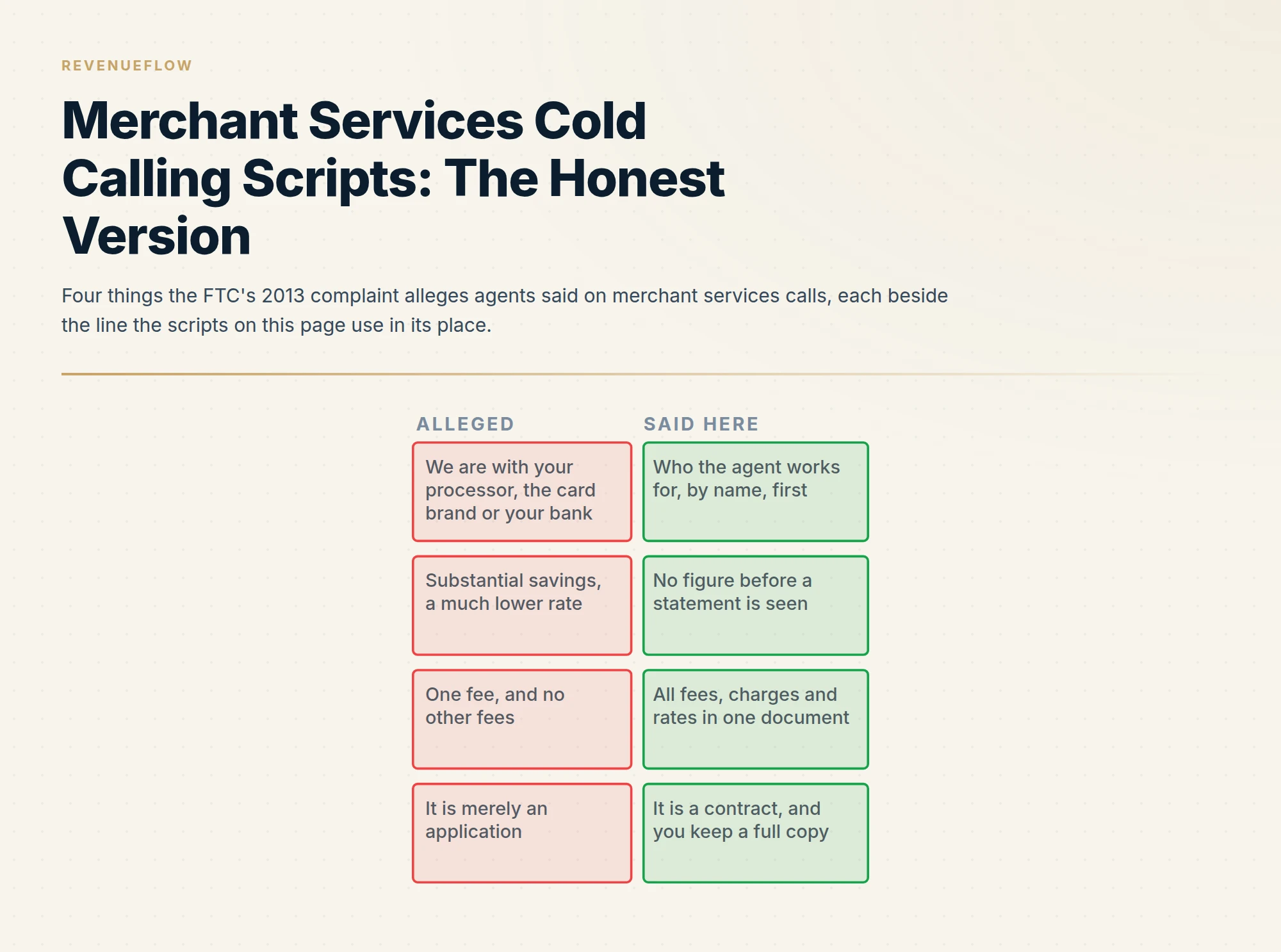
Merchants hear this call weekly and the FTC has described how it goes wrong: agents implying they are the current processor, promising savings, quoting one fee and calling a contract an application. Honest merchant services scripts name the ISO first, deny any tie to the processor, bank or card brands, ask for a statement and put every fee in writing.
Key takeaways
- The FTC's 30 July 2013 complaint alleges ISO sales agents typically called small businesses and led them to believe they were associated with the current card processor, Visa or MasterCard, or the bank.
- The 27 October 2014 settlement required a separate document disclosing all fees, charges and rates before any contract is signed, plus a complete copy of whatever the merchant signs.
- A business owner in a July 2024 r/sales thread reports two or three of these calls a week, hangs up on the dialer pause, and admits lying about being under contract to end the call.
- Visa's partner page says agents must register through a Visa client sponsor and that merchants will prefer registered agents listed on the Visa Global Registry of Service Providers.
Reviewed and updated September 19, 2026
Merchant Services Cold Calling Scripts: The Honest Version
The phone rings behind the counter of a print shop. The owner picks up, says the shop's name, and hears nothing for two seconds. Then a voice asks for the person in charge of merchant services. The owner hangs up, searches the number, sees what kind of call it was, and blocks it. The agent on the other end never said a word of the script.
This page is for the merchant services agent, the independent sales organisation (ISO) rep and the payment processor's inside sales team who call merchants about card acceptance. That is one specific corner of payments. A company selling payments software or infrastructure to banks and platforms is in a different sale, which fintech lead generation covers. The scripts here are built around what regulators have said about this exact call, so that an honest agent sounds different from the calls that came before. Every outside source was fetched on 18 September 2026. No rate, fee or savings figure appears in any script except as a placeholder, for reasons the next section makes plain.
What the merchant has already been told, and by whom
The Federal Trade Commission has described this call in a complaint. In its 30 July 2013 release on an ISO that sold card processing to storefront businesses and sole proprietorships, the agency alleged that sales agents "typically call small businesses and lead them to believe they are associated with the businesses' current card processor, Visa or MasterCard, or their bank." The agents allegedly promised substantial savings, specified a much lower rate than the business currently paid, and quoted "one fee, a fixed per-transaction cost, without mentioning all the other fees the businesses will have to pay." Merchants who asked about other fees were allegedly told there were none, and were persuaded to sign binding contracts on the spot by being told the documents were merely applications.
The settlement announced on 27 October 2014 required the defendants to give merchants a separate document disclosing all fees, charges, and rates before any contract is signed, and a complete copy of anything the merchant signs. The pattern did not end there. In July 2022 the agency acted against a payment processor and two sales affiliates, alleging false claims about fees and cost savings and a service made difficult and expensive to cancel.
Set that beside the script that ranks first for this search. Beacon Payments, an ISO, publishes a basic cold calling script for merchant services whose pitch line tells the agent to say that clients often save a stated percentage on processing costs. A savings figure quoted before the caller has seen a statement is the first thing the 2013 complaint describes. Nothing on this page says that ISO deceives anyone. The point is narrower: the standard script in this trade opens with the claim that regulators and merchants have learned to distrust, so an honest agent gains by dropping it.
Who picks up, and what they do in the first seconds
The best merchant-side voice in the search results is a business owner answering an agent's question in an r/sales thread on payment processing appointment setting, in July 2024. The owner reports two or three of these calls a week and describes them from the inside. The callers, the owner writes, "asked to speak to the person in charge of our merchant services", and "there's usually a big pause in between me answering the phone and somebody actually being there", at which point the owner hangs up and blocks the number. On the rare occasions the conversation continues, the owner's method is simple: "I just lie and say that I'm under contract".
Three things follow for a script. The pause is a dialer artefact, and it ends the call before any wording matters; what cold calling is and which rules apply quotes the FTC's two-second standard for an abandoned call. Asking for the person in charge of merchant services marks the caller at once, because nobody inside a shop calls the role that. And the contract objection is often a polite exit, so arguing with it is pointless.
At an owner-led business the person who answers is counter staff, a manager on duty or the owner, and the live page on cold calling business owners explains why that person is seldom a trained screener and why the owner keeps a trade's hours, not office hours. Ask whoever answers when the owner is least busy; they know, and they will usually say.
Script 1: whoever answers the counter line
Grounded in the thread: no pause, and no request for the person in charge of merchant services.
Hi, this is {{name}}, a local agent with {{iso_name}}. We set up card processing for shops around {{town}}. No pitch today. Is {{owner_name}} the owner? When is a quiet time to catch them for two minutes?
Dial it by hand. A line that opens on a live voice is the cheapest difference an agent can buy.
Script 2: the owner, first twenty seconds
Grounded in the 2013 complaint: it says who the caller is and is not, and it promises nothing.
{{owner_name}}, this is {{name}} with {{iso_name}}, an independent agent. We're not your current processor, your bank or the card brands, and this is a sales call. We read processing statements for {{business_type}} shops and tell the owner, in writing, what every line is. Sometimes there's money in it and sometimes there isn't. Could we look at one month's statement?
Script 3: the request to just send rates
Grounded in the complaint's "one fee" allegation. A rate quoted without the statement is the thing to avoid, so the script says why.
We could, and it would tell you nothing, because a headline rate leaves out most of what you pay. What we can send is a one-page list of every fee we charge, all of them, in writing. Send over last month's statement and each line on yours gets marked the same way, so you can put the two side by side.
Script 4: the merchant who is under contract
Grounded in the thread, where the owner admits the line is often untrue, and in the 2022 action, which turned on a service made expensive to cancel.
That's fine, and nobody is asking you to break it. Two questions and that's it: do you know when the term ends, and do you know what it costs to leave? If you don't, the agreement says, and it's worth knowing either way. We can call back the month before it ends if that's useful.
If the owner gives a date, that date is the whole value of the call. If not, leave. A written approach tied to the end of a term is a new campaign with its own reason, not a chase of this one.
Script 5: the merchant who gets these calls every week
That's believable, plenty of them come from a dialer and some claim to be your processor. This is one person who dialled by hand, and it can be checked: {{iso_name}} is registered as an agent with Visa through {{sponsor_bank}}. If you'd rather look that up first and call back, the number is {{phone}}.
The checkable fact is real. Visa's third party agent registration page says agents are required to get registered "to help establish trust and accountability in the payment industry", that registration happens with a Visa client sponsor, and that merchants will prefer to work with registered agents listed on the Visa Global Registry of Service Providers. Visa's registry page adds that service providers that store, process or transmit Visa cardholder data must be registered and must validate PCI DSS compliance every 12 months. An agent who cannot name the sponsor should find out before the next dial.
Script 6: the voicemail
{{owner_name}}, {{name}}, independent agent with {{iso_name}}, {{phone}}. We review card processing statements for {{business_type}} shops and put every fee in writing. If you'd like yours looked at, call {{phone}}. If not, ignore this and we won't call again.
What an agent hands over before anything is signed
The 2014 order is a usable checklist even for an agent it never bound, because it describes what the regulator thought a merchant was owed.
The ISO by name, and the Visa client sponsor it is registered through.
All fees, charges, and rates disclosed before any contract is signed.
Never described as merely an application.
Of anything the merchant signs, handed over before it is submitted.
The rules on the call
A call to a shop's business line about card processing is a business-to-business call. The federal position on those calls, the carve-outs, and the separate statute on autodialers and mobile numbers are quoted in is cold calling against the law. Two points sit close to this trade. The 2013 complaint covered storefront businesses and sole proprietorships, and a sole proprietor's line is often a personal mobile, which is where the consumer-facing rules come nearest; that hub draws the line and this page gives no legal reading. And the part of the FTC's rule that still binds a business caller is the ban on misrepresentation, which is the subject of every case cited above.
When a script is the wrong tool
The thread's owner processes a small annual card volume and says so: not a big get. No wording changes that. The decision about which merchants are worth a person's attention is a list decision, as bank cold calling scripts argues for a caller in the neighbouring trade. A script is also the wrong tool for an agent who cannot produce the fee document in Script 3, because every script here ends by putting something in writing.
Where the call sits next to written outreach
RevenueFlow runs email and LinkedIn for clients and does not cold-call, so these scripts describe this trade's reality and are not our motion. How email and cold calling each fail compares the channels. For a merchant services seller the written channel has one particular use: the fee list and the agent's registration can be in front of the owner before any conversation, which turns the distrust described above into an introduction that helps. Our own campaigns carry one message each, with no bumps. If building that list and message is the part you would rather hand over, see what a first campaign would target.
The short version
Merchants get this call every week, often from a dialer, often with a savings claim, and the FTC has twice described how it goes wrong. The scripts that work for an honest agent name the ISO first, deny any tie to the current processor, the bank or the card brands, quote nothing before a statement is seen, and end by putting every fee in writing.
Frequently asked questions.
Frequently asked questions- What should a merchant services agent never say on a cold call?
- Anything the FTC's 2013 complaint describes. It alleges agents led small businesses to believe they were associated with the current card processor, Visa or MasterCard, or the bank, promised substantial savings, quoted one fee without mentioning the others, and called binding contracts mere applications. An honest script names the ISO, denies those ties and quotes no figure before seeing a statement.
- How do you answer a merchant who says they are under contract?
- Do not argue, because it is often a polite exit. A business owner in a 2024 r/sales thread admits using the line untruthfully to end these calls. Ask only whether the owner knows when the term ends and what it costs to leave, offer to call back the month before, and go. A date is the most useful thing the call can produce.
- How can a merchant check that an agent is legitimate?
- Visa's third party agent registration page says agents are required to get registered through a Visa client sponsor, and that merchants will prefer registered agents listed on the Visa Global Registry of Service Providers. An agent should be able to name the ISO and the sponsor on the call and invite the merchant to look both up before calling back.
- Why do merchants hang up before the script starts?
- Often because of the dialer. The owner in the r/sales thread describes a big pause between answering the phone and somebody actually being there, and hangs up and blocks the number at that point. The second marker is the phrase asking for the person in charge of merchant services, which nobody inside a shop uses. Hand dialling and asking for the owner by name remove both.
About the author.

B2B cold email experts helping companies generate qualified leads through done-for-you outreach campaigns.
RevenueFlow Team
Explore more.
Ready to scale your outreach?
We build GTM engines that book real meetings. See the receipts.
Related articles.
Cold Calling Scripts for 3PL Companies: One Lane at a Time
Six call scripts for brokers and 3PLs calling shippers: the front office line, the one-lane opener, the incumbent answer, the email brush-off and the voicemail.
Cold Calling Scripts for SEO Agencies: After Google's Warning
Six call scripts for SEO agencies calling local businesses, written around what Google and the FTC tell owners about this call: no Google tie, no ranking guarantee.
Cold Calling Scripts for Accounting Firms, by Service Line
Six call scripts for accounting firms by service line, the Supreme Court case that lets CPAs call business prospects, and the filing calendar that says when to.
Cold Calling Scripts for Law Firms: Who Answers and What Works
Five call scripts for vendors calling law firms: the receptionist, the legal assistant, the firm administrator and the partner, plus why firms cannot cold call clients.
Cold Calling Scripts for Restaurants: Call Between Services
Six call scripts for vendors calling independent restaurants: when the line can talk, who to ask for by name, the contract objection and the pre-opening call.
Sales Outsourcing for SaaS Companies: What to Hand Over
For SaaS companies weighing an outside sales team: what the industry's own survey found, what a third party cannot hold in a software sale, and what can go out.