Sales Outsourcing for SaaS Companies: What to Hand Over
For SaaS companies weighing an outside sales team: what the industry's own survey found, what a third party cannot hold in a software sale, and what can go out.
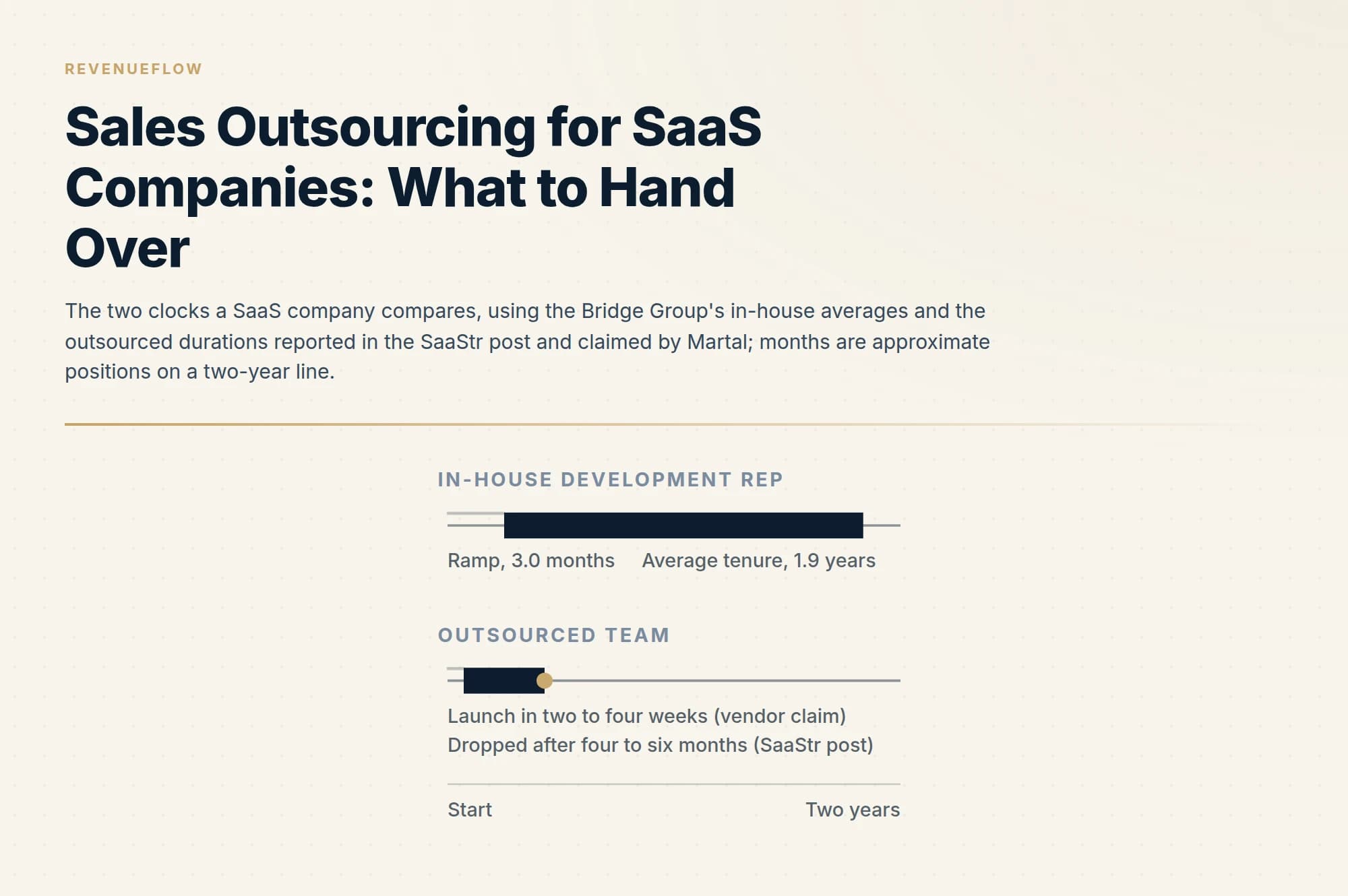
Outsourcing works for a SaaS company only after founder-led selling has proven the message, the customer profile and the offer. In a SaaStr survey of more than 1,200 respondents, 7 percent said outsourced development reps really worked. Keep the trial hand-off, pricing and closing inside; hand over list building, first messages, inbound qualification or a new region.
Key takeaways
- In the SaaStr survey published on 28 May 2023, with more than 1,200 respondents, 7 percent said outsourced sales development reps had really worked and 26 percent said they had sort of worked.
- Operators commenting under that post said B2B SaaS customers expect product knowledge even at the appointment setting stage, and that a complex product with a high order value has no substitute for an in-house team.
- The Bridge Group's 2025 study of 351 B2B companies, 83 percent B2B SaaS, puts the in-house alternative at a 3.0 month ramp, 1.9 years of average tenure, 40 percent annual attrition and 60 percent of reps at quota.
- The FTC's CAN-SPAM guide says a company cannot contract away its legal responsibility, so an agency's unsubscribes have to reach the SaaS company's own lists, including product emails to trial users.
Reviewed and updated September 19, 2026
Sales Outsourcing for SaaS Companies: What to Hand Over
Picture a workflow software company that signs an agency in March to book demos. The agency's callers are diligent and the calendar fills. By June the account executives are complaining that prospects arrive expecting answers about integrations that the caller could not give, and the founder is spending Friday afternoons rewriting the agency's scripts. In September the contract is not renewed, and nobody can say whether outsourcing failed or whether the wrong part of the job was outsourced.
This page is for the SaaS company on the buying side of that decision: a founder, a revenue leader or a head of sales development deciding whether an outside firm should do some of the selling. The general decision is already covered in SDR outsourcing, which sets out the models and what each costs, and it is not repeated here. Readers selling to software companies want cold email for SaaS. What follows is the part that is specific to software: what the SaaS industry's own survey found, what an outsider cannot hold in a software sale, and where the hand-off sits. Sources were fetched on 18 September 2026.
What the SaaS industry found when it asked itself
Jason Lemkin of SaaStr published the result of a survey on 28 May 2023 under a headline that gave the answer: only 7 percent of respondents had really got outsourced sales development reps to work. Another 26 percent, in Lemkin's count, said it had sort of worked. He puts the respondents at more than 1,200. His own experience, in the same post, is that an experienced outsourced team brought in new sponsors for SaaStr itself and added about 8 percent of new revenue, worth it, but at lower margins than core customers and with a lot of bandwidth consumed. He had invested in two startups that micromanaged outsourced teams to some success, managing the resources, writing the scripts and reviewing the lists, and neither stayed with its agency after four to six months. He had not seen an outsourced team replace an in-house one.
A vendor's page agrees with the direction. Martal, an agency that sells this service, wrote on 2 July 2026 that the most expensive mistake in SaaS sales outsourcing is handing strategy and execution to an agency before founder-led sales has proven what message, customer profile and offer convert. When the seller of a service and the sceptic about it name the same precondition, the precondition is probably real.
What a third party cannot hold in a software sale
The comments under Lemkin's post are the vertical speaking for itself, and they are specific about software. Eric Harrington, a co-founder of TeamSupport, wrote that it is hard for B2B SaaS where the solution is geared towards sophisticated customer workflows, because customers expect more product knowledge even at the appointment setting stage. James Rehm, chief operating officer of Skuuudle, wrote that it had not worked for them across a number of well-managed, diligent organisations, and that for a high order value and a complex product there is no substitute for having your own team and investing in its expertise. Marcus Kingsley of SchoolStatus wrote that for opening up a new region or segment it is viable, given enablement tools and regular oversight, but that outside resources are harder to pivot quickly in seasonal cycles or sudden changes in market conditions, and that internal people have real-time access to cross-functional information.
Software adds one more thing an outsider does not hold: the product's own data. ProductLed's survey of more than 600 SaaS businesses, in a post dated 5 February 2025, found that free accounts flagged by their usage as product qualified leads convert about three times better than free accounts in general, and that Sales is the function most often responsible for converting free accounts to paid. The flag comes from inside the product. An agency working from a purchased list cannot see which trial accounts unlocked a high-value feature this week, so the trial hand-off is a job for whoever can.
| Part of the sale | Who holds it | Per |
|---|---|---|
| Message, customer profile and offer | Stays inside | Martal; Lemkin |
| Trial accounts flagged by usage | Stays inside | ProductLed |
| Complex product, high order value | Stays inside | Rehm; Harrington |
| Pricing and late-stage closing | Stays inside | Martal |
| List building and cold outreach | Can go out | Martal |
| Inbound qualification | Can go out | Kost |
| A new region or segment | Can go out | Kingsley |
Martal's own list of what to keep is strategy, pricing, the customer profile and late-stage closing, and what to hand over is list building, cold outreach and qualification. Kevin Kost, a customer success director at GrammaTech, gave the operators' version under the same post: an outsourced team either needs to specialise within your market or be used exclusively for inbound qualification.
Who owns the decision inside a SaaS company
Martal addresses its guide to founders, chief revenue officers, sales vice presidents and sales development leaders. The Bridge Group's 2025 study of sales development, published on 6 February 2025 from 351 B2B companies of which 83 percent were B2B SaaS, shows why the owner varies: 60 percent of development teams report to Sales, 26 percent to Marketing and 10 percent to a chief officer. Whoever owns the in-house team owns the outsourced one, and the account executives who receive the meetings are the people who can veto it in practice. The study reports one development rep to 2.4 account executives, so an outsourced programme of any size is feeding several closers, and their view of meeting quality is the programme's real review.
The clock: what the in-house alternative looks like
The fair comparison is with the in-house team a SaaS company would really get, and the Bridge Group measures it. Average ramp is 3.0 months, the lowest since 2010. Average tenure is 1.9 years. The Bridge Group puts median annual attrition at 40 percent, of which 16 points are promotions. The Bridge Group reports sixty percent of reps at quota, the lowest in the study's history.
Against that, Martal says an outsourced team can launch outreach in two to four weeks, a vendor's claim about its own service, and Lemkin's two startups left their agencies after four to six months. The pattern in those two facts is that outsourcing starts faster and, in the cases the vertical reports, ends sooner.
Budget is the second clock. SaaS Capital's spending benchmarks of 10 June 2026, from its survey of more than 1,000 private B2B SaaS companies completed in March 2026, put median selling costs at 15 percent of annual recurring revenue, and at 12 percent for a company with 3 to 5 million dollars of recurring revenue. An outsourced programme comes out of that line. How the units of outsourced pricing compare is set out in outsourced SDR pricing.
Contract size decides whether there is anything to outsource
SaaS Capital reported on 14 August 2026 that the median annual contract value across private B2B SaaS companies is 24,266 dollars, and 18,643 for bootstrapped companies. The companies in the Bridge Group study have a median selling price of 50,000 dollars. ProductLed found the highest median free-to-paid conversion among products with a contract value of 1,000 to 5,000 dollars. Put together, a product at the low end sells itself and has no top-of-funnel job to hand to anyone; a product at the high end has the job but, per Rehm and Harrington, needs the product knowledge an outsider lacks. The workable middle is a contract large enough to need outbound and a product simple enough to explain in a first conversation. Where that threshold sits is argued in B2B SaaS lead generation.
One rule that does not transfer with the work
The Federal Trade Commission's CAN-SPAM guide says the Act makes no exception for business-to-business email, and it is direct about outsourcing: a company cannot contract away its legal responsibility to comply, and both the company whose product is promoted and the company that sends the message may be held responsible. It requires accurate header information, subject lines that are not deceptive, a valid physical postal address and an opt-out honoured within 10 business days. For a SaaS company that means the agency's unsubscribes have to reach the company's own lists, including the product's marketing emails to trial users. The Commission's Telemarketing Sales Rule guide lists most business-to-business calls as exempt, except the sale of nondurable office or cleaning supplies. Recipients outside the United States fall under their own regimes, which this page does not summarise, and none of this is legal advice.
Channel reality, and when outsourcing is the wrong play
What the vendors in this market do is visible on their own pages. Martal describes cold outreach across email, phone and LinkedIn. Aexus, which sells market entry to software vendors, describes a fuller engagement in a page published on 6 May 2024: a business development manager, a sales director and a research function, working from a shortlist through presentations to a trial or proof of concept and then a framework agreement. Sales Force Europe argues that a company's sales stars at home do not necessarily travel, and that Europe is often treated as one continent and not as 44 separate countries. Those are vendors' descriptions of their services and are recorded as such. Our own motion is email and LinkedIn, one message per campaign and no bump sequences.
- Yes: Founder-led sales has already proven the message, the customer profile and the offer
- Yes: The job is opening a new region or segment with regular oversight
- Yes: The work handed over is list building, cold outreach or inbound qualification
- No: The product is complex and customers expect product knowledge in the first conversation
- No: The contract is small enough that the product converts free accounts by itself
- No: The market changes suddenly or seasonally and the message must pivot quickly
It is the wrong play before the pattern exists, which is the point on which Lemkin, Martal and the survey agree. It is the wrong play for a complex product with a high order value, in Rehm's and Harrington's experience. It is the wrong play where the product converts by itself, because there is no outbound job to hand over. And it is a poor fit, in Kingsley's words, for seasonal cycles or very sudden changes in market conditions. The company's own selling plan, which decides all four, is the subject of sales strategy for SaaS.
Three openers an outside team could send for a SaaS company
Each of these is a message that needs no product depth to write honestly, which is the test for handing it over. The companies and facts in them are invented for illustration, and none claims a result.
New region: to an operations director in Germany
We make scheduling software used by logistics firms in the Netherlands, and we are opening in Germany this autumn with a German-language product and a local contract. Is route scheduling handled in your team, or should I ask someone else? 1
Inbound qualification: to someone who requested a demo
Thank you for asking for a demo. So that the right specialist joins, could you tell me how many people would use it and which system it needs to connect to? We will book the time as soon as we hear back. 2
New segment: to a finance manager at a veterinary group
Our billing product is used mostly by dental groups, and we are finding out whether veterinary groups have the same problem with multi-site invoicing. Would you be willing to tell me how you handle it today? 3
- 1Built on Kingsley's comment that opening a new region is a viable use, and on Sales Force Europe's point that each country is its own market.
- 2Built on Kost's comment that an outsourced team can be used exclusively for inbound qualification; the product questions go to the specialist.
- 3Built on Kingsley's comment about a new segment; the message asks a question and leaves the product explanation to the company's own team.
Deciding it
Prove the pattern with founder-led selling first. Keep the trial hand-off, pricing and closing inside. Hand over only work that can be done honestly without product depth: a list, a first message, an inbound qualification, a new region. Make the account executives the judges of meeting quality, and route every unsubscribe back to the company's own lists. The decision framework that applies to any company is in outbound sales outsourcing.
If the pattern is proven and the constraint is running the outbound part, RevenueFlow books qualified meetings for SaaS companies on a pay-per-meeting basis, by email and LinkedIn, with the qualification criteria agreed in writing before launch.
Survey result, Lemkin's account and the operators' comments per the SaaStr post of 28 May 2023; vendor descriptions per Martal, 2 July 2026, Aexus, 6 May 2024, and Sales Force Europe; in-house benchmarks per The Bridge Group's 2025 report, 351 B2B companies; product-led findings per ProductLed, 5 February 2025; contract value and spending per SaaS Capital's 15th annual survey, posts of 14 August and 10 June 2026; outreach rules per the FTC's two guides. All fetched 18 September 2026.
Sources: Outsourced SDRs survey post, SaaStr, SaaS Sales Outsourcing Guide, Martal, A Strategic Approach to SaaS Sales Outsourcing, Aexus, Sales Outsourcing for Growing SaaS Startups, Sales Force Europe, SDR Models, Motions and Metrics 2025, The Bridge Group, Product-Led Growth Benchmarks, ProductLed, Average Deal Size for Private SaaS Companies, SaaS Capital, 2026 Spending Benchmarks, SaaS Capital, CAN-SPAM Act Compliance Guide, FTC, Complying with the Telemarketing Sales Rule, FTC
Frequently asked questions.
Frequently asked questions- Does outsourcing sales work for SaaS companies?
- For a minority, by the industry's own count. In a SaaStr survey published on 28 May 2023 with more than 1,200 respondents, 7 percent said outsourced development reps had really worked and 26 percent said they had sort of worked. Jason Lemkin, who ran it, wrote that two startups he backed made it work by managing the agency closely, and that neither stayed with its agency after four to six months.
- What should a SaaS company keep in-house when it outsources sales?
- Whatever needs product depth or product data. Martal, an agency, lists strategy, pricing, the customer profile and late-stage closing as the parts to keep. ProductLed's survey shows trial accounts flagged by usage convert about three times better, and only the company can see that usage, so the trial hand-off stays inside too. List building, cold outreach and inbound qualification are the parts operators say can go out.
- When should a SaaS company outsource its SDR work?
- After founder-led selling has proven what message, customer profile and offer convert, which is the precondition that the SaaStr survey's author and the agency Martal both name. Operators under the survey post add two workable uses: opening a new region or segment with regular oversight, and inbound qualification. Before the pattern exists, an outside team has nothing proven to repeat.
- Who is responsible for compliance when an agency sends email for us?
- Both of you. The Federal Trade Commission's CAN-SPAM guide says a company cannot contract away its legal responsibility to comply, and that both the company whose product is promoted and the company that sends the message may be held responsible. In practice the agency's opt-outs must reach your own lists within the 10 business days the guide allows. This is a summary, not legal advice.
About the author.

B2B cold email experts helping companies generate qualified leads through done-for-you outreach campaigns.
RevenueFlow Team
Explore more.
Ready to scale your outreach?
We build GTM engines that book real meetings. See the receipts.
Related articles.
LinkedIn Outreach for Machine Shops
How a job shop or CNC machine shop uses LinkedIn to win OEM work: the four buyer titles, the RFQ gate, the ISO, AS9100 and ITAR facts, and LinkedIn's own rules.
Cold Calling Scripts for SEO Agencies: After Google's Warning
Six call scripts for SEO agencies calling local businesses, written around what Google and the FTC tell owners about this call: no Google tie, no ranking guarantee.
Appointment Setting for 3PL Companies: Fit Before the Calendar
For 3PLs, warehousing operators and brokers wanting shipper meetings: the five fit gates, the bid calendar, contract terms, the trade's rules and three openers.
Lead Generation for Telecommunications Companies: Four Lead Sources
For carriers, ISPs, UCaaS providers and MSPs: the installed base, the advisor channel, dated outbound and the funded network map as lead sources, with FCC rules.
Merchant Services Cold Calling Scripts: The Honest Version
Six call scripts for merchant services agents and ISO reps, built around what the FTC alleged about this exact call: no affiliation claim, no rate before a statement.
Cold Calling Scripts for 3PL Companies: One Lane at a Time
Six call scripts for brokers and 3PLs calling shippers: the front office line, the one-lane opener, the incumbent answer, the email brush-off and the voicemail.