Sales Strategy for SaaS: Contract Value Sets the Motion
For private B2B SaaS companies: choosing the selling motion by contract value, the product-to-person hand-off, expansion as a quota, and what a rep returns.
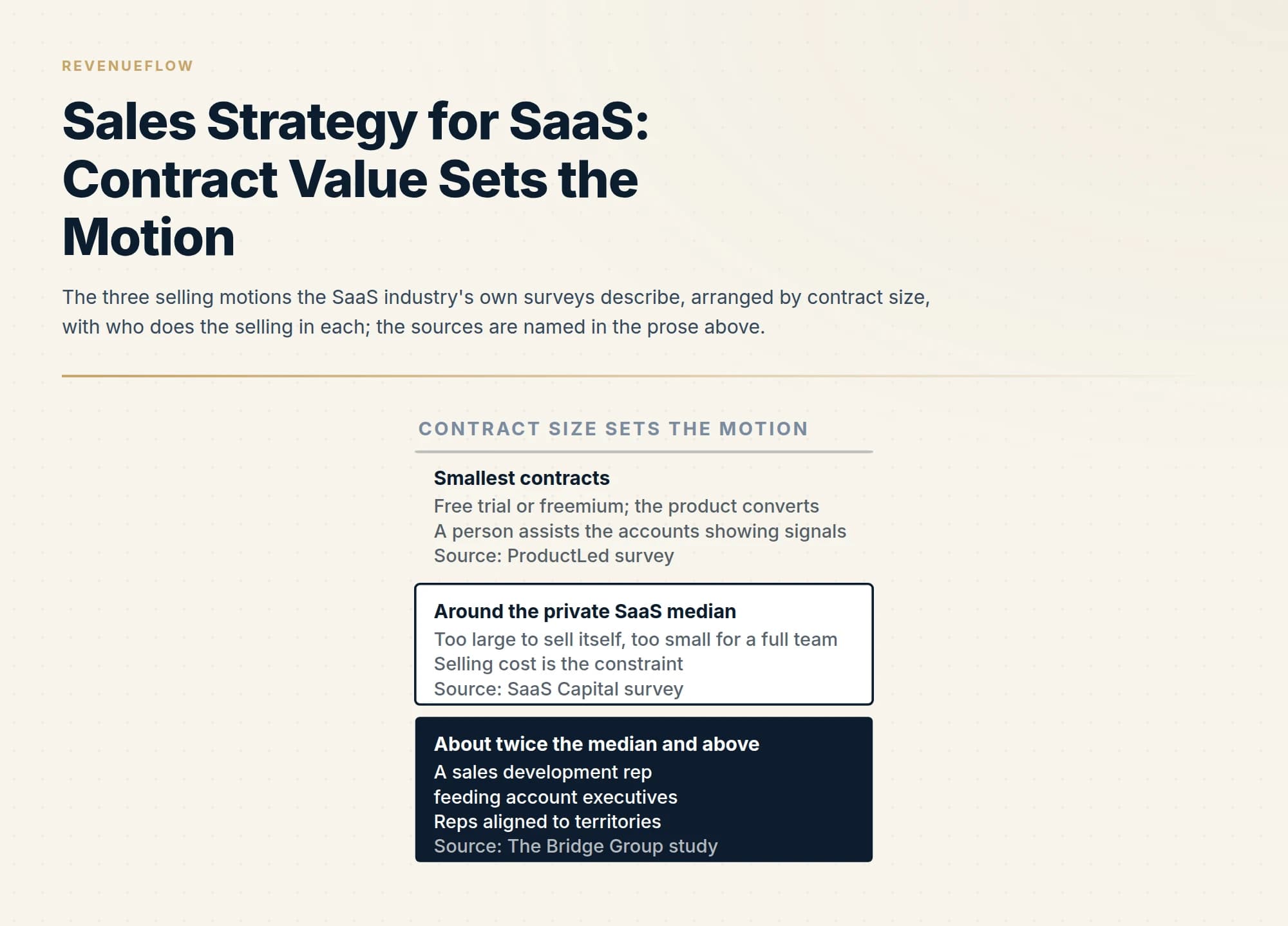
A SaaS sales strategy starts from the contract value the company has. SaaS Capital's 2026 survey of more than 1,000 private B2B SaaS companies puts the median at 24,266 dollars, about half the selling price in the Bridge Group's rep-led benchmarks. Small contracts let the product convert, large ones pay for reps, and expansion needs its own quota.
Key takeaways
- SaaS Capital's 15th annual survey, more than 1,000 private B2B SaaS companies, reports a median annual contract value of 24,266 dollars, 46,788 at 10 to 20 million of recurring revenue, and 18,643 for bootstrapped against 39,880 for equity-backed companies.
- ProductLed's survey of more than 600 SaaS businesses found about 9 percent of free accounts convert to paid, that only about a quarter of product-led companies use product qualified leads, and that conversion is about three times higher where they do.
- The Bridge Group's 2025 study of 351 B2B companies, 83 percent of them B2B SaaS, reports 3.78 million dollars of raw pipeline per sales development rep, a 3.0 month ramp, 40 percent annual attrition and 60 percent of reps at quota.
- A rep-led outbound strategy is the wrong one at the smallest contract sizes, before the founder has proven the pattern, when the existing base is shrinking, and when the plan needs every rep at quota from month one.
Reviewed and updated September 18, 2026
Sales Strategy for SaaS: Contract Value Sets the Motion
Picture a software company with four million dollars of recurring revenue that hires two account executives and a sales development rep because the board deck of a company ten times its size had them. A year later the average contract is still under twenty thousand dollars and the cost of the team is eating the margin the product earned. The strategy was copied from a company whose contract value could pay for it.
This page is for the software company deciding how it sells: a founder, a head of sales or a revenue leader at a private B2B SaaS business writing the plan for the next year. It is the company's own strategy, which makes it a different page from cold email for SaaS, written for a reader selling to software companies. The argument about where inbound stops and outbound starts is made in B2B SaaS lead generation and is not repeated here. Every figure below was fetched on 18 September 2026 from the surveys the SaaS industry runs on itself, and each is shown with its date and its population.
Start from the contract value you have, not the one you want
SaaS Capital, a lender to private software companies, reported on 14 August 2026 from its 15th annual survey of more than 1,000 private B2B SaaS companies that the median annual contract value across all respondents is 24,266 dollars, down from 26,265 the year before. Contract value rises with company size in SaaS Capital's data: companies with 10 to 20 million dollars of recurring revenue reported a median of 46,788 dollars, 85 percent above the 25,278 reported by companies at 3 to 5 million. It also differs by funding. Bootstrapped companies reported a median contract of 18,643 dollars and equity-backed companies 39,880.
Those medians are the first input to a sales strategy because they decide what a company can afford to spend winning one customer. The Bridge Group's 2025 study of sales development, published on 6 February 2025 from 351 B2B companies of which 83 percent were B2B SaaS, describes a population with a median average selling price of 50,000 dollars. The rep-led model that study measures, a sales development rep feeding account executives, is the model of companies selling contracts about twice the size of the private SaaS median.
At the other end, ProductLed's benchmarks from a survey of more than 600 SaaS businesses, in a post dated 5 February 2025, found that products with an annual contract value of 1,000 to 5,000 dollars had the highest median conversion from free accounts to paid ones. At that contract size the product does the selling and a person assists.
Who sells, at each contract size
The vertical's own surveys name the sellers more clearly than the buyers, because a SaaS company's buyer depends on what its product does, while its selling organisation follows a few known shapes.
In a product-led company, ProductLed found that the Product function is involved in creating the strategy 49 percent of the time and Marketing 42 percent, but that Sales is responsible for converting free accounts to paid in 23 percent of companies, more than any other function, with Customer Success at 15 percent. In the same ProductLed survey, Sales and Customer Success together hold 58 percent of the responsibility for upsells. For a sales strategy that means naming who owns the free account, who owns the conversion and who owns the expansion, because the survey shows those are usually three different teams.
In a rep-led company, the Bridge Group study reports one sales development rep to 2.4 account executives, with 82 percent of companies aligning those reps to account executive territories. Smaller companies, it notes, deploy more development reps per account executive.
The buyers show up in these surveys only through their behaviour. The KeyBanc Capital Markets and Sapphire Ventures survey of more than 100 private SaaS companies, released on 20 December 2023, reported that budget cuts and conservative buying patterns were driving customer churn, longer deal cycles and reduced contract values. A strategy written in a year like that one plans for a smaller first contract and a longer path to it.
The hand-off between the product and a person
Most SaaS companies now run some product-led motion, 58 percent in the ProductLed survey, and when they first adopt one, 75 percent choose a free trial or a freemium plan. The strategic question is where a person enters. ProductLed's finding is specific. Across models, ProductLed found, about 9 percent of free accounts convert to paid. Only about a quarter of product-led companies in ProductLed's survey use product qualified leads, meaning free accounts flagged by their usage as likely to convert, and where they are used the conversion rate is about three times higher: 25 percent on average for free trials, 30 percent for products with a contract value of 1,000 to 5,000 dollars and 39 percent between 5,000 and 10,000. The signals it lists are activation points, high-value feature unlocks and the usage profile. ProductLed also found that activation is tracked only 34 percent of the time, which means the signal the hand-off depends on often goes unmeasured.
The companies without a product-led motion told ProductLed why: product readiness was the main reason and 24 percent named product complexity. A complex product sold to a committee will not convert itself; its strategy is the rep-led one below.
Pricing and retention decide what selling is for
In SaaS the first contract is rarely the whole sale, and the surveys say how much that matters. SaaS Capital found that companies with net revenue retention of at least 120 percent reported a median contract value of 61,802 dollars against 26,269 for companies below that mark, and its reading is that strong retention usually reflects a product customers can grow into, often through a broader platform or more flexible pricing. SaaS Capital's growth benchmarks from the same survey found that moving net revenue retention from the 90 to 100 percent range to the 100 to 110 percent range improves growth rate by 5 percentage points, and that contract value by itself showed no overall correlation with growth rate.
Read together, those findings say expansion needs a named owner and a quota like any other selling. The pricing model decides how it happens: the KeyBanc and Sapphire survey released on 13 November 2025 found 67 percent of companies already monetising AI and favouring a subscription model over usage-based and hybrid models. A subscription expands through a conversation about seats and tiers; a usage-based contract expands without one and the account team's work is adoption.
What the vertical spends on selling, and what a rep returns
SaaS Capital's spending benchmarks of 10 June 2026, from the same survey completed in March 2026, put the median spent on selling costs at 15 percent of annual recurring revenue, up from 13 percent the year before, and marketing at 8 percent, unchanged. In SaaS Capital's benchmarks a typical company with 3 to 5 million dollars of recurring revenue spends 12 percent on selling and 8 percent on marketing. Equity-backed companies, SaaS Capital reports, spend 70 percent more on sales and 100 percent more on marketing than bootstrapped ones.
The Bridge Group study supplies the rep-side arithmetic for companies with contracts large enough to use it. Median pipeline sourced per development rep is 3.78 million dollars a year, raw pipeline and not closed revenue, and the study attributes the rise from 2.83 million in 2022 to higher selling prices, not more meetings. The Bridge Group puts average ramp at 3.0 months, median annual attrition at 40 percent and the share of reps at quota at 60 percent, the lowest in the study's history. Monthly quota depends on how far the rep qualifies before handing over: a median of 16.0 held first meetings in what the study calls the introductory model, 10.4 where the rep hands over semi-qualified meetings and 9.0 where they are fully qualified.
| Measure | Value |
|---|---|
| Introductory model | 16meetings |
| Semi-qualified | 10.4meetings |
| Fully qualified | 9meetings |
The study's methodology note says its sample skews toward organisations with engaged sales development leadership. Use the numbers to check a plan, never to set one: a plan that assumes every rep at quota in month one contradicts the vertical's own medians on ramp, attainment and attrition. The worksheet for that arithmetic is the sales strategy template.
The rules that reach a SaaS company's outreach
Two federal guides cover most of what a United States SaaS company sends. The Federal Trade Commission's CAN-SPAM guide says the Act covers all commercial messages and makes no exception for business-to-business email. It requires header information that is not false or misleading, subject lines that are not deceptive, a valid physical postal address, a clear way to opt out, and an opt-out honoured within 10 business days, and it says a company cannot contract away its responsibility when another firm sends on its behalf. The Commission's Telemarketing Sales Rule guide lists most business-to-business calls as exempt, with the sale of nondurable office or cleaning supplies as the exception. Recipients outside the United States fall under their own regimes, which this page does not summarise. None of this is legal advice.
One SaaS-specific point follows. A message promoting an upgrade to a free-trial user is still a commercial message under the guide's definition, so the opt-out duty applies to product-led outreach as much as to cold outreach.
What operators say goes wrong
The SaaS industry argues about its own sales strategy in public. Under a SaaStr post by Jason Lemkin dated 28 May 2023, Colin Cadmus, a former sales vice president at Aircall, wrote that he had never seen a company crack the outbound model and then switch to outsourcing it, and compared the alternative to trying to hire a sales team before the chief executive has proven the sales model, which he said rarely works. Ben Virdee-Chapman of Gig Wage wrote that selling before a pattern exists is brutally hard because it requires so much iteration.
Those are sequencing objections: the pattern has to exist before it can be scaled by hiring or by buying. The decision between hiring and buying, once there is a pattern, is covered in outbound for SaaS founders, and what can be handed to a third party in sales outsourcing for SaaS companies.
Channel reality, and when a rep-led strategy is the wrong one
The Bridge Group records what development reps in this vertical do all day: a median of 112 daily activities, of which 44 are phone, 41 email, 19 LinkedIn and 8 text or other, and phone-centric teams average more quality conversations a day than email-centric ones. That is the vertical's reality as its own study reports it. Our own motion is email and LinkedIn, one message per campaign and no bump sequences.
A rep-led outbound strategy is the wrong one in four sourced cases. It is wrong at the smallest contract sizes, where ProductLed shows the product converting and a person only assisting. It is wrong before the founder has closed enough deals to know the pattern, which is the operators' objection above. It is wrong when net revenue retention is under 100 percent, meaning the existing base is shrinking without new customers, because SaaS Capital's data ties growth to retention and new customers poured into a leaking base do not compound. And it is wrong when the plan only works with every rep at quota from the first month.
Three openers a SaaS company could send
Each opener below rests on one fetched finding and one fact the sender can see. None claims a result.
To the team lead at a company with an active free trial
Four people on your team built reports in the trial this week, which is usually the point where the shared workspace starts to matter. Would a twenty minute walk through the team plan be useful before the trial ends? 1
To the operations director at an existing customer
Your finance team has used the approvals module every day since March, and your procurement team has asked our support desk about it twice. Is it worth a conversation about extending it to them at renewal? 2
To a department head at a company that has announced budget cuts
Your annual report says software spending is under review this year. We offer a single-team plan that starts small and can be cancelled at the end of any quarter. Would that be an easier first step than a company-wide contract? 3
- 1Built on ProductLed's finding that product qualified leads convert about three times better; the usage signal is the reason to write.
- 2Built on SaaS Capital's finding that high net revenue retention goes with larger contracts; expansion is a sales motion with its own opener.
- 3Built on the KeyBanc and Sapphire finding that conservative buying brings longer deal cycles and reduced contract values; the smaller first contract is the answer.
The trial, the customer and the annual report in those messages are invented for illustration. Each message is sent once; a new signal is a new campaign.
Writing it down
Put the median contract value at the top of the page and choose the motion it can pay for. Name the owner of the free account, the conversion and the expansion, and give expansion a quota. Check the rep plan against the vertical's ramp, attainment and attrition. The wider frame for launch decisions is in go-to-market strategy.
If the constraint is running the outbound part once the pattern is proven, RevenueFlow books qualified meetings for SaaS companies on a pay-per-meeting basis, by email and LinkedIn, with the qualification criteria agreed in writing before launch.
Figures per SaaS Capital's 15th annual survey (posts of 14 August and 10 June 2026 and its growth benchmarks page), The Bridge Group's 2025 report, ProductLed's benchmarks post of 5 February 2025, the KeyBanc Capital Markets and Sapphire Ventures releases of 20 December 2023 and 13 November 2025, the SaaStr post of 28 May 2023 and the FTC's two guides. All fetched 18 September 2026.
Sources: Average Deal Size for Private SaaS Companies, SaaS Capital, 2026 Spending Benchmarks, SaaS Capital, 2026 Growth Rate Benchmarks, SaaS Capital, SDR Models, Motions and Metrics 2025, The Bridge Group, Product-Led Growth Benchmarks, ProductLed, Private SaaS Company Survey 2025, KeyBanc Capital Markets, Private SaaS Company Survey 2023, Sapphire Ventures, Outsourced SDRs survey post, SaaStr, CAN-SPAM Act Compliance Guide, FTC, Complying with the Telemarketing Sales Rule, FTC
Frequently asked questions.
Frequently asked questions- What is a good sales strategy for a SaaS company?
- One that matches the selling motion to the contract value. The industry's surveys describe three shapes: the product converts free accounts and a person assists at the smallest contracts, a rep-led team of development reps and account executives at about twice the private median and above, and a cost-constrained middle around the median of 24,266 dollars that SaaS Capital reported in August 2026. Pick the motion the contract can pay for, then name who owns conversion and expansion.
- How much do SaaS companies spend on sales?
- SaaS Capital's spending benchmarks of 10 June 2026, from a survey of more than 1,000 private B2B SaaS companies completed in March 2026, put median selling costs at 15 percent of annual recurring revenue, up from 13 percent, and marketing at 8 percent. A typical company at 3 to 5 million of recurring revenue spends 12 percent on selling. Equity-backed companies spend 70 percent more on sales than bootstrapped ones.
- When should a product-led SaaS company add salespeople?
- Where the usage signal exists. ProductLed found Sales is the function most often responsible for converting free accounts to paid, and that free accounts flagged as product qualified leads convert about three times better, yet only about a quarter of product-led companies flag them and activation is tracked only 34 percent of the time. The first hire works the flagged accounts; without the signal there is nothing to hand over.
- When is rep-led outbound the wrong strategy for SaaS?
- In four cases drawn from the surveys and the operators quoted on this page: at the smallest contract sizes, where the product converts by itself; before the founder has closed enough deals to know the pattern; when net revenue retention is under 100 percent, because SaaS Capital ties growth to retention; and when the plan only works with every rep at quota from the first month, which the Bridge Group medians contradict.
About the author.

B2B cold email experts helping companies generate qualified leads through done-for-you outreach campaigns.
RevenueFlow Team
Explore more.
Ready to scale your outreach?
We build GTM engines that book real meetings. See the receipts.
Related articles.
Sales Outsourcing for SaaS Companies: What to Hand Over
For SaaS companies weighing an outside sales team: what the industry's own survey found, what a third party cannot hold in a software sale, and what can go out.
Merchant Services Cold Calling Scripts: The Honest Version
Six call scripts for merchant services agents and ISO reps, built around what the FTC alleged about this exact call: no affiliation claim, no rate before a statement.
Appointment Setting for 3PL Companies: Fit Before the Calendar
For 3PLs, warehousing operators and brokers wanting shipper meetings: the five fit gates, the bid calendar, contract terms, the trade's rules and three openers.
LinkedIn Outreach for Machine Shops
How a job shop or CNC machine shop uses LinkedIn to win OEM work: the four buyer titles, the RFQ gate, the ISO, AS9100 and ITAR facts, and LinkedIn's own rules.
Lead Generation for Telecommunications Companies: Four Lead Sources
For carriers, ISPs, UCaaS providers and MSPs: the installed base, the advisor channel, dated outbound and the funded network map as lead sources, with FCC rules.
Cold Calling Scripts for SEO Agencies: After Google's Warning
Six call scripts for SEO agencies calling local businesses, written around what Google and the FTC tell owners about this call: no Google tie, no ranking guarantee.