Outbound for SaaS Founders: Adding a Sales Motion
Outbound is a different funnel rather than an extension of the inbound one, and contract value decides which version of it a SaaS company can fund.
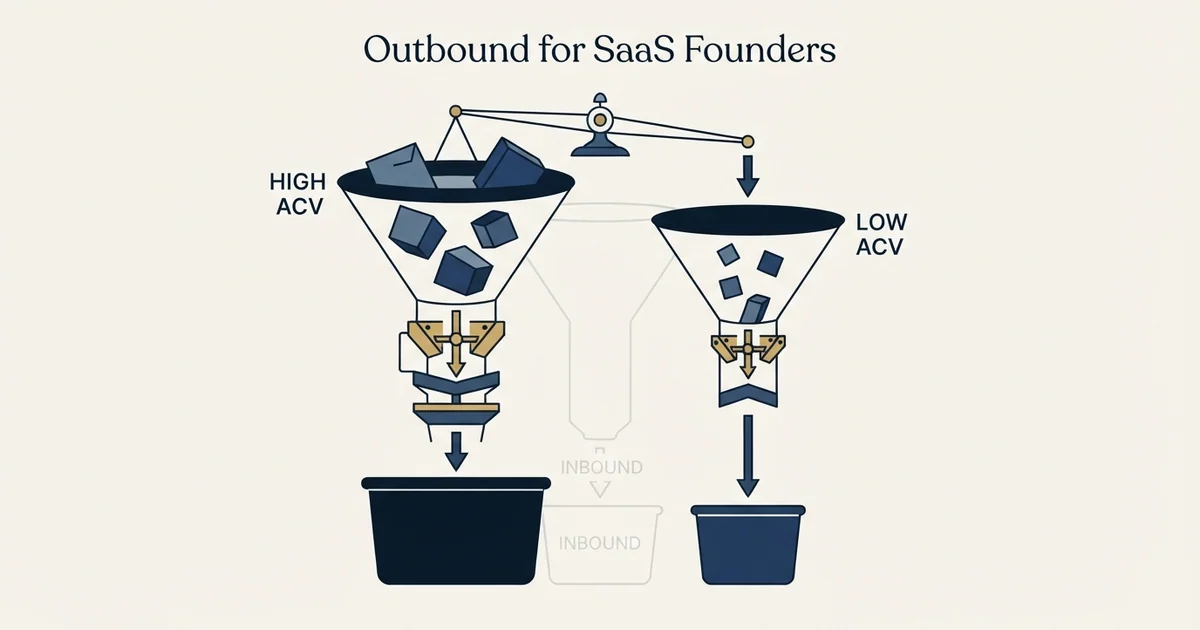
Outbound in a SaaS company creates intent rather than capturing it, so targeting runs on external evidence instead of product usage and the copy has to earn a question rather than answer one. Contract value decides which motion is affordable, and retention moves that line further than any tactic does.
Key takeaways
- Inbound copy and outbound copy do different jobs. Inbound answers a question the reader already asked, while outbound has to convince someone that the problem deserves attention this quarter.
- Product-qualified signals do not exist for an outbound target, so targeting has to run on external evidence about the company rather than on in-product behaviour.
- Contract value sets the ceiling on cost per meeting and therefore on how much human attention each account can receive, and improving retention often makes an unaffordable motion affordable without changing the outreach at all.
- In a payback calculation the meeting-to-customer conversion term moves the answer further than the price term, which is why targeting quality beats volume in this category.
Reviewed and updated September 1, 2026
Most SaaS companies arrive at outbound from the same place: a self-serve funnel that works, a content engine that produces signups, and a growth curve that has flattened because the people who were going to find the product on their own have mostly found it. Outbound is the first motion that goes and gets buyers who were not already looking, and it behaves differently enough from inbound that the instincts built on the first funnel actively mislead on the second.
This page is for the SaaS founder adding a first deliberate outbound motion to a company that has been growing on product and inbound. It covers what changes when you stop waiting for intent, the variable that actually decides whether outbound can pay for itself, how a done-for-you motion is structured, and what to check before buying one.
What changes when nobody is already looking
An inbound signup arrives with the hard part done. They have a problem, they have named it, and they have decided software might solve it. Everything the funnel does after that is qualification and conversion. Outbound starts a step earlier and has to do a job inbound never does, which is convincing someone that the problem is worth attention this quarter.
Three consequences follow, and they are the ones that surprise founders coming from a product-led company.
Your best inbound copy is the wrong copy. Inbound copy answers a question the reader already asked. Outbound copy has to earn the right to ask one. Feature language that converts beautifully on a pricing page reads as noise in an inbox, because the reader has not conceded that the category is relevant yet.
Product-qualified signals do not exist yet. A product-led company runs on in-product behaviour: activation, usage depth, seats added. Outbound targets have generated none of it, so the targeting has to run on external evidence about the company instead. The preconditions that make a product-led motion work in the first place, and what happens to them when a sales motion is bolted on, are set out in product-led growth.
More people are involved than your self-serve funnel ever showed you. A single user swiping a card is one decision. A team purchase involves the person with the problem, the person who owns the budget and often a technical or security reviewer, and outbound has to pick which one it is addressing. The multi-stakeholder reality, and how it changes the message, is covered in cold email for SaaS.
The variable that decides everything
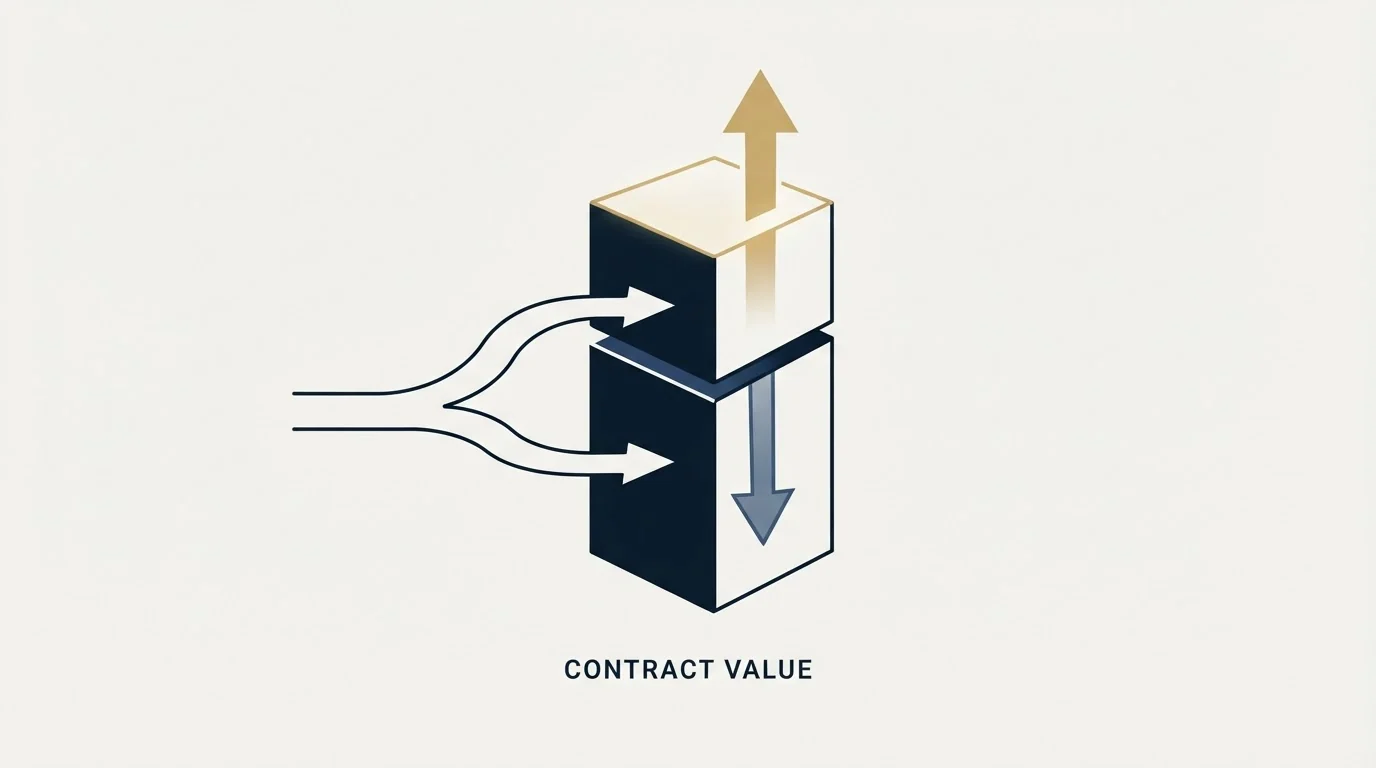
The question founders usually ask is whether outbound works for SaaS. The more useful question is which outbound motion your contract value can fund, because the answer changes completely across the range and the same tactics are right on one side of the line and ruinous on the other.
Contract value sets the ceiling on cost per acquired customer, which sets the ceiling on cost per meeting, which decides how much human attention each account can receive. Below the line, a motion has to be almost entirely automated and channel-cheap to survive. Above it, research-heavy work on a small number of named accounts pays for itself easily. The threshold argument and what changes on each side of it is set out in contract value picks the motion, and the channel version of the same arithmetic, which prices email, LinkedIn and phone per attempt, is in outbound lead generation for B2B SaaS.
Two things about that arithmetic get missed regularly by founders whose instincts were formed on a self-serve funnel.
Retention moves the line more than any tactic does. A motion that cannot be funded at your current net revenue retention can often be funded comfortably at a better one, because the customer is worth more over their life without anything about the outreach changing. Fixing retention is frequently a cheaper route to an affordable outbound motion than optimising the outbound.
Free trials compete with your own outbound. When the self-serve path is one click away, a cold message that asks for a call is competing with a route the reader finds lower-friction and lower-commitment. That is not a reason to skip outbound, and it does mean the message has to be aimed at the buyer for whom self-serve is not the answer, which is usually a team rather than an individual.
Where that self-serve route is a platform app store rather than your own site, the same test runs through a merchant economics instead, which is the subject of SDR outsourcing for ecommerce software companies.
- Targeting runs on in-product behaviour
- Copy answers a question the reader already asked
- One user can decide and pay
- Volume scales with content and category demand
- Learning arrives as usage data
- Targeting runs on external evidence about the account
- Copy has to make the problem worth attention
- A team purchase involves several people
- Volume is chosen, and capped by deliverability
- Learning arrives as reply patterns by segment
Build, buy, or leave it to the product
Once contract value has told you which motion is affordable, the delivery question is who runs it. The three routes carry different risks for a company that has never had a sales-led motion.
That same tension between buying outside expertise and building it internally surfaces again when evaluating evaluating go-to-market consulting deliverables.
Building in-house means hiring for a function that does not exist yet, into a company with no playbook to hand the hire. The first person has to invent the targeting, the message and the infrastructure while also doing the sending, and a founder who has never run outbound cannot tell whether a slow first quarter is a bad hire or a bad premise. That ambiguity is the real cost, and it usually takes two quarters to resolve.
Running it yourself for a while is genuinely useful in a product-led company, more so than in most, because the founder reading raw replies learns which of the product's several possible framings a stranger responds to. That is positioning research, and it is worth some weeks of founder time even if the plan is to hand it over immediately afterwards.
Buying the motion moves the sourcing, the infrastructure and the sending to a provider and leaves you approving the message. The four arrangements that get sold under one phrase, and what each does when the person running your account leaves, are separated in SDR outsourcing.
Go-to-market agency label explained unpacks how that broader category splits into strategy, execution and channel-access firms, which helps when vetting any outsourced motion.
The arithmetic worth running before choosing is a payback calculation, and the figures in the next paragraph are invented for the worked example. They are not benchmarks and they are not RevenueFlow results.
Suppose your average contract is worth 12,000 units a year, your gross margin is 80 percent, and a meeting converts to a customer one time in six. Each meeting is then worth about 1,600 units of gross profit in year one, and a motion that costs more than that per meeting loses money in the first year and has to be justified on lifetime value instead. Change the conversion rate to one in ten and the same motion needs its cost per meeting to come down by a third to stand still. That sensitivity is the whole reason targeting quality matters more than volume in a SaaS motion: the conversion term moves the answer further than the price term does.
Invented example figure
Invented example figure
Arithmetic on the two invented figures above
How a bought motion is put together

Stated as policy rather than as a performance claim, this is the shape of our own motion, and it is a reasonable template for what to expect from any provider that runs outbound end to end.
One message per campaign, sent once. Each campaign carries a single premise. There are no bumps and no thread replies, and a later approach exists as a separate campaign with its own reason to exist. For a company still deciding which of three positioning statements is the right one, that structure is what makes the result readable, because a reply belongs to one premise rather than to an accumulation of attempts.
Copy approved by the client before anything sends. In a product-led company this gate matters more than usual, because the founder is often the only person who can tell whether a framing is true about the product.
Qualification agreed in writing before launch. What counts as a qualified meeting is written down before the first send. Budget, timing and authority are not billing conditions, which keeps the definition from quietly narrowing later.
Email and LinkedIn. Those are the channels. No phone.
What to check before you buy
Provider-neutral questions, and the answers matter more than the deck.
Can they show the targeting criteria, including the disqualifiers? For SaaS this is sharper than usual, because company size, existing stack and funding stage all change whether a company can even buy your product. Ask what excludes a company from the list.
Are they sending from your primary domain? A product-led company's main domain carries transactional email, trial notifications and password resets. Outbound must not run on it. Sending domains should be separate, and the provider should say so without being asked.
What definition of a meeting are you paying for? Booked, attended and qualified-and-attended are three different products. Get it in writing.
Who answers the replies, and how fast? Reply handling is where most of the value sits and the first thing a thin provider leaves with you.
When is this the wrong purchase? A provider who cannot answer that is selling rather than diagnosing. For us the honest cases are a self-serve product with a very low contract value where the arithmetic above does not close, a market of a few hundred named accounts where relationship depth beats reach, and a company whose retention problem is the actual constraint. Buying pipeline on top of a leaky product buys a more expensive version of the same problem.
The short version

Outbound in a SaaS company is a different funnel rather than an extension of the existing one. Intent has to be created rather than captured, targeting runs on external evidence because no product usage exists yet, and the purchase usually involves more people than a self-serve signup ever revealed.
Contract value decides which motion is affordable before any tactical question matters, and retention moves that line further than tactics do. Run the payback arithmetic with your own numbers, and notice that the conversion term moves the answer more than the price term, which is why targeting quality beats volume in this category.
If the arithmetic works and building the function in-house is not where you want the next two quarters to go, we run outbound end to end and are paid on attended meetings that meet criteria agreed in writing before launch. You can see what a campaign would look like for your market.
Frequently asked questions.
Frequently asked questions- Does outbound work for product-led SaaS?
- It works when contract value can fund it and the buyer is a team rather than an individual. A self-serve path one click away competes with any cold message asking for a call, so the message has to be aimed at the buyer for whom self-serve is not the answer. Run the payback arithmetic first.
- Can I reuse my inbound copy for cold outreach?
- Generally no. Feature language that converts on a pricing page reads as noise in an inbox, because an outbound reader has not yet conceded that the category is relevant. Outbound copy has to make the problem worth attention before it can describe a solution, which is a different piece of writing.
- How do I target outbound accounts without product usage data?
- Use external evidence about the company: size, stack, funding stage, hiring, and whatever observable change makes the problem urgent now. Write the disqualifiers as carefully as the qualifiers, because company size and existing tooling frequently decide whether a prospect can buy your product at all.
- Should I hire a first sales rep or use an agency?
- A first hire has to invent the targeting, the message and the infrastructure while also sending, and a founder who has never run outbound cannot tell whether a slow quarter is a bad hire or a bad premise. Buying the motion removes that ambiguity and replaces hiring risk with provider and definition risk.
About the author.

B2B cold email experts helping companies generate qualified leads through done-for-you outreach campaigns.
RevenueFlow Team
Explore more.
Ready to scale your outreach?
We build GTM engines that book real meetings. See the receipts.
Related articles.
Win Rate Benchmarks: Which Figures State a Population
A catalogue of the published average sales win rates, sorted by whether the page names the population behind its own number. Most do not.
Sales Kickoff Agendas: Five Published, Session by Session
Five publishers print a sales kickoff agenda. They agree on four blocks and disagree on session length, rehearsal and where the agenda comes from.
SDR Outsourcing for Logistics Companies: The Brokerage Line
What an outside sales development team may do in a freight company's name, the calling and email rules it inherits, and which arrangement survives a bid-shaped market.
SDR Outsourcing for Business Brokers: The Fee Timing
Whether a success-fee brokerage should rent sales development at all: the fee timing, the texts that limit what an outside person may say about value, and who signs.
Sales Cycle Length Benchmarks: What Each Figure Counts
The published B2B sales cycle benchmarks, sorted by what each page says it counted. The same number means two different things in two of them.
Sales Enablement Charters: What the Published Ones Ask For
Six publishers set out what a sales enablement charter should contain. Five describe a document nobody can check, and one writes a definition with inspection in it.