Lead Generation for Telecommunications Companies: Four Lead Sources
For carriers, ISPs, UCaaS providers and MSPs: the installed base, the advisor channel, dated outbound and the funded network map as lead sources, with FCC rules.
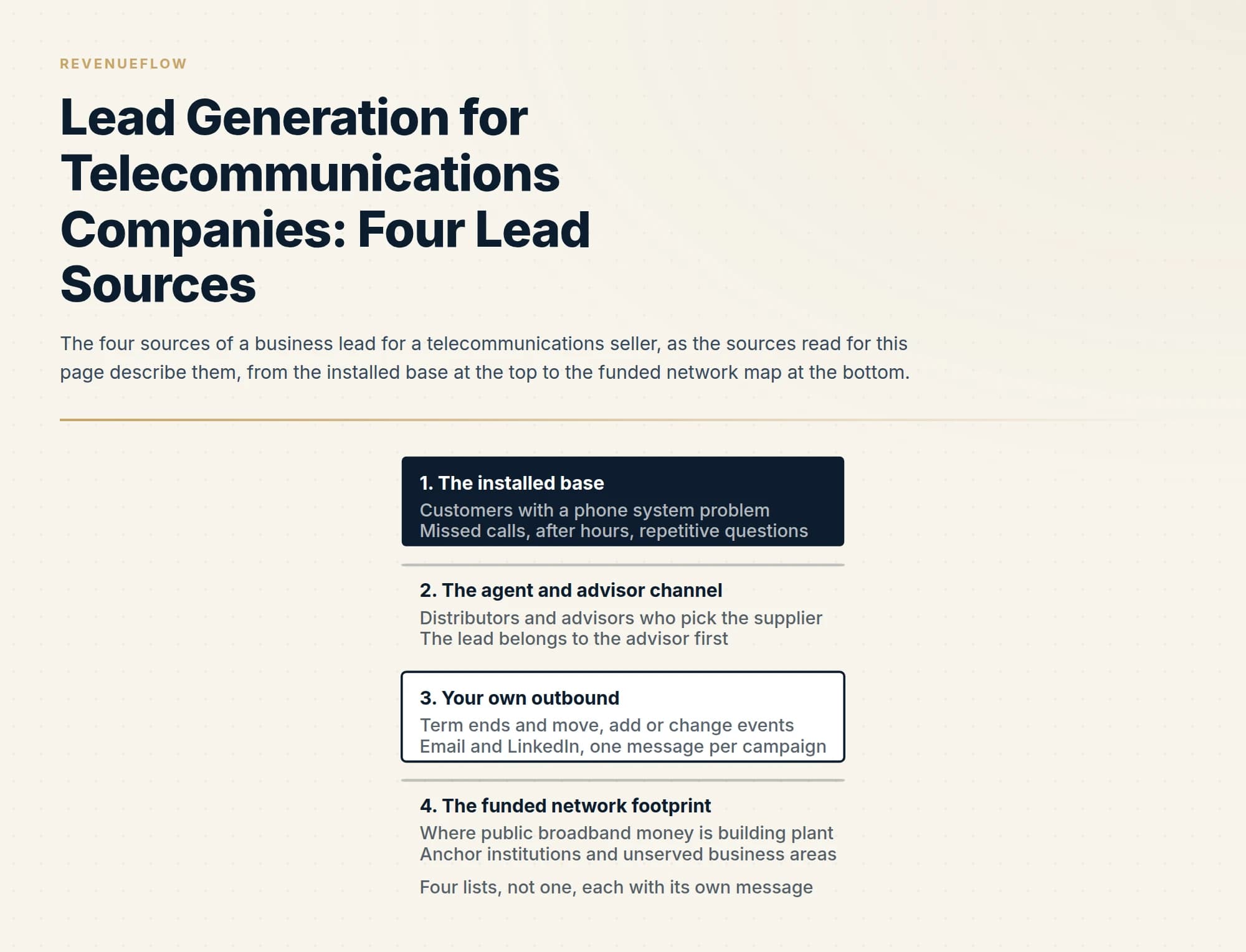
A telecom business lead comes from one of four places: the installed base with a problem the phone system creates, the advisor channel that owns the relationship, your own outbound built on contract end dates and site events, and the publicly funded network footprint. Each needs its own list, and every record carries the month the current agreement ends.
Key takeaways
- Telecom Reseller reported on 1 September 2026 that the add-customers, add-seats model gets harder when small businesses stop adding staff, and quoted BCM One's CRO that customers ask their provider to stop losing business when the phone is not answered.
- GenSales describes the enterprise buying group as evaluators, budget holders and procurement, with a network engineer asking about integration, a finance lead about total cost and a security reviewer about risk; the meeting is set with whoever can convene them.
- NTIA describes BEAD as a 42.45 billion dollar programme with allocations announced for all 56 states and territories in June 2023, eligible for unserved areas, community anchor institutions and multi-unit buildings, which makes the funded footprint a defined territory.
- The FCC's guide requires prior permission for automated calls or texts to cell phones and bars telemarketing calls to homes before 8 a.m. and after 9 p.m.; the FTC's CAN-SPAM guide holds both the promoted company and the sender responsible.
Reviewed and updated September 19, 2026
Lead Generation for Telecommunications Companies: Four Lead Sources
A managed service provider in a mid-sized city has two hundred business customers on hosted voice, and its growth formula for a decade was to add customers, add seats and add revenue. Its customers stopped adding employees. Trade press for the channel put it plainly on 1 September 2026: that model gets harder when a small business is not adding staff, and the partner's job becomes finding new revenue inside accounts that are not growing.
This page is for the telecommunications seller: the carrier, the internet service provider, the unified communications provider, the managed service provider and the technology advisor who sells connectivity and communications to businesses. It is about where business leads come from in that market and what a lead record has to carry to be worth working. Selling into telecom companies is the other direction, covered by cold email for telecom; the search results for this topic mix both directions, with Callbox and Beyond Codes publishing telecom pages that serve vendors targeting telecom accounts as much as telecom sellers, and this page serves only the seller. Every fact below was fetched on 18 September 2026 and dated where it sits.
Who buys connectivity, and how the vertical describes them
The buying group changes shape with the size of the account, and the vertical's own vendors describe both ends. GenSales, an appointment setting firm that lists Lumen, Ciena and Comcast Business among its clients, wrote on 16 August 2026 that a small-business sale often turns on one owner and a short conversation, while an enterprise technology or telecom deal moves through evaluators, budget holders and procurement. Its description of the roles is the most useful sentence in the vertical's marketing: a network engineer cares about integration, a finance lead cares about total cost, and a security reviewer cares about risk. ViB, an appointment vendor writing for telecom marketers on 17 October 2025, names the same committee as CIOs, CTOs, IT leaders and finance teams and calls the cycles notoriously long, putting the average at 103 days; that figure is ViB's own and carries no method on the page, so it is recorded as the vendor's claim.
Small business
One owner, one short conversation, one decision. The question is whether the phone gets answered and what it costs a month.
Enterprise and multi-site
- Network engineer: does it integrate with what we run
- Finance lead: what is the total cost over the term
- Security reviewer: what is the risk
- Procurement: how is it contracted and renewed
The lead-generation consequence is that a telecom lead is an account with a shape, not a contact. At the small end the shape is the owner and the current phone bill. At the enterprise end the shape is the person who can convene the other four, which is the person GenSales says a booked meeting must be set with.
The four places a business lead comes from
The first source is the base you already serve, and it is the one the channel press is worried about. Telecom Reseller's 1 September 2026 report on UCaaS partners quotes Bryan Sheppeck, chief revenue officer of BCM One, the parent of the white-label platform SkySwitch: customers are not asking for an AI voice agent by name, they are asking their managed service provider or reseller to solve a specific problem, to stop losing business when the phone is not answered. The article's own framing is that missed after-hours calls, appointment scheduling and employees tied up answering repetitive questions are business problems customers already understand. A lead inside the base is a customer with one of those problems and a contract that lets you add to it.
The second source is the agent channel. Intelisys, the technology services distributor owned by ScanSource, describes itself on its own site as offering flexible routes to market for its partner community through a simplified model, and invites advisors to become sales partners with access to its supplier portfolio. The Channel Partners Conference, which its organiser describes as thirty years old and next held at the Venetian in Las Vegas from 15 to 18 March 2027, brings thousands of technology advisors, managed service providers and suppliers into one room; the Cloud Communications Alliance counts over 150 member entities in the cloud communications sector. For a carrier or platform, a large share of business leads arrive through those advisors, who own the customer relationship and pick the supplier. For an advisor, the suppliers are the product catalogue and the leads are the advisor's own to find.
The third source is your own outbound, and in telecom it runs on dates. A business on a term contract with another provider is a lead in the months before that term ends and nothing before. A business opening a second site, moving offices or hiring a first remote team has a move, add or change event that creates a connectivity requirement on a date it already knows. Those dates are findable: in lease and planning records, in hiring pages, in the customer's own announcements. A list built on them is a list of reasons to write, which is the standard outbound lead generation sets for any vertical and which telecom meets more easily than most because the contract is the product.
The fourth source is the map of where networks are being built with public money. The National Telecommunications and Information Administration's BroadbandUSA page describes the Broadband Equity, Access, and Deployment programme as a 42.45 billion dollar federal grant programme, with allocation amounts announced for all 56 states and territories in June 2023, and lists among its eligible uses deploying or upgrading infrastructure in unserved or underserved areas, improving service to community anchor institutions, and installing service in multi-unit residential buildings. The Federal Communications Commission's Broadband Data Collection page is the map that programme runs on. For a provider building or reselling in a funded area, the anchor institutions and the businesses inside the footprint are a defined list with a construction date attached.
Timing, in a market where the contract is the product
Telecom has no single fiscal calendar, because its customers span every kind of organisation. What it has instead is the term. Business connectivity and communications are sold on multi-year agreements, and the vendor pages read for this page describe large contracts, multi-year commitments and cross-departmental buy-in as the reason enterprise cycles run long. The lead-generation implication is that the most valuable field in a telecom lead record is the month the current agreement ends, and the second most valuable is the event that will force a change before then.
- Yes: The month the current connectivity or voice agreement ends
- Yes: The current provider, and whether an advisor placed it
- Yes: Sites, seats and the move, add or change event on the horizon
- Yes: The person who can convene the engineer, finance and security roles
- Depends: Whether the address sits inside a funded build footprint
- No: A job title and an email address, nothing else
The rules that reach outbound in this vertical
Telecommunications sellers operate inside the rules the Federal Communications Commission writes for everyone else, and are held to them more visibly. The Commission's consumer guide on telemarketing and robocalls, read on 18 September 2026, describes the Telephone Consumer Protection Act rules: calls, texts or prerecorded messages to cell phones require the recipient's prior permission unless sent manually, prerecorded or artificial-voice calls must begin with the caller's name, phone number and organisation, telemarketing calls to homes are prohibited before 8 a.m. and after 9 p.m., and the National Do Not Call Registry covers landline and wireless numbers. The rules themselves sit at 47 CFR 64.1200 on eCFR, whose timeline shows amendments applied as recently as March 2026. For email, the Federal Trade Commission's CAN-SPAM guide requires accurate headers, an honest subject line, a physical address and an opt-out honoured within ten business days, and it states that both the company whose product is promoted and the company that sends the message may be held responsible.
None of that is legal advice, and a business owner's mobile is a wireless number under those rules whatever the lead vendor's spreadsheet calls it. What the rules require of the sender is the same in every vertical; what is specific here is that a telecom company's own regulator wrote them.
What the vertical says gets in the way
The objections are in the vendors' own pages and the channel's own press. ViB tells telecom marketers that many lead generation vendors promise big results but deliver unqualified meetings that waste the team's time and budget, and that gatekeepers are everywhere: reaching IT or network executives directly is tough, and many cold calls or emails never get past the first filter. GenSales, citing HubSpot's roundup of sales statistics, says a quarter of sales professionals name direct contact with decision makers as one of their hardest problems, and explains the reason as enterprise gatekeeping, with unknown callers routed through reception, assistants and shared inboxes. And the channel press quoted above says the seat-based growth model has hit its limit.
Read those together and the objection is not to being contacted. It is to being contacted with nothing specific, by someone who cannot name the contract, the site or the problem. A message that carries the term end date and the event does not meet a gatekeeper because it does not read like the messages gatekeepers exist to stop.
Channel reality, and when this is the wrong play
The vertical's own lead generation is phone-heavy. GenSales dials every number by hand and runs client-branded caller ID; Telecom Inc and the other contact centres on the results page sell live agents. That is the vertical's reality and it is described here as such. Our own motion is email and LinkedIn, one message per campaign, with no bump sequences and no second LinkedIn message under an ignored one, and it works in this vertical for the same reason outbound works anywhere: a list built on dates and events gives the message a reason to exist.
Outbound is the wrong play in three cases. A target mid-way through a multi-year term with no event on the horizon cannot buy, however good the message, and belongs on a dated list for later. An account placed by a technology advisor is the advisor's relationship, and a direct approach from a supplier that advisor represents is a channel conflict rather than a lead. And a commodity seat pitched to a business that is not growing is the exact model the channel press says has hit its limit; the lead in that account is the problem the phone system creates, not another seat. The companion page on appointment setting for telecom companies covers what a booked meeting has to carry in this market once the lead exists.
To the owner of a twelve-person dental practice
Your reviews mention that calls after five go to voicemail. Practices on our hosted voice route after-hours calls to a scheduling line instead; would it be worth ten minutes to see what yours does now? 1
To the IT director of a company opening a third site
The planning notice for your new site lists an opening in the spring. Connectivity at a new address usually needs ordering before the fit-out; we can tell you the lead time for that street if you tell us the target date. 2
To the facilities lead at a community college
Your county's funded broadband build names community anchor institutions in its eligible uses, and your campus sits inside the footprint. We are one of the providers building on it; is the current contract term something you can share? 3
- 1Built on the problem the channel press quotes customers bringing to their provider, a phone that is not answered; the ask is about the owner's own setup.
- 2Built on a move, add or change event visible in public records; the message offers a fact the buyer needs and asks for a date.
- 3Built on the BEAD programme's eligible uses as NTIA states them; it asks for the term end, the field the lead record needs most.
Running it
Build four lists, not one, because the four sources above have different owners and different messages. Mine the base for the problems the channel press names. Work the advisor channel as a partner programme, with the leads left to the advisors who hold them. Run outbound only against accounts with a term end or an event inside the next two quarters. And treat the funded footprint as a defined territory with a construction date. The general framework for turning a list into meetings is in B2B lead generation; the telecom-specific part is that every record on the list carries a date. If a vendor builds that list for you, qualified lead generation services sets out what any provider should deliver.
If the constraint is building the dated list and getting the first message out, RevenueFlow builds it and books qualified conversations on a pay-per-meeting basis, by email and LinkedIn only, with qualification agreed in writing before launch. Whether the meeting becomes an order depends on the term, which is why the term is on the list.
Channel quotations per Telecom Reseller's report of 1 September 2026; buying-group descriptions per GenSales, 16 August 2026, and ViB, 17 October 2025; distributor and event descriptions per Intelisys, the Channel Partners Conference and the Cloud Communications Alliance; the BEAD programme per NTIA's BroadbandUSA page; outreach rules per the FCC's consumer guide, 47 CFR 64.1200 on eCFR and the FTC's CAN-SPAM guide. All fetched 18 September 2026. Confirm current rules with the regulator before relying on them.
Sources: UCaaS Partners Look Beyond the Seat, Telecom Reseller, B2B Appointment Setting for Technology and Telecom, GenSales, Pay-for-performance appointment setting for B2B telecom companies, ViB, Intelisys, Channel Partners Conference and Expo, Cloud Communications Alliance, Broadband Equity, Access, and Deployment Program, NTIA BroadbandUSA, Broadband Data Collection, FCC, Telemarketing and Robocalls, FCC, 47 CFR 64.1200, eCFR, CAN-SPAM Act Compliance Guide, FTC, Telecom Lead Generation Services, Callbox, Telecom, Beyond Codes
Frequently asked questions.
Frequently asked questions- How do telecom companies generate B2B leads?
- From four sources that need separate lists: existing customers with a problem the phone system creates, such as missed after-hours calls; the technology advisor channel that distributors like Intelisys organise; direct outbound built on contract end dates and move, add or change events; and the footprint of publicly funded network builds, where anchor institutions and unserved business areas are a defined territory with a construction date.
- Who makes the decision when a business buys connectivity or voice?
- At a small business, one owner in a short conversation, per GenSales. At an enterprise or multi-site account the vendors describe evaluators, budget holders and procurement, with a network engineer asking about integration, a finance lead about total cost and a security reviewer about risk. The useful contact is the person who can convene the others, because a single form fill rarely reaches more than one of them.
- What rules apply to a telecom company's own outbound calls and emails?
- The FCC's Telephone Consumer Protection Act rules at 47 CFR 64.1200: automated or prerecorded calls and texts to cell phones need prior permission, prerecorded calls must identify the caller, home telemarketing calls are barred before 8 a.m. and after 9 p.m., and the Do Not Call Registry applies. The FTC's CAN-SPAM guide governs email, including a ten business day opt-out. This is a summary, not legal advice.
- When is outbound the wrong play for a telecom seller?
- When the target is mid-way through a multi-year term with no event coming, because it cannot buy; when the account was placed by a technology advisor, because a direct approach is a channel conflict; and when the pitch is another seat to a business that is not growing, which the channel press says is the model that has hit its limit. In those cases the lead is the problem inside the account, or the advisor, or a later date.
About the author.

B2B cold email experts helping companies generate qualified leads through done-for-you outreach campaigns.
RevenueFlow Team
Explore more.
Ready to scale your outreach?
We build GTM engines that book real meetings. See the receipts.
Related articles.
Lead Generation for Material Handling Companies
How a forklift dealer, racking maker or integrator finds plants with a dated reason to talk: OSHA evaluation cycles, dealer consolidation, MHI show rosters.
LinkedIn Outreach for Machine Shops
How a job shop or CNC machine shop uses LinkedIn to win OEM work: the four buyer titles, the RFQ gate, the ISO, AS9100 and ITAR facts, and LinkedIn's own rules.
Cold Calling Scripts for SEO Agencies: After Google's Warning
Six call scripts for SEO agencies calling local businesses, written around what Google and the FTC tell owners about this call: no Google tie, no ranking guarantee.
Appointment Setting for 3PL Companies: Fit Before the Calendar
For 3PLs, warehousing operators and brokers wanting shipper meetings: the five fit gates, the bid calendar, contract terms, the trade's rules and three openers.
Lead Generation for Trucking Companies: Three Routes
How a motor carrier finds freight customers: the load board, the broker relationship and the shipper's annual bid, with the calendar and the rules on outreach.
Merchant Services Cold Calling Scripts: The Honest Version
Six call scripts for merchant services agents and ISO reps, built around what the FTC alleged about this exact call: no affiliation claim, no rate before a statement.