Lead Generation for Trucking Companies: Three Routes
How a motor carrier finds freight customers: the load board, the broker relationship and the shipper's annual bid, with the calendar and the rules on outreach.
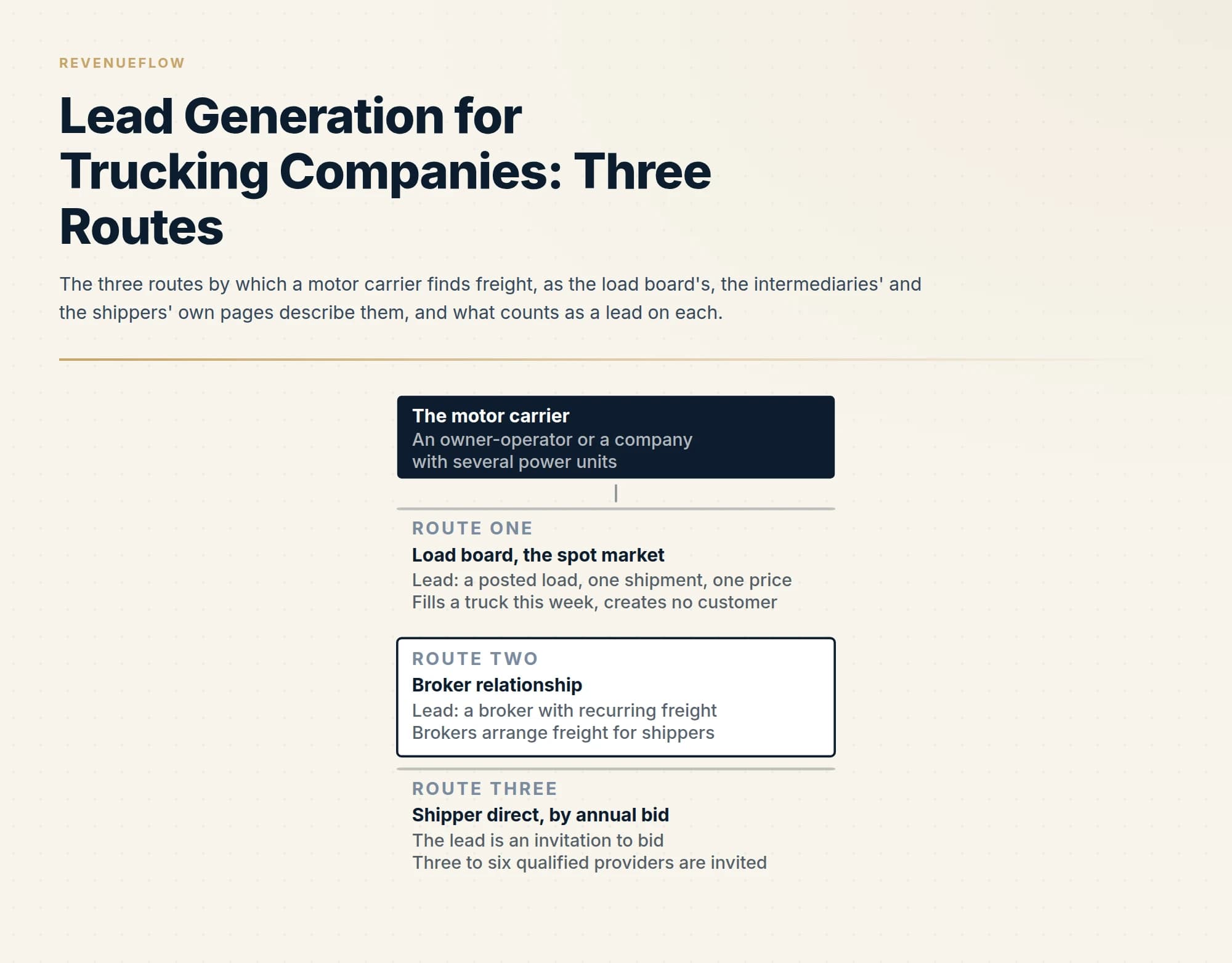
A trucking company finds freight by three routes: the load board, where a lead is one posted load; the broker, where it is recurring freight on its lanes; and the shipper's annual bid, where guides tell shippers to invite between three and six providers. Lead generation is being known to the shipper before that list is drawn up.
Key takeaways
- ATA's American Trucking Trends 2025 reports that 91.5% of carriers operate 10 or fewer trucks and 99.3% operate fewer than 100 power units, so a small carrier is one of a very large number of similar sellers.
- FMCSA defines three authorities: a motor carrier operates the vehicles, a broker arranges transportation without assuming responsibility for the cargo, and a freight forwarder assumes responsibility and may transport the freight itself.
- Shippers' guides describe contract freight as set in an annual bid, often held in the first or last quarter, lasting between 8 and 12 weeks, with between three and six qualified providers invited.
- A carrier's interstate operating authority is public and identified by a docket number, and its outreach email falls under the FTC's CAN-SPAM guide, which makes no exception for business-to-business email.
Reviewed and updated September 19, 2026
The American Trucking Associations' annual data book describes the industry a trucking company sells in with one sentence: "The industry remains one made up of small businesses, with 91.5% of carriers operating 10 or fewer trucks and 99.3% operating fewer than 100 power units" (ATA, American Trucking Trends 2025, 28 August 2025). The same release reports that trucks moved 11.27 billion tons of freight in 2024, down from 11.41 billion tons the year before, on revenues of $906 billion, down from $1.004 trillion. A small carrier looking for freight is therefore one of a very large number of near-identical sellers in a market that shrank, and lead generation for that carrier is the question of how it gets out of the crowd.
This page is for the motor carrier, from the owner-operator with authority to the regional fleet, that wants freight customers: shippers and the brokers who serve them. It is not about selling to trucking companies; that reader is served by cold email for trucking. Driver recruiting, which some searches for this phrase are really about, is a different need with different buyers and is not covered here.
Who a carrier can sell to, in the regulator's definitions
The Federal Motor Carrier Safety Administration defines the three kinds of company in the market, and the definitions say who holds the freight. A motor carrier operates commercial motor vehicles to transport property, and the agency adds: "It could be a company with several power units, or it could be an owner-operator." A broker sits between a shipper and a motor carrier: "Brokers arrange for the transportation of property or household goods," and the page says they do not operate motor vehicles or have drivers and do not assume responsibility for the cargo. A freight forwarder organizes shipments, assembles and consolidates them, and differs from a broker in one way that matters: "Unlike Brokers, Freight Forwarders assume responsibility for the transportation and may transport the freight itself" (FMCSA, definitions of motor carrier, broker and freight forwarder authorities, last updated 22 May 2023).
So a carrier has three possible customers: the shipper that owns the freight, the broker that arranges it, and the forwarder that takes responsibility for it. The intermediaries are organised. The Transportation Intermediaries Association says its members "serve tens of thousands of shippers and carriers, bringing together the transportation needs of the cargo interests with the corresponding capacity and special equipment offered by rail, motor, air, and ocean carriers," and that it serves more than 1,800 third-party logistics members (TIA, About Us, read 18 September 2026). The small carriers are organised too: the Owner-Operator Independent Drivers Association reports that "More than 150,000 members of OOIDA are men and women in all 50 states and Canada who collectively own and/or operate more than 240,000 individual heavy-duty trucks and small truck fleets" (OOIDA, About Us, read 18 September 2026).
| Row | May transport the freight | Arranges or organizes shipments | Assumes responsibility for cargo |
|---|---|---|---|
| Motor carrier | Yes | No | No |
| Broker | No | Yes | No |
| Freight forwarder | Yes | Yes | Yes |
Three routes to freight, and what a lead is on each
A carrier finds freight by three routes, and a lead means something different on each.
The first is the load board, the spot market's storefront. DAT, the largest of them by its own description, advertises its network to carriers as "the industry's largest load board network" and says more than 291 million loads and trucks are posted on it annually (DAT, Load Boards, read 18 September 2026; DAT's own figures). A lead here is a posted load: one shipment, one price. DAT markets the same network to brokers as access to "over 1.7 million trucks," so the party posting can be an intermediary and not the shipper. It fills a truck this week and creates no customer.
The second is the broker relationship. Brokers arrange freight for shippers, so a carrier that becomes a broker's regular capacity on its lanes is carrying that broker's customers without selling to each of them. A lead here is a broker with recurring freight on the carrier's lanes.
The third is the shipper directly, and it runs on a written process. RXO, writing for shippers, explains contract rates this way: "They are usually set during an annual bid, aka request for proposal (RFP)," in which a business takes its forecasted shipping needs to its providers and asks for committed pricing, and "At the end of the bid process, the shipper will award lanes to specific providers based on rate, service, capacity and other considerations" (RXO, Contract Rates vs. Spot Rates, read 18 September 2026). Among the reasons it gives for carriers to want this: "More predictable revenue." A lead here is an invitation to bid, and the number of invitations is small. Worldwide Express's guide for shippers running a freight RFP says that "Most organizations invite between three and six qualified providers" (Worldwide Express, Freight RFP Guide, read 18 September 2026).
That last figure is the case for lead generation in trucking. The shipper's list is three to six names long, and a carrier that is not known to the shipper's freight procurement team when the list is drawn up is unlikely to be on it.
The calendar: bid season and the weeks inside a bid
The shipper's buying calendar is published by the people who run bids. Ryan Transportation wrote for shippers that "Many shippers hold annual transportation sourcing events during the first or last quarter of the year so they can evaluate their transportation costs and create the new budget for the coming fiscal year," and added that "Monthly and quarterly bid cycles became more popular" after a strong hurricane season and the electronic logging device mandate (Ryan Transportation, When is the Right Time to Run a Bid Cycle?, 20 January 2021). The same article tells shippers something carriers should hear: carriers "have become more aware that shippers expect them to lower rates during this time in order to secure contracts," and many no longer do.
Inside a bid the clock is also printed. Worldwide Express puts a freight RFP at "between 8 and 12 weeks" and breaks it into four phases: data preparation, two to three weeks; distribution and responses, three to four weeks; evaluation and negotiation, two to three weeks; contracting and final selection, one to two weeks. It advises shippers not to launch a bid during peak retail season, holiday shipping surges or capacity-constrained market conditions. For a carrier the natural moment to become a name on the list is the first phase, while the shipper is still preparing its data. Once the RFP is distributed, the invitations have gone out.
| Phase | Duration | What a carrier can do |
|---|---|---|
| Data preparation | Two to three weeks | Be known to the freight procurement team while the list is drawn up |
| Distribution and responses | Three to four weeks | Respond, if invited; the invitations have gone out |
| Evaluation and negotiation | Two to three weeks | Answer on rate, service and capacity |
| Contracting and final selection | One to two weeks | Accept the lanes awarded |
What the rules require of the carrier
Two sets of rules touch a carrier's lead generation, and the first decides whether a shipper can buy from it at all. FMCSA states that, in general, companies that transport federally-regulated commodities owned by others for compensation in interstate commerce are required to have interstate operating authority in addition to a USDOT number, that the authority is identified by a docket number, and that "a company may need to obtain multiple operating authorities to support its planned business operations" (FMCSA, Get Operating Authority, read 19 September 2026). A carrier's authority is public and a shipper's or broker's first check, so the docket number belongs in the first message, not the third.
The second is the ordinary rule for commercial email. The Federal Trade Commission's guide states that the CAN-SPAM Act "makes no exception for business-to-business email," that penalties run to $53,088 for each separate email in violation, and that a valid physical postal address and a clear way to opt out are required in every commercial message (FTC, CAN-SPAM Act: A Compliance Guide for Business, read 18 September 2026). A carrier writing to a shipper about its lanes is sending commercial email. Whether a specific practice is compliant is a question for counsel.
The objections, from the shipper's side of the table
The objections a carrier will meet are written down in the guides shippers use.
The first is that price is not the whole score. Worldwide Express tells shippers that "The most common freight procurement mistake is selecting the lowest bidder without evaluating overall capability," and offers a sample weighted scorecard in which pricing carries the largest weight, followed by service capability, technology and financial stability. A small carrier hears "technology" and "financial stability" as objections, because they are scored.
The second is service, defined in advance. The same guide lists the service levels a shipper should set before the bid: on-time pickup targets, on-time delivery requirements, transit time expectations, claims management processes and escalation procedures. A carrier that cannot state its own numbers on those has nothing to put against the incumbent.
The third is that the shipper may not tender what it awards. A second RXO guide for shippers names compliance to RFP awards, the shipments tendered to the primary carrier against the shipments awarded, as a meaningful measure and warns that a low figure means "you are not meeting carrier expectations, giving them less incentive to accept volume surges" (RXO, 7 Steps for Conducting a Better Transportation RFP, read 19 September 2026). That is the carrier's own objection, put to shippers in print: an award is not freight until it is tendered.
Channel reality, and when outbound is the wrong play
The load board needs no outreach and builds no customer. The broker and the shipper are reached by people, in writing and by phone. The phone is how much of this industry talks, and it is described here as the vertical's reality, not as our motion: RevenueFlow runs email and LinkedIn and does not cold-call. A written message to a shipper's freight procurement team that names the carrier's lanes, equipment and authority, sent before bid season, is legitimate lead generation here.
Outbound is the wrong play in three cases. It is wrong in the middle of a distributed RFP, because the three to six invitations have already gone out. It is wrong in the periods Worldwide Express tells shippers to avoid, peak retail season and holiday shipping surges, because the buyer is moving freight, not reviewing carriers. And it is wrong for a carrier with no lanes to name: a message that says a carrier will haul anything anywhere is what every one of the small carriers in ATA's count can say.
Three openers, each grounded in a page the buyer can check
Three sample first lines a carrier could send, each tied to one fetched source. No opener claims a result, addresses a real person or includes contact details.
To the freight procurement lead at a regional shipper, before bid season. Freight RFP guides tell shippers to invite between three and six qualified providers and to spend the first two to three weeks preparing data. If you run a bid in the first quarter, we would like to be one of the names considered for your outbound lanes from our terminal's region. Our operating authority docket number is in the signature for you to check. The figures are from a published guide and the ask is a place on the list.
To a broker that arranges freight on the carrier's lanes. We run dry van capacity out of our home market five days a week and hold our own authority. If you arrange recurring freight on those lanes, a short conversation about becoming regular capacity for it is the ask. The message offers what FMCSA's definition says a broker needs: a carrier to move what it arranges.
To a shipper whose carrier contract is ending. Worldwide Express lists an upcoming carrier or 3PL contract expiration first among the common triggers for a logistics RFP. If yours is coming up, we would like to show you our service record on the lanes we already run near you before the bid is written. The trigger is quoted from a guide shippers read.
To: Freight procurement lead, a regional shipper, before bid season
Freight RFP guides tell shippers to invite between three and six qualified providers and to spend the first two to three weeks preparing data. 1
If you run a bid in the first quarter, we would like to be one of the names considered for your outbound lanes from our terminal's region. Our operating authority docket number is in the signature for you to check. 2
Postal address and opt-out line in the footer. 3
- 1Figures from Worldwide Express's guide for shippers, which the reader can check.
- 2Timed to the first quarter, and gives the docket number, which is a shipper's first check.
- 3The postal address and opt-out line the FTC's CAN-SPAM guide requires of every commercial email.
What a lead is for a trucking company
On the load board a lead is a load. With a broker it is recurring freight on lanes the carrier already runs. With a shipper it is a place among the three to six providers invited to bid, earned before the first quarter, with the operating authority public and the service numbers ready. How a supplier writes to fleets, the opposite direction from this page, is in cold email for trucking; how vendors sell to logistics companies is in logistics lead generation; and the difference between buying names and buying meetings is in appointment setting versus lead generation.
RevenueFlow runs the written channels, email and LinkedIn, with one message per campaign, criteria agreed in writing before launch and payment on attended meetings that meet them. If the written side of reaching shippers and brokers is the part you would rather have run, you can see what a campaign would look like for your market.
The association pages, FMCSA's pages, the freight companies' guides and the FTC guide were fetched on 18 September 2026 from the pages linked, and RXO's bid guide and FMCSA's operating authority page on 19 September 2026. DAT's, RXO's, Ryan Transportation's and Worldwide Express's statements are those companies' own, written for their customers. Rules change; confirm them at the source. Nothing here is legal advice.
Sources: ATA, American Trucking Trends 2025, FMCSA, authority definitions, FMCSA, Get Operating Authority, TIA, About Us, OOIDA, About Us, DAT, Load Boards, RXO, Contract Rates vs. Spot Rates, Ryan Transportation, bid cycle timing, Worldwide Express, Freight RFP Guide, RXO, 7 Steps for Conducting a Better Transportation RFP, FTC, CAN-SPAM compliance guide
Frequently asked questions.
Frequently asked questions- How do trucking companies find shippers instead of relying on load boards?
- By being known to the shipper before its annual bid. RXO's guide for shippers says contract rates are usually set during an annual bid in which the shipper awards lanes on rate, service, capacity and other considerations, and Worldwide Express's freight RFP guide says most organizations invite between three and six qualified providers. A carrier earns an invitation by writing to the freight procurement team ahead of bid season with its lanes, equipment and operating authority.
- When is bid season for trucking contracts?
- Ryan Transportation wrote in January 2021 that many shippers hold annual transportation sourcing events during the first or last quarter of the year, so they can evaluate costs and set the budget for the coming fiscal year, and that monthly and quarterly bid cycles had become more popular. Worldwide Express's guide puts a freight RFP at between 8 and 12 weeks and advises shippers against launching one during peak retail season or holiday shipping surges.
- What do shippers score when they evaluate carriers in a freight RFP?
- More than price. Worldwide Express's guide calls selecting the lowest bidder without evaluating overall capability the most common freight procurement mistake and offers a sample weighted scorecard covering pricing, service capability, technology and financial stability. It also lists the service levels a shipper should define in advance: on-time pickup targets, on-time delivery requirements, transit time expectations, claims management processes and escalation procedures.
- When is outbound the wrong lead generation play for a trucking company?
- In the middle of a distributed RFP, because the three to six invitations have already gone out. In the periods shippers are told to avoid for procurement, peak retail season and holiday shipping surges, because the buyer is moving freight and not reviewing carriers. And when the carrier has no lanes to name, because a message offering to haul anything anywhere is one every small carrier in ATA's count could send.
About the author.

B2B cold email experts helping companies generate qualified leads through done-for-you outreach campaigns.
RevenueFlow Team
Explore more.
Ready to scale your outreach?
We build GTM engines that book real meetings. See the receipts.
Related articles.
Sales Strategy for Logistics Companies: Segment, Seat, Cycle
How a broker, forwarder, carrier or 3PL sets its sales strategy: Armstrong's segments and contract terms, the four provider seats shippers keep, and the rate cycle.
Lead Generation for Telecommunications Companies: Four Lead Sources
For carriers, ISPs, UCaaS providers and MSPs: the installed base, the advisor channel, dated outbound and the funded network map as lead sources, with FCC rules.
Sales Strategy for Manufacturing Companies: Direct or Reps
How a manufacturer decides whose salespeople carry its line: the published definition of a representative, MANA's agreement clauses and the split commission problem.
LinkedIn Outreach for Software Development Companies
LinkedIn outreach for development firms: buyers are saturated with capacity pitches, LinkedIn prohibits the usual playbook, and public signals earn a reading.
Lead Generation for HR Consulting Firms: The Threshold Map
Lead generation for HR consultancies and PEOs built on federal headcount thresholds: 15, 20, 50 and 100 employees, each a dated reason to write to an owner.
Lead Generation for Material Handling Companies
How a forklift dealer, racking maker or integrator finds plants with a dated reason to talk: OSHA evaluation cycles, dealer consolidation, MHI show rosters.