Sales Strategy for Manufacturing Companies: Direct or Reps
How a manufacturer decides whose salespeople carry its line: the published definition of a representative, MANA's agreement clauses and the split commission problem.
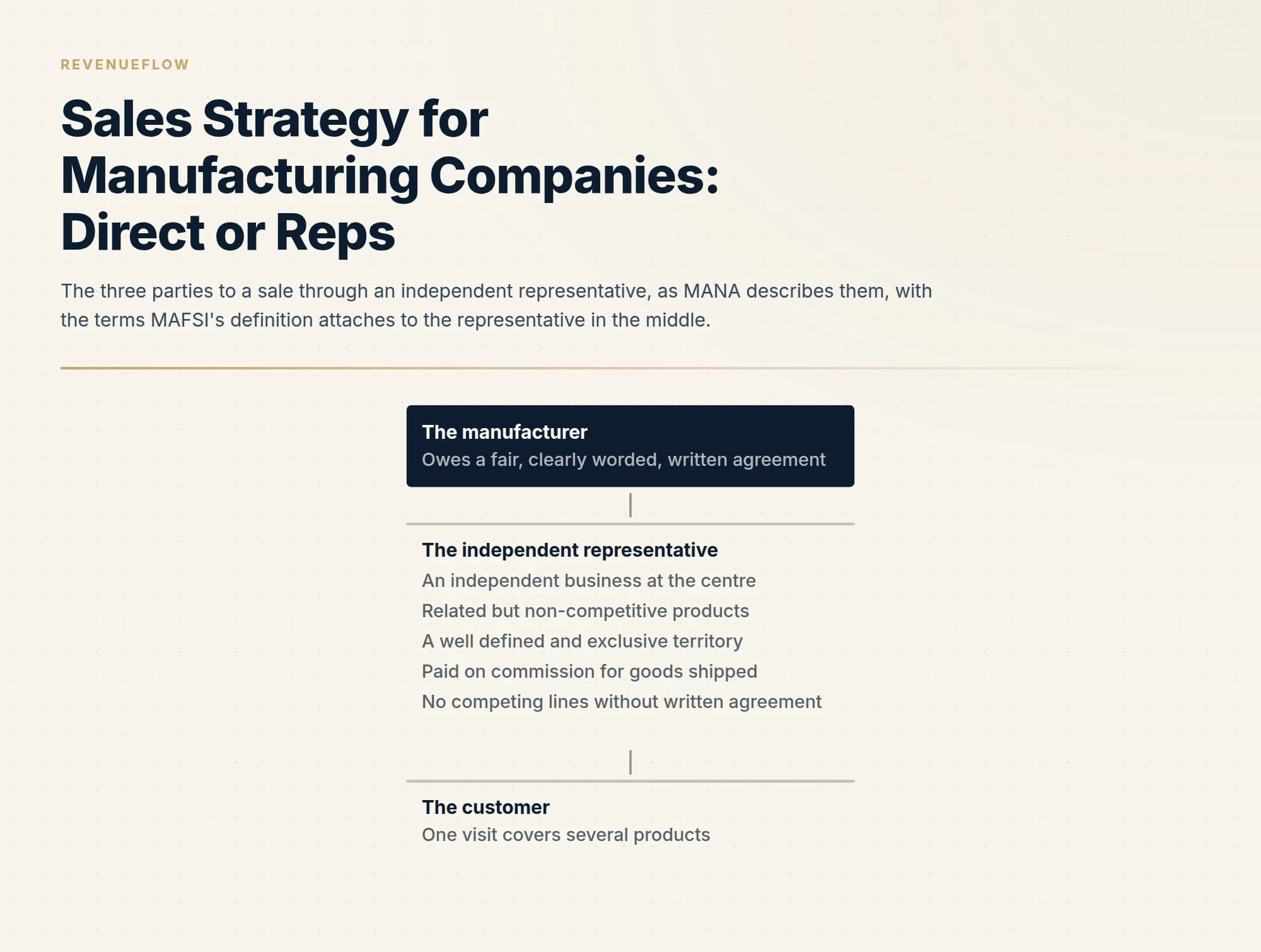
For most manufacturers the sales strategy is a channel decision first. NAM reports that all but 4,177 of 239,265 manufacturing firms are small, so few can staff every territory. The alternative, an independent representative, carries two or more non-competitive lines in an exclusive territory on commission, under a written agreement whose clauses MANA lists.
Key takeaways
- NAM reports 239,265 manufacturing firms in 2022, all but 4,177 of them small, with around three-quarters having fewer than 20 employees, which is why the channel decision comes before everything else.
- MAFSI defines a manufacturers' representative as an independent business representing two or more related but non-competitive products in a well defined and exclusive territory, compensated primarily on commission for goods shipped.
- MANA recommends a written agreement covering territory, commission, split commissions, termination and rights upon termination, and warns that holding back existing business as house accounts will often doom a new relationship.
- A MANA article of 25 November 2024 describes the buying group through the split commission case: the specifying in one location, the purchase order cut in a second, the end user serviced in a third.
Reviewed and updated September 19, 2026
The National Association of Manufacturers publishes the fact that shapes most manufacturers' sales strategy before anyone writes one: "In 2022, there were 239,265 firms in the manufacturing sector, with all but 4,177 firms considered to be small (i.e., having fewer than 500 employees)," and of those, "around three-quarters of these firms have fewer than 20 employees, and 93.1% have fewer than 100 employees" (NAM, Facts About Manufacturing, last updated 6 May 2025, from the Census Bureau's Statistics of U.S. Businesses). A company of twenty people that makes a good product cannot put a salesperson in every territory where that product is bought. For the firms NAM counts under twenty employees the sales strategy is therefore a channel decision first: whose salespeople carry the line.
This page is for the manufacturer deciding how its own products get sold. It is not about selling to manufacturers; that reader is served by the site's cold email guide for manufacturing and, for the wider picture of reaching plants, by manufacturing lead generation. It concentrates on the decision the trade's own associations have written the most about, a direct sales force against independent representatives, because that is where published rules exist. Distributors are a third route, and no source fetched for this page supports saying more about them than that.
The first decision: whose salesperson
The alternative to a direct force has a published definition. The Manufacturers' Agents Association for the Foodservice Industry describes a manufacturers' representative as "an independent business comprised of sales, marketing and customer service professionals acting as an independent proprietor, partnership or corporation representing two or more related but non-competitive products in a well defined and exclusive territory, and compensated primarily on a commission basis for goods shipped or billed from the manufacturer represented" (MAFSI, What is a Rep?, read 18 September 2026). Every clause in that sentence is a strategy term: more than one line, non-competitive lines, an exclusive territory, and pay on what ships.
MAFSI also states the case for the model, and it should be read as an association of representatives making it. Its argument is that "Through multiple line selling both the effectiveness and cost-effectiveness of the basic selling function are increased," because a single visit covers several products, and that a representative "receives only a commission, and only for their results," so manufacturers who want to lower and stabilize sales expenses relative to the flow of orders can turn to representatives. The trade-off the same page implies is attention: a representative carrying several lines divides the visit among them.
The wider profession has had a home for a long time. The Manufacturers' Agents National Association describes itself as "Successfully connecting reps and manufacturers since 1947" and explains its own logo as the structure of the sale: "Three waves represent the manufacturer, customer, and independent sales rep," with the representative in the centre connecting the other two (MANA, About, read 18 September 2026).
The agreement is the strategy document
A manufacturer that chooses representatives has chosen to run its sales strategy through a contract, and MANA is direct about what the contract is for: "This written agreement establishes mutually agreed upon goals and allows each party to manage the expectations of the other" (MANA, Rep Agreements, read 18 September 2026). It recommends discussing a list of clauses with an attorney experienced in representative agreements, among them appointment and acceptance, territory, products and services, commission, computation and payment of commission, split commissions, acceptance of orders, terms of sale, term of agreement and termination, and rights upon expiration or termination.
MANA's code of ethics, which it says new members subscribe to when they apply, puts duties on both sides (MANA, About, read 18 September 2026). The sales agency owes the manufacturer, which the code calls the principal, the duty "To conscientiously cover the assigned territory, accounts or industry segment" and a promise "To refrain from representing competing lines without written agreement of the Principal." The manufacturer owes the agency a contract: "To enter into a fair, clearly worded, written Sales Representative (Independent Contractor) Agreement which addresses the needs, concerns, expectations and objectives of both parties," and a second duty: "To refrain from modifying the terms of this agreement, except by mutual written consent following full discussion of the matter."
The same page carries the warning that matters most to a manufacturer switching from a direct force: "Holding back existing business as house accounts will often doom the new relationship before it even begins." Where the manufacturer has no existing business in a territory to share, MANA suggests it may be appropriate to offer the representative what it calls a shared territory development fee. Both points say the same thing about strategy. A representative is paid on what ships, so a territory with no shipments and no fee is a territory in which the manufacturer is asking for unpaid work.
| Who owes it | The duty, in the code's words | What it governs |
|---|---|---|
| Sales agency | To conscientiously cover the assigned territory, accounts or industry segment | Coverage |
| Sales agency | To refrain from representing competing lines without written agreement of the Principal | Exclusivity of the line |
| Manufacturer | To enter into a fair, clearly worded, written Sales Representative (Independent Contractor) Agreement | The contract |
| Manufacturer | To refrain from modifying the terms of this agreement, except by mutual written consent | Stability of the terms |
Who is the buyer when the sale crosses three places
The buying group for a manufactured product is often spread across locations, and the profession describes it through its hardest commission problem. A MANA article on split commissions sets out the usual case: "The front-end work on an order is completed in Location A. A purchase order is cut in Location B. Final destination for the order is Location C" (MANA, Coming to Agreement on Split Commissions, 25 November 2024). It describes projects in which the specifier and consulting engineers are not where the product will be consumed, and lists the questions that have to be answered before anyone is paid: "Who specified it? Where was the purchase order cut? Who services the account at the end-user level?"
Those three questions are the buying group. The specifier, often an engineer, decides what is bought. The purchasing function that cuts the order decides from whom and on what terms. The end user takes delivery and needs service, training and replacement parts, which the article also lists. A manufacturer's strategy has to say who covers each of the three, in which territory, and what each is paid for. The article's own closing question is the strategic one: what is the manufacturer paying the representative to do, get the order or service the account.
| Row | Location A | Location B | Location C |
|---|---|---|---|
| Front-end work on the order, including the specifying | Yes | No | No |
| The purchase order is cut | No | Yes | No |
| Final destination, where the end user is serviced | No | No | Yes |
The calendar the trade publishes
One date on a manufacturer's selling calendar is printed by the show itself. The International Manufacturing Technology Show lists its 2026 edition for 14 to 19 September 2026 in Chicago (IMTS, read 18 September 2026, while the show was running). For a manufacturer that sells to other manufacturers, the weeks before a show of that kind are when a request for a short meeting at the show is a small ask, and the weeks after are when the conversations started there are followed up. No source fetched for this page states a fiscal year or a capital budgeting month common to manufacturers' customers, so none is asserted; ask each account when its capital plan closes.
What the rules require of the manufacturer's outreach
The rule on the message is the ordinary one for commercial email. The Federal Trade Commission's guide says the CAN-SPAM Act "makes no exception for business-to-business email," sets the penalty for each separate email in violation at up to $53,088, and requires a valid physical postal address and a clear way to opt out (FTC, CAN-SPAM Act: A Compliance Guide for Business, read 18 September 2026). A manufacturer writing to a purchasing manager is sending commercial email.
MANA's code is not law, and MANA itself sends both parties to an attorney for the agreement. It is still the standard a representative will measure a manufacturer against, and a manufacturer recruiting agencies should expect to be asked about each clause on MANA's list. Whether a specific practice is compliant, or a specific clause enforceable, is a question for counsel.
The objections, from the profession's own pages
The first objection a manufacturer will hear from a good agency is about house accounts, and MANA has already written the answer: holding them back "will often doom the new relationship before it even begins."
The second is about who gets paid. The split commission article exists because, as it says, the representative who got the order used to be the one who got the commission and that is no longer always so. An agency asked to do specification work in its territory for an order that will be cut in someone else's will ask what the agreement says, and a promise to sort it out later is the wrong answer.
The third is about support. MANA's code asks the manufacturer to recognize the agency as an important element in its sales goals and to support its efforts with timely responses and open communication. Slow quotes are a sales strategy problem before they are an operations problem, because the representative has other lines to sell while waiting.
Channel reality, and when outbound is the wrong play
Written outreach by email and LinkedIn has two jobs for a manufacturer. It reaches the specifiers and purchasing managers in accounts no one is covering, and it recruits the agencies that will cover them. It is the motion RevenueFlow runs, one message per campaign, and RevenueFlow does not cold-call. In-person selling and trade shows are a large part of how manufactured products are sold, and they are described here as the vertical's practice, not as our motion.
Direct outbound is the wrong play in three cases. It is wrong in a territory a representative already covers exclusively, because the definition above says the territory is theirs and a message from the factory undercuts the agency the manufacturer depends on. It is wrong as a way around a commission dispute, for the same reason. And it is wrong when the manufacturer cannot say who will service the account at the end-user level, because that is one of the three questions the buyer's side will ask.
Three openers, each grounded in a page the reader can check
Three sample first lines a manufacturer could send, each tied to one fetched source. A results claim, a real recipient and contact details are left out of each.
To the principal of a representative agency in an uncovered territory. MANA's guidance says holding back house accounts will often doom a new relationship before it begins. We have no direct salespeople in your territory and no house accounts there, and we would want a written agreement on MANA's clauses, including split commissions. If our line is non-competitive with the ones you carry, a conversation is the ask. The standard is the profession's own and the message says how the manufacturer meets it.
To a consulting engineer who specifies products of this kind. A MANA article on split commissions starts from the fact that the specifying is often done in one place and the purchase order cut in another. We make a component you may specify, and we would like to send you the documentation you need to evaluate it, wherever the order is eventually placed. The message is written to the first of the three buyers and asks for nothing but a review.
To a purchasing manager at a company attending a trade show. IMTS runs from 14 to 19 September in Chicago. If you are there, we would like fifteen minutes to show you what we make and how we quote; if not, the same conversation by video works. The dates are the show's own and the ask is sized to the event.
To: Principal, a representative agency in an uncovered territory
MANA's guidance says holding back house accounts will often doom a new relationship before it begins. 1
We have no direct salespeople in your territory and no house accounts there, and we would want a written agreement on MANA's clauses, including split commissions. If our line is non-competitive with the ones you carry, a conversation is the ask. 2
Postal address and opt-out line in the footer. 3
- 1A warning from MANA's own page on representative agreements.
- 2Answers the house accounts and split commissions objections before they are raised.
- 3The postal address and opt-out line the FTC's CAN-SPAM guide requires of every commercial email.
What the strategy has to decide
A manufacturer's sales strategy, read from the profession's own documents, is four decisions: whose salespeople carry the line in each territory; what the written agreement says about territory, commission, split commissions and termination; who covers the specifier, the purchasing function and the end user when they sit in three places; and what the factory will do, in quotes and responses, to deserve a share of a multi-line representative's visit. How vendors approach plants from the other direction is in manufacturing lead generation, the general shape of an outbound programme is in the outbound sales playbook, and what a written strategy has to state before its number can be believed is in the sales strategy template.
RevenueFlow's model is email and LinkedIn only, a single message per campaign, qualification criteria agreed in writing before launch, and payment on attended meetings that meet them. If reaching specifiers, purchasing managers or agencies in writing is the part you would rather have run, you can see what a campaign would look like for your market.
The NAM, MANA, MAFSI, IMTS and FTC pages were fetched on 18 September 2026 from the pages linked. MAFSI's and MANA's statements about the representative model are those associations' own, made on behalf of their members. Rules and dates change; confirm them at the source. Nothing here is legal advice.
Sources: NAM, Facts About Manufacturing, MAFSI, What is a Rep?, MANA, About, MANA, Rep Agreements, MANA, Coming to Agreement on Split Commissions, IMTS, FTC, CAN-SPAM compliance guide
Frequently asked questions.
Frequently asked questions- Should a manufacturer use independent sales reps or a direct sales force?
- It depends on how many territories the company can staff. NAM reports that around three-quarters of manufacturing firms have fewer than 20 employees, which rules out a national direct force for most. MAFSI, an association of representatives, argues that multiple line selling makes each visit more cost-effective and that a representative receives only a commission, and only for results. The trade-off is attention, since a representative divides a visit among the lines carried.
- What should a manufacturer's rep agreement include?
- MANA recommends discussing a list of clauses with an attorney experienced in representative agreements, including appointment and acceptance, territory, products and services, commission, computation and payment of commission, split commissions, acceptance of orders, terms of sale, term of agreement and termination, and rights upon expiration or termination. Its code of ethics asks the manufacturer for a fair, clearly worded, written agreement and not to modify it except by mutual written consent.
- What is a split commission in manufacturing sales?
- It is how a commission is divided when one sale involves several territories. A MANA article of 25 November 2024 describes the usual case: the front-end work on an order is completed in Location A, the purchase order is cut in Location B, and the final destination is Location C. It lists the questions to settle first: who specified it, where the purchase order was cut, and who services the account at the end-user level.
- When is direct outbound the wrong play for a manufacturer?
- In a territory an independent representative already covers exclusively, because a message from the factory undercuts the agency the manufacturer depends on. As a way around a commission dispute, for the same reason. And when the manufacturer cannot say who will service the account at the end-user level, because that is one of the three questions the buying side asks. In those cases the agreement is the work, and outreach follows it.
About the author.

B2B cold email experts helping companies generate qualified leads through done-for-you outreach campaigns.
RevenueFlow Team
Explore more.
Ready to scale your outreach?
We build GTM engines that book real meetings. See the receipts.
Related articles.
Sales Strategy for Logistics Companies: Segment, Seat, Cycle
How a broker, forwarder, carrier or 3PL sets its sales strategy: Armstrong's segments and contract terms, the four provider seats shippers keep, and the rate cycle.
Appointment Setting for Manufacturers: Who a Setter May Call
For the manufacturer hiring a setter: the ranked titles to hand over, the rep and distributor map that decides which accounts may be called, and the meeting types.
Lead Generation for Trucking Companies: Three Routes
How a motor carrier finds freight customers: the load board, the broker relationship and the shipper's annual bid, with the calendar and the rules on outreach.
Command of the Sale: Force Management's Process Programme
Command of the Sale is Force Management's sales process and qualification programme, not its messaging one. What the vendor says it is, delivers and how it runs.
LinkedIn Outreach for Machine Shops
How a job shop or CNC machine shop uses LinkedIn to win OEM work: the four buyer titles, the RFQ gate, the ISO, AS9100 and ITAR facts, and LinkedIn's own rules.
MEDDIC vs SPICED: What Each Qualifies, From Both Publishers
MEDDIC and SPICED from their own publishers: six themes that audit an existing deal against five elements written to carry across a subscription customer's whole journey.