Manufacturing Lead Generation: The Channel You Might Bypass
Industrial purchases start with an engineer, not a VP, and often sit inside a partner's territory. How to build a manufacturing target list that respects both.
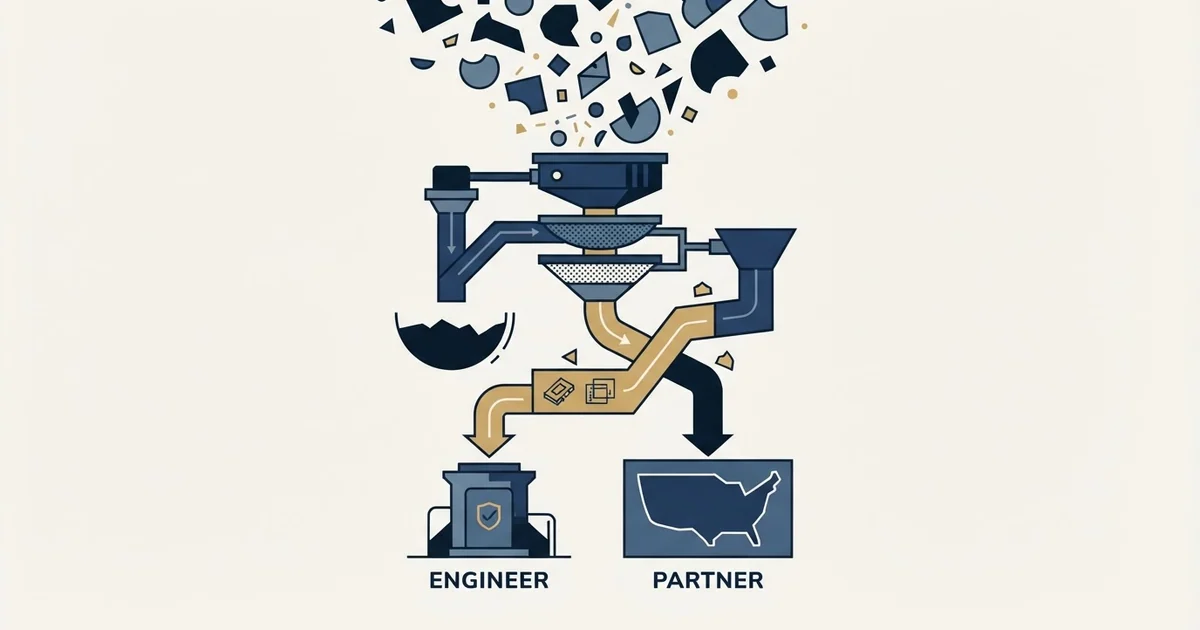
Manufacturing lead generation works when the list targets sites and processes rather than logos and titles. Industrial purchases usually start with an engineer solving a live problem, senior approval comes later, and distributor or rep agreements decide which accounts can be approached directly at all.
Key takeaways
- Industrial purchases usually begin with a process, quality or maintenance engineer working a live problem, and reach a VP only when spend needs approval.
- Multi-site manufacturers are several accounts wearing one logo: a corporate contact list does not say which plant runs the process you serve.
- Channel agreements are a targeting constraint that has to be resolved before the list is built, because they decide which accounts are addressable.
- A design-in opportunity and a replacement opportunity look identical in a meetings-booked column and have completely different economics.
Reviewed and updated September 1, 2026
Manufacturing Lead Generation: Engineers, Plants, and the Channel You Might Be Bypassing
A precision components supplier builds a target list of eight hundred manufacturers, finds the VP of Operations at each one, and sends a well-written message about reducing scrap rates. The replies that come back are polite and unhelpful. Two of them are from distributors asking why the supplier is going around them. One is from an engineer who forwarded it internally and never heard anything. The rest is silence.
Nothing in that campaign was sloppy. The list was accurate, the message was specific, the titles were senior. What was missing was a model of how a manufacturing purchase actually starts, who starts it, and whether the company selling was allowed to talk to that person at all.
The buyer is usually not the person with the senior title
Industrial purchases tend to begin with somebody solving a problem, and that person is rarely a VP. A process engineer who has been fighting a tolerance issue for six months, a maintenance manager watching a line stop twice a shift, a quality lead preparing for an audit: these are the people who go looking, and they are the ones who bring a vendor into the building.
The senior title matters later, when the spend needs approval, and it matters enormously then. Targeting it first inverts the order in which the purchase naturally forms. A VP of Operations who receives an unsolicited message about scrap rates has no context, no active problem in front of them, and no reason to spend attention on a supplier they have not heard of. The same message reaching the process engineer working that exact problem is useful.
The exception worth knowing is the account where a senior mandate exists: a new plant coming online, a cost programme announced publicly, a quality event that has made a specific problem an executive priority. In those accounts the senior title is the right first target, because the problem is already theirs. Identifying which accounts are in that state is real research rather than a filter, and it is why a manufacturing list built properly is smaller than one built from a database export.
- VP Operations, COO, Plant Manager
- Easy to assemble from any contact database
- No signal about whether a relevant problem is live
- Recipient has to route the message to someone who cares
- Produces polite replies and stalled threads
- Process, quality, maintenance and manufacturing engineering roles
- Requires knowing the plant, the process and the equipment
- Message can name a specific condition the reader recognises
- Recipient is the person who would evaluate it anyway
- Produces technical conversations that escalate upward
The practical work here is unglamorous. It means knowing which of a company's sites runs the process you serve, because a corporate headquarters contact list tells you nothing about which plant has the equipment. Multi-site manufacturers are effectively several different accounts wearing one logo.
That same problem of picking the right unit to target shows up in construction, where project-based lead targeting replaces the company as the meaningful account.
Channel conflict is a targeting constraint, not a sales problem
Manufacturers who sell through distributors, manufacturer's representatives or system integrators carry a constraint that pure-direct companies never think about. Direct outreach into an account a partner considers theirs can cost more than the deal is worth, and the damage is not commercial so much as relational: the rep who feels bypassed stops bringing you opportunities.
Whether a manufacturer runs a direct force at all, or carries its line through independent representatives under the written agreement their association describes, is the subject of sales strategy for manufacturing companies, written for the manufacturer rather than for its suppliers.
This has to be resolved before the list is built, because it changes who is targetable.
A manufacturer on the other side of that boundary, deciding whether an outside setter may call its accounts at all, will find the same map drawn from its own desk in appointment setting for manufacturers.
- Yes: Which accounts are formally protected by a rep or distributor agreement
- Yes: Whether outreach into a protected account is banned, or allowed with the partner copied in
- Yes: Which territories or verticals are direct-only by design
- Yes: Whether new logos in a partner's territory count to the partner regardless of who sourced them
- Yes: Who inside your company adjudicates a conflict when it happens
- No: Assuming the CRM's account owner field reflects the partner agreement
- No: Running the campaign first and handling conflicts as they arise
The answer is often that direct outreach is fine for accounts nobody has touched in two years, fine for a named list of house accounts, and off-limits for the rest. That is a workable brief. What does not work is discovering the boundary through an angry phone call.
Material handling is the clearest case, because dealers hold territories, and appointment setting for material handling companies covers how a booked meeting is routed there.
There is a version of this that works in the partner's favour, and it is worth proposing internally before assuming the channel is an obstacle. Outreach that surfaces a technical opportunity and then hands it to the rep who owns that territory gives the partner something they did not have, which is the opposite of bypassing them. It requires the handoff to be real, with the partner brought in early enough to own the relationship rather than being told after the fact. Where that arrangement exists, the addressable list widens considerably, because protected accounts stop being excluded and start being routed.
Design-in cycles change what a first meeting is worth
Some manufacturing sales are transactional replacements of a consumable. Others are design-in, where your component or process gets specified into a product that will then run for years. The second kind has an entirely different economic shape, and a lead generation program that does not distinguish them will misprice its own results.
A design-in opportunity may produce no revenue for eighteen months and then produce predictable volume for a decade. A first meeting with an engineer who is currently specifying a new platform is worth many times a first meeting with a plant that is happy with its incumbent supplier. Both look identical in a meetings-booked column.
- Month 0First technical conversation
Engineer describes the application and the constraints
- Month 1 to 3Samples and evaluation
Your part is tested against the spec, often alongside an incumbent
- Month 3 to 9Qualification
Approval, documentation, and sometimes a customer audit of your facility
- Month 9 to 18Specification
You are written into the drawing or the approved vendor list
- After launchRecurring volume
Revenue arrives on the product's production schedule, not your sales cycle
Programs that survive their first year in manufacturing usually agreed up front which of these two shapes they were hunting, and defined a qualified meeting to match. If the target is design-in work, a meeting with a purchasing manager at a plant with no active development is not a qualified meeting, however senior the person is. Writing that definition down before launch is the single cheapest thing a manufacturer can do to keep the program honest. The distinction between buying meetings and buying leads is covered in appointment setting versus lead generation.
What actually gets read by a technical audience

Engineers and plant leadership are not hostile to vendor email. They are hostile to vendor email that could have been sent to anyone. The bar is specificity about the operating reality, and it is a bar most industrial outreach fails at the first sentence.
Where manufacturing engineers judge outreach on operational specificity, IT buyers apply an even sharper filter, as covered in selling to IT buyers who outbound.
Three things separate a message that gets a technical reply from one that does not.
It names the process, not the industry. "Manufacturers" is not a shared identity. Injection moulders, CNC job shops, food processors and electronics assemblers have nothing in common operationally. A message that names the process, the material or the equipment tells the reader immediately whether it is for them.
It states a specific condition rather than a benefit. Tolerance drift on a particular operation, changeover time on a specific line type, a certification requirement that has recently moved. Benefits like efficiency and cost reduction are unfalsifiable and read as filler.
It asks for something proportionate. A technical reader early in an evaluation will trade a short conversation for something concrete. A signed purchase order is not on the table and asking as if it is ends the exchange. What works is an ask sized to the reader's actual next step: a sample, a spec sheet against their tolerance, a short call with someone who has solved the same problem on the same equipment.
A fourth thing helps and is often skipped. Industrial buyers check whether a supplier is credible before replying, and they check in ways that have nothing to do with your website copy. Certifications, the equipment list, the industries already served, and whether the company has done work at their scale. Making those findable removes a silent reason for a technically interested reader to do nothing.
A contract manufacturer on the other side of that exchange, finding the OEM engineers who will send a drawing, has its own page in sales prospecting for contract manufacturers.
We keep a separate write-up of what the receiving side does to industrial outreach in manufacturing cold email benchmarks, and the data side of building these lists in best data enrichment tools for manufacturing.
One message per approach, and why that constraint helps here
Our own position on outreach mechanics is narrow and worth stating, because industrial lead generation advice usually recommends the opposite. Each approach carries one message, built on one premise, sent once. If a later approach is worth making, it is a separate campaign with its own premise, aimed at a different role, a different site, or a different observation about the account.
In manufacturing that constraint is unusually well suited to the market. Engineers are a small, connected community. Reputation travels between plants and between employers, and a supplier who becomes known for pestering people loses access to a technical audience that will remember. The discipline of having one shot at each approach forces the specificity that this audience responds to, because a message that could have gone to anyone is wasted on the only chance you get.
A job shop or CNC machine shop running that same one-message discipline on LinkedIn to win OEM work has its own page, LinkedIn outreach for machine shops, written for the shop rather than for a supplier selling to it.
It also forces honesty about list size. A programme that must earn its reply on the first message cannot rely on volume to cover weak targeting, which usually means a smaller list, better resolved, aimed at sites rather than logos.
Where to start if the current program is not working

Take the existing target list and ask three questions of it. Does each row identify a site rather than a corporate entity? Does each row carry a reason to believe the relevant process is running there? Is each account cleared against the channel agreement? A list that fails all three is the most common cause of a manufacturing outbound program that produces activity and no pipeline, and the fix is upstream of anything written in the message.
Then size the effort honestly. Industrial buying is slow, the qualified population is often smaller than expected, and the cost per qualified conversation is correspondingly higher than in software. Working that arithmetic before launch is covered in cost per lead in B2B.
If you want this built against your own account list and channel map, see what a first campaign looks like.
Frequently asked questions.
Frequently asked questions- Who should we target at a manufacturer, engineering or the VP?
- Start with the engineering or operations role that owns the problem your product solves, because that person is who goes looking and who brings a vendor into the building. The senior title matters when spend needs approval. The exception is an account with a public cost programme, a new plant or a recent quality event, where the problem already belongs to the executive.
- Can we do direct outbound if we sell through distributors?
- Usually yes, but only after the boundary is written down. Decide which accounts are protected by a rep or distributor agreement, which territories are direct-only, and who adjudicates a conflict. Many manufacturers land on direct outreach for dormant and house accounts with partner handoff elsewhere, which widens the addressable list rather than shrinking it.
- Why do manufacturing campaigns get replies but no pipeline?
- Most often the list identifies corporate entities rather than sites, and carries no evidence that the relevant process runs at the location contacted. Recipients are real and senior, so they reply politely, and nothing progresses because the problem is not theirs. Check whether each row names a site, a process and a cleared channel position before rewriting any copy.
- How long should a manufacturing outbound program run before judging it?
- Long enough to see qualification, which in design-in selling means quarters rather than weeks. A component specified into a customer's product may generate no revenue for a year and then produce volume for a decade. Judge early results on technical conversations with the right process at the right site, and agree that definition in writing before launch.
About the author.

Ben Carden is CRO at RevenueFlow, which builds and operates outbound revenue engines for B2B companies. Previously at Gartner Enterprise. Studied at London School of Economics.
Ben Carden · CRO
Connect on LinkedIn →Explore more.
Ready to scale your outreach?
We build GTM engines that book real meetings. See the receipts.
Related articles.
Two Agencies, One Target List: Who Owns Which Accounts
Two outbound suppliers on one market will contact the same companies unless the buyer splits it first. How to cut the list, run the exclusion feed and check the overlap.
HR Lead Generation: The Renewal Clock and Who Signs
An HR buyer who agrees with every word still cannot act outside their own renewal window. Which triggers are observable, and who signs.
IT Lead Generation: The Buyer Runs Your Playbook
Technology buyers evaluate outbound for a living, and their purchases carry a security review nobody in your meeting owns. Which triggers are real.
5 ABM Campaign Examples and How Each One Is Built
Five worked account-based campaign examples, each built on the same five fields: account set, tier, plays in order, owner and handoff, and the exit condition.
Last Outbound Agency Did Not Deliver: Locating the Failure
The leads were bad names a symptom and no stage. Four places an outbound engagement fails, the counts that separate them, and what to change in the next purchase.
When Outbound Stops Scaling: What Breaks First
Doubling the budget rarely doubles the meetings. The five constraints that bind in order, the signature each one leaves in the numbers, and what actually buys more.