Sales Prospecting for Contract Manufacturers: OEM Sources
Where a contract manufacturer finds OEM accounts: the FDA registration database, RFQ marketplaces, sourcing shows with dates, reps, and the triggers worth writing on.
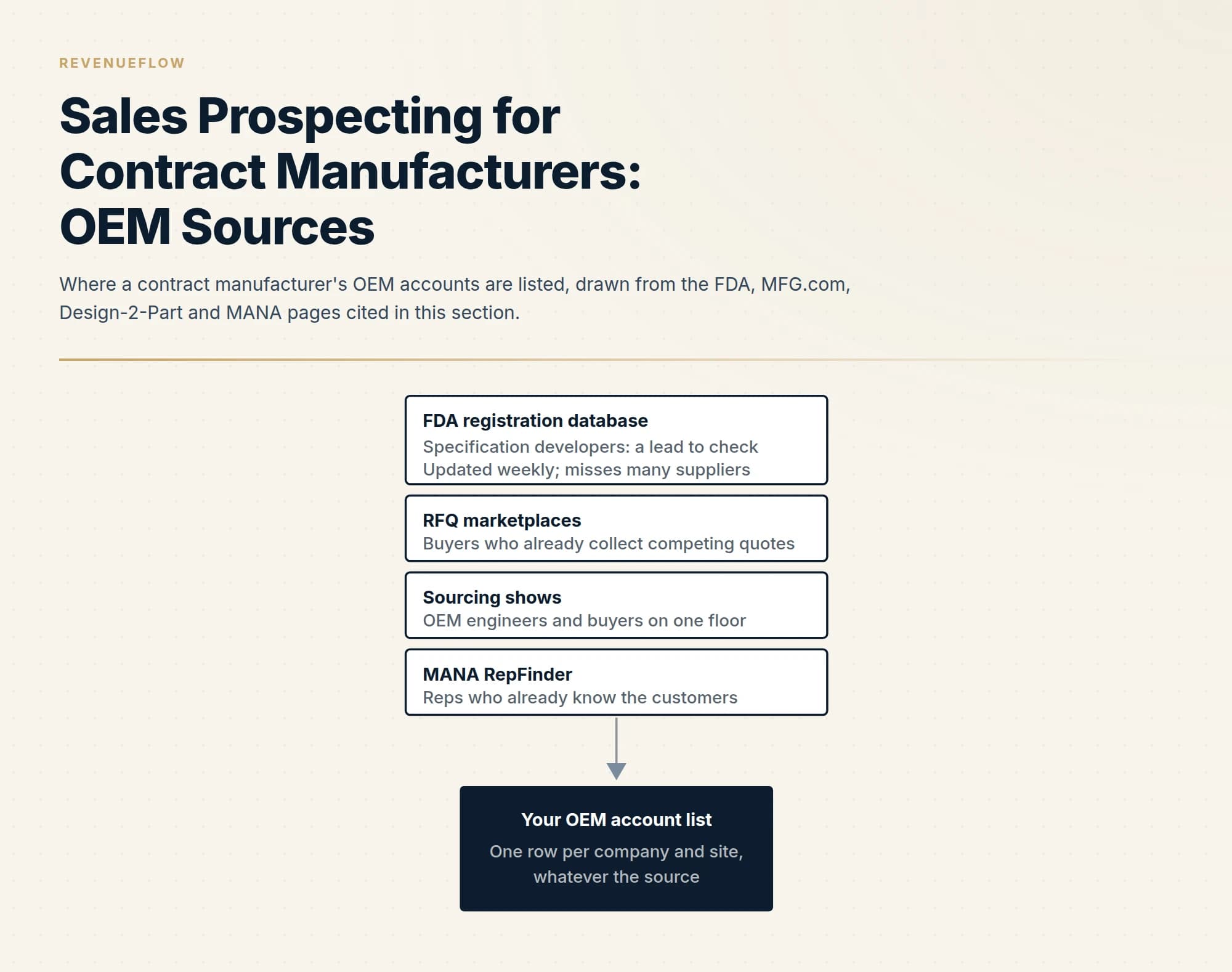
Contract manufacturers can build an OEM prospect list from published sources: the FDA's public device registration database, which separates contract manufacturers from specification developers, RFQ marketplaces, Design-2-Part sourcing shows and MANA's rep directory. New 510(k) clearances and USTR Section 301 actions are dated triggers, and the quote request is the first pipeline stage that counts.
Key takeaways
- The FDA requires device establishments to register annually and list their activities, and its public database is generally updated weekly by Monday evening.
- The FDA's chart lists Specification Developer as its own registered activity, separate from Contract Manufacturer, which points a prospector at device companies that design and may not build.
- Design-2-Part says its shows are exclusively for North American companies that specialize in contract manufacturing services, with dates listed for Marlborough in 2026 and Santa Clara in 2027.
- A request for quote is the first stage that counts as pipeline, so a first message should state processes, materials, tolerances, certifications and order size.
Reviewed and updated September 18, 2026
On the day this was written, MFG.com's home page carried a live counter aimed at machine shops and contract manufacturers: "We have 123 RFQs valued at over $2.6M looking for US manufacturing quotes." (MFG.com, read 18 September 2026.) The number will be different tomorrow. What it shows is permanent: in contract manufacturing the demand a salesperson is looking for gets published, as a request for quote, by the buyer.
This guide is for a contract manufacturer looking for OEM customers: a machine shop, a fabricator, a moulder, an electronics or medical device assembler whose sales team has to fill the quote pipeline. It is not for vendors selling to manufacturers. The general prospecting method, five decisions from who to write to through to what counts as qualified, is on our sales prospecting page and is not repeated here. What follows is the part that belongs to this industry: where OEM accounts and sourcing events are listed, which events they publish, why the quote is the stage prospecting feeds, the show calendar with dates, the channel that already exists, and when outbound prospecting is the wrong play.
Where OEM accounts are enumerated
Most verticals make a seller infer who buys. This one has registries, because regulators and show organisers need to know who makes what.
The FDA's device registration database, for medical work. The Food and Drug Administration requires that establishments "involved in the production and distribution of medical devices intended for commercial distribution in the United States" register annually, and most must list their devices and "the activities performed on those devices at that establishment" (FDA, who must register, list and pay the fee, read 18 September 2026). The activities are the useful part. The agency's chart has a row for the contract manufacturer, defined as one that "Manufactures a finished device to another establishment's specifications", and a separate row for the Specification Developer, which must also register and list. The database is public and searchable, and the FDA says updates "are generally completed weekly by Monday evening" (FDA Establishment Registration and Device Listing, read 18 September 2026).
Read those two rows as a prospector. A record filed under the contract manufacturer activity is a competitor or a peer. A record filed under specification developer is a company registered for writing the specification, which makes it the first place to look for a device company that designs and does not build. Treat the label as a lead to check, not as proof, and heed the agency's own caution that registration "does not in any way denote approval of the establishment or its products by FDA." One gap matters for component shops: the same chart marks a "Manufacturer of components that are distributed only to a finished device manufacturer" as not required to register, so the database maps finished device companies and misses many of their suppliers.
The RFQ marketplaces. MFG.com describes what it offers a shop in one sentence: "Get discovered by buyers, capture RFQs, and turn opportunities into orders". A marketplace is an account source with a bias. Every buyer there has already decided to collect competing quotes, so the list is real and the competition is built in.
The sourcing shows. Design-2-Part says its shows have "connected OEM engineers and buyers with American manufacturing experts face-to-face" since 1975, and that they are "exclusively for North American-based companies that specialize in contract manufacturing services" (Design-2-Part, read 18 September 2026). The organiser has filtered both sides of the room: the exhibitors are contract manufacturers, and the attendees are the OEM engineers and buyers a prospector wants.
The reps' directory. The Manufacturers' Agents National Association runs RepFinder, which it describes as a way to "Connect with qualified independent sales reps who already know your market, territory, and customers." (MANA, read 18 September 2026.) That is a directory of people who already hold OEM relationships, and the section on channels below returns to it.
Whatever the source, build the row the way our manufacturing lead generation guide describes: by site and by process, not by logo. That page also covers why the engineer is usually the first contact and how a design-in cycle changes what a meeting is worth, so neither argument is remade here.
The trigger events this industry publishes
A registry tells you who exists. A trigger tells you why this quarter.
The clearest published trigger in medical work is a new device. The FDA explains that Section 510(k) "requires device manufacturers who must register, to notify FDA of their intent to market a medical device at least 90 days in advance", and the agency adds: "You can also download zipped 510(k) files for specific time periods." (FDA 510(k) clearances, read 18 September 2026.) A company with a newly cleared device has a product to build at volume. The clearance file is a dated reason to ask who is building it.
Trade policy is the second family of triggers, and it is public too. The Office of the United States Trade Representative lists its Section 301 investigations on one page, and one of the entries is titled "Structural Excess Capacity and Production in Manufacturing Sectors" (USTR Section 301 investigations, read 18 September 2026). An investigation is not a tariff, and it does not tell you which OEM will move work. It tells you which import categories are under review, which is a fair moment to ask an OEM in that category whether a domestic second source is on the agenda.
The third trigger is the RFQ itself, which leads to the stage that defines this market.
The quote is the stage prospecting feeds
In software a first meeting leads to a demo. Here it leads to a drawing. An OEM engineer or buyer who takes the conversation seriously sends a part file and asks for a price and a lead time, and nothing counts as pipeline before that. The practical consequence is that prospecting should be measured in quote requests from qualified accounts, and that a first message should make it easy to send one: the processes you run, the materials, the tolerances you hold, the certifications, and the size of order you are built for.
It also explains the limit of the marketplaces. A shop that lives on open RFQs only ever sees work that has already gone out to bid. Prospecting exists to reach the engineer earlier, while the design is still moving and the supplier list is not yet written.
A registry record, a newly cleared device, a tariff action or a show floor conversation.
With the engineer or buyer, about one process, material and tolerance.
The OEM sends a part file and asks for a price and a lead time.
Nothing counts as pipeline before this stage.
The show calendar, with dates
Shows anchor this industry's year, and the organisers publish dates far enough ahead to plan around. As read on 18 September 2026:
- September 14 to 19, 2026IMTS, McCormick Place, Chicago
The International Manufacturing Technology Show
- September 30 and October 1, 2026Design-2-Part, Marlborough, Massachusetts
Contract manufacturing suppliers only
- October 21 to 23, 2026FABTECH, Las Vegas
Las Vegas Convention Center
- March 31 and April 1, 2027Design-2-Part, Santa Clara
Santa Clara Convention Center
IMTS, the International Manufacturing Technology Show, gives its own dates and place: "IMTS 2026 will be held September 14-19, 2026 at McCormick Place, Chicago." (IMTS, read 18 September 2026.) FABTECH's site lists October 21 to 23, 2026 at the Las Vegas Convention Center (FABTECH, read 18 September 2026). Design-2-Part lists a show on September 30 and October 1, 2026 in Marlborough, Massachusetts, and one on March 31 and April 1, 2027 at the Santa Clara Convention Center.
The two kinds of show do different jobs for a prospector. IMTS and FABTECH are where OEM manufacturing engineers go to look at equipment, so they tell you who is investing in a process. Design-2-Part is where OEM engineers and buyers go to find suppliers, so it is the floor where your buyers are shopping. The weeks before a show are the natural reason to write to an engineer in that region, and the weeks after are when the same engineer has a shortlist and a drawing.
The channel that already exists
Independent manufacturers' reps are the incumbent route to OEM accounts in much of this industry, and MANA's RepFinder is the published directory of them. A contract manufacturer that signs reps has bought relationships in exchange for commission and has also taken on a constraint: direct outreach into a rep's territory undercuts the person who is supposed to be selling for you. Our manufacturing lead generation guide treats channel conflict as a targeting rule, and the same applies here. Decide which territories and accounts belong to reps before anyone builds a list, and route what outbound finds in those territories to the rep.
Three reasons to write, each from a published source
None of these names a real person or claims a result.
The cleared device.
Your {{device}} shows in the FDA's 510(k) files as cleared on {{date}}. We are a registered contract manufacturer running {{process}} in {{material}} to {{tolerance}}. If the build partner for volume is still open, which drawing would you want quoted first?
The source is the FDA's downloadable 510(k) files.
The show.
Design-2-Part is in {{city}} on {{dates}} and we are exhibiting {{process}} parts there. If you are walking the floor, bring a print for {{part_family}} and we will quote it at the booth.
The source is the organiser's dated show list.
The second source.
USTR lists a Section 301 investigation touching {{category}}. If a domestic second source for {{part_family}} is on your agenda, we can quote from your existing drawing with no change to it.
The source is USTR's public list of investigations.
When outbound prospecting is the wrong play
It is the wrong play for a shop at capacity, because a quote you cannot deliver on costs more than no quote. It is the wrong play inside territories you have given to reps. It is the wrong play where the certification the OEM requires is one you do not hold, since the first question after the drawing will be about it. And it is weak for pure build-to-print commodity work, where the marketplace RFQ is the faster and cheaper route to the same buyer.
It fits when you have a process few shops run, a registry that lists the companies who need it, and a dated reason to write. RevenueFlow runs that kind of programme in writing, by email and LinkedIn, with one message per campaign and a new campaign only when a new trigger appears. What the receiving side does with industrial mail is in our manufacturing cold email benchmarks, and the data side of building the list is in best data enrichment tools for manufacturing. If you want a registry-built list and a first message aimed at the quote, see what a first campaign looks like.
The short version
Contract manufacturing publishes its own demand. The FDA's registration database separates contract manufacturers from specification developers, RFQ marketplaces list buyers already collecting quotes, Design-2-Part puts OEM engineers and buyers on a floor of contract manufacturers only, and MANA lists the reps who hold the relationships. New 510(k) clearances and USTR's Section 301 list are dated reasons to write. The quote is the first stage that counts, the shows have published dates through spring 2027, and outbound is the wrong play for a shop at capacity or inside a rep's territory.
FDA, USTR, show organiser, MANA and MFG.com pages quoted above were read on 18 September 2026. Show dates and marketplace figures change. Confirm them on the organisers' own pages.
Frequently asked questions.
Frequently asked questions- Where can a contract manufacturer find OEM customers?
- Start with published sources. The FDA's Establishment Registration and Device Listing database is public and records each establishment's activities, including specification developers. RFQ marketplaces such as MFG.com list buyers collecting quotes. Design-2-Part shows bring OEM engineers and buyers to a floor of contract manufacturers only. MANA's RepFinder lists independent reps who already hold OEM relationships in a territory.
- What trigger events matter for contract manufacturing sales?
- Three are public and dated. The FDA lets anyone download 510(k) files for specific time periods, so a newly cleared device is a reason to ask who builds it. USTR lists its Section 301 investigations, which flag import categories where a domestic second source becomes interesting. And an RFQ on a marketplace is the buyer stating demand outright.
- Which trade shows should contract manufacturers plan around?
- As of 18 September 2026 the organisers list IMTS on September 14 to 19, 2026 at McCormick Place in Chicago, Design-2-Part on September 30 and October 1, 2026 in Marlborough, Massachusetts, FABTECH on October 21 to 23, 2026 in Las Vegas, and Design-2-Part on March 31 and April 1, 2027 in Santa Clara. Confirm dates on each organiser's page.
- When is outbound prospecting wrong for a contract manufacturer?
- When the shop is at capacity, because a quote it cannot deliver damages the account. Also inside territories assigned to independent reps, where direct outreach undercuts the rep, and where the OEM requires a certification the shop does not hold. For commodity build-to-print work, an open marketplace RFQ is usually the faster route to the same buyer.
About the author.

B2B cold email experts helping companies generate qualified leads through done-for-you outreach campaigns.
RevenueFlow Team
Explore more.
Ready to scale your outreach?
We build GTM engines that book real meetings. See the receipts.
Related articles.
Sales Prospecting for Cloud Services: Dated Triggers
How a cloud services company builds a prospect list: co-sell with platform sellers, partner-to-partner routes, and the end-of-support dates Microsoft publishes.
Sales Strategy for Manufacturing Companies: Direct or Reps
How a manufacturer decides whose salespeople carry its line: the published definition of a representative, MANA's agreement clauses and the split commission problem.
Cold Call Openers: Eleven Lines by Situation, and the Data
Eleven cold call openers sorted by what is true about the call, the four beats every opener has, and what Gong's 2018 opener study actually counted.
B2B Lead Lists for Collection Agencies: Fields and Sources
What a creditor prospect list needs for a collection agency: the fields that matter, the FDIC, NCUA, CMS and court sources behind them, and the rules that apply.
3x3 Research: Three Facts in Three Minutes Before Outreach
3x3 research as Funnel Clarity publishes it: three unique facts in three minutes that the prospect would be surprised you know, the variants, and where it fits.
Appointment Setting for Manufacturers: Who a Setter May Call
For the manufacturer hiring a setter: the ranked titles to hand over, the rep and distributor map that decides which accounts may be called, and the meeting types.