Cold Call Openers: Eleven Lines by Situation, and the Data
Eleven cold call openers sorted by what is true about the call, the four beats every opener has, and what Gong's 2018 opener study actually counted.
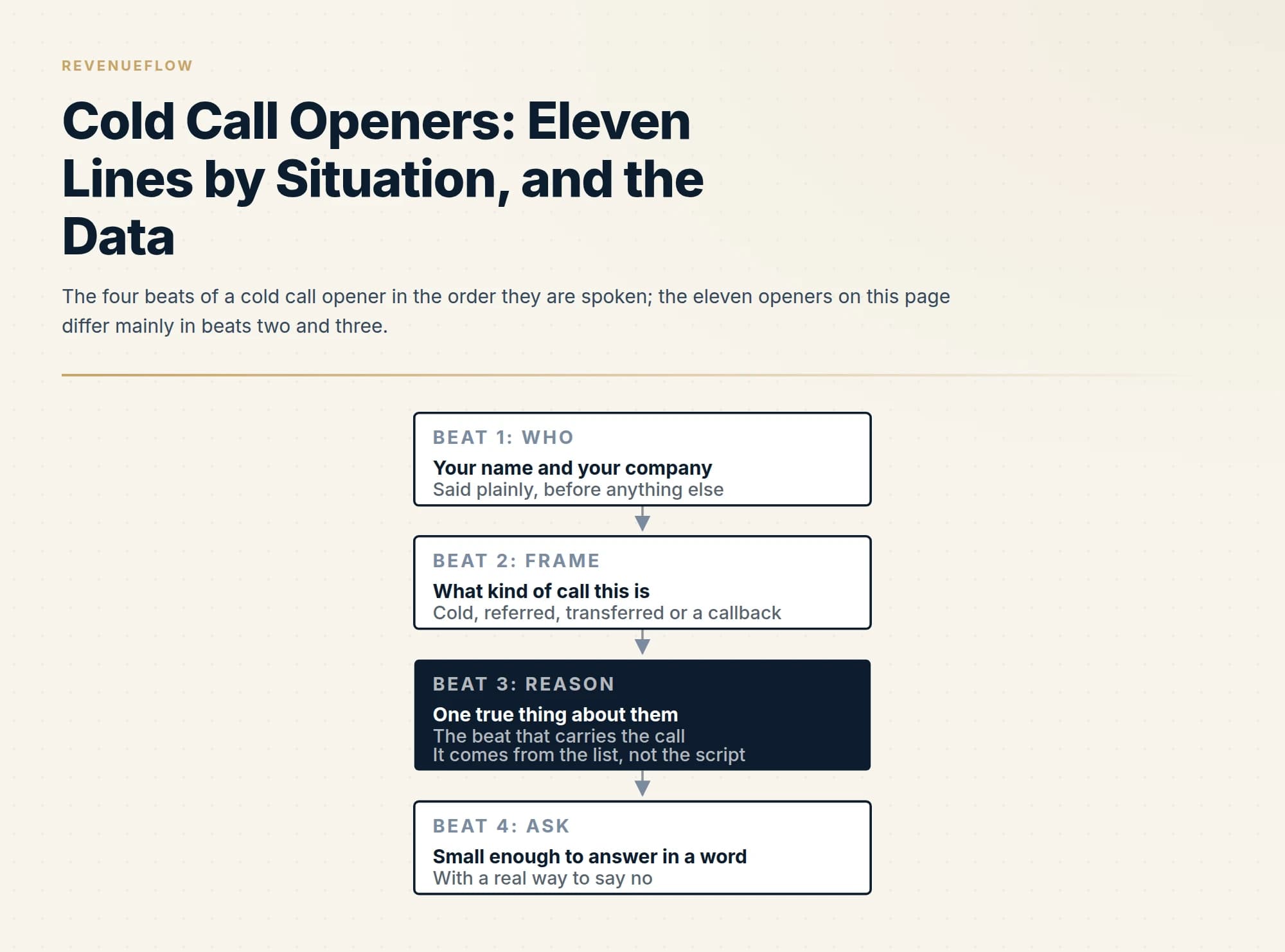
A cold call opener has four beats: who is calling, what kind of call it is, one true reason about the listener, and an ask small enough to answer in a word. Choose the line from what is true about the call: a callback, a transfer, a referral, an earlier conversation, a recent event, or otherwise a reason-first default.
Key takeaways
- An opener has four beats, who, frame, reason and ask, and the reason is the one that carries the call; it comes from the research behind the list, so no wording rescues a call with nothing true to say.
- The figures most opener lists repeat come from one Gong post published April 19, 2018 on 90,380 cold calls: a 1.5% baseline, 0.9% for the bad-time question, 5.2% for how are you, and 10.01% for how have you been.
- That post does not say how many calls used each line, which industries were called or whether the differences were tested, and its author says opening lines have a shelf life.
- Pick the opener from the facts of the call, leave out any line that implies a relationship you do not have, and test on your own list with counts beside every rate.
Reviewed and updated September 19, 2026
Almost every list of cold call openers in circulation leans on one study, and almost none of them say what that study counted. Gong published it on April 19, 2018, it covered 90,380 cold calls, and it found that the most popular permission line of its day performed below the baseline. The lists that repeat its figures tend to leave out the date, the population and the author's own warning about opening lines: "they have a shelf life".
This page does two jobs. It reads that study at its source, and it sets out eleven openers by situation with the logic for choosing between them. RevenueFlow runs written outbound, email and LinkedIn, and does not sell calling, so nothing below is a results claim of ours. The lines are invented for illustration, including every company, name and event in them, and the method is stated as method.
What an opener has to do
An opener is the first fifteen seconds or so of a call the other person did not ask for, and it has four beats. It says who is calling. It frames what kind of call this is. It gives one reason that is about them. It ends on an ask small enough to answer in a word, with a real way to say no.
Most failed openers skip the third beat or bury it. A caller who gives a name, a company and then a description of the product has spent the whole opening on the seller. The reason is the beat that carries the call, and it is a property of the research behind the list: if nothing true and specific can be said about why this person is being called today, no wording rescues it. Our sales pitch examples work through one opener in that spirit, inside a wider set of pitch formats.
What the Gong study counted
The post is Proven cold call opening lines that work by Chris Orlob, published April 19, 2018 and marked last modified March 4, 2026, as read on Gong's blog on 18 September 2026. Its population is stated in one phrase, "In our dataset of 90,380 cold calls", and the post says the calls were captured and analysed with artificial intelligence. Gong's post uses success to mean booking the meeting, and it gives the baseline across the dataset as 1.5%.
Against that baseline the post reports four lines, and says of the winner that "one opening line stood head and shoulders above the rest":
- "Did I catch you at a bad time": calls that opened with a version of it had a 0.9% success rate, by Gong's account.
- "How are you?": Gong's post gives a 5.2% success rate to calls that opened with a version of it.
- "How have you been?": in Gong's words, "Cold calls that opened with this question boasted a 10.01% success rate compared to the 1.5% baseline", which the post gives as 6.6 times the baseline.
- A reason for the call, stated early: reported as a multiple only, 2.1 times the baseline, with no rate given.
The post anticipates the obvious objection to the winning line and answers it: "This data set was exclusively first interactions".
Three things the post does not state, as read on that date: how many of the calls used each line, which industries or seniorities the calls went to, and whether the differences were tested for significance. Pages that cite it as a study of B2B calls with statistically significant results are adding words that are absent from the page we fetched. The author's own caution is the most useful sentence in it: "they have a shelf life". A finding from calls recorded before April 2018 tells you what was unusual then. A line that has since appeared on every list is no longer unusual.
| Measure | Value |
|---|---|
| Did I catch you at a bad time | 0.9% |
| Baseline, all calls | 1.5% |
| How are you? | 5.2% |
| How have you been? | 10.01% |
We read those figures as one dated measurement on one vendor's customers, worth knowing and not worth copying blind. The way to use it is to test openers on your own list, with a count beside every rate. Our page on cold calling statistics explains why published calling rates disagree so sharply about what they divide by.
Eleven openers, by situation
Each line below is invented. The seller is a made-up freight audit firm and the callers, prospects and events do not exist. None repeats the three openers in our older 12 Cold Call Scripts page or the one in the sales pitch examples.
1. Reason first, the default. Invented opener:
"Hi Maria, it's Sam Okafor at Ashcombe Freight Audit. The reason for my call is the carrier surcharge change that landed this month, because firms shipping on your routes are seeing it on every invoice. Are you the person who looks at those?"
The reason arrives in the second sentence and the ask is a routing question, which is easy to answer.
2. Permission with a time box. Invented opener:
"Hi Maria, Sam Okafor at Ashcombe Freight Audit. Give me half a minute to say why I rang, and then you decide whether we keep going. Fair?"
This asks for a specific, small amount of time and promises an exit. It avoids the bad-time question that Gong's data counts against.
What its proponents and its critics say about this line, and how it measured against the bad-time question on Gong's larger 2024 dataset, is on the permission-based opener.
3. The plain admission. Invented opener:
"Maria, we have never spoken, and this is a sales call, so I will be quick. Sam Okafor, Ashcombe Freight Audit. I rang because your team posted for an accounts payable analyst, and invoice checking is usually what that hire ends up doing. Worth two minutes?"
Naming the call for what it is removes the thing the listener was waiting to find out.
4. The trigger event. Invented opener:
"Hi Maria, Sam Okafor at Ashcombe. I saw the announcement about the new distribution centre in Memphis. New routes usually mean new carrier contracts, and that is where billing errors start. Is that on your desk or someone else's?"
The event has to be real and recent. If it is not, this becomes the worst opener on the page.
5. The one-word question. Invented opener:
"Hi Maria, Sam Okafor at Ashcombe Freight Audit. Quick question before anything else: do you audit carrier invoices in house today?"
Either answer moves the call. Yes leads to how, no leads to why not.
6. The internal referral. Invented opener:
"Hi Maria, Sam Okafor at Ashcombe. I spoke to Dev Patel in your logistics team on Tuesday and he said invoice disputes sit with you. Did he mention it?"
Only when the conversation happened. Expect the prospect to check.
7. The peer reference. Invented opener:
"Hi Maria, Sam Okafor at Ashcombe Freight Audit. We do the invoice audit for two regional distributors in the Southeast, and the same surcharge issue showed up at both. I wanted to ask whether you are seeing it."
Use a reference you can speak to in detail and have permission to name. Otherwise describe the peer without naming them.
8. After a front-desk transfer. Invented opener:
"Hi Maria, it's Sam Okafor at Ashcombe Freight Audit. Your front desk put me through, and I told them what I will tell you: I rang about the surcharge change on your carrier invoices."
The buyer often hears a one-line summary from whoever transferred the call. Match it. Getting to that transfer is covered in how to get past the gatekeeper.
9. They are returning your voicemail. Invented opener:
"Thanks for ringing back, Maria. It's Sam at Ashcombe. I left the message about carrier surcharges. Did the message make sense, or shall I start from the top?"
A callback is already a small yes. Do not restart the pitch from zero.
10. The re-approach with a new premise. Invented opener:
"Hi Maria, Sam Okafor at Ashcombe. We spoke for a minute in the spring and the timing was wrong. I am ringing about something different: the rate filing your main carrier published last week. Is that worth a minute?"
Say that you have spoken before only if you have. The new premise has to be new, which is the same rule we apply to re-entry in our written campaigns.
11. The ordinary greeting. Invented opener:
"Hi Maria, it's Sam Okafor at Ashcombe Freight Audit. How are you today?" Then, after the answer: "The reason for my call is the surcharge change on your carrier invoices."
This is the plain social opener that the Gong post found ahead of baseline, paired with the reason line it also found ahead. It depends on sounding like a person and fails when it sounds like a script.
The one we leave out
The best performing line in the Gong post, "How have you been?", is absent from the list above on purpose.
The post argues it works as a pattern interrupt, and answers the obvious objection in its own words: "You can plausibly ask that question to a perfect stranger." Our house method declines it because it implies a relationship that does not exist, and we hold every script we write to the same rule across channels: no fake thread markers in email, no pretended familiarity on a call. That is a position about honesty rather than a measurement, and a team that disagrees can test the line against opener 11 on its own list.
Choosing between them
The choice runs on what is true about this call. If someone inside the company sent you, say so. If something happened at the company, lead with it. If the call was transferred or is a callback, frame it that way. If none of those is true, the reason-first default carries the call, and the time box or the plain admission are variations for a listener who sounds guarded.
The remaining three are tools inside those branches. The one-word question suits a list where you do not yet know who owns the problem. The peer reference needs a reference you are allowed to use. The ordinary greeting is a delivery choice that can sit in front of any of them.
| Opener | Needs | Fails when |
|---|---|---|
| 1. Reason first | A true reason about them | The reason is about you |
| 2. Time box | A pitch that fits the box | You overrun it |
| 3. Plain admission | A steady voice | It sounds like a gimmick |
| 4. Trigger event | A real, recent event | The event is wrong or old |
| 5. One-word question | A question either answer helps | It sounds like a survey |
| 6. Internal referral | A conversation that happened | The colleague denies it |
| 7. Peer reference | Permission to name the peer | You cannot give detail |
| 8. After a transfer | The same reason you gave the desk | The two stories differ |
| 9. Callback | A voicemail with a reason in it | You restart the pitch |
| 10. Re-approach | A new premise | It is the old ask again |
| 11. Ordinary greeting | Sounding like a person | It sounds scripted |
Testing an opener honestly
An opener test needs a fixed list segment, one change at a time and enough connects to mean something. Here is arithmetic invented for illustration, and it measures nothing: a rep who makes 60 dials a day and connects on 5 of them has 25 connects in a week, and two openers split across 25 connects cannot be told apart. The same split across several hundred connects can start to be. Record connects, conversations past the first half minute and meetings booked as three separate counts, because an opener can only move the middle one. Our cold calling tips page separates the connect rate, which is mostly a data question, from what happens once someone answers.
For a call into a conversation that already exists, the openings are different and the set is in follow up call scripts.
The short version
An opener has four beats: who, frame, reason, ask. The reason is the one that carries the call and it comes from the list. The figures the opener lists repeat come from one Gong post dated April 19, 2018, whose population is "In our dataset of 90,380 cold calls", and which reports rates for four lines without saying how many calls used each. Pick the opener from what is true about the call, leave out any line that implies a relationship you do not have, and test on your own list with counts beside the rates.
If the harder problem is that too few of the right people hear from you at all, that is the part we run, in writing: see what a first campaign would look like.
Gong's post was fetched and read on 18 September 2026 and is cited as Gong's own statement about its own dataset. Every opener, company, person and event in this article is invented for illustration.
Frequently asked questions.
Frequently asked questions- What is the best opening line for a cold call?
- There is no single best line, because the right opener depends on what is true about the call. If you were referred, transferred or are returning to an earlier conversation, say so. If something recent happened at the company, lead with it. Otherwise give your name and company, state one true reason for ringing this person, and end on a question that can be answered in a word.
- Does the Gong study say to open with how have you been?
- Gong's post of April 19, 2018 reports that calls opening with that line had a 10.01% success rate against a 1.5% baseline in a dataset of 90,380 cold calls. It does not say how many calls used the line or which markets were called, and the author notes that opening lines have a shelf life. We leave the line out because it implies a relationship that does not exist.
- Should you ask did I catch you at a bad time on a cold call?
- Gong's 2018 post counts against it: calls that opened with a version of that question had a 0.9% success rate against a 1.5% baseline in its dataset. A time-boxed permission line does the same job with less risk, by asking for half a minute to explain the reason for the call and promising that the listener then decides whether to continue.
- How long should a cold call opener be?
- Roughly fifteen seconds, which is enough for a name and company, a frame, one reason and a short ask. Anything longer is a pitch delivered before permission. If the reason cannot be said in one sentence, the problem usually sits in the research behind the list and a longer opener will not repair it. Practise the line aloud until it sounds like speech.
About the author.

B2B cold email experts helping companies generate qualified leads through done-for-you outreach campaigns.
RevenueFlow Team
Explore more.
Ready to scale your outreach?
We build GTM engines that book real meetings. See the receipts.
Related articles.
The Permission-Based Opener: What Its Publishers Say and Measure
The permission-based cold call opener from the people who teach it, the critic who argues against it, and Gong's two dated measurements of which permission line works.
3x3 Research: Three Facts in Three Minutes Before Outreach
3x3 research as Funnel Clarity publishes it: three unique facts in three minutes that the prospect would be surprised you know, the variants, and where it fits.
Cold Calling for SaaS Companies: What Changes on the Call
The two calls a software company makes, who picks up in crowded and uncrowded categories, how the first thirty seconds go, and why a SaaS list is a mobile-number list.
Cold Calling for Legal Tech Companies: Who Answers at a Firm
What changes when a legal tech company cold calls a law firm: which desks answer, why the billable hour hurts the pitch, the 2027 show dates, and what not to ask.
Sales Prospecting for Cloud Services: Dated Triggers
How a cloud services company builds a prospect list: co-sell with platform sellers, partner-to-partner routes, and the end-of-support dates Microsoft publishes.
Healthcare Sales Prospecting: The Public Registries Reps Skip
Where healthcare accounts are enumerated in public records: the NPI files, Open Payments, certificate of need filings and Form 990s, and the dated events each publishes.