7 Sales Pitch Examples and the Script Behind Each
Seven sales pitch examples with the script written out for each, from the elevator pitch and cold call opener to the champion script.
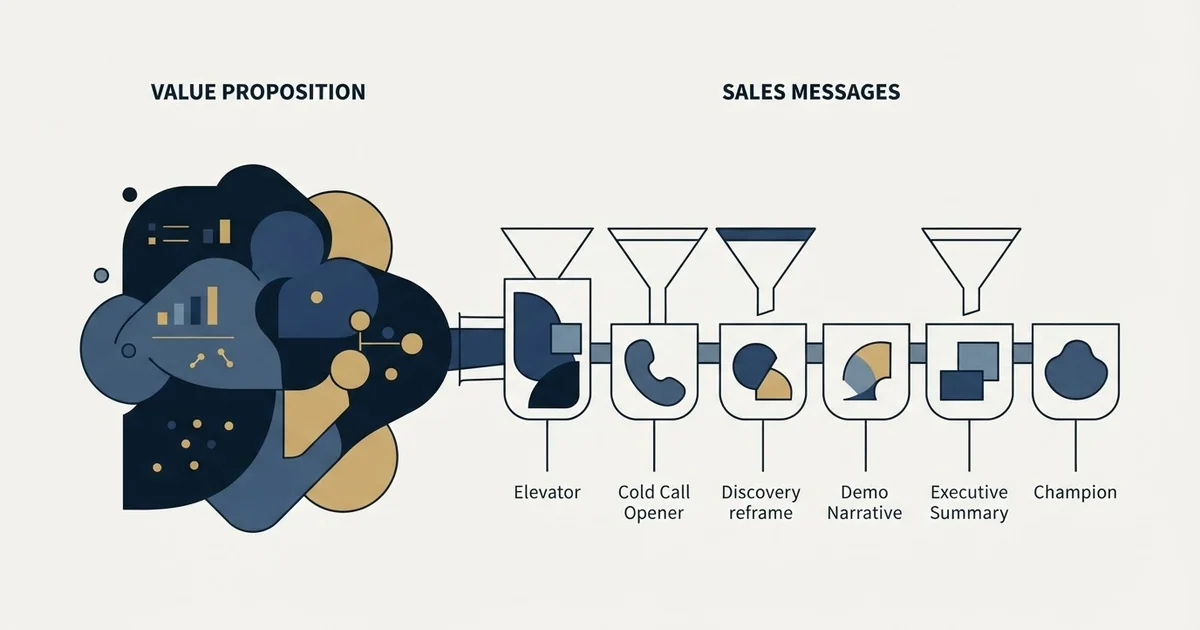
Seven sales pitch examples, one per format: the elevator pitch, cold call opener, discovery reframe, demo narrative, executive summary, competitor displacement line and champion script. Each script fills the same three slots in order, the listener's situation, what it costs them, and one thing you do about it. Every example is invented, so copy the structure.
Key takeaways
- A sales pitch is a format choice before it is a wording choice: seven formats run from a fifteen second cold call opener to a three to five minute demo narrative.
- Every format fills three slots in order: a situation the listener is in, the consequence in their own currency, and one move you make about it.
- Spoken pitches must survive an interruption and end on something answerable in a word, while written pitches must survive being forwarded with no seller present.
- A wrong fact about the listener costs more than a generic line, because it shows the specificity was automated.
Reviewed and updated September 18, 2026
Useful sales pitch examples are sorted by format, because a sales pitch is not one artefact. The thirty second version you give at a conference, the fifteen seconds you have before somebody hangs up, the five minutes at the top of a demo and the paragraph your champion forwards to a finance director are four different pieces of writing with four different failure modes. Most pitch advice treats them as one and produces a paragraph that fits none of them.
Seven worked examples follow, one per format, each with the script written out and the mechanism named underneath. Every company, role, number and outcome in them is invented for this article. The structures transfer; the specifics have to come from the accounts you actually sell to.
A successful sales pitch is a format choice before it is a wording choice, and picking the wrong format is the failure no amount of rewriting repairs.
A message is one component of something larger, and five worked account-based campaigns are each built from an account set, a tier, ordered plays, an owner and an exit condition.
What does a good sales pitch example look like?
A good sales pitch example shows the script and the format it was written for, because the same argument has to change shape between a hallway, a phone call, a demo and a forwarded email. Each of the seven sales pitch scripts below states a condition the listener is in, what it costs them, and one thing you do about it, at the length its format allows.
| Pitch | Length | Delivered |
|---|---|---|
| 1. Elevator pitch | Roughly thirty seconds | Spoken, to somebody who did not ask |
| 2. Cold call opener | Fifteen seconds | Spoken, before permission |
| 3. Discovery reframe | Two or three sentences | Spoken, mid conversation |
| 4. Demo narrative | Three to five minutes | Spoken, before anything is shown |
| 5. Executive summary | One paragraph | Written, to somebody who will never take your call |
| 6. Competitor displacement | Two or three sentences | To somebody who already bought a competing product |
| 7. Champion enablement | Three sentences | Said by your advocate when you are not there |
The three slots underneath all seven
Whatever the length, a pitch is doing the same three things in the same order.
The situation. A condition the listener is in, stated as fact rather than as a question. This is where the specificity lives and it is the slot people skip in favour of introducing themselves.
The consequence. What that condition costs, in the currency the listener's job is measured in. Not the industry's currency. Theirs.
The move. One thing you do about it, in plain words, with no clause explaining the previous clause.
A pitch that opens on the company, the funding round or the category has spent its first slot on the seller. The single sentence version of this constraint, and twelve worked lines inside it, is in sales pitch one-liners and the structure behind them.
1. The elevator pitch
Format: roughly thirty seconds, spoken, to somebody who did not ask.
Invented example. "Most operations teams in mid-market logistics still reconcile carrier invoices by hand, and it eats about a week a month for one person. We read the invoices against the contract automatically and flag only the lines that disagree. Companies your size usually find the first month pays for the year."
The mechanism: the listener is never asked to understand a product category. The first sentence describes their week, the second describes the software in one clause, and the third gives a reason to continue that is not a feature. If somebody who does that job would not nod at the first sentence, the pitch has already failed and the remaining twenty seconds cannot recover it.
The common failure: opening with the company. "We are a logistics automation platform" spends the whole first slot and gives the listener nothing to agree with.
2. The cold call opener
Format: fifteen seconds, on a call the person did not want, before permission has been granted.
Invented example. "Hi, this is a cold call. You can hang up. I am calling because you posted for a second billing analyst last month, and the teams that hire the second one usually find the problem is the reconciliation rather than the headcount. Can I take thirty seconds to say what we do about it, or is now genuinely bad?"
The mechanism: naming the call for what it is buys more attention than any pretext, because the listener already knows and is waiting to see whether you will pretend otherwise. The ask at the end is answerable in one word and offers a real exit, which is what makes it answerable at all.
Cold call, first fifteen seconds
"Hi, this is a cold call. You can hang up." 1
"I am calling because you posted for a second billing analyst last month, and the teams that hire the second one usually find the problem is the reconciliation rather than the headcount." 2
"Can I take thirty seconds to say what we do about it, or is now genuinely bad?" 3
- 1Names the call for what it is. The listener already knows, and is waiting to see whether you will pretend otherwise.
- 2The situation slot: one fact about the listener, which has to be true because they can check it.
- 3An ask answerable in one word, with a real exit. The exit is what makes it answerable at all.
The common failure: the false familiarity opener. Anything that implies a prior relationship gets the call ended faster than a plain cold approach.
Eleven more openers, sorted by what is true about the call, are in cold call openers by situation.
3. The discovery reframe
Format: two or three sentences, mid conversation, after they have described the problem in their own words.
Invented example. "So the reporting is late because the data arrives in three formats and somebody normalises it by hand. Every team we work with describes it as a reporting problem first and it is almost always an ingestion problem, which matters because fixing the report does nothing and fixing the ingestion fixes both. That is the part we do."
The mechanism: this is the only pitch on the page that is allowed to contradict the buyer, and it earns the right by repeating their own description back first. The reframe has to be genuinely more accurate, not merely more flattering to your product, and a seller who reframes every problem into their category will be caught doing it within two calls.
The common failure: reframing before the buyer has finished describing the problem, which reads as not listening rather than as insight. What discovery has to establish before this point is set out in running discovery so that it disqualifies well.
4. The demo narrative
Format: three to five minutes at the top of a demonstration, before anything is shown.
Invented example. "Before I show anything: you told me the finance close takes eleven days and that four of those are waiting on the same two reports. I am going to show you three things. Where those reports come from today, what the same view looks like when the data is already normalised, and what your team would still do by hand afterwards. If the third one is longer than you expected, tell me and we can stop."
The mechanism: it names an agenda in three items, ties each to something the buyer said, and pre-commits to disclosing what the product does not solve. That last clause is the part that separates a demo narrative from a product tour, and it is the one buyers remember.
The common failure: a feature walkthrough with no narrative at all, which forces the buyer to do the translation into their own situation while also watching the screen.
5. The executive summary pitch
Format: one paragraph, written, addressed to somebody who will never take your call.
Invented example. "Your team spends roughly four days a month reconciling carrier invoices manually, which is where the late close originates. We automate the comparison against contract terms and surface only the disagreements. Implementation takes about three weeks and runs alongside the current process until you switch. The decision in front of you is whether four days a month is worth reclaiming this quarter or next."
The mechanism: no adjectives, an explicit implementation cost, and a decision stated in the buyer's terms rather than a request for a meeting. This is the version that gets forwarded, and it has to survive being read with no seller in the room. The written value claim underneath it has its own structure in the value proposition statement template.
The common failure: writing this like the elevator pitch. Spoken and written pitches fail differently, and a spoken cadence on the page reads as sales copy the moment a finance reader sees it.
6. The competitor displacement pitch
Format: two or three sentences, to somebody who already bought a competing product.
Invented example. "You already run something that does the core of this, so I am not going to argue about the core. The question is whether your team still exports and re-keys the exceptions afterwards, because that is the part we replace and the part nobody switches for until a renewal makes them count it. If they do not, this is not for you."
The mechanism: concede the incumbency in the first clause, name one specific gap, and give the listener a clean exit. A pitch against a satisfied user that does not concede anything reads as uninformed, and the exit at the end is what makes the concession credible.
The common failure: the invented switching statistic. A number about how many customers left the incumbent is a claim you cannot defend when asked and it ages badly.
7. The champion enablement pitch
Format: the three sentences your internal advocate will use when you are not there.
Invented example. "They fix the invoice reconciliation, which is where our four late days come from. It runs alongside the current process for three weeks so there is no cutover risk. If it does not hold, we stop at the end of the pilot and nothing has changed."
The mechanism: this pitch is written for somebody else's mouth, so it carries no seller vocabulary, no product name in the first sentence, and a stated downside case. The champion is spending their own credibility, and a pitch that does not protect them will not get used.
The common failure: handing a champion the elevator pitch. It is written to interest a stranger, and the internal audience is not a stranger, they are a colleague deciding whether to attach their name to it.
Pitches 1 and 2
Spoken, to a stranger
- Opens on a situation, never on a company
- Short enough to finish before an interruption
- Ends on a question answerable in one word
- Offers a real exit
Pitches 3 and 4
Spoken, in the room
- Repeats the buyer's own words first
- Names an agenda in three items
- Pre-commits to what it will not solve
- May contradict the buyer, once
Pitches 5 and 7
Written, read without you
- No adjectives and no seller vocabulary
- States the implementation cost explicitly
- Carries the downside case
- Survives being forwarded with no context
Where all seven fail the same way
The invented fact. Formats one, two, five and six all depend on something being true about the listener. Getting it wrong does not cost you the meeting, it costs you the account, because they now know the specificity was automated and wrong.
The borrowed statistic. A pitch built on a percentage from somebody else's report cannot be defended when questioned and cannot be updated when the report ages. Structures survive. Numbers borrowed from a listicle do not.
Two arguments at once. Stacking a second reason in case the first misses halves the strength of each. The listener is not weighing your arguments, they are deciding in about a second whether this was aimed at them.
Testing on volume that cannot answer. A pitch tried on a dozen conversations has produced a result indistinguishable from noise, and the confident verdict that follows is the most expensive habit on this list.
Where the pitch sits inside the motion
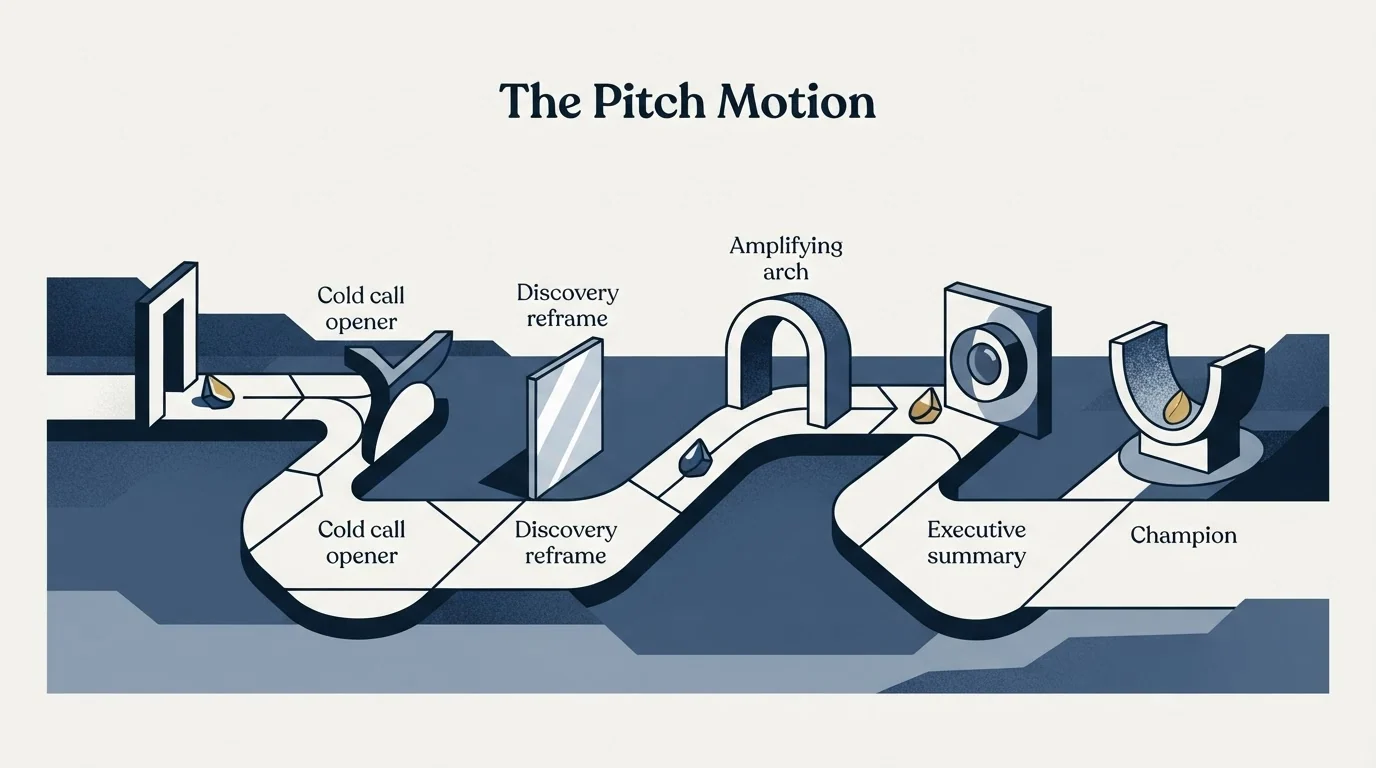
A pitch does not create the conversation it is delivered in. Formats one, two and five are what happens after somebody has been reached, and reaching them is a separate discipline with its own arithmetic, set out in the outbound sales playbook.
Our own campaigns put unusual weight on the written formats, because we send one message per campaign with no bumps and no thread replies. There is no second touch to recover a weak opening, so the argument has to stand alone on its first reading or the campaign teaches us something and ends. Where that argument becomes a full email rather than a paragraph, the shapes are in sales pitch email templates.
The short version
There are seven pitches, not one: the elevator version, the cold call opener, the discovery reframe, the demo narrative, the executive summary, the competitor displacement line and the script your champion uses without you.
All seven fill the same three slots in the same order. The situation they are in, what it costs in their own currency, and one thing you do about it. A pitch that opens on your company has spent the first slot on the wrong person.
What none of the seven settles is how to finish, and the wording for that, as twelve worked lines with the assumption under each, is in sales pitch conclusion examples.
Spoken and written pitches fail differently. Spoken versions have to survive an interruption and end on something answerable in a word. Written versions have to survive being forwarded, which means no adjectives, an explicit implementation cost, and a stated downside case.
Every example on this page is invented as an illustration. Build from the structures rather than from the wording, and get the one specific fact right, because a wrong fact about the listener costs more than a generic line does. Where the constraint is that too few of the right people are hearing any pitch at all, see what a first campaign produces against your market.
Frequently asked questions.
Frequently asked questions- What is a good example of a sales pitch?
- A thirty second elevator pitch that opens on the listener's week rather than your company. The invented example in this article tells a logistics operations lead that reconciling carrier invoices by hand eats about a week a month, says in one clause what the software does about it, and ends on a reason to keep talking that is not a feature.
- What should a sales pitch script include?
- Three slots in a fixed order. First the situation, a condition the listener is in, stated as a fact they could contradict. Then the consequence, what it costs in the currency their job is measured in. Then the move, one thing you do about it in plain words. A script that opens on the company has spent its first slot on the seller.
- How long should a sales pitch be?
- It depends on the format. An elevator pitch runs roughly thirty seconds and a cold call opener about fifteen. A discovery reframe or a competitor displacement line is two or three sentences. A demo narrative takes three to five minutes before anything is shown, and an executive summary is one written paragraph that has to work with no seller in the room.
- How do you open a cold call pitch?
- Name the call for what it is, state one true fact about the listener, and ask something answerable in one word with a real exit. The listener already knows it is a cold call and is waiting to see whether you will pretend otherwise. Openers implying a prior relationship end the call faster than a plain cold approach does.
About the author.

B2B cold email experts helping companies generate qualified leads through done-for-you outreach campaigns.
RevenueFlow Team
Explore more.
Ready to scale your outreach?
We build GTM engines that book real meetings. See the receipts.
Related articles.
Cold Calling for PPC Agencies: What You Can See First
A paid media prospect is partly readable before the call and has already been told by the platform what to do when a stranger rings about its ads.
Cold Calling for Chemical Companies: Who Picks Up
A chemical cold call rarely arrives first. It reaches a formulator who has already been comparing suppliers on a screen, for one of three published reasons.
Cold Calling for Telecom Companies: A Carrier's Own Rules
What only a telecom company meets on the phone: the FTC exemption that stops at its contractor, the verified carrier change, and the CPNI limit on lists.
Cost of Inaction in Sales: Building the Do Nothing Case
How the cost of inaction case is built, from the publishers who teach it: the buyer's own numbers, found in discovery, kept apart from risk, and where it backfires.
SDR Outsourcing for Business Brokers: The Fee Timing
Whether a success-fee brokerage should rent sales development at all: the fee timing, the texts that limit what an outside person may say about value, and who signs.
SDR Outsourcing for Financial Services: The Third Party
What a bank, broker-dealer, adviser or agency's regulators say about an outside team that speaks for it, the licensed line, and which arrangement survives due diligence.