Cost of Inaction in Sales: Building the Do Nothing Case
How the cost of inaction case is built, from the publishers who teach it: the buyer's own numbers, found in discovery, kept apart from risk, and where it backfires.
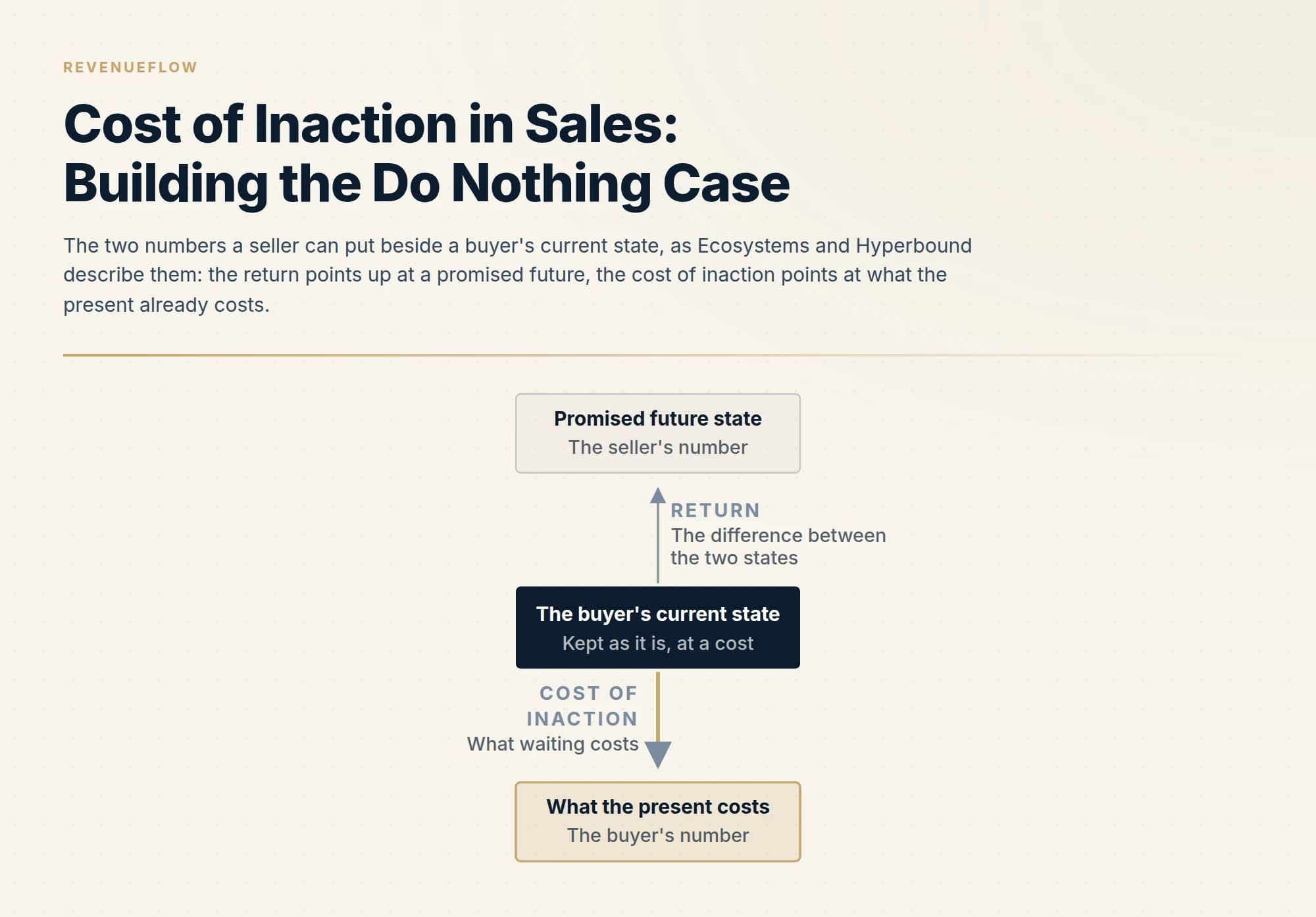
The cost of inaction is what a buyer pays by continuing as they are, and its publishers agree on how the case is built: from the buyer's own facts in discovery, as a conservative running cost kept apart from unearned revenue and unrealised risk, agreed by more than one buyer, and shown as two futures rather than a threat.
Key takeaways
- Hyperbound defines the cost of inaction as the tangible and intangible price a business pays by maintaining the status quo, and Ecosystems explains why a return projection alone fails: prospects are content with their current state.
- Every publisher agrees on authorship: Inflexion-Point in 2008, Hyperbound and Nomi since then all say the number is co-created with the buyer in discovery, never presented pre-calculated.
- The do-nothing costs the publishers name fall into three classes, a cost paid today, revenue not earned and a risk not yet happened, and presenting a risk as a running cost loses a finance reader's trust.
- Dixon and McKenna's no-decision research splits buyers into those who never accepted the problem and those who accepted it and cannot choose; the cost of inaction answers the first and worsens the second.
Reviewed and updated September 21, 2026
A deal that has a budget, a sponsor and a good demo stalls at the point where the buyer has to choose, and the reason is rarely a rival. It is the option that was on the table before the seller arrived: keep doing what they do now. The cost of inaction is the sales-training name for putting a number on that option, and the publishers who teach it agree on more than the phrase suggests: the number belongs to the buyer, it is built in discovery rather than announced at the close, and it is a case to be presented rather than a calculator to be run. This page takes the practice from those publishers' own pages and says where it backfires. No figure below is ours; every worked number is a named publisher's own example. The seller's-side negotiation the case feeds is on sales negotiation, and the reason a buyer who agreed the cost still chooses nothing is on the JOLT Effect.
Two senses of the phrase, and the one this page means
The phrase carries two meanings, for two different readers. Anthony Iannarino's The Sales Blog (published 25 July 2023, fetched 21 September 2026) uses it for the seller's own delay: "The cost of inaction in sales is one reason salespeople fail to reach their sales goals and miss their quotas." That is a post about prospecting discipline.
The sense this page covers is the buyer's. Salesfolks' explainer (undated, fetched 21 September 2026) states it plainly: "COI refers to the potential costs associated with not taking a particular action or decision." Hyperbound's guide (published 4 August 2025) is fuller: "The Cost of Inaction is the tangible and intangible price a business pays by maintaining the status quo - by not making a change or decision." FinanSys, a finance-software vendor writing for its own buyers (published 27 May 2022, modified 10 May 2023), puts it from the buyer's side: "In essence, the cost of inaction is the cost you incur from not doing something to grow your business."
The idea is older than the current posts. Bob Apollo at Inflexion-Point wrote on 24 December 2008 that "The potential cost of inaction is driven by the consequences of the prospect deciding not to deal with a problem right now.", the necessary complement, in his account, to a return projection that no longer moved risk-averse buyers on its own.
Why the return-on-investment case is not enough
Ecosystems, a value-selling vendor, publishes the clearest account of the gap (published 26 July 2024). In the standard pitch the seller compares the buyer's current state to a promised future one, and "The difference between the current state and that promised future state is called the return." The reason that pitch fails, in the same post: "Because prospects are okay with their current state, also known as the status quo." And the consequence: "If a prospect isn't motivated to seriously seek alternatives, no amount of pushing ROI stats is going to move the needle."
Hyperbound puts the reversal in one line: where ROI shows what prospects gain, "the COI flips the script and reveals what prospects lose by doing nothing." The return is the seller's number about a future the buyer has not seen; the cost of inaction is the buyer's number about a present they are living in, which is why the second is believed more readily.
The research the publishers lean on is Matt Dixon and Ted McKenna's, whose own site (published 20 September 2022) describes it as "A new study of 2.5 million sales conversations reveals why customers tend to chose inaction over action". What that study splits no-decision losses into, and why the split matters here, is taken up below and in full on the JOLT Effect.
What goes into the number
The publishers list the same ingredients under different headings. Hyperbound's list is financial losses, wasted time and resources, missed opportunities, increased risk exposure and competitive disadvantage. Salesfolks separates the tangible costs from the intangible ones, competitiveness, reputation and customer dissatisfaction. FinanSys, writing for a finance reader, names the ones a department does not see day to day: staff who leave under the extra workload, and processes that bottleneck growth.
Ecosystems' post works the ingredients through five product categories. For sales technology it names the cost of activities such as data entry and note-taking, and the revenue missed because deals were not worked; for cybersecurity, breach recovery, downtime, lost trust and regulatory penalties; for cloud storage, the on-premise server's maintenance, staff and downtime; for health technology, manual entry and readmissions; for education technology, manual operations and staff turnover. Across the five, every do-nothing cost falls into one of three classes: something the buyer is paying today without counting it, something they are failing to earn, and something that has not happened yet and would be expensive if it did.
Those three classes behave differently and should be kept apart. The first is the only one that is a fact, countable from the buyer's own records; the second is an estimate with a probability attached; the third is a risk, and presenting a risk as a running cost is the fastest way to lose a finance reader's trust.
| Product area, per Ecosystems | Do-nothing costs the post names | Class |
|---|---|---|
| Sales technology | Data entry, note-taking, contact lookups; deals not worked | Paying today; revenue not earned |
| Cybersecurity | Breach recovery, downtime, lost trust, regulatory penalties | Risk not yet happened |
| Cloud storage | On-premise maintenance, IT staff, downtime, limits on scaling | Paying today; revenue not earned |
| Health technology | Manual data entry, inefficient communication, readmissions | Paying today; risk |
| Education technology | Manual operations, staff turnover, skills falling behind | Paying today; revenue not earned |
Building the case: the buyer does the arithmetic
Every publisher says the same thing about authorship, which is what separates a case from a pitch. Inflexion-Point in 2008: "Just as ROI calculations are most credible when they are co-created with the prospect, and built up through the course of the buying process, the same holds true for the cost of inaction." Hyperbound in 2025: "Don't present a pre-calculated cost analysis. Instead, collaborate with your prospect to build the calculation together". Nomi's calculator page (published 17 December 2025): "You cannot guess this number. You must co-create it with the prospect" during discovery.
The arithmetic is simple, and Hyperbound and Nomi publish the same shape of formula: how often the problem occurs, multiplied by the time each occurrence costs, multiplied by what that time costs per hour, multiplied by the number of periods. Nomi's worked example is ten sales representatives spending an hour a day on data entry at fifty dollars an hour, which its page runs to five hundred dollars a day and ten thousand dollars a month. Those are Nomi's figures for an invented team; the point is the structure, in which every factor is a fact the buyer holds and the seller does not.
That is why the questions come first. Hyperbound's sequence moves from the size of the business, to how the problem affects revenue or efficiency, to how many hours a week it consumes, to what happens in twelve months if nothing changes. Inflexion-Point adds the step that turns a number into a case, "getting key members of the prospect's decision making team to acknowledge the risks of deciding to do nothing." A number one contact agreed on a call is a number; a number three people on the buying side have accepted is a case.
Two habits keep the number credible. Hyperbound's instruction is to underestimate rather than exaggerate, and to check the estimate with the buyer before using it. Salesfolks adds that one number does not serve the whole account: "Tailor the COI to match the specific interests and concerns of each decision-maker involved in the purchasing process." The operations lead counts hours; the executive counts what the delay does to a plan.
Presenting it: two futures, one question
The number is presented as a comparison rather than an accusation. Hyperbound's third step frames two scenarios, the buyer continuing as they are and the buyer acting, then asks whether recovering part of the calculated cost would justify moving now rather than later; Salesfolks calls the same device comparative scenarios. Ecosystems' summary of what the number does for the buyer is the right test of whether it has been presented well: "Establishing the true cost of inaction allows your prospect to truly size up their problem and determine if it is worth making a switch or trying something new." The buyer sizes up their own problem; the seller supplied the frame.
Timing is part of presentation. Hyperbound places the subject in discovery and qualification, after the seller understands the problems, and says "It's not a topic for the first few minutes of a cold call." Inflexion-Point says the same from the other end: probing early for the cost of inaction lets a seller qualify out deals where it is weak, because such deals rarely close. Read together, the practice is a discovery discipline that produces a presentation rather than a closing technique that produces a discount.
A cautionary example of the shape without the substance: ConnectAndSell's own page on the subject (published 20 January 2025, modified 13 February 2025) lists eight cost headings for a team that does not adopt its product, from missed pipeline to employee burnout, and attaches no figure to any of them; its conclusion is that "The cost of inaction with ConnectAndSell is significant." That is a vendor's case for itself with the buyer's numbers absent, the version every publisher above argues against, and what a buyer receives when the seller supplies the arithmetic instead of asking for it.
Where it backfires
The practice has one failure mode its publishers name and a second the indecision research names.
The first is manufactured pressure. Hyperbound's list of practices to maintain includes "The goal is to illuminate real costs, not manufacture false urgency through high-pressure tactics.", and its closing section repeats it: "Remember that true urgency isn't created through artificial deadlines or pressure tactics." Nomi's page shows how close the line is. Its presentation advice is sound, "Do not throw this number in their face. Validate it with them.", and its script for a buyer who asks to wait then converts the agreed monthly figure into a loss accepted for every month of delay. Whether that reads as a fact or as pressure depends on whose number it was: a buyer who built it is being reminded of their own arithmetic, a buyer who was handed it is being threatened with the seller's. The difference between a deadline that exists and one a seller invents is the subject of the urgency close.
The second failure is aiming the practice at the wrong buyer. Dixon and McKenna's research splits deals lost to no decision into buyers who never accepted that the problem was worth solving and buyers who accepted it and then could not choose. The cost of inaction answers the first group; pushed harder at the second, it makes the fear of choosing badly worse, because a buyer afraid of getting it wrong is being told to hurry. The JOLT Effect sets out what the second group needs instead, and the first question on any call is the one that sorts them: what happens if they do nothing. A buyer with a real answer is in the first group or already past it; a buyer with no answer at all is the case the tire-kicker guide describes, where nothing in their world gets worse and no case can be built.
Works when
- The buyer supplied every factor and agreed the total
- It is raised in discovery, after the problem is understood
- The buyer has not yet accepted the problem is worth solving
- Each decision maker sees the cost in their own terms
- The estimate is conservative and checked before use
Backfires when
- The seller supplied the arithmetic and announced the result
- It is raised in the first minutes of a cold call
- The buyer agreed the problem and is afraid of choosing badly
- One number is pushed at the whole account
- A risk that has not happened is presented as a running cost
Where our own practice differs
Our work sits before any of this, getting a qualified conversation onto the calendar for a client, and two positions follow.
The first is that the cost of inaction is never asserted in a first message. A cold email that tells a stranger what their inaction costs is the seller supplying the arithmetic to somebody who has not been asked a single question. Our campaigns send one message per person, on one premise, and a later approach is a separate campaign with a separate premise; nobody is reminded of a cost they never agreed. The reasoning, and the fifteen-touch design it declines, is on the Agoge sequence.
The second is that the number is built on the call, by the buyer, and the meeting counts whether or not it is large: a meeting we book is qualified against criteria agreed in writing before launch, and budget, timing and authority are never conditions of it having counted. A cost of inaction that turns out to be small is a good outcome of a first call: it is the qualify-out Inflexion-Point describes, found in thirty minutes instead of a quarter. The arithmetic step that follows a real one is on value-based selling.
The short version
The cost of inaction is what a buyer pays by continuing as they are, and the publishers who teach it agree on how it is built: from the buyer's own facts, in discovery, as a conservative running cost kept apart from unearned revenue and unrealised risk, acknowledged by more than one person on the buying side, and presented as two futures rather than a threat. It answers the buyer who never accepted the problem and worsens the buyer who accepted it and cannot choose. A vendor page that lists cost headings with no figures is the shape without the substance.
If the deeper problem is that too few first conversations exist in which the question can be asked, that is a supply question: a first campaign shows how many buyers in a market have a real answer to what happens if they do nothing.
Every quotation above is from the named page as fetched on 21 September 2026: Ecosystems (published 26 July 2024); Hyperbound (published 4 August 2025); Inflexion-Point (published 24 December 2008); Salesfolks (undated); Nomi (published 17 December 2025); FinanSys (published 27 May 2022, modified 10 May 2023); The Sales Blog (published 25 July 2023); ConnectAndSell (published 20 January 2025, modified 13 February 2025); the JOLT Effect site (published 20 September 2022). Publishers revise these pages; confirm the current text before relying on it.
Frequently asked questions.
Frequently asked questions- What is the cost of inaction in sales?
- It is the price a buyer pays by continuing as they are rather than deciding. Hyperbound defines it as the tangible and intangible cost of maintaining the status quo, Salesfolks as the potential costs of not taking a particular action, and Ecosystems contrasts it with the return, which is the seller's number about a promised future. The cost of inaction is the buyer's number about a present they are living in.
- How do you calculate the cost of inaction for a prospect?
- From facts the buyer holds and the seller does not. Hyperbound and Nomi publish the same shape of arithmetic: how often the problem occurs, times the time each occurrence costs, times what that time costs per hour, times the periods until they act. Every publisher says the buyer supplies each factor and agrees the total in discovery; a number the seller announces is a pitch, and a number the buying side accepted is a case.
- When should you raise the cost of inaction with a buyer?
- In discovery and qualification, after the seller understands the problem. Hyperbound says it is not a topic for the first minutes of a cold call, and Inflexion-Point says probing early for it lets a seller qualify out deals where it is weak, because those rarely close. It is a discovery discipline that produces a presentation rather than a closing technique that produces a discount.
- Can the cost of inaction backfire?
- Yes, in two ways its own literature names. Manufactured pressure: Hyperbound says the goal is to illuminate real costs, never to create false urgency through pressure, and a number the seller supplied reads as a threat where a number the buyer built reads as a reminder. And the wrong buyer: a prospect who accepted the problem and is afraid of choosing badly is made worse by being told to hurry, which is the JOLT Effect's finding.
About the author.

B2B cold email experts helping companies generate qualified leads through done-for-you outreach campaigns.
RevenueFlow Team
Explore more.
Ready to scale your outreach?
We build GTM engines that book real meetings. See the receipts.
Related articles.
MEDDIC vs SPICED: What Each Qualifies, From Both Publishers
MEDDIC and SPICED from their own publishers: six themes that audit an existing deal against five elements written to carry across a subscription customer's whole journey.
Sandler vs Challenger: What Each Trains, From Both Publishers
Sandler and Challenger from their own publishers: a seven-step system that qualifies before presenting, against a message that reframes the buyer's thinking first.
Gap Selling vs SPIN Selling: What Each Method Diagnoses
Gap Selling and SPIN Selling from their authors' own pages: four question types that develop a stated need, against a measured gap between two states.
Objection Handling Frameworks: LAER, AAA and Others Compared
The named objection-handling frameworks with their publishers quoted: Carew's LAER, RAIN Group's four steps, HubSpot's five, Gong's three and both AAAs.
3x3 Research: Three Facts in Three Minutes Before Outreach
3x3 research as Funnel Clarity publishes it: three unique facts in three minutes that the prospect would be surprised you know, the variants, and where it fits.
MEDDIC vs BANT: What Each Qualifies and When to Use Which
MEDDIC and BANT from the originators' own text: IBM's BANT form as a gate after the first call, PTC's six themes as an audit of a live deal, and when to run each.