Sandler vs Challenger: What Each Trains, From Both Publishers
Sandler and Challenger from their own publishers: a seven-step system that qualifies before presenting, against a message that reframes the buyer's thinking first.
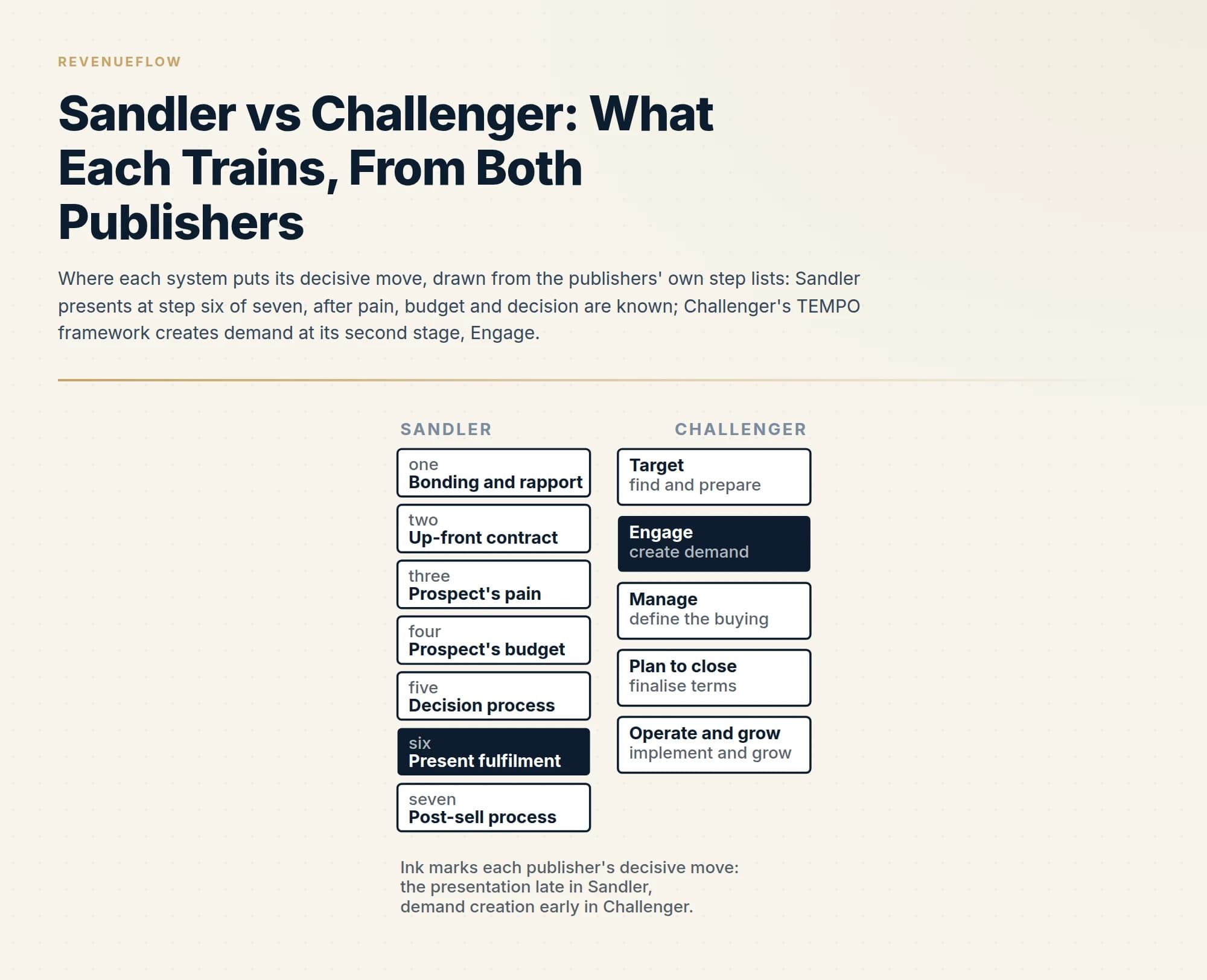
Sandler is a published seven-step system that keeps the seller in control of discovery and establishes pain, budget and decision process before presenting at step six. Challenger, as Challenger Inc publishes it, teaches, tailors and takes control on the strength of a Commercial Insight. One assumes a buyer who states a problem, the other a buyer to reframe.
Key takeaways
- Sandler's own page defines the system as seven steps in a low-pressure, consultative approach that puts the salesperson in control of discovery, with the presentation sixth of seven.
- Challenger Inc's own page names three moves, teaching, tailoring and taking control, built on a Commercial Insight, and publishes a five-stage TEMPO framework whose Engage stage creates demand.
- Sandler assumes a prospect who will state their pain and answer whether they can invest; Challenger assumes a buyer whose picture of their business is incomplete and a Mobilizer who can build consensus.
- Both use the word control: Sandler means an up-front contract that sets roles and ground rules, Challenger means constructive tension inside the customer, which its 2026 post says is never hostile or forceful.
Reviewed and updated September 19, 2026
Sandler and Challenger are usually compared as two answers to the question of how to persuade, and they are answers to two different questions. Sandler, as Sandler publishes it, is a system for controlling the discovery process and qualifying a prospect before anything is presented. Challenger, as Challenger Inc publishes it, is a way of changing what a buyer thinks about their own business before they know they have a purchase to make. Both companies keep their own descriptions online, so this page takes each system from its publisher's text, says what each trains, which buyer each assumes, and where each fits an outbound motion, and it ranks neither.
The seven Sandler steps in the publisher's wording, and the argument for the one worth stealing, are on the Sandler Selling System; the three Challenger verbs as the 2011 book states them are in the Challenger Sale entry; the map that places both among sixteen named methodologies is B2B sales methodologies. This page stays on the pair.
What Sandler trains, in Sandler's words
Sandler's page for the system (published 28 September 2022, last modified 8 September 2026, fetched 19 September 2026) opens with a definition and a posture: "Sandler Selling System is a seven-step system for successful selling." and "It's a low-pressure, consultative selling approach that puts you, the salesperson, in control of the discovery process." The seven steps run from bonding and rapport, through an up-front contract, the prospect's pain, the prospect's budget and the decision process, to the presentation at step six and a post-sell step at seven.
The order is the argument. The presentation arrives after pain, budget and the decision process have been established, so a Sandler seller does not propose until they know what the problem costs, whether the prospect is willing and able to invest, and who decides how. The page describes the origin as a reaction against a stereotype: David Sandler "teamed up with a clinical psychologist and designed an approach to sales that would break the traditional stereotypes of salespeople", one that "would focus on mutual respect, clarity, and qualifying decisions." The line the company uses to separate itself from the rest of the training market is this one: "While other sales training teaches you how to get better at playing the sales game, the Sandler Selling System is designed to prevent the games from ever being played."
So what Sandler trains is control of a conversation that already exists: how to agree its terms up front, how to get the buyer to state their own pain, and how to qualify hard enough that the presentation, when it comes, is made to somebody who has already said what a solution is worth and how they would buy it.
What Challenger trains, in Challenger's words
Challenger Inc's sales training page (published 9 November 2022, last modified 5 December 2025, fetched 19 September 2026) states the premise in one sentence: "The difference between a successful sale and a failed sale comes down to being able to shift a customer's thinking about their business or highlighting sales operation problems and then giving them a compelling reason to take action (a.k.a. being a Challenger)." The three moves are listed on the same page as "Teaching their customers new selling methods", "Tailoring their insights to address buyers' needs" and "Taking control of the conversation to help buyers make decisions".
The asset underneath the three verbs has a name. The page says two characteristics of a sales message change a customer's thinking, "teaching your customer something new about their business and giving them a compelling reason to take action", and gives the name Commercial Insight to "ideas designed to challenge assumptions, motivate action, and connect to your solution." The company sells the building of that insight as a service alongside the training, and it publishes a five-stage execution framework called TEMPO: Target, Engage, Manage, Plan to close, Operate and grow, where Engage is glossed as "Reach out and create demand".
What Challenger trains, then, is a message and the skills to deliver it: an argument about the buyer's own business that the buyer has not heard, adapted to the person in the room, delivered with enough control of the commercial process to reach a decision. The company's own page on whether the method is too aggressive (published 17 July 2026, modified 5 August 2026, fetched 19 September 2026) draws the line it wants drawn: "Challenger sellers set out to disrupt the customer's way of thinking, not their day."
The buyer each one assumes
The clearest difference is who is expected to already know what.
Sandler's steps assume a prospect who has a problem and will articulate it under questioning. Step three is the prospect's pain, and the page's definition of that step is to "Uncover the problems and their potential impact to identify reasons for doing business." The word is uncover: the problem is uncovered from the prospect rather than brought by the seller. The problem exists in the buyer's world and the seller's job is to get it stated, costed and owned before anything else happens. Step four assumes a prospect who can answer whether they are "willing and able to invest the time, money, and resources needed to fix the problem." A buyer who has not yet recognised a problem has nothing to uncover, and Sandler's system has no step for creating that recognition.
Challenger assumes the opposite buyer: one whose picture of their own business is incomplete, and who will not move until it is corrected. Its books page (last modified 5 December 2025, fetched 19 September 2026) states the company's research claim directly, that "classic relationship building is a losing approach for winning deals, especially when it comes to selling complex, large-scale B2B solutions and services." The buyer it wants is named in the second book: "Simply being a Challenger seller isn't enough; your success or failure also depends on who you challenge." The person to find is the Mobilizer, described on the same page as "the buying influences who can enable change and build consensus around the problem, solution, and vendor selection".
The two systems also mean different things by the word relationship. Sandler's first step is bonding and rapport, defined on its page as "Develop equal business stature and encourage open, honest communication." Challenger's post on aggression argues that a relationship worth having is the product of a good sales experience rather than its precondition, and answers the objection in its own words: "Challenger methodology isn't about using aggressive tactics, pressuring buyers, or sacrificing relationships. It isn't about challenging people at all." Both companies therefore claim to protect the relationship; one protects it by agreeing terms and qualifying honestly, the other by bringing the buyer something worth their time.
| Question | Sandler's answer | Challenger's answer |
|---|---|---|
| Where does the problem come from? | Uncovered from the prospect under questioning at step three | Brought by the seller as a Commercial Insight the buyer had not heard |
| When does the seller present? | Step six, after pain, budget and the decision process | After the insight has reframed the buyer's thinking |
| What does control mean? | Control of the discovery process, agreed in an up-front contract | Taking control of the conversation to help buyers make decisions |
| What is the relationship for? | Equal business stature, so qualifying questions can be asked | A result of a good sales experience, never the winning approach |
Control, and the two words each side uses for it
Both systems use the word control, and the way each one qualifies it is where the temperaments differ.
Sandler's control is procedural. The up-front contract, step two, is defined as the point where the seller and prospect "Establish roles and ground rules to create a comfortable environment within which to do business." Control means both parties know what the meeting is for and what the acceptable outcomes are, including the outcome where there is no fit, and it is the seller who proposes those terms. The pressure the page promises to remove is the pressure of ambiguity.
Challenger's control is conversational, and the company has a term for the discomfort it accepts: constructive tension. Its 2026 post defines what it is and what it is not. It is "Strategic, empathetic, and aimed at exploring conventional ways of thinking, assumptions, and answers" and it is not "Aggressive, hostile, or forceful". The post's own account of where the tension sits is the useful line: "It's about creating tension within the customer themselves; the tension lies between what they thought before and the information a Challenger rep uniquely presents." The post also records the wording rule the company teaches for delivering a reframe without indicting the person, quoting its head of insights on removing the word you from the sentence.
A team choosing between the two should notice that these are compatible in principle and expensive in combination. An up-front contract can open a call that then delivers a commercial insight. What cannot be combined cheaply is the training and the input: Sandler's steps run on questions a seller can learn to ask, while Challenger's steps run on an insight somebody has to research, build and refresh, which is why Challenger sells insight design as a service next to the training.
Where each fits an outbound motion, and where it does not
Neither system creates the first conversation, and both publishers say so in their own way. Sandler's page describes the system as putting the salesperson in control of the discovery process, which presupposes a discovery process. Challenger's TEMPO framework puts creating demand at its Engage stage, after a Target stage that finds and prepares the accounts, and the company's page on informed buyers describes the current buyer as outreach-averse. The question for an outbound team is which of the two survives contact with a stranger who did not ask to be contacted.
Sandler transfers to outbound badly in its opening steps and well in its later ones. An up-front contract needs two parties and a first message has one; a pain step that asks a stranger to articulate their problem before they have any reason to reply is asking for work with nothing to pay for it. Once a reply exists and a call is booked, the contract, the pain step and the budget question are exactly what a first call needs, and our own page on the discovery call reaches the same conclusion by a different route.
Challenger transfers to outbound at the message and fails at the seat. A first message that carries one specific observation about the buyer's own business, and what it usually means, is a commercial insight in miniature, and it is the only kind of cold message worth sending. What Challenger's own pages do not address is how a seller with a genuine insight gets thirty minutes with a person who has never heard of them, which is the constraint an outbound team is actually up against. The insight helps get the reply; the six-step choreography needs the room.
The honest summary is that a written outbound programme borrows Challenger's standard for what a first message must contain and Sandler's standard for what the first call must establish, and licenses neither. Both companies sell the operating apparatus, the coaching, the certification and the message design, and that apparatus is what makes either system hold after the workshop ends.
- One specific observation about the buyer's own business
- What that observation usually means for them
- A reason to act now, connected to what you sell
- An up-front contract on what the call is for and its outcomes
- The pain uncovered in the buyer's own words
- Whether they can invest, learned on the call
Where our own practice differs
Both publishers describe reaching a buyer as a sequence of contacts, and Challenger's Engage stage is built on outreach. We send one message per campaign, on one premise, once; a later approach is a separate campaign with a separate premise, and on LinkedIn we do not send a second message at all. The reasoning and its cost are set out where we take apart a published fifteen-touch cadence, the Agoge sequence.
We also keep Sandler's budget and decision questions out of the definition of a qualified meeting. A meeting we book qualifies when the company is in the agreed audience, the person has real responsibility for the area, they agreed to a relevant business conversation and they attended, against criteria agreed in writing before launch. Whether they are willing and able to invest is something to learn on the call, which is where Sandler's step four belongs, and never a condition on whether the call counted.
The short version
Sandler trains control of a discovery process that already exists: seven published steps, with pain, budget and the decision process established before the presentation at step six, built on mutual respect and an up-front contract, and designed, in the company's words, to prevent the games from ever being played. Challenger trains a message and the skills to deliver it: teaching, tailoring and taking control, built on a Commercial Insight the company will help you design, delivered with constructive tension that its own pages define as tension inside the customer rather than between the two of you. Sandler assumes a buyer who will state a problem under questioning; Challenger assumes one whose picture of their business needs correcting first. Neither creates the conversation it runs in.
If the constraint is the number of qualified conversations rather than what happens inside them, that is the half we run, and a first campaign is the cheapest way to see what your market returns before choosing a system to run on it.
Every quotation above is from the named page as fetched on 19 September 2026: Sandler's Sandler Selling System page (published 28 September 2022, modified 8 September 2026); Challenger Inc's sales team training page (published 9 November 2022, modified 5 December 2025), Challenger sales books page (modified 5 December 2025) and its post on whether Challenger selling is too aggressive (published 17 July 2026, modified 5 August 2026). Publishers revise these pages; confirm the current text before relying on it.
Frequently asked questions.
Frequently asked questions- What is the main difference between Sandler and Challenger?
- Where the problem comes from. In Sandler's published steps the seller uncovers the prospect's pain, budget and decision process through questioning and presents only at step six. In Challenger's published method the seller arrives with a Commercial Insight that changes how the buyer sees their own business, then tailors it and takes control of the conversation. One qualifies a recognised problem; the other creates recognition of one.
- Is Challenger selling aggressive compared with Sandler?
- Challenger Inc's own 2026 post says its method is not about aggressive tactics, pressuring buyers or challenging people, and defines constructive tension as tension within the customer between what they thought and what the seller presents, never hostile or forceful. Sandler's page describes a low-pressure approach built on mutual respect and an up-front contract. Both publishers claim to protect the relationship by different means.
- Can a sales team use Sandler and Challenger together?
- In principle yes: an up-front contract can open a call that then delivers a commercial insight, and Sandler's budget and decision steps can qualify the opportunity the insight created. The expensive part is the input. Sandler runs on questions a seller learns to ask; Challenger runs on an insight somebody has to research, build and refresh, which is why Challenger sells insight design alongside its training.
- Which fits an outbound sales motion better, Sandler or Challenger?
- Neither creates the first conversation. Sandler's opening steps need two parties, so they start once a call is booked, where its contract, pain and budget steps fit a first call well. Challenger's insight is what a cold first message should carry, but its six-step choreography needs the room. A written outbound programme borrows Challenger's standard for the message and Sandler's for the first call.
About the author.

B2B cold email experts helping companies generate qualified leads through done-for-you outreach campaigns.
RevenueFlow Team
Explore more.
Ready to scale your outreach?
We build GTM engines that book real meetings. See the receipts.
Related articles.
MEDDIC vs SPICED: What Each Qualifies, From Both Publishers
MEDDIC and SPICED from their own publishers: six themes that audit an existing deal against five elements written to carry across a subscription customer's whole journey.
Gap Selling vs SPIN Selling: What Each Method Diagnoses
Gap Selling and SPIN Selling from their authors' own pages: four question types that develop a stated need, against a measured gap between two states.
Objection Handling Frameworks: LAER, AAA and Others Compared
The named objection-handling frameworks with their publishers quoted: Carew's LAER, RAIN Group's four steps, HubSpot's five, Gong's three and both AAAs.
The Summary Close: Restating What Was Agreed Before the Ask
The summary close restates the buyer's needs, the agreed answer to each and then asks. What the publishers say, the structure, a worked example, and where it fails.
Command of the Sale: Force Management's Process Programme
Command of the Sale is Force Management's sales process and qualification programme, not its messaging one. What the vendor says it is, delivers and how it runs.
MEDDIC vs BANT: What Each Qualifies and When to Use Which
MEDDIC and BANT from the originators' own text: IBM's BANT form as a gate after the first call, PTC's six themes as an audit of a live deal, and when to run each.