Objection Handling Frameworks: LAER, AAA and Others Compared
The named objection-handling frameworks with their publishers quoted: Carew's LAER, RAIN Group's four steps, HubSpot's five, Gong's three and both AAAs.
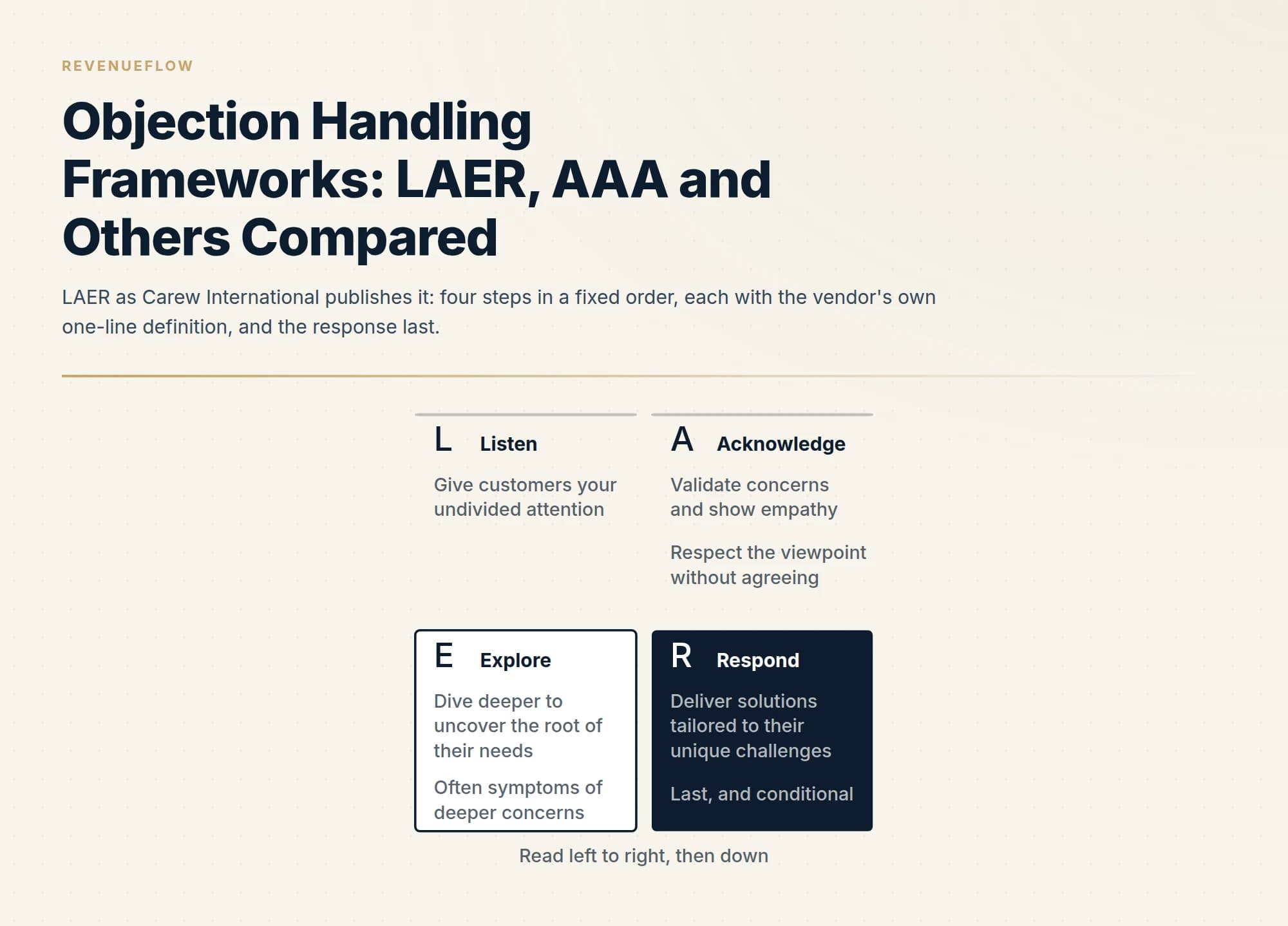
An objection-handling framework is a fixed order of moves that applies whatever the buyer said. LAER is Carew International's: listen, acknowledge, explore, respond. RAIN Group adds a confirmation step, HubSpot adds anticipation, Gong starts by agreeing, and AAA exists in two versions. They share one spine: do not answer yet, find the real concern, then answer.
Key takeaways
- LAER has an author: Carew International publishes listen, acknowledge, explore, respond as its own method and defines each step in one line, and HubSpot's five-step version credits Carew for four of its five.
- The frameworks share a spine of a move before answering, a move to find the real concern, and the answer last; RAIN Group's fourth step, confirming the objection was actually satisfied, is the one addition worth taking whichever framework you adopt.
- AAA is two different frameworks: Uplift GTM's acknowledge, ask, advocate explores the concern, while the acknowledge, associate, ask version attributed to Alex Hormozi reframes it, and a team adopting AAA should know which one it is adopting.
- A framework is a property of a conversation: for a written channel its home is the reply thread after a real position, never silence, which carries no objection to handle and never earns a second unsolicited message.
Reviewed and updated September 19, 2026
Most objection-handling advice is a list of rebuttals sorted by what the buyer said. A framework is the other thing: a fixed order of moves that applies whatever the buyer said, so the seller does not have to think of the answer before understanding the question. Several of these have names, and the useful fact about them is that most have a publisher you can read. Carew International teaches LAER and says so on its own pages. RAIN Group publishes four steps. HubSpot publishes five and credits Carew for four of them. Two different expansions of AAA circulate under two different authors. Feel, felt, found belongs to nobody. This page sets the named frameworks side by side with their publishers quoted, says what they share, and says where any of them applies to a team that sends one message and handles what comes back.
It sits beside three live pages and repeats none of them. Objection handling email templates carries the reply-thread emails; objection handlers is about which prepared entries earn a place in a library; cold call objections carries Gong's three-bucket taxonomy and its three-step response shape. This is the page for the frameworks themselves.
LAER: the one with an author
LAER stands for Listen, Acknowledge, Explore, Respond, and Carew International, a sales training company, publishes it as its own. Carew's article on the framework, published on 9 January 2025, modified on 5 June 2025 and fetched on 19 September 2026, says: "It's a method we teach in Carew's flagship sales training program, Dimensions of Professional Selling", and defines the four steps in one line each. Listen: "Give customers your undivided attention." Acknowledge: "Validate their concerns and show empathy." Explore: "Dive deeper to uncover the root of their needs." Respond: "Deliver solutions tailored to their unique challenges."
Carew's second article, on using the framework for last-minute objections, published on 24 September 2025, gives the two steps that do the work their operating definitions. On acknowledging: "Effective acknowledgment demonstrates respect for their viewpoint without necessarily agreeing with their conclusions." On exploring: "Last-minute objections frequently represent symptoms of deeper concerns." The same article lists what to avoid at the acknowledge step, dismissive responses, invalidating language and confrontational positioning, and gives exploring questions of the shape what would need to change for you to feel confident moving forward.
What distinguishes LAER from a list of rebuttals is the position of the response. It is last, and it is conditional on the third step having happened. That ordering is the thing every other framework on this page either copies or argues with.
The other named frameworks, publisher by publisher
RAIN Group's four steps. RAIN Group, a sales training company, published its four-step approach on 6 March 2024, modified it on 28 July 2026, and it was fetched on 19 September 2026. The steps are listen fully to the objection, understand the objection completely, respond properly and confirm you have satisfied the objection. The second step is where its method differs from LAER: "To do this, ask permission from the buyer to understand and explore the issue. From there, restate the concern as you understand it." and it keeps going past the first answer, asking what else and why even after the buyer confirms the restatement, because "Many objections hide underlying issues that the buyer can't or isn't ready to articulate." The fourth step is RAIN Group's own addition and it exists for a reason the page states: "Just because they nodded during your response doesn't mean they agree with everything you said." The same page sorts objections into four types, need, urgency, trust and money, which is a taxonomy rather than a framework and is not repeated here.
HubSpot's five steps, which are LAER with a step in front. HubSpot's guide to handling objections, written by Mark Burdon and fetched on 19 September 2026 (the page shows an updated marker without a date the fetch could read), runs the framework as anticipate, listen, acknowledge, explore, respond, and credits the last four: "Listen, Acknowledge, Explore, and Respond are taught by Carew International as LAER: The Bonding Process." Its added step is preparation: "Anticipating means preparing for the objections you're most likely to hear before the call, so none of them catch you cold." HubSpot also names which step fails most: "The Explore step, the one most reps rush past, is where average reps lose deals and top reps win them."
Gong's three steps. Gong publishes a three-step shape for cold-call objections, agree, incentivise conversation, then sell the next step rather than the product, drawn from its own call analysis. Gong's blog did not serve to the fetch behind this page on 19 September 2026, so it is not quoted here; the live cold call objections page quotes it and carries the reasoning, and the framework belongs on this list because its first move, agreeing, is the acknowledge step taken to its limit.
AAA, in two versions with two authors. The letters are shared and the frameworks are not. Uplift GTM's guide, dated March 2026 on the page and fetched on 19 September 2026, expands it as acknowledge, ask, advocate, and places it: "Better suited to complex B2B sales where the stated objection often masks a deeper concern." with the middle step defined as "Ask: Ask a clarifying question. The surface objection is rarely the real one." The CFO Accelerator, a newsletter for fractional finance practices, published on 5 December 2025 a version it attributes to Alex Hormozi, acknowledge, associate, ask, whose middle step is different in kind: "Next, associate what they said with the action of purchasing", or at least, the page adds, with a positive trait. One AAA explores; the other reframes. A team adopting AAA should know which one it is adopting.
Ledge, disrupt, ask. The same newsletter reports a three-step framework it attributes to Jeb Blount and his book on objections: a ledge statement that buys time, a disruption that redirects rather than resists, and an ask. Its description of the first step: "The Ledge statement is a nearly-automatic reply that is designed to help buy you time to formulate a more logical and less emotional response." It is quoted here as that publisher's report of Blount's method, not from the book.
Feel, felt, found, which nobody claims. The oldest pattern on this list has no publisher claiming to have written it. Consensus, a demo-automation vendor, published a guide to it on 23 September 2025 that calls it verbal judo; Uplift GTM calls it the classic empathy-based framework; The CFO Accelerator gives its three steps as affirming the reservation, linking it to how past clients felt, and introducing a reason to reconsider phrased as what others found. Its weakness is stated by the live objection-handlers page on this site, which says it reads as manipulation when the found is a testimonial in disguise; none of the three publishers here claims an author for it, and this page does not invent one.
| Framework | Published by | Steps, in order |
|---|---|---|
| LAER | Carew International, its own method, 2025 | Listen, acknowledge, explore, respond |
| Four steps | RAIN Group, 2024, modified 2026 | Listen fully, understand completely, respond properly, confirm |
| Five steps | HubSpot, crediting Carew for four | Anticipate, listen, acknowledge, explore, respond |
| Three steps | Gong, quoted on the cold call page | Agree, incentivise conversation, sell the next step |
| AAA, first version | Uplift GTM, March 2026 | Acknowledge, ask, advocate |
| AAA, second version | The CFO Accelerator, attributing Alex Hormozi, 2025 | Acknowledge, associate, ask |
| Ledge, disrupt, ask | The CFO Accelerator, attributing Jeb Blount, 2025 | Ledge, disrupt, ask |
| Feel, felt, found | No author claimed; Consensus, Uplift GTM, The CFO Accelerator | Feel, felt, found |
What they share, and the two steps they argue about
Line the frameworks up and the same spine appears under most of them: a move before answering, a move to find the real concern, the answer, and sometimes a check afterwards.
Every framework except the oldest puts something before the answer. LAER listens and acknowledges; RAIN Group listens fully; Gong agrees; both AAAs acknowledge; Blount's ledge exists purely to delay the reply. The publishers give different reasons, Carew's respect without agreement, Gong's removal of the thing the buyer is reacting to, Blount's cooler head, and they converge on the same instruction: do not answer yet.
Four of the eight then go looking for the real concern outright and two more do a version of it, and this is the step the publishers agree is skipped. Carew calls it explore, RAIN Group understand, Uplift ask, HubSpot says it is the step reps rush past. The one framework that reframes instead of exploring is Hormozi's associate step, which is why the two AAAs are different tools: one finds out what the buyer means, the other tells the buyer what their objection means.
The answer comes third or fourth in every version, and only RAIN Group adds a check after it. In the grid below, a step a framework has in a different form is marked partial. That confirm step is the least glamorous idea on this page and the most useful for written work, because a written answer to a written objection has no nod to misread; the buyer's next reply is the confirmation, or its absence is.
| Row | Before answering | Find the concern | The answer | Check after |
|---|---|---|---|---|
| LAER (Carew) | Yes | Yes | Yes | No |
| Four steps (RAIN Group) | Yes | Yes | Yes | Yes |
| Five steps (HubSpot) | Yes | Yes | Yes | No |
| Three steps (Gong) | Yes | Partial | Yes | No |
| Acknowledge, ask, advocate | Yes | Yes | Yes | No |
| Acknowledge, associate, ask | Yes | Partial | Partial | No |
| Ledge, disrupt, ask | Yes | No | Partial | No |
| Feel, felt, found | Yes | No | Yes | No |
Where a framework applies, and where nothing does
A framework is a property of a conversation. Somebody says a thing, the seller does the steps, the buyer responds, and it resolves in the same sitting. The phone rewards that, which is why the frameworks were written for calls, and the live objection handlers page adds the sorting that has to happen before any of them: half of what a caller hears is a reflex with no information in it, and a framework applied to a reflex is a script for arguing with a position nobody holds.
Written outbound has no equivalent to the conversation, and this is the boundary that decides everything for a team like ours. A first message goes to a stranger who has objected to nothing. If they reply with a real position, there is a conversation, and every framework above applies inside that thread. If they do not reply, there is no objection to handle: silence carries no information, cannot be listened to, acknowledged or explored, and a second unsolicited message written as a rebuttal to it is the worst habit in the channel. Our campaigns send one message per person and schedule nothing behind it for exactly that reason, and the full argument is in why we stopped using follow-ups.
So the frameworks' home, for a written channel, is the reply thread. The invented example below shows LAER applied to a written objection in one. The company, Fennimore Freight, and its Head of Revenue Operations are fictional, the objection is a written note on switching costs after a migration that took four months, and the message is not one of the templates on the live templates page.
Re: your note on switching costs, to the Head of Revenue Operations at Fennimore Freight (invented)
Understood: the last migration took your team four months and you are not going to sign up for another one on a promise. 1
That is a fair reason to stop, and it would be mine too. 2
Was the four months the data move itself, or the retraining afterwards? The answer changes what we would propose, because we can do one of those for you and not the other. 3
If it was the data, the honest version is a two-week parallel run on your last quarter's records before anything is switched over, and no contract until it reconciles. 4
- 1Listen, in writing: the objection restated in the buyer's own terms before anything else, so they can see it was read.
- 2Acknowledge without agreeing that the deal is dead: the concern is validated, not the conclusion.
- 3Explore with one question that splits the objection into the two things it could mean, and says why the answer matters.
- 4Respond conditionally, to one branch only, with a step the buyer can refuse. RAIN Group's confirm step is the buyer's next reply.
Choosing one
The differences between these frameworks are smaller than the difference between using one and improvising, so the choice does not deserve much time. Three things settle it.
Choose by the step your team skips. If reps answer before they have understood, LAER or RAIN Group's four steps, because both make the answer conditional on exploration. If reps freeze, Blount's ledge, because it exists to give them something to say. If reps argue, Gong's agree step, because it removes the thing being argued with.
Prefer the one with an author. Carew publishes LAER as its own and defines every step; RAIN Group defines its four; HubSpot credits its source. The same test sorts outbound frameworks, and the Agoge sequence is the case on this site where an author, a date and published copy made a method easy to evaluate. A framework whose steps are defined by its publisher can be taught consistently, and one that circulates under a name with no author, feel, felt, found among them, drifts into whatever the last person to explain it meant.
And take RAIN Group's fourth step whichever framework you adopt. Confirming that the objection was actually resolved costs one question on a call and nothing in writing, and it is the step that turns a handled objection into a closed one rather than a paused one.
If the constraint is that there are too few conversations in which any of this happens, that is the half we run: a first campaign against your market produces the replies these frameworks were written for.
The short version
An objection-handling framework is a fixed order of moves that applies whatever the buyer said. LAER is Carew International's, listen, acknowledge, explore, respond, with the response last and conditional. RAIN Group's four steps add a confirmation afterwards; HubSpot's five add anticipation before; Gong's three start by agreeing; AAA exists in two versions with different middle steps and different authors; ledge, disrupt, ask is attributed to Jeb Blount; feel, felt, found has no author anyone claims. They share a spine: do not answer yet, find the real concern, then answer. All of them are properties of a conversation, which for a written channel means the reply thread and never silence.
Publisher pages quoted as fetched on 19 September 2026: Carew International (published 9 January 2025, modified 5 June 2025; and 24 September 2025), RAIN Group (published 6 March 2024, modified 28 July 2026), HubSpot (updated marker on the page, undated in the fetch), Uplift GTM (March 2026), The CFO Accelerator (5 December 2025), Consensus (23 September 2025). Gong's page did not serve to the fetch and is not quoted. Publishers revise these pages; confirm the current text before relying on it.
Frequently asked questions.
Frequently asked questions- What is the LAER objection handling framework?
- LAER stands for Listen, Acknowledge, Explore, Respond, and Carew International publishes it as a method taught in its Dimensions of Professional Selling programme. Carew defines the steps as giving customers your undivided attention, validating their concerns and showing empathy, diving deeper to uncover the root of their needs, and delivering solutions tailored to their challenges. The response comes last and depends on the exploring step.
- What is the AAA framework for handling objections?
- Two frameworks share the letters. Uplift GTM's version is acknowledge, ask, advocate: hear the concern, ask a clarifying question because the surface objection is rarely the real one, then offer evidence. The CFO Accelerator reports a version attributed to Alex Hormozi, acknowledge, associate, ask: repeat the objection back, associate it with the action of purchasing or a positive trait, then ask the next question. One explores, the other reframes.
- Which objection handling framework is best?
- The differences between them are smaller than the difference between using one and improvising. Choose by the step your team skips: LAER or RAIN Group's four steps if reps answer before understanding, Jeb Blount's ledge if reps freeze, Gong's agree step if reps argue. Prefer a framework with a publisher who defines its steps, and add RAIN Group's confirmation step whichever one you pick.
- Do objection handling frameworks work for cold email?
- Only inside a reply thread. Every framework assumes a conversation in which the buyer said something, and a first cold message goes to a stranger who has objected to nothing. If they reply with a real position, LAER and the rest apply in writing, with the buyer's next reply serving as the confirmation step. If they do not reply, there is no objection to handle, and a second unsolicited message written as a rebuttal to silence is a bump.
About the author.

B2B cold email experts helping companies generate qualified leads through done-for-you outreach campaigns.
RevenueFlow Team
Explore more.
Ready to scale your outreach?
We build GTM engines that book real meetings. See the receipts.
Related articles.
Command of the Sale: Force Management's Process Programme
Command of the Sale is Force Management's sales process and qualification programme, not its messaging one. What the vendor says it is, delivers and how it runs.
The Urgency Close: Real Deadlines and Manufactured Ones
The urgency close from the publishers who teach it, the test that separates a real deadline from a manufactured one, the structure, and why we never invent one.
MEDDIC vs BANT: What Each Qualifies and When to Use Which
MEDDIC and BANT from the originators' own text: IBM's BANT form as a gate after the first call, PTC's six themes as an audit of a live deal, and when to run each.
The Summary Close: Restating What Was Agreed Before the Ask
The summary close restates the buyer's needs, the agreed answer to each and then asks. What the publishers say, the structure, a worked example, and where it fails.
ValueSelling Framework: The Stages and the Prospect Formula
The ValueSelling Framework is a licensed methodology, not the generic idea. Its four stages, the Qualified Prospect Formula and its delivery, from the vendor's pages.
The Columbo Close: One More Thing, and Where It Works
The Columbo close is the question asked from the door once the buyer thinks the selling is over. Its two readings, the buyer it suits, and where it fails.