Objection Handlers: Which Entries Earn Their Place
Half of what gets logged as an objection contains no information at all. Sorting a handler library into reflexes and positions, and deleting most of it.
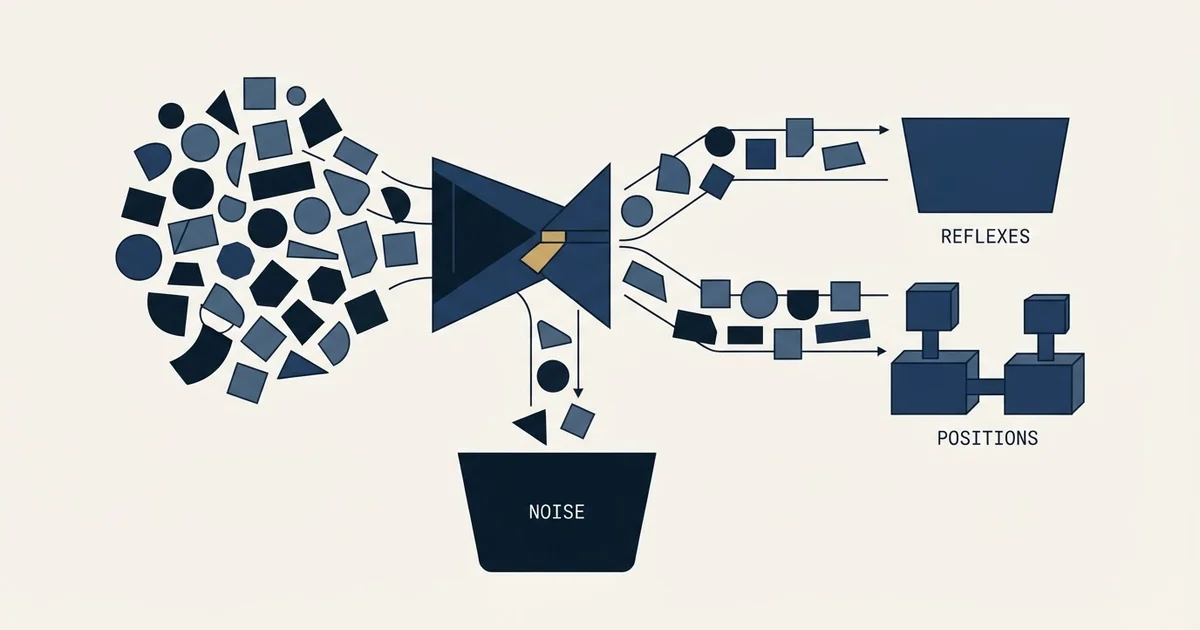
An objection handler is a prepared response to something a buyer says. The useful sort is between a reflex, which contains no information about their situation, and a position, which names a constraint. Only the second is answerable, and most library entries argue with the first.
Key takeaways
- The test for whether something is a real objection is whether it contains a fact you did not have before; if it does not, there is nothing to handle.
- Delete every entry that argues with a reflex and every entry that characterises a competitor, because people defend their own decisions better than anything else.
- Good entries are questions rather than statements, and shorter than the objection they answer, since volume reads as anxiety.
- Silence is not an objection, so nothing in this practice transfers to sending a second unsolicited message.
Reviewed and updated September 2, 2026
Open the objection-handling document any sales team has been maintaining for two years and count the entries. Forty is normal. Ask which five get used and somebody will name three, hesitate, and then explain that most of them are for situations that do not really come up. That document is the artefact this page is about, and the useful work is deciding which of its entries to keep.
An objection handler is a prepared response to something a buyer says. The prepared part is the value and the prepared part is also the risk, because a response written in advance is a response written before anyone knew what the buyer actually meant.
Objection management is the same practice under a manager's name, and the work it describes is deciding which entries deserve to stay in the library rather than writing new ones.
Most advice on how to overcome objections assumes every objection is answerable. The first move is deciding which ones contain a fact at all, because arguing with the rest is what makes a caller sound pushy.
Published lists of common sales objections group them by the words the buyer used, which puts a reflex and a position in the same bucket and then prescribes one response for both.
The textbooks call this class a source objection, meaning the buyer is objecting to you rather than to the offer, and it is a position rather than a reflex whenever it names something checkable about your company.
The distinction that decides everything else
A prospect saying there is no budget to consider your offer right now sits on the right of this table whenever it carries a date or a constraint, and on the left when it arrives as the first thing they say. The two need different responses, and the tell is whether the sentence contains a fact you did not already have.
Half of what gets logged as an objection carries no information at all, and handling it as though it does is the most expensive habit in the practice.
There is a difference between a reflex and a position. "Not interested", said nine seconds into an interruption, is a reflex: the person has not evaluated anything, so there is no argument in it to answer. "We signed a two-year contract with somebody else in March" is a position: it is a fact about the world, it is answerable, and it tells you what to do next.
A related question about where such account facts originate is explored in what ZoomInfo covers and its limits, which maps the platform's three layers and where they stop.
Both arrive in the same tone of voice, which is why the distinction has to be made deliberately rather than felt. The test is whether the statement contains a fact you did not have before. If it does not, there is nothing to handle, and the job is getting to whatever the actual position is.
- Arrives before you have explained anything
- Contains no fact about their situation
- Standard forms: not interested, send me information, I am in a meeting, how did you get my number
- Arguing against it means arguing with a position they do not hold
- What it needs: another fifteen seconds of voluntary attention
- Arrives after they have understood what you are asking about
- Names a constraint, a date, an incumbent or a person
- Standard forms: no budget until April, we use X, that sits with a different team
- Answerable, though usually not in this conversation
- What it needs: a specific question about the constraint
This distinction is worked out in more depth for the phone, where objections are most concentrated, in how cold call objections sort into three buckets. The published taxonomy behind that piece puts the reflex category at roughly half of everything a caller hears.
What to delete from the library
Most objection-handling documents contain four kinds of entry, and two of them make outcomes worse.
Delete the rebuttals to reflexes. Any entry whose job is to argue with "not interested" is a script for arguing with somebody who has not formed a view. These are the entries that produce the tone buyers describe as pushy, and they are the ones most likely to end the conversation they were written to save. Libraries of objection rebuttals are usually organised by the words the buyer used, which is why they reach forty entries and why so many of them argue with reflexes; sorting the same material by category before wording shows how few genuine positions there are to answer, and a rebuttal written against a statement carrying no information is an entry to delete rather than to improve.
Delete anything that criticises an incumbent. Attacking a decision the buyer already made puts them in the position of defending it, and people defend their own decisions better than they defend anything else. The productive version establishes what the incumbent does not cover, with no characterisation of the incumbent at all, and lets the comparison be made by the person who is allowed to make it.
Keep the clarifying questions. These are the entries that convert a reflex into a position, and they are the highest-yield category by a wide margin. They are also the shortest, which is why they look insubstantial in a document full of paragraphs.
Keep the honest concessions. Entries that agree with a real constraint and propose a next step timed against it. "That sounds like it sits with procurement rather than with you, and the useful thing is probably to know when the renewal comes up" is a handler. It just does not look like one, because it does not win anything today.
The entries worth writing, and what makes them work
The entry buyers raise most often is that the price is too high for the value, and it earns a place in the library only when the written response names what the price buys that a cheaper quote leaves the buyer to do themselves.
The feel felt found sales technique is the best known script pattern of this kind, and it passes or fails on the same test as any other entry: it works when the third part carries a specific fact the objector did not have, and it reads as manipulation when the found is a testimonial in disguise.
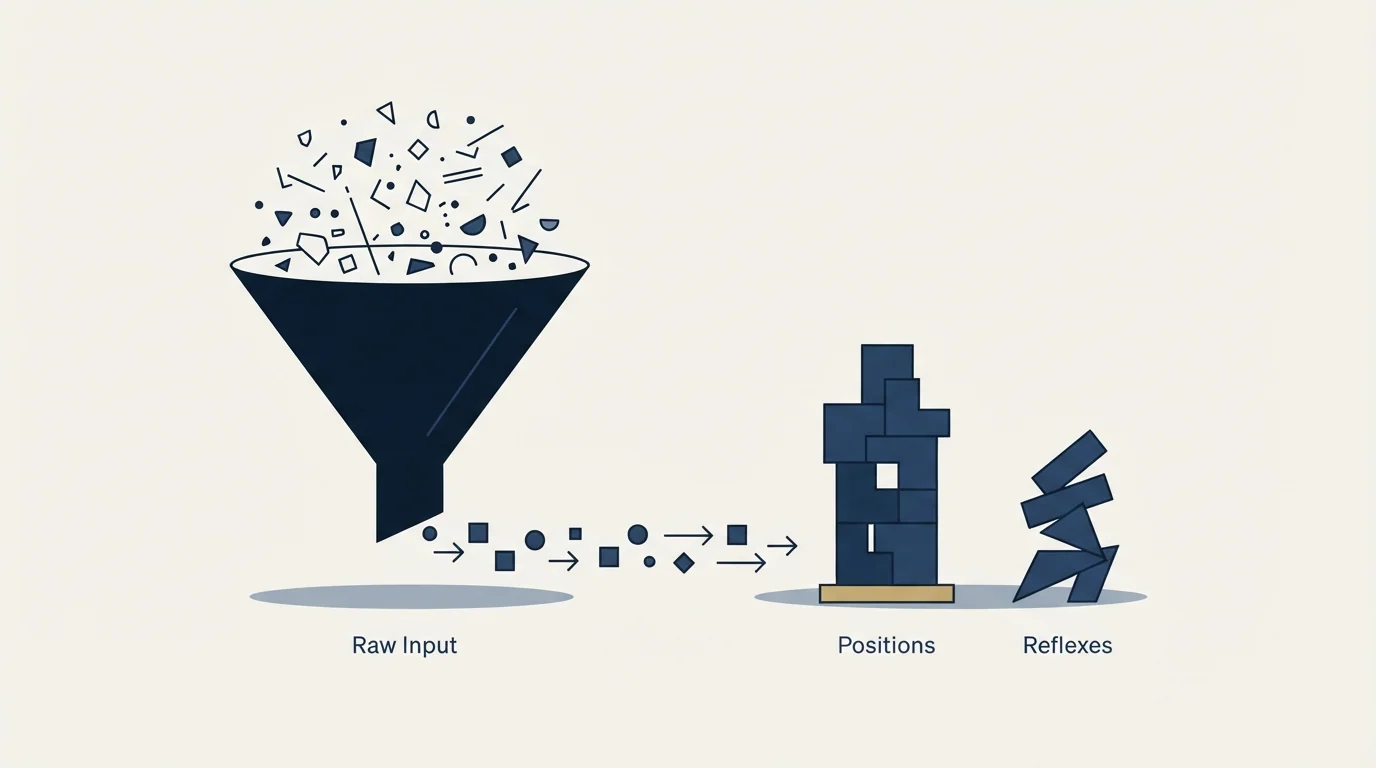
A handler earns its place when it does one of three things: it converts a reflex into a position, it answers a position with a fact, or it ends the conversation cleanly.
Answering a position with a fact often needs the technical seat beside the rep, and what that seat needs to answer quickly treats the shared demo environment as the expensive part.
The third is the one nobody writes and everybody needs. A fast clean ending returns your time and leaves the account intact, and a library with no exit entries produces sellers who keep talking because they have nothing prepared for stopping.
The common property of good entries is that they are questions rather than statements. A statement invites agreement or disagreement, and a buyer who has just produced a reflex will disagree with anything on principle. A question about their situation is answerable without anyone conceding anything, which is why it survives the moment.
Length matters more than most teams expect. An objection response should be shorter than the objection, because volume reads as anxiety. Entries in a library tend to grow over time as people add qualifications, and a periodic pass that cuts every entry back to its first two sentences usually improves the whole document.
Where the practice stops applying
Objection handling is a property of synchronous conversation. Somebody says a thing, you respond, they respond, and it resolves in one sitting. The phone rewards it for exactly that reason.
Written outbound has no equivalent, and the attempt to build one produces the worst habit in the channel: a second unsolicited message written as a rebuttal to silence. Silence is not an objection. It carries no information, it cannot be sorted into reflex or position, and answering it stacks another message underneath the one the recipient already chose to ignore.
One message per campaign is the house rule here, with nothing scheduled behind it, for exactly that reason. The distinction is worth stating precisely because it gets misread as squeamishness: a conversation earns a response because the other person supplied one, and a non-response supplies nothing to respond to, so anything sent into it is a repeat of the original approach at higher volume. The full argument, including what it costs us, is in why we stopped using follow-ups.
Where written objection handling does apply is inside a live thread, after somebody has replied with a real position. That is a conversation, and it responds to the same sorting. The email library for that case covers the wording.
Practising the right thing
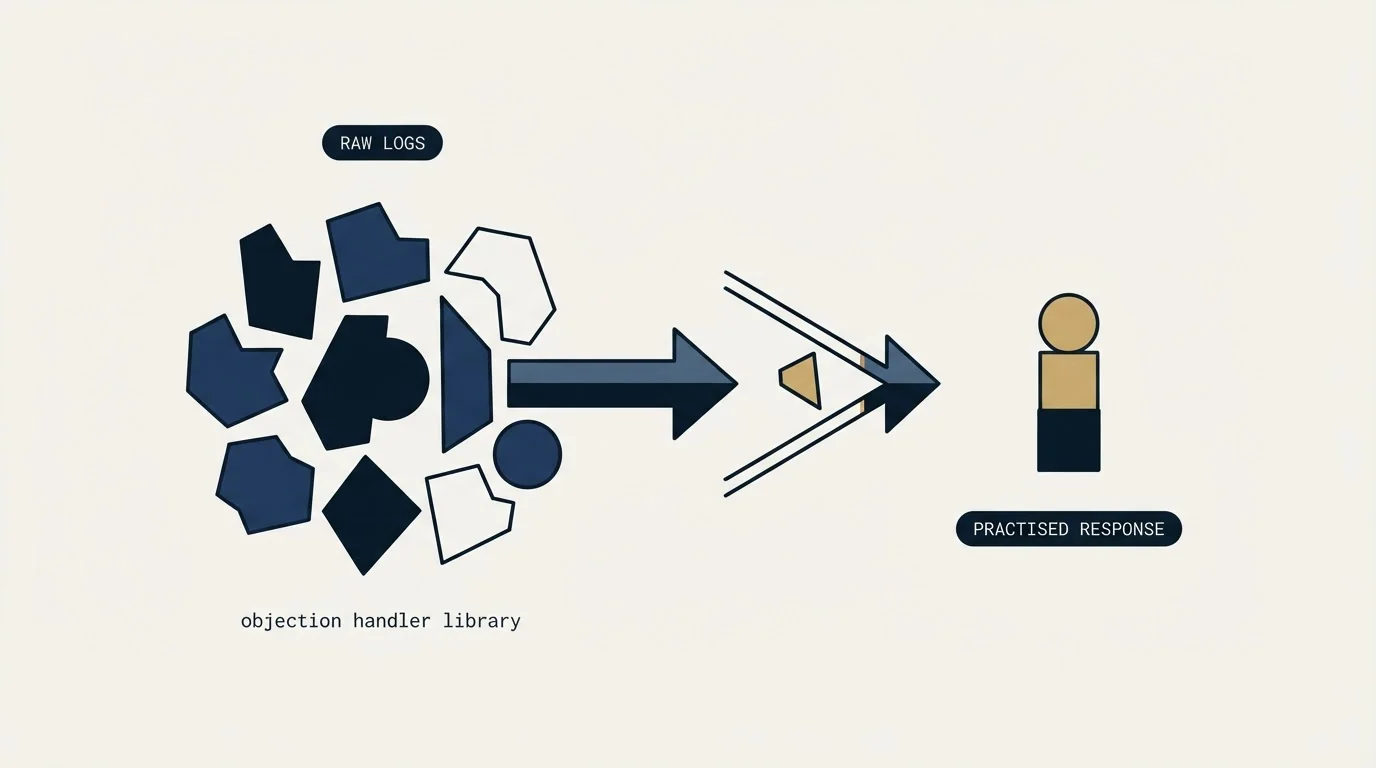
A library is only worth maintaining if it changes what a team practises, and most training time goes to the wrong half.
- Yes: It converts a statement with no information into one that has some
- Yes: It is a question rather than an assertion
- Yes: It is shorter than the objection it answers
- Yes: Somebody used it in the last quarter
- No: It argues against a reflex
- No: It characterises a competitor
- Depends: It exists because one memorable deal was lost that way
Two habits make the library operational.
Tag logged objections by category rather than by wording. Forty distinct phrases look like forty problems and are unmanageable. The same list sorted into reflexes, positions and incumbents usually shows one category dominating, and that concentration tells a manager what next week's practice is actually about.
Practise the transition, not the rebuttal. For reflexes the entire skill lives in the fifteen seconds between the reflex and the first real piece of information, and it is a tone problem more than a wording problem. Reading an entry aloud in a training room does not rehearse the part that is hard.
There is a third habit worth adopting and it is the one that changes the distribution rather than the response. Watch which category moves when the opening changes. An opening that names a specific, verifiable reason for the contact tends to shift volume out of reflexes and into positions, because the recipient now has something concrete to disagree with. That shift is a real improvement even before the meeting count moves, and it is one of the few leading indicators the channel offers.
A market that produces almost no traditional objections is usually producing reflexes rather than positions, and the absence of an argument is not evidence of agreement: it means nothing in the approach has yet given the recipient something concrete to disagree with.
Two things that are not objections
A hang-up is not an objection. It is the absence of a conversation, and there is nothing to handle. Teams that log hang-ups and then coach against them are coaching a shadow.
A wrong person is not an objection either. "That is not my area" is frequently true, and the correct response is to ask who it is and end the call quickly. Trying to persuade the wrong person to become the right one wastes the conversation and burns the account, and the account is the more expensive loss. That case is also a list problem presenting as a conversation problem: if a meaningful share of contacts reach somebody with no ownership of the area, the fix is upstream in who is on the list rather than in any rebuttal.
The same logic applies one level up. A high volume of price objections from a segment is a positioning signal rather than a training signal, and no library entry fixes it. The reasons buyers give for stopping are the highest-quality targeting feedback available anywhere in the business, and they are worth counting from a fixed list rather than answering individually. Disqualifying well on a discovery call covers where those reasons get produced.
The short version

An objection handler is a prepared response, and the preparation is both the value and the risk. Sort what you hear into reflexes, which contain no information, and positions, which contain a fact, and handle only the second. Delete every entry that argues with a reflex and every entry that criticises an incumbent. Keep the clarifying questions and the clean exits, and cut everything to its first two sentences.
Handling is a property of live conversation. Silence is not an objection, so nothing in this practice transfers to sending a second unsolicited message, and where the objections concentrate on fit or seniority the answer sits in the list rather than in the library.
If the constraint is that there are too few of these conversations to have, that is the half we run: see what a first campaign produces.
Frequently asked questions.
Frequently asked questions- What is an objection handler?
- A prepared response to something a buyer says during a sales conversation. The preparation is both the value and the risk, since a response written in advance was written before anyone knew what the buyer meant. The entries that survive contact tend to be short clarifying questions rather than prepared arguments.
- How do I tell a real objection from a brush-off?
- Ask whether the statement contains a fact about their situation you did not have before. A reflex arrives before you have explained anything and names nothing. A position names a constraint, a date, an incumbent or a person. Both arrive in the same tone, which is why the distinction has to be made deliberately.
- Which objection handlers should be deleted?
- Any entry whose job is to argue with a brush-off, because it argues with a view the person has not formed, and any entry that criticises an incumbent, which puts the buyer in the position of defending a decision they already made. Keep clarifying questions and clean exits, and cut what remains to two sentences.
- Does objection handling apply to cold email?
- Not to silence. Objection handling is a property of live conversation where somebody says a thing and you respond. A non-response carries no information and cannot be classified, so a second unsolicited message is a repeat of the first at higher volume. Inside a live reply thread, where a real position has been stated, it applies normally.
About the author.

B2B cold email experts helping companies generate qualified leads through done-for-you outreach campaigns.
RevenueFlow Team
Explore more.
Ready to scale your outreach?
We build GTM engines that book real meetings. See the receipts.
Related articles.
LinkedIn Outreach for Banks: A Regulated Message
How a bank's relationship managers use LinkedIn to reach business owners: what the FFIEC guidance, FINRA's notices and LinkedIn's own rules require, and where to stop.
Appointment Setting for Business Brokers: The Seller Meeting
What a bought meeting with a business owner has to be for a brokerage: the three-part qualification, the confidentiality rules, the licence line and the owner's reasons.
Objection Handling Frameworks: LAER, AAA and Others Compared
The named objection-handling frameworks with their publishers quoted: Carew's LAER, RAIN Group's four steps, HubSpot's five, Gong's three and both AAAs.
Command of the Sale: Force Management's Process Programme
Command of the Sale is Force Management's sales process and qualification programme, not its messaging one. What the vendor says it is, delivers and how it runs.
B2B Lead Lists for Aviation Companies: Build or Buy
Aviation is one of the few industries whose accounts are published by its regulator, which changes what is worth buying and what is worth downloading yourself.
Cold Calling for PPC Agencies: What You Can See First
A paid media prospect is partly readable before the call and has already been told by the platform what to do when a stranger rings about its ads.