Appointment Setting for Business Brokers: The Seller Meeting
What a bought meeting with a business owner has to be for a brokerage: the three-part qualification, the confidentiality rules, the licence line and the owner's reasons.
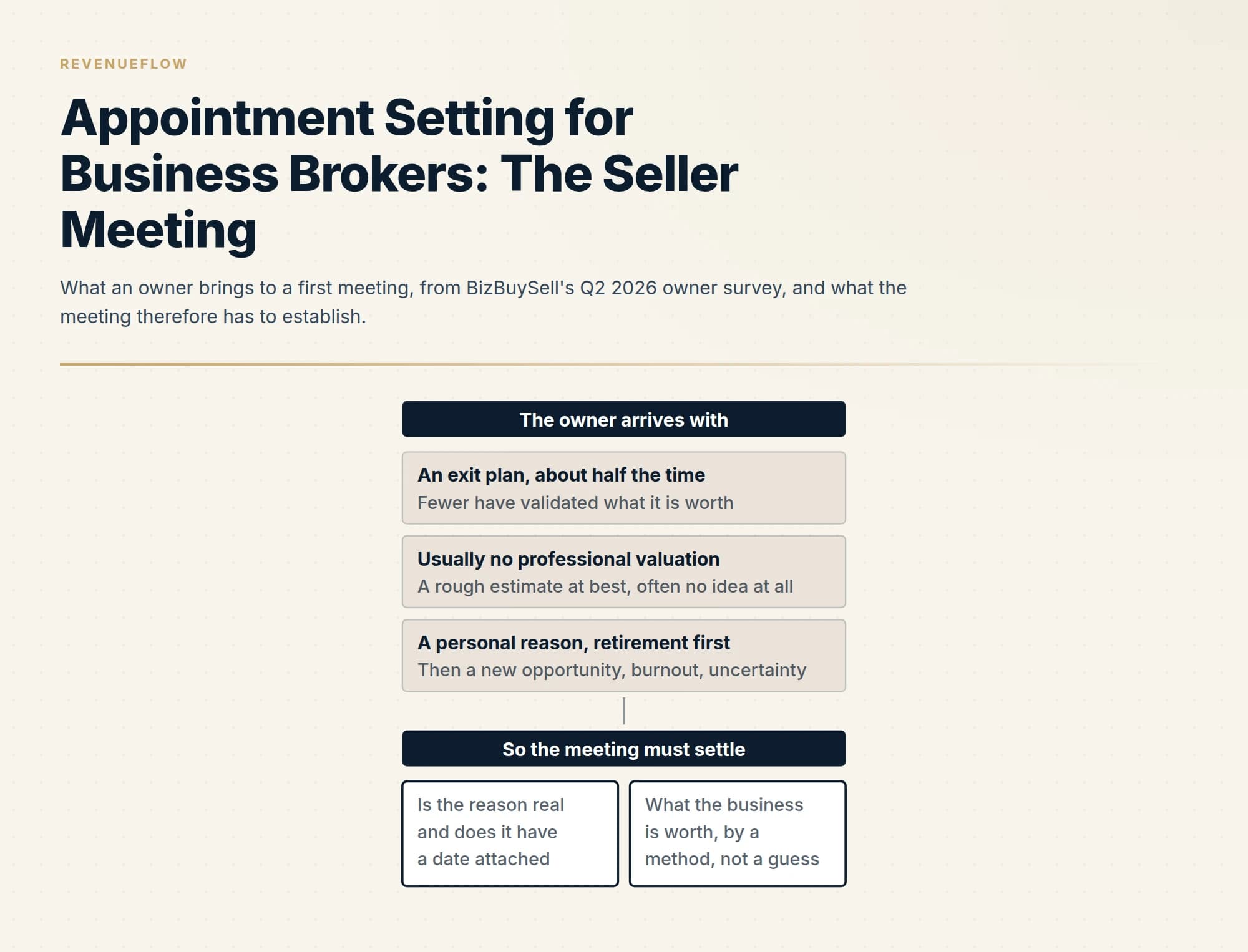
A qualified seller meeting for a business brokerage has three parts: the owner's own reason with a date, the valuation gap, and a promise of nothing but a confidential conversation with a named broker. The setter never says the business is for sale or invents a buyer, and in Florida procuring sellers of business enterprises is itself brokerage.
Key takeaways
- The owner sells once and has usually never had the business valued, so the meeting worth paying for is the valuation conversation, held by a broker and never by the setter.
- A qualified seller meeting has three checkable parts: a reason in the owner's words, the valuation gap, and a transcript showing no buyer, price or timeline was promised.
- Confidentiality is the vertical's own objection, so the setter never says the business is for sale, never contacts staff or customers, and never invents a buyer.
- Florida's statute counts taking any part in procuring sellers of business enterprises as brokerage, and the FCC requires consent before autodialed calls or texts to a wireless number, so the licence position and the vendor's consent practice are settled before the first message.
Reviewed and updated September 21, 2026
An appointment setter books a business broker into a meeting with the owner of a regional plumbing company. The owner took the call because the setter said a buyer was interested. There is no buyer. There is an owner who has never had the business valued, a broker who now has to explain what the meeting is, and a first conversation that began with a sentence nobody can stand behind. That is the ordinary failure of bought meetings in this trade, and why the definition of the meeting matters more here than the count.
This guide is for the business brokerage and the lower-middle-market advisory firm that wants meetings with owners who might sell, and is deciding what a bought meeting has to be before it pays for one. It is not about selling services to brokers, and the wider question of whether a success-fee practice should hand any sales development to an outside team is its own decision; a private equity fund's deal team weighing outreach to the same owners from the buy side has SDR outsourcing for private equity firms. This page is about the meeting: who it is with, what qualifies it, the rule that governs its first minute, the licence line a setter may not cross, and why an owner takes it now.
The meeting is with a person who will do this once
The International Business Brokers Association, the trade body formed in 1984 that awards the Certified Business Intermediary designation, puts the asymmetry in one line on its seller Q&A page: "The typical business owner will only sell a business once." The same page describes the other side of the table: "Most corporate buyers have acquired multiple businesses while sellers usually have only one sale." (IBBA, Common Business Buyer and Business Seller Questions, read 21 September 2026.) A bought meeting with an owner is the first conversation of the only sale that person will make, and the owner knows it.
BizBuySell's Insight Report for the second quarter of 2026, which tracks United States business-for-sale transactions and surveys owners, buyers and brokers, says where those owners start: BizBuySell reports that "More than half of owners (52%) say they have an exit plan, but few have taken the steps necessary to validate their business's value", that "Only 14% have completed a professional valuation", and that "more than a third (35%) admit they have no idea at all". BizBuySell also reports the reasons, which are personal rather than financial: "Retirement remained the leading reason owners planned to sell (45%), followed by pursuing a new opportunity (29%), burnout (21%), and economic uncertainty (13%)" (BizBuySell Insight Report, Q2 2026, read 21 September 2026).
Read those two sources together and the meeting's job is obvious. By BizBuySell's figures a small minority of owners have had the business valued, close to half will sell to retire, and each is doing it for the first time. The meeting is the valuation conversation, and the broker worth the owner's hour is the one who can hold it.
What a qualified seller meeting is
Every vendor that books meetings has a definition of a meeting, and the definition decides what is bought. Our guide to comparing B2B appointment setting companies treats a checkable definition as the veto term in any contract; in this trade it needs three parts.
The first is the reason. The owner has said, in their own words, why a sale is on the table: retirement, a new opportunity, burnout, or uncertainty, the kinds BizBuySell's survey lists. A setter who reports only that an owner is interested in an exit has reported nothing.
The second is the valuation gap. The owner has said whether the business has been valued and by whom. IBBA's page tells owners: "A business owner should never accept a computer-generated valuation or a one-size-fits-all approach when selling the business", and "A third party valuation is a good idea for anyone seriously considering the sale of their business". An owner with a recent professional valuation is a different meeting from one without, and the setter's note says which.
The third is what the owner was promised: nothing. No buyer, no price, no timeline. The meeting was offered as a confidential conversation about what the business is worth, with a named broker, and the setter's transcript shows those were the words used. A meeting that fails any of the three is not a meeting under the contract, and the brokerage does not pay for it.
Confidentiality is the objection, and the first rule of the meeting
The vertical's own bodies say why an owner hesitates. BizBuySell's seller guide states it: "If word that the business is being sold gets out to your creditors, customers, competitors, or employees, it could trigger a negative reaction, weakening your business momentum and therefore its value." It adds that "Moreover, prospective buyers may become hesitant if they feel sensitive information has been shared with others." (BizBuySell, Selling Your Business Confidentially, read 21 September 2026.) IBBA's Q&A page lists confidentiality first among the reasons to use a broker: "A Business Broker will protect the identity of the company and contact only owner approved buyers through a blind profile". And an IBBA article in its Winter 2025 issue warns brokers themselves that "not handling confidentiality appropriately can derail your objective and leave you with a mess to clean up after a deal fails" (IBBA, Business Broker Specialization and Role in Selling a Business, read 21 September 2026).
For a bought meeting this sets four contract rules. The setter never says or writes that the business is for sale. The setter never contacts an employee, a customer or a supplier to reach the owner. The setter never says a buyer exists unless the brokerage has a named buyer under a signed agreement, and then only with written approval. And the owner's name, the business's name and the fact of the conversation are the brokerage's confidential information, returned or deleted at the end of the engagement. A volume model, reaching thousands of owners a month by text and phone, will find those rules expensive; that cost is the price of a meeting an owner can trust.
May say
- A named broker would like a confidential conversation about what the business is worth
- The conversation carries no obligation and no listing
- Most owners who sell do so once, and most have not had a valuation
- Nothing will be said to anyone else
May never say
- That the business is for sale, to anyone at all
- That a buyer is interested, unless one is signed and named
- A price, a multiple or a timeline
- Anything to an employee, customer or supplier to reach the owner
The licence line, and the rules for a caller or a texter
Whether a person who finds sellers for a brokerage needs a licence is a state question, and one state's statute shows how wide the definition can be. Florida's Chapter 475 defines a broker as a person who, for compensation, offers or agrees to "negotiate the sale, exchange, purchase, or rental of business enterprises or business opportunities", and it includes a person "who takes any part in the procuring of sellers, purchasers, lessors, or lessees of business enterprises or business opportunities" and one "who directs or assists in the procuring of prospects" (Florida Statutes, section 475.01, read 21 September 2026). Procuring sellers is what an appointment setter does. Other states define brokerage of a business differently or not at all; a brokerage settles its own state's position, with its own counsel, before a setter procures anyone. None of this is legal advice.
The setters who serve this vertical reach owners by text and phone. Taskblink, the one vendor page for business brokers among the ten that answer a search for this phrase, says: "We find the business owners who are ready to sell, reach out for you by text, email, and phone, and book the ready ones straight onto your calendar", and it describes plans of "3,000 new contacts a month" rising to "15,000 new contacts a month" (Taskblink, Appointment Setting for Business Brokers, read 21 September 2026). That is the vendor's own description of its model. The rule such a model runs under is the Federal Communications Commission's: "FCC rules also require a caller to obtain your oral or written consent before making an autodialed or prerecorded call or text to your wireless number" (FCC, Stop Unwanted Robocalls and Texts, read 21 September 2026). How a vendor obtains that consent, and how it dials, is a question to put in writing before the first message. For email, the Federal Trade Commission's guide states that "The law makes no exception for business-to-business email" and that a company "can't contract away your legal responsibility to comply with the law" by hiring a sender (FTC, CAN-SPAM Act: A Compliance Guide for Business, read 21 September 2026). RevenueFlow sends email and LinkedIn messages only, one message per campaign, and does not call or text.
When the seller meeting is possible, and who takes it
The market's own survey says the scarce side is the seller. The IBBA and M&A Source Market Pulse survey for the first quarter of 2026, "conducted April 1-16, 2026 and was completed by 300 business brokers and M&A advisors", reports "strong buyer interest in Q1" with "83% of deals over $5 million attracting at least 3 offers, and 18% attracting an impressive 10+ bids" (IBBA and M&A Source, Market Pulse Q1 2026, via PR Newswire, 30 June 2026, read 21 September 2026). BizBuySell's report for the following quarter says the same under the heading that demand "Continues to Outpace the Supply of Quality Businesses". A brokerage does not need bought meetings with buyers; it needs the owner who has decided or is close to it, and that owner's timing is personal. The meeting is possible when the reason has a date attached, which is the first qualification above.
The person who takes the meeting is the broker, never the setter; IBBA's warning against computer-generated valuations applies with more force to a setter reading from a script. The setter's job ends when the owner agrees to a time; the broker's begins with the first question about the numbers. Which pricing model puts a vendor's attention where the brokerage needs it is in reading an appointment setting agency's pricing, and the per-appointment unit in pay per appointment in B2B.
No-shows, and the second meeting
An owner who agreed to a confidential conversation and then does not appear has usually thought about the confidentiality and decided against it. The vendor's contract treats the no-show as the vendor's, allows one rebooking, and treats a second no-show as the end of that owner's file, with nothing sent to anyone else at the business. The dispute rules for no-shows are in the comparison guide linked above; the trade-specific point is that a no-show here is a confidentiality signal, and chasing it damages the brokerage's name.
The second meeting is the engagement conversation, months away for an owner who has only just heard a number: the first meeting gives them that number by a method, and the second happens when the personal reason and the number line up. A setter cannot book that one, and a brokerage that measures a vendor on engagements signed within a quarter is measuring the wrong thing.
When buying seller meetings is the wrong play
It is the wrong play where the state defines procuring sellers as brokerage and the vendor's people are not licensed or supervised as the statute requires, and with a vendor that will not put the four confidentiality rules in the contract. It is the wrong play for the smallest businesses, where the fee on a sale cannot carry the cost of a bought meeting. And it is the wrong play for buyer meetings, which the Market Pulse survey suggests the market does not lack.
It fits a brokerage with a named broker for every meeting, a settled licence position, a definition in writing, and more owners than it can reach alone.
Three openers, each on a fetched fact
Three illustrative openers follow, each built on a page read on 21 September 2026, each one message to one owner, sent once, promising no buyer and no price. None names a real recipient or claims a result, and the brokerage that speaks in each is invented.
The first rests on BizBuySell's finding that retirement is the leading reason owners plan to sell.
You have run the company for twenty-six years by the state filing, which is the point at which many owners start thinking about what comes after. We are a brokerage in your county with a named broker who would like a confidential conversation about what the business would be worth, by a method rather than a guess, with no listing and no buyer attached. If that conversation is useful in the next year rather than this one, say so and we will write again then.
The second rests on BizBuySell's finding that only a small share of owners have completed a professional valuation.
Most owners we meet have a rough idea of what their business is worth and have never had it valued. Our broker would put an hour into a valuation conversation with you, confidentially, and leave you with the number and the method. Nothing about the conversation goes to anyone else, and there is nothing to sign.
The third rests on IBBA's line that the typical owner sells a business once.
You will probably sell one business in your life, and the buyer across the table will have bought several. Our broker holds the IBBA's Certified Business Intermediary designation and would like a confidential first conversation about what a sale would take, without a price, a buyer or a timeline attached. Is a morning in the next month possible?
To: the owner of a regional company, invented for the example
From: a named broker at the brokerage, sent once
You have run the company for twenty-six years by the state filing, which is the point at which many owners start thinking about what comes after. 1
We are a brokerage in your county with a named broker who would like a confidential conversation about what the business would be worth, by a method rather than a guess, with no listing and no buyer attached. 2
If that conversation is useful in the next year rather than this one, say so and we will write again then. 3
- 1A public fact about the owner's tenure, and retirement as the reason the survey puts first, never stated as a claim about this owner.
- 2The offer is the valuation conversation, confidential, with a named broker; no buyer and no price, which is the third part of the qualification.
- 3The owner's timing is personal, so the message lets them name the year; one message, no chase behind it.
What to agree in writing
The three-part definition of a qualified seller meeting, with the setter's note showing the reason, the valuation gap and the promise made. The four confidentiality rules. The state licence position, settled before anyone procures a seller. The consent practice, if the vendor texts or calls. The no-show rule. One message per campaign, no bump, and the broker as the only person who talks about value. A brokerage that wants to see a researched owner list and a single confidential invitation for its territory before paying for any meeting can start with a free campaign and count the valuation conversations that begin.
The IBBA, BizBuySell, PR Newswire, Florida Legislature, FCC, FTC and Taskblink pages were read on their own sites on 21 September 2026. Survey figures are as each publisher reported them for the quarter named. Nothing here is legal advice; licensing is a state question for the brokerage's own counsel.
Frequently asked questions.
Frequently asked questions- What counts as a qualified appointment for a business broker?
- A meeting with an owner who has said, in their own words, why a sale is on the table and roughly when, who has said whether the business has been professionally valued and by whom, and who was promised nothing except a confidential conversation about value with a named broker. BizBuySell's Q2 2026 survey found only 14 percent of owners had a professional valuation, which is why that gap is part of the definition.
- Can an appointment setter tell an owner a buyer is interested?
- Not unless the brokerage has a named buyer under a signed agreement and has approved the sentence in writing. The vertical's own bodies say confidentiality is the owner's first concern: BizBuySell warns that word reaching creditors, customers, competitors or employees can weaken the business's value, and IBBA describes brokers protecting a company's identity through a blind profile. An invented buyer breaks the trust the meeting depends on.
- Does an appointment setter for business brokers need a licence?
- It is a state question. Florida's Chapter 475 defines a broker to include a person who, for compensation, takes any part in the procuring of sellers of business enterprises or business opportunities, which describes what a setter does; other states define brokerage of a business differently or not at all. A brokerage settles its own state's position with its own counsel before anyone procures a seller on its behalf. None of this is legal advice.
- Why do owners not show up to a booked valuation conversation?
- Usually because they thought about confidentiality and decided against it. The vendor contract treats a no-show as the vendor's, allows one rebooking, and treats a second no-show as the end of that owner's file with nothing sent to anyone else at the business. Chasing an owner who has gone quiet damages the brokerage's name in a market where a mishandled confidentiality, in IBBA's words, leaves a mess to clean up.
About the author.

B2B cold email experts helping companies generate qualified leads through done-for-you outreach campaigns.
RevenueFlow Team
Explore more.
Ready to scale your outreach?
We build GTM engines that book real meetings. See the receipts.
Related articles.
SDR Outsourcing for Business Brokers: The Fee Timing
Whether a success-fee brokerage should rent sales development at all: the fee timing, the texts that limit what an outside person may say about value, and who signs.
LinkedIn Outreach for Banks: A Regulated Message
How a bank's relationship managers use LinkedIn to reach business owners: what the FFIEC guidance, FINRA's notices and LinkedIn's own rules require, and where to stop.
SDR Outsourcing for Logistics Companies: The Brokerage Line
What an outside sales development team may do in a freight company's name, the calling and email rules it inherits, and which arrangement survives a bid-shaped market.
Cold Calling for PPC Agencies: What You Can See First
A paid media prospect is partly readable before the call and has already been told by the platform what to do when a stranger rings about its ads.
Cold Calling for Chemical Companies: Who Picks Up
A chemical cold call rarely arrives first. It reaches a formulator who has already been comparing suppliers on a screen, for one of three published reasons.
Sales Prospecting for Health Systems: The Public Record
Where health systems are written down in public: the Medicare cost report, the facility list a non-profit system files, and the two gates that follow qualification.