SDR Outsourcing for Private Equity Firms: Deal Origination
Which part of private equity deal origination an outside SDR team can carry, what it may say in the firm's name, and the rules the firm keeps when it outsources.
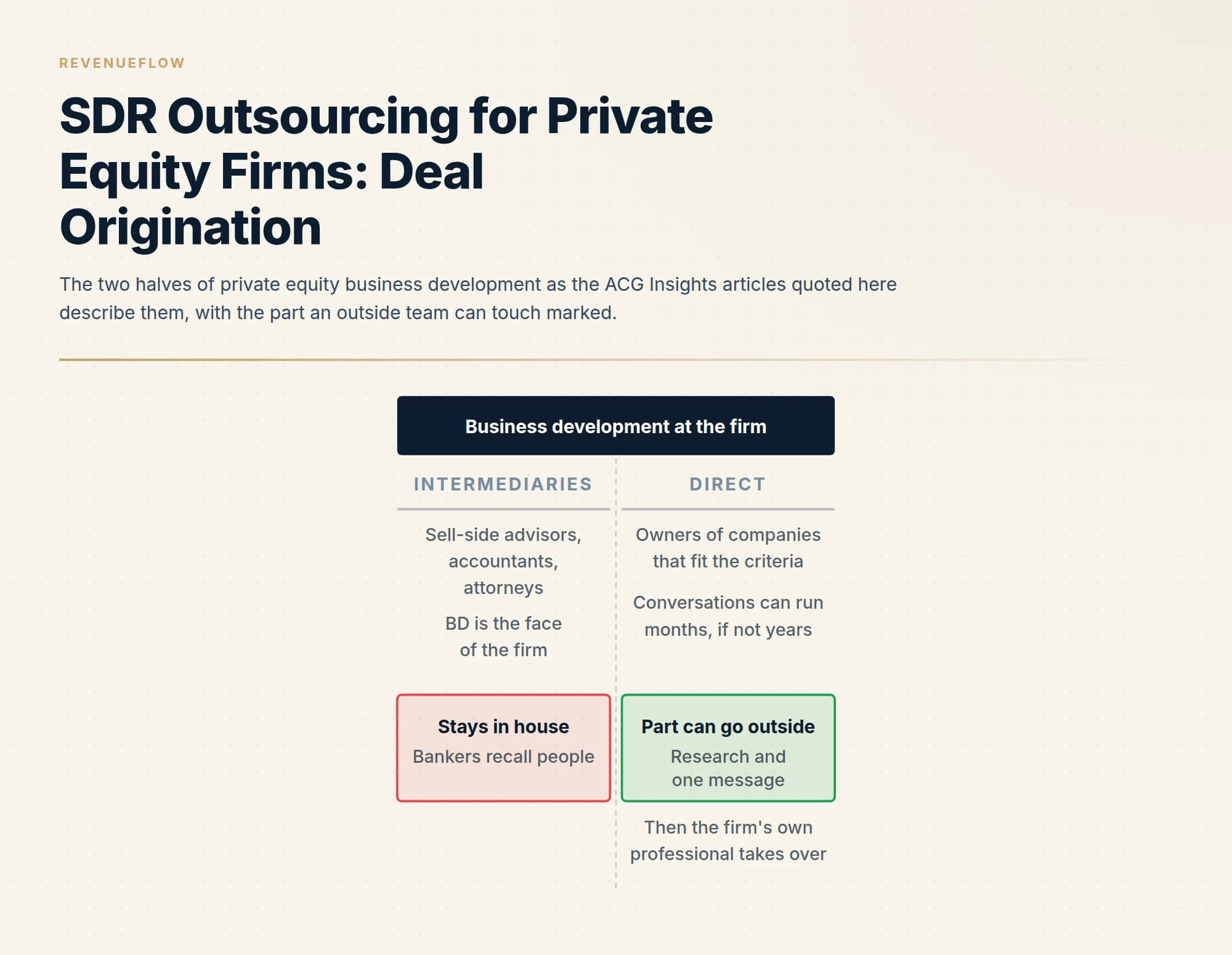
A private equity firm can outsource part of deal origination, not all of it. Research and a single first written approach to business owners can go to an outside team. Intermediary coverage and everything after an owner's first reply stay with the firm's own business development professional, because ACG's trade press describes those conversations as running months or years.
Key takeaways
- ACG's trade press cites BraddockMatthews estimating that the number of private equity BD professionals in the U.S. has increased by more than 300% since 2016.
- The same article says the BD role serves as the face of a private equity firm among intermediaries, including sell-side advisors, accountants and attorneys, which cannot be outsourced.
- Katie Oswald of Crossplane Capital writes that conversations with prospects can span several months, if not years, so the handover to the firm should happen at the first reply.
- The FTC's CAN-SPAM guide says a company that hires another to handle its email marketing cannot contract away its legal responsibility to comply with the law.
Reviewed and updated September 18, 2026
A private equity firm that wants to outsource its outreach is outsourcing a job that barely existed a decade ago. "This was not a job 10 years ago," Brendan Burke of Capstone Headwaters told Middle Market Growth, the magazine of the Association for Corporate Growth, in a story dated April 27, 2020. The job is business development, and the same article describes what it still runs on: "much deal origination is still shoe leather and personal relationships" (ACG Insights, Business Development Grows Up, read 18 September 2026).
This guide is for one reader inside a private equity firm: the deal team, and specifically whoever owns business development and origination, deciding whether an outside sales development team should do part of the outreach to business owners. Two other readers are left out on purpose. A firm's operating partners installing a sales pipeline at portfolio companies are buying ordinary outsourced sales development, and our guide to SDR outsourcing covers the four arrangements on offer. Raising capital from limited partners is a regulated activity of a different kind and is not discussed. If you sell services to private equity firms, cold email for private equity is written for you. What follows is how the origination job divides, which part an outside team can carry, what it may say in the firm's name, the rules the firm keeps, and when outsourcing is the wrong play.
The job being outsourced has two halves
ACG's trade press has tracked the role for years. A March 21, 2023 piece cites the executive search firm BraddockMatthews, which "estimates that the number of private equity BD professionals in the U.S. has increased by more than 300% since 2016", and defines the first half of the job: "The BD role serves as the face of a private equity firm among intermediaries, including sell-side advisors, accountants, attorneys and other sources of deal flow." (ACG Insights, Business Development Goes Next Level, read 18 September 2026.)
That half is relationship coverage. Katie Oswald, managing director of business development at Crossplane Capital, writes in the same piece that advisors "appreciate the chance to get smart on a firm's portfolio companies years in advance of potentially pitching for a sell-side mandate." Adam VeVerka of NewSpring Capital told the magazine in April 2022 why he travels for it: "I want bankers to remember us, to know our story." (ACG Insights, Private Equity Takes a More Targeted Approach, read 18 September 2026.) Nothing in that can be handed to a contractor. The banker is meant to remember a person at the firm.
The second half is direct contact with companies, the proprietary side. The 2023 piece names veterans who "have shown that proprietary origination can be a career-defining track", and Oswald describes the pace: "In my experience, conversations with prospects can span several months, if not years." She also names the best source of add-on targets, which is inside the portfolio: company management teams "are intimately knowledgeable of their competitors and often already possess relationships with potential add-on targets."
Which part an outside team can carry
The executive recruiter quoted by ACG explains why the role is hard to fill, and the same reasoning shows where a contractor's limit lies. There is no playbook, said William Matthews of BraddockMatthews in the 2020 article, and he explained why: "You can't pull someone out of school and train for this role. They have to understand how to build the relationships, size markets and interpret a wide range of data points."
Take that list apart. Sizing a market and reading data points is research, and research travels. A good outside team can build the universe of companies that fit a firm's criteria, keep it current, and find the owner's name and address, working from the same databases the firms already use; the 2022 article names Grata, Axial, PitchBook and DealCloud among the tools in play. A first written approach to an owner, in the firm's name and words, can also travel, because it is one message whose only job is to find out whether a conversation is welcome.
Building the relationship does not travel. By Oswald's account the conversation that follows can last years, and the person on the other end is deciding whether to sell a company they built. The handover from the outside team to a named professional at the firm should therefore happen at the first reply, not at the first meeting.
| Task | Who carries it | Why |
|---|---|---|
| Build and maintain the universe of companies that fit the criteria | Outside team can | Sizing markets and reading data is research |
| First written approach to an owner, in the firm's words | Outside team, under the firm's name and review | One message that asks whether a conversation is welcome |
| Everything after the first reply | The firm's own professional | Conversations can span months, if not years |
| Intermediary coverage | The firm's own professional | The BD role is the face of the firm among intermediaries |
| Add-on targets | Start with portfolio management teams | They often already have the relationships |
Read against our SDR outsourcing guide, that division points at the models that sell research and writing, and away from the ones that sell dials. An outcome-based arrangement, paid per meeting, fits badly unless the definition of a meeting is unusually strict, because a vendor paid per meeting has a reason to book an owner who was only being polite, and in this market a wasted first meeting costs a relationship the firm may want in three years. Whatever the model, the qualification standard should be agreed in writing before anything is sent, which is how RevenueFlow works on any engagement, by email and LinkedIn, with one message per campaign and no bumps behind it.
What an outside team may say in the firm's name
Three limits, each grounded in something above.
It says who it is. A message sent for a firm should come from the firm's domain and be signed by the named professional who will take the reply, since that is the person the owner will eventually sit across from.
It says what is public. The firm's criteria, its sectors, its existing portfolio companies and its completed deals are on its website. Those are what Oswald says advisors want to hear about, and they are what an owner can check.
It does not talk about performance, and it does not talk about raising money. The Securities and Exchange Commission's Marketing Rule defines an advertisement as a communication that "offers the investment adviser's investment advisory services with regard to securities to prospective clients or investors in a private fund advised by the investment adviser" (17 CFR 275.206(4)-1, eCFR, read 18 September 2026). An owner being asked about selling a company is not being offered advisory services, and the words of the definition concern clients and fund investors. That is a reading of the text and not legal advice, and it is a reason for care, not comfort: a contractor's script that drifts into the fund's returns, or into who invests in it, has wandered toward the communications the rule is about. Keep both out of the script and have the firm's compliance officer approve the wording.
The rules the firm keeps
Hiring someone to send does not move responsibility for the sending. The Federal Trade Commission's CAN-SPAM guide says so directly: "even if you hire another company to handle your email marketing, you can't contract away your legal responsibility to comply with the law", and it notes that "The law makes no exception for business-to-business email." (FTC, CAN-SPAM Act compliance guide, read 18 September 2026.) If the outside team phones owners, the federal position on business calls and the separate rules on dialers and mobile numbers are in whether cold calling is against the law, which matters whenever the number on file for an owner is a mobile.
One more rule is the firm's own. The advice our cold email for private equity guide gives to anyone writing to a fund applies in reverse here: never reference non-public deal information. An outside researcher who learns that a company is quietly for sale must not put that in a message.
How long the outside part lasts
Oswald's phrase, "several months, if not years", sets the proportion. The figure below is a schematic of that proportion and not a measurement.
Three reasons to write to an owner, each from a public source
None names a real person, mentions performance or claims a result.
The portfolio fit.
{{firm}} owns {{portfolio_company}}, which serves the same customers as {{company}} from the other side of {{market}}. {{name}} leads business development at {{firm}} and will take any reply personally. If a conversation about where {{company}} goes in the next few years would ever be useful, we would like to have it, on your timetable.
The source is the firm's own published portfolio, which is the knowledge Oswald says the role runs on.
The sector thesis.
We have invested in {{sector}} since {{year}} and published our view of it here: {{link}}. Owners in your position often want to know what a partner would change and what it would leave alone. Happy to answer that in writing before any call.
The source is the firm's own published material.
The long view.
No transaction in mind. Conversations like this one tend to run for a long time before anything happens, and most never lead to a deal. We would still like to know the business. Is there a good time of year for a first conversation?
It states the pace the trade press describes instead of pretending to urgency.
When outsourcing is the wrong play
It is the wrong play for intermediary coverage, which is the firm's face. It is the wrong play when the firm has no named professional with time to take every reply the same day, because the handover is the whole design. It is the wrong play for add-on sourcing where portfolio management teams already know the targets. And it is the wrong play if the vendor's model rewards booked meetings over welcome ones.
It fits a firm with a clear written thesis, a universe too large for its own team to research, and a business development professional who wants more first replies to work with. If you want to see the research and the single first message built before committing to anything, see what a first campaign looks like.
The short version
Private equity business development has two halves. Intermediary coverage, where the BD professional is the face of the firm among advisors, accountants and attorneys, cannot be outsourced. Direct contact with owners partly can: research and one first written approach travel, and everything after the first reply belongs to a named person at the firm, because those conversations run for months or years. An outside team says who it is and what is public, never performance or fundraising, and the firm stays responsible for what is sent in its name. ACG's trade press reports the BD headcount up more than 300% since 2016, which is the clearest sign firms treat origination as their own job.
ACG Insights, eCFR and FTC pages quoted above were read on 18 September 2026. Rules change. Confirm current requirements with counsel before relying on any of this.
Frequently asked questions.
Frequently asked questions- Can a private equity firm outsource deal sourcing outreach?
- Partly. Building and maintaining the universe of companies that fit the firm's criteria is research, and a first written approach to an owner in the firm's name and words can also be handled outside. Relationship coverage of intermediaries, and every conversation after an owner first replies, belong to the firm's own business development professional.
- Why is private equity business development hard to outsource?
- Because it runs on relationships. ACG's magazine reports that much deal origination is still shoe leather and personal relationships. William Matthews of BraddockMatthews told it there is no playbook and that people in the role have to understand how to build relationships, size markets and interpret data. Only the market sizing and data work travel to a contractor.
- What can an outsourced team say on behalf of a private equity firm?
- Who it is, signed by the named professional who will take the reply, and what is public: the firm's criteria, sectors, portfolio companies and completed deals. It should not discuss fund performance or fundraising. The SEC Marketing Rule's definition of an advertisement concerns communications offering advisory services to prospective clients or fund investors, so keep those topics out and have compliance approve the wording.
- When is outsourcing origination the wrong choice for a PE firm?
- For intermediary coverage, where the professional is the firm's face. When nobody at the firm can take each reply the same day, since the handover is the whole design. For add-on sourcing where portfolio company management teams already know the targets. And when the vendor is paid per booked meeting, which rewards meetings an owner accepted out of politeness.
About the author.

B2B cold email experts helping companies generate qualified leads through done-for-you outreach campaigns.
RevenueFlow Team
Explore more.
Ready to scale your outreach?
We build GTM engines that book real meetings. See the receipts.
Related articles.
SDR Outsourcing for Biotech Companies: When It Fits
SDR outsourcing for life science sellers: which parts of the job can go outside, what FDA research use only guidance means for the brief, and when it is the wrong play.
Outbound Sales for Law Firms: What the Rules Allow
Outbound business development for law firms, read against ABA Model Rules 7.1 to 7.3: who a firm may approach, what a message must carry, and when it is the wrong play.
SDR Outsourcing for Fintech Companies: Assessability Test
For the fintech weighing an outside setter: the three assessability sentences, the promotion rules that bind every message, the sponsor test and which model fits.
B2B Lead Lists for Collection Agencies: Fields and Sources
What a creditor prospect list needs for a collection agency: the fields that matter, the FDIC, NCUA, CMS and court sources behind them, and the rules that apply.
Outbound Sales for Food and Beverage Companies: Who to Reach
Outbound sales for food and beverage brands: the four buyers behind a yes, the public show calendar, what a message may claim, and when outbound is the wrong play.
Outbound Sales for Higher Education Vendors: Which Door to Use
Outbound for higher education vendors, built on universities' own purchasing policies: three doors, the ask that fits each one, and a dated accessibility review.