Appointment Setting Agency: What Pricing Models Hide
Retainer, per-appointment, per-seat or commission: each pricing model rewards different vendor behaviour. What each one optimises for and where each fails.
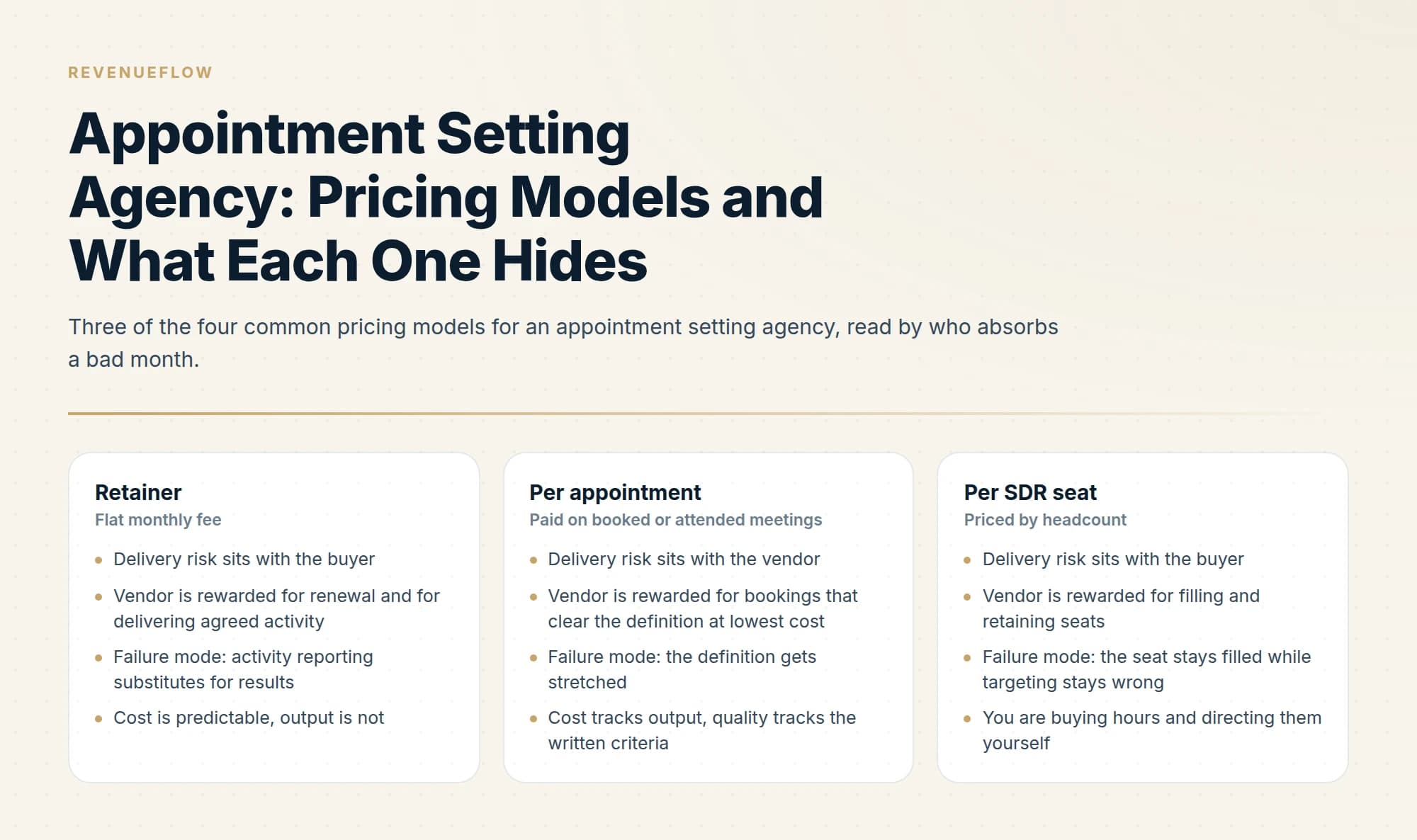
Appointment setting agencies price on a retainer, per appointment, per SDR seat, or a flat fee plus commission. The model determines who carries delivery risk and what the vendor optimises for, which predicts their behaviour more reliably than anything stated on the pricing page.
Key takeaways
- A retainer prices activity, so the vendor is paid the same whether the campaign converts or not, and the burden of defining progress sits with you.
- Per-appointment pricing transfers delivery risk to the vendor and concentrates all of the risk you retain onto the written definition of an appointment.
- Per-seat pricing buys capacity rather than output, so results follow from how well you direct the seat.
- Flat fee plus commission aligns the vendor to closed revenue but requires them to see your pipeline data, which is a reporting dependency worth settling up front.
Reviewed and updated September 2, 2026
Two appointment setting agencies can run the same playbook, hire from the same talent pool, and send near identical emails, and still behave completely differently three months into an engagement. The reason is usually sitting on the pricing page. A retainer, a per-appointment fee, a per-SDR seat and a flat fee plus commission each place delivery risk with a different party, and whoever carries that risk is the one who decides what gets optimised when a month goes badly.
That makes the pricing model a better predictor of vendor behaviour than anything in the pitch. Process descriptions and team credentials change with the account manager. The commercial structure keeps applying pressure in the same direction for the length of the contract, including on the days nobody is watching.
The same reading applies outside this category, where Northbeam bands tiers by ad spend and anchors a number before the conversation starts.
If you are reading this as one of the agency owners it is written for, the persona-specific version of this playbook lives in our guide to outbound for agency owners.
Where the risk sits in each model
- Delivery risk sits with the buyer
- Vendor is rewarded for renewal and for delivering agreed activity
- Failure mode: activity reporting substitutes for results
- Cost is predictable, output is not
- Delivery risk sits with the vendor
- Vendor is rewarded for bookings that clear the definition at lowest cost
- Failure mode: the definition gets stretched
- Cost tracks output, quality tracks the written criteria
- Delivery risk sits with the buyer
- Vendor is rewarded for filling and retaining seats
- Failure mode: the seat stays filled while targeting stays wrong
- You are buying hours and directing them yourself
The fourth model, a flat fee plus commission on closed revenue, sits outside that grid because it moves the vendor's interest past the meeting entirely. It gets its own section below.
Retainer: you are buying effort
A flat monthly fee buys a quantity of work. Revenue is fixed for the vendor the moment you sign, so the commercial pressure is to deliver the agreed activity at a sustainable cost and to keep you renewing.
Renewal is the part people underrate. A retainer vendor with a long average tenure has a genuine interest in results, because churn is expensive to replace. The problem is that renewal pressure arrives on a quarterly cycle, and the incentive between renewal points is much weaker than the incentive a per-outcome vendor feels every week.
The failure mode is drift toward activity reporting. When output is thin, a retainer vendor can point honestly at sends, connects and dials, all of which were delivered as described. Nothing has been breached. You still have no meetings. The defence is a stated output expectation written into the agreement even where it is not a guarantee, so a thin month starts from a shared reference point rather than from an argument about whether the work happened.
Martal's entry tier is structured this way. It is a flat monthly fee, and the published monthly output for that tier is stated as 3,000 to 5,000 prospects targeted, 9,000 to 12,000 emails sent, and 20 to 30 qualified leads. Those are stated expectations rather than commitments, which is precisely why they are worth reading closely and worth repeating back in writing.
Per appointment: the definition becomes the product

Pay only for meetings and the vendor absorbs the bad month. That is a real transfer of risk and it is priced accordingly, which is why per-appointment rates look expensive next to a retainer until you divide the retainer by the meetings it actually produced.
What the model rewards is bookings that clear your definition at the lowest cost the vendor can achieve. Everything good and everything bad about this model follows from that sentence. With criteria written down before launch, the vendor's cheapest path and your best outcome point the same way, and this is the most closely aligned of the four models. With a vague definition, the cheapest path is a junior attendee at a company that vaguely resembles your target, who agreed to a conversation because agreeing was easier than replying no.
There is a second-order effect that vague criteria will not catch. Cost per booking varies enormously across a target list, so a vendor paid per meeting has a standing reason to work the easiest reachable slice of your market and leave the rest. Your hardest segment is usually the one you most wanted help with. The guard is agreeing the account list or the firmographic ranges alongside the meeting definition, so the population is fixed and only the booking rate is variable.
Belkins is the clearest published example of an outcome commitment inside a retainer: a starter package quoted from $5,000 per month, stating 1,500 leads a month across 3 outreach channels and 100 guaranteed appointments a year. That is a floor rather than a rate, and a floor changes the negotiation from price per meeting to what happens when the floor is missed.
Two operational terms decide whether this model behaves. One is what a no-show costs and who eats it. The other is the window you get to reject a meeting and what counts as a valid reason. Both are contract questions rather than pricing questions, and we work through the wording in the buyer's checklist before you sign.
Per SDR seat: you are buying capacity
SalesRoads sells this shape explicitly, publishing a starting price billed per four weeks rather than per month, and stating cancel anytime with no commitments. There is no outcome guarantee attached, which is consistent: a seat is an input, and inputs do not come with output promises.
You are buying hours, and the results depend on how well those hours are directed. A meaningful share of that direction is yours, because you own the market knowledge, the positioning and the answer to whether a given title really owns the decision. Seat pricing is honest about that split in a way outcome pricing is not.
The failure mode is quiet. The seat stays filled, the activity numbers hold, and the underlying targeting is wrong for two months while the unit you purchased is being delivered in full every single day. Nobody is at fault under the contract. The fix is a short, real review cadence in the first eight weeks aimed at targeting and messaging rather than at volume, because volume is the one thing this model reliably produces.
Seat pricing is the right purchase when you already know your market, you have messaging that has worked, and the binding constraint is people. It is the wrong purchase when you are still discovering who buys, because you will be paying full capacity rates to run an experiment. That comparison against hiring is worked through in outsourced SDR versus in-house.
Flat fee plus commission: attention moves past the meeting
Martal's higher tiers add a sales commission on top of a flat monthly fee. The commission is the interesting part, because it extends the vendor's field of view beyond the booking to what the booking turns into.
That has an obvious upside. A vendor with revenue at stake cares whether the person in the meeting can actually buy, and will push back on targeting that produces polite conversations and nothing else. It also has a less obvious cost: the vendor becomes a stakeholder in your sales process, and stakeholders ask for things. Expect requests for pipeline visibility, for faster follow-up from your closers, and for a say in which opportunities get worked.
The recurring dispute in this model is attribution. Settle it in writing before signing: the attribution window, what counts as a sourced account, what happens when the vendor books a meeting at a company already sitting in your CRM, and what happens to commission on a deal that closes after termination. None of that is difficult to agree in advance. All of it is painful to agree after an invoice lands.
Reading a quote for its incentive

Any quote can be reduced to its incentive in about four questions, and the answers are more informative than the number at the top.
- Step 1Find the payment trigger
What event releases money: the calendar month, a booked meeting, an attended meeting, a filled seat, or a closed deal.
- Step 2Find the billing unit
Per month and per four weeks are different products. Confirm which one the number refers to and get the annual total in writing.
- Step 3Ask what happens in a bad month
Whoever absorbs it is carrying delivery risk. If the answer is a rebate, a rollover or extra weeks, the vendor is carrying some.
- Step 4Ask who wrote the definition
Whoever defines the payable unit controls the model. A vendor definition you cannot amend is designed around what that vendor can reliably book.
Step four is the one buyers skip. A per-appointment price is only meaningful against an appointment definition, and a vendor supplying both has quietly set its own pass mark.
Questions that expose the model
- Yes: What triggers an invoice, stated as an event rather than a date
- Yes: Whether the fee is quoted per month or per four weeks
- Yes: What the vendor does differently in a month that is running behind
- Yes: Whether the meeting definition is amendable by the client
- Yes: Whether any part of the fee is at risk against output
- No: Whether the headline figure is the whole cost
- Depends: Whether commission or attribution terms apply after termination
A vendor that answers all of these plainly is not necessarily the cheapest, and is almost always the easier one to run an engagement with, because every one of these questions becomes an argument later if it is left open now.
Where every model fails the same way

No pricing structure repairs a missing input. Every model degrades identically when the suppression list arrives late, when nobody can settle which title owns the decision, or when meetings get booked and your own team takes four days to confirm them.
None of the four fixes a positioning problem either. If meetings are happening and none of them progress, adding a pricing structure that produces more meetings makes the problem more expensive at exactly the same conversion rate.
And all four have a ramp. Judging any model on month one measures the setup work rather than the programme, which is worth remembering when a pilot minimum and a ramp period are quoted as though they are unrelated. Vendor-by-vendor terms are laid out in appointment setting companies, and what each price point actually includes is in appointment setting services. The wider retainer economics for agency-delivered pipeline sit in the lead generation agency cost guide.
The short version
Four models, four different answers to who absorbs a bad month. A retainer buys effort and leaves delivery risk with you, so protect yourself with written output expectations. Per-appointment pricing transfers risk to the vendor and converts the meeting definition into the actual product, so fix the definition and the target population before you discuss the rate. Seat pricing buys hours you have to direct yourself. Flat fee plus commission buys attention further down the funnel and brings attribution disputes with it.
Ask what triggers payment, what the billing unit is, who absorbs a bad month, and who wrote the definition. Those four answers tell you more than the price.
RevenueFlow is paid on attended meetings that meet criteria agreed in writing before anything sends, which is the per-outcome model with the definition question settled up front. You can see what a campaign would look like for your market.
Vendor pricing structures verified against the vendors' own pages in mid-2026. Terms change; confirm current pricing and commitments directly before contracting.
Sources: Belkins appointment setting, SalesRoads appointment setting services, SalesHive pricing, Martal pricing
Frequently asked questions.
Frequently asked questions- Which appointment setting pricing model is best?
- It depends on where you want the delivery risk. A retainer keeps risk with you and buys flexibility and control. Per-appointment moves risk to the vendor and makes the meeting definition the entire contract. Per-seat buys capacity you direct. None is inherently better, but a mismatch between model and your constraint is expensive.
- Why do most appointment setting agencies use retainers?
- Because the work is genuinely expensive to produce before any meeting lands, covering list building, sending infrastructure, copy and reply handling. A retainer funds that ramp. The trade is that the vendor is paid identically whether the campaign works, so you need agreed progress measures from month one.
- Is pay per appointment cheaper than a retainer?
- Not usually per unit, because the vendor is pricing in the risk they now carry. It can be cheaper in total when volume is uncertain, since you pay for output rather than effort. The comparison only works once you have a written definition of what counts as a billable appointment.
- What does a commission-based appointment setting model require?
- Visibility into what closes, which means sharing pipeline and revenue data with the vendor and agreeing attribution before launch. It aligns incentives to revenue rather than meetings, but it introduces a reporting dependency and a longer feedback loop than either party usually expects.
About the author.

Ben Carden is CRO at RevenueFlow, which builds and operates outbound revenue engines for B2B companies. Previously at Gartner Enterprise. Studied at London School of Economics.
Ben Carden · CRO
Connect on LinkedIn →Explore more.
Ready to scale your outreach?
We build GTM engines that book real meetings. See the receipts.
Related articles.
B2B Lead Generation Companies by Pricing Model: 15 Vendors
Nine of fifteen B2B lead generation vendors publish a dollar figure and six publish none. The five pricing models behind the numbers, each figure cited to its page.
Lead Generation as a Service: What the Service Part Changes
Most vendors selling lead generation as a service have productised the scope and kept the price bespoke. What that trade buys you, and how to tell which half is fixed.
ABM Metrics: Coverage Decides Every Other Number
Every published ABM metric is a ratio whose denominator somebody chose. Six numbers, the denominator each one needs, and the comparison that settles it.
Lead Verification: What Each Check Actually Proves
Lead verification covers two different jobs. One asks whether a mailbox will accept mail, the other asks whether the person behind the row is real and lawful to contact.
5 ABM Campaign Examples and How Each One Is Built
Five worked account-based campaign examples, each built on the same five fields: account set, tier, plays in order, owner and handoff, and the exit condition.
Blue Zebra Appointment Setting: The Vendor's Pages Are Gone
Search results still describe a B2B appointment setting firm at this address. The pages themselves return 404 and the domain now serves something else entirely.