Northbeam Pricing: Banded by Your Ad Spend
Four tiers banded by your own ad spend, all four asking you to contact sales. Two print a figure anyway, and only one of those states a period.
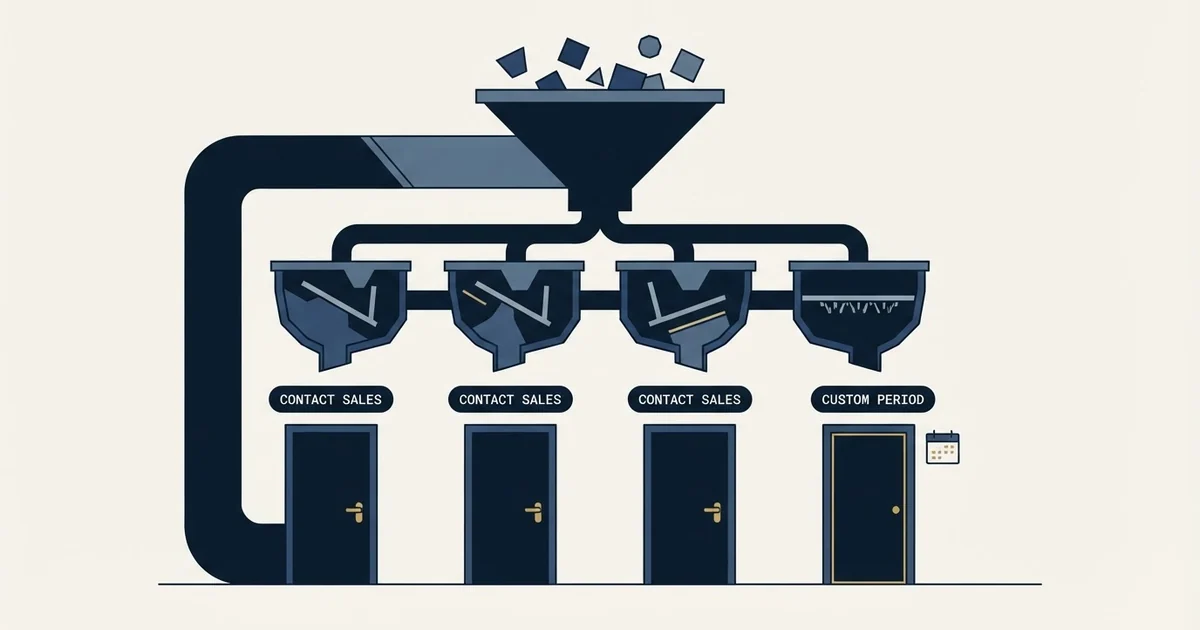
Northbeam pricing is banded by annual ad spend and every tier asks you to contact sales. Starter shows $1,500 with no period on its card, Professional shows $3,500 per month on an annual term, and Growth and Enterprise are custom. The page's FAQ makes Starter month-to-month and usage-based for Shopify brands.
Key takeaways
- Northbeam's four tiers are banded by ad spend, from Starter under $1.5m a year to Enterprise above $500k a month, and every tier reads "Contact us for a quote".
- Starter shows $1,500 with no period and Professional $3,500 per month; the FAQ makes Starter month-to-month and Professional and Enterprise annual terms.
- Integration beyond Shopify starts at Professional, granular touchpoint export sits at Enterprise, and incrementality and media mix modelling are optional add-ons.
- Ad credit allowances run from up to $50,000 on the agency-sold Growth tier to up to $200,000 on Enterprise.
Reviewed and updated September 21, 2026
A growth team opens Northbeam's pricing page expecting a rate card and finds a page headed "Based on your annual marketing spend, choose the option that's best for you", with four tiers each carrying the line "Contact us for a quote". Two of them also print a figure directly underneath that instruction, and only one of those figures carries a unit of time.
Calling that evasion misses what the page is doing, and calling it a rate card misses it too. It does two jobs at once: qualifying a buyer by ad spend, and anchoring a number before the conversation starts. Reading it correctly means separating what the page commits to from what it merely displays.
Here is what the page actually shows, how the tiers are banded, and the question a B2B team should settle before any of it applies.
Northbeam pricing is banded by your ad spend, not your seat count
The page opens by stating its own logic: plans and pricing "Based on your annual marketing spend, choose the option that's best for you". Each tier then names a spend band rather than a company size or a feature set, and the social-proof line beneath them reads "Trusted by 1000+ companies".
| Tier | Spend band | Figure shown |
|---|---|---|
| Growth | Under $200K a month, through an agency partner | Custom |
| Starter | Under $1.5m a year | $1,500, no period |
| Professional | Up to $500k a month | $3,500 per month |
| Enterprise | Over $500k a month | Custom |
Two details in that table are worth pausing on, because both are easy to read past.
Only the Professional figure carries a period. The page renders that one as "$3,500" beside the words "per month". On the same page Starter renders as "$1,500" followed by the phrase "for maximum value" rather than by any unit of time. The card does not attach a period to the figure, but the page's own FAQ does: it describes Starter as "month-to-month usage-based pricing for Shopify brands that are in the early growth stage" and calls what a buyer pays a monthly price informed by pageview volume, so the monthly reading is supported by the vendor one section further down the same page. Confirm the figure itself in the quote.
Every tier carries "Contact us for a quote", including the two with numbers printed. So the displayed figures are anchors rather than prices, and the actual commercial is negotiated in all four cases.
The term differs by tier as well as the figure. The same FAQ describes Starter as month-to-month and usage-based, for Shopify brands, and puts Professional and Enterprise on annual terms, billed annually or semi-annually depending on the agreement. So Professional's $3,500 a month sits inside an annual commitment, $42,000 across a year at the displayed figure, and the FAQ adds that the monthly price itself is informed by the volume of data in the business, measured in pageviews.
The tier ordering is not the order the page presents
Read the bands on that page in order of spend and the sequence is Starter at under $1.5m a year, Growth at under $200K a month, Professional at up to $500k a month, Enterprise above that. The page gives two Enterprise thresholds: the card bands it above $500k a month on ads, while the FAQ recommends Enterprise to anyone spending more than $250,000 a month on performance marketing, so take the lower figure into the sales conversation. Growth is presented first, and Growth is the tier sold through an agency: its description names creative, strategy and media buying support from a preferred partner, with "Preferred Northbeam pricing built into your agency engagement".
That makes Growth a channel rather than a rung. A brand buying through an agency partner reaches the platform on the agency's commercial terms, which is a different purchase from the self-directed ladder the other three tiers describe.
The ad credit allowances run in an order that repays a second look too. On the page Growth reads "Up to $50,000 in ad credits from our ad platform partners", Starter up to $100,000, Professional up to $150,000, and Enterprise "Up to $200,000 in ad credits from our ad platform partners". The agency-sold tier therefore carries the smallest allowance of the four.
What the tiers actually gate

Three boundaries matter more than the figures.
Starter
- First-party multi-touch attribution
- Omnichannel dashboards
- Custom attribution through Apex
- View-through conversions
Professional adds
- Unlimited users, exports and integrations
- MCP access
- Any ecommerce platform
- A dedicated media strategist
Enterprise adds
- Media buying guidance
- Success manager and Slack channel
- Optional hourly conversion data
- Granular touchpoint export
Ecommerce platform integration. Professional's card includes "Integration with any ecommerce platform, not just Shopify", which says plainly that the tier below is Shopify-shaped. Enterprise extends that to direct integration with any platform including custom builds. A business that does not run on Shopify starts at Professional whatever its spend band suggests.
Data export granularity. Unlimited data exports and integrations appear at Professional. The line "Export granular touchpoint data for deep customer journey analysis" appears at Enterprise. If the plan is to take the touchpoint data into your own warehouse and model it there, that capability sits at the top of the ladder.
Warehouse-first stacks change who holds that data, since RudderStack's warehouse-native model stores nothing itself and leaves the loading and modelling inside your own warehouse.
The two heavier measurement products are optional add-ons rather than tier contents. "Incrementality" carries an OPTIONAL marker on Professional and Enterprise, and "Media Mix Modeling+" carries one on Enterprise. Both are named as separate options rather than as included features, so a plan that depends on either needs its cost established separately from the tier.
The results figures on the page, and how to read them
The pricing page publishes averaged outcome claims in two places. It states that "+3.5% Increase in ROAS", "-4.9% Decrease in Customer Acquisition Cost" and "+7.2% Increase in New Customer Transactions" are "the average improvements we see in ad accounts 180 days after activating Northbeam". Separately it opens a second block "Over one year, Northbeam Enterprise customers experienced" and puts a 37 percent increase in ROAS, a 14 percent increase in conversion rate and a 20 percent decrease in customer acquisition cost underneath it. Those are the vendor's own claims and are reproduced here as such rather than as findings.
Neither set comes with a sample size, a control group or a methodology, and the two differ by an order of magnitude on the same metric, which is a reason to ask what population each describes before either number enters a business case.
The question a B2B team should settle first

Northbeam's own FAQ answers who the product is for, and the answer is specific: "If you are running experiment-based growth marketing across multiple ad channels for an e-commerce business, you will be interested in learning more about Northbeam."
Every part of that sentence matters. Multiple ad channels, meaning paid media as the primary acquisition motion. Experiment-based, meaning enough volume to run experiments. And e-commerce, meaning a purchase that completes on the site and can be attributed to a touchpoint within a measurable window.
A B2B outbound programme fails all three tests, and not marginally. Acquisition runs through sent messages rather than bought impressions. Volume is measured in hundreds of conversations rather than in experiment-grade samples. And the conversion is a signed contract months after the first touch, decided by a committee, with no event on the site to attach revenue to.
Budget in that motion goes to contact data rather than impressions, and enrichment charged only for found records meters it by what resolves rather than by what is sent.
That does not make multi-touch attribution irrelevant to B2B. It makes this implementation of it built for a different shape of problem. The models themselves transfer and the tradeoffs between them are the same, which is why they are worth understanding on their own terms: last-touch attribution sets out what a single-credit model deletes, position-based attribution covers the U and W shapes and the timestamps they rely on, and time decay attribution covers setting the half-life. Those decisions are worth making regardless of whose platform computes them.
Fits
- Paid media across several channels drives acquisition
- The conversion completes on the site and is timestamped
- Volume supports experiments rather than anecdotes
- Your commerce platform is supported at your tier
Does not fit
- A months-long committee decision is the conversion
- Acquisition runs through sent messages, not bought impressions
- The displayed figure is being read as the price
How to run the evaluation
Take it in this order.
Establish your spend band first, because that is the axis the page sorts buyers on and it determines which conversation you get. Then check the two capability boundaries that are not about spend at all: whether your commerce platform is supported at the tier your band suggests, and whether you need granular touchpoint export.
Then price the optional products separately. Incrementality and media mix modelling are named as options on this page rather than as tier contents, and a measurement plan that depends on either has a cost the tier figure does not include.
Then treat both displayed figures as opening positions, because the page asks you to contact sales on all four tiers. The one number stated with a period is the Professional monthly figure; everything else is an anchor or a custom quote.
And before any of that, confirm the product is measuring the motion you actually run. The general form of that check, which layer of tooling can reach which bottleneck, is mapped in sales process optimization tools. An attribution platform can tell you which paid touch preceded a purchase. It cannot create demand, and where the flow of qualified conversations is what is short, the constraint is upstream of every dashboard, which is the argument in landing page lead generation applied one layer out.
The short version
Four tiers are banded by the buyer's own ad spend and each carries "Contact us for a quote". Two print an indicative figure beside that instruction on the page, and only the Professional one, at "$3,500", sits beside a period. The Starter figure of "$1,500" carries no unit of time on its card, though the page's FAQ describes Starter as month-to-month. Professional and Enterprise are annual terms. Ad credit allowances on that page run from up to $50,000 on the agency-sold Growth tier to up to $200,000 on Enterprise.
Integration beyond Shopify starts at Professional, granular touchpoint export at Enterprise, and both incrementality and media mix modelling are optional additions rather than tier contents. The vendor's own FAQ names its buyer as an ecommerce business running experiment-based growth marketing across multiple ad channels, which is worth settling against your own motion before the spend band matters at all.
When the shortage is the supply of qualified conversations rather than the attribution of the ones you already have, see what a first campaign produces against your own market.
Tier names, spend bands, displayed figures, feature lists, contract terms and the vendor's own outcome claims above are from northbeam.io/pricing. Vendor pricing moves and every tier there is sold by quote. Verify current terms with the vendor before relying on them.
Frequently asked questions.
Frequently asked questions- How much does Northbeam cost?
- Northbeam's pricing page shows Starter at $1,500 with no period on its card and Professional at $3,500 per month, while Growth and Enterprise are custom. Every tier also reads "Contact us for a quote", and the FAQ says the monthly price is informed by pageview volume, so the displayed figures are starting points rather than prices.
- Does Northbeam require an annual contract?
- Not on Starter. Northbeam's FAQ describes Starter as month-to-month usage-based pricing for Shopify brands in the early growth stage, and puts Professional and Enterprise on annual terms with annual or semi-annual billing depending on the agreement. At the displayed $3,500 a month, a Professional year is $42,000 before any usage adjustment.
- Which Northbeam plan should I choose?
- The page bands tiers by ad spend: Starter under $1.5m a year, Professional up to $500k a month and Enterprise above that. Its FAQ recommends Enterprise to anyone spending more than $250,000 a month on performance marketing. A store not on Shopify starts at Professional, since that is where integration with any ecommerce platform begins.
- Is Northbeam a good fit for B2B companies?
- Northbeam's own FAQ names its buyer as an e-commerce business running experiment-based growth marketing across multiple ad channels. A B2B motion that converts through a months-long committee decision, with no purchase event on the site, fails that description, so the attribution models are worth learning but this platform is built for a different problem.
About the author.

Ben Carden is CRO at RevenueFlow, which builds and operates outbound revenue engines for B2B companies. Previously at Gartner Enterprise. Studied at London School of Economics.
Ben Carden · CRO
Connect on LinkedIn →Explore more.
Ready to scale your outreach?
We build GTM engines that book real meetings. See the receipts.
Related articles.
RudderStack Pricing: The Event Count Is the Cheap Axis
Free at 250,000 events a month, and for a B2B programme the volume is never what binds. Sync latency, connection counts and the Enterprise-only apps decide the tier.
What RudderStack Is: A Customer Data Platform
RudderStack is warehouse-native, which its own docs define as storing and persisting nothing. What that changes about ownership, attribution and the exit cost.
ABM Reporting: Three Readers, Three Cadences
ABM reporting built around who reads it: a weekly operating page, a monthly allocation page and a one-page quarterly board report, each computed from CRM fields.
Crunchbase Pricing: The Annual Rate Is Introductory
The annual figure Crunchbase shows a new visitor is a first year rate, and its own help centre says so. Where the price lives, and why the export cap decides it.
LeadMagic Pricing: What a Credit Buys Per Endpoint
LeadMagic publishes two different per credit rates for the same plan, and both are right. The four tiers, the endpoint costs, and the clock that separates them.
Typeform Alternatives: Read the Response Meter First
Typeform meters responses with a hard ceiling and counts seats inside the plan. What Tally, Fillout, Formbricks and Jotform count instead, from their own pricing pages.