Landing Page Lead Generation: Every Form Field Is a Price
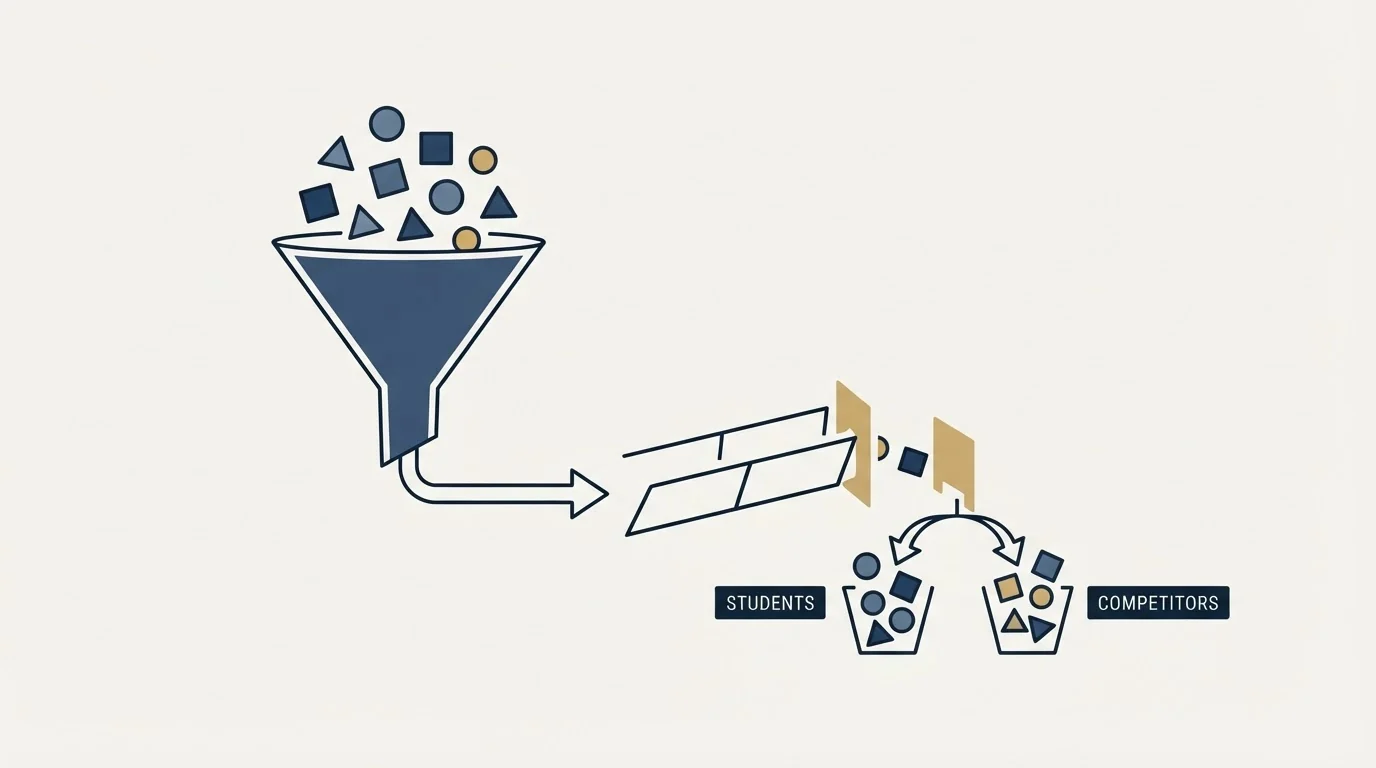
A page asked to maximise submissions will do exactly that, and hand sales a list of students and competitors. The conversion rate was never the binding problem.

A landing page is a transaction where the visitor pays with effort and information, so every field raises the price and needs to be justified by what it buys. In B2B the person who converts is often a researcher rather than the buyer, message match is the largest lever, and what happens after submit is usually weaker than the page.
Key takeaways
- Ask only for what you cannot infer, because a work email resolves to a domain and a domain resolves to most of the firmographics a form would demand.
- Budget and timeline fields lower completion and produce optimistic answers, because respondents work out which answers get them the thing.
- The person who downloads is often a researcher acting for a director, which makes them a route into an account rather than a deal that failed.
- Conversion rate improves when you soften the offer and remove fields, which is why it is the wrong number to optimise on its own.
Reviewed and updated September 2, 2026
Landing Page Lead Generation: Every Form Field Is a Price the Visitor Pays
A B2B software company runs a campaign to a landing page offering an industry report. The page converts at a rate the marketing team is pleased with. Sales works the leads for three weeks and stops, because almost none of them are at companies that could buy, and a noticeable share of the job titles are students and competitors.
The page did its job. It was asked to maximise submissions, and it did. Nobody had specified what a submission was supposed to be worth, so the page optimised the only number it was given.
Landing pages are the most heavily written-about surface in marketing and almost all of that writing is about how to increase the conversion rate. In B2B the conversion rate is rarely the binding problem, and treating it as one produces exactly the outcome above.
Testing that rate has a cost of its own, and what an experimentation platform will not publish offers a test for whether the price matters at your volume.
Landing page conversion rate optimization as the category teaches it means page speed, a single call to action and image weight, and none of those is usually the binding constraint on a B2B page; the levers that are, in rough order of size, are message match, the price the form charges, and what happens after somebody submits it.
Most sales funnel landing page examples circulating as inspiration are judged on how they look and how they convert, and neither number tells you whether the submissions were worth working.
The same holds for the artefacts people reach for instead of the argument: a gallery of high-converting landing page examples, a pack of landing page templates, or a different landing page builder tool will each change how the page looks without changing what it has been asked to be worth.
A sample lead generation form is worth less than the rule behind it, because every field you copy from someone else's template is a price your visitor pays.
The form is a price, not a data collection exercise
A webinar registration page is the clearest instance of this, because the visitor is paying for a session they have not seen yet, so every extra field raises the price before any of the value has been delivered.
The most useful way to think about a landing page is as a transaction with two sides. You offer something. The visitor pays with effort, attention and personal information. The exchange completes when the perceived value exceeds the perceived price.
A lead capture page is that transaction with the form attached, so every question about how to build one resolves into what the page offers and what it charges for it.
Every field on the form raises the price. A work email is cheap. A phone number is expensive, because the visitor knows exactly what it will be used for. Company size is cheap. Budget and timeline are very expensive, because answering them commits the visitor to a conversation they have not agreed to yet.
- Work email address
- First name
- Company name
- Anything you could infer later from the domain
- Phone number
- Company size and role, when the offer is casual
- Anything the visitor reads as a qualification test
- Budget and purchase timeline
- Free-text descriptions of their problem
- Questions answerable from public data you already have
The third column matters because those fields are frequently added by a sales team that wants better qualification, and they degrade the input on both sides. Fewer people complete the form, and the ones who do give optimistic answers to questions about budget and timing, because they have correctly worked out which answers get them the thing.
The better version of that instinct is to buy the qualification with data rather than charging the visitor for it. A work email address resolves to a domain, and a domain resolves to firmographics you can look up without asking anyone. Ask for what you cannot infer, and infer the rest.
Hidden form fields are the one exception to the pricing rule, because they record the campaign, the source and the landing URL without asking the visitor for any of it, which is the only way to add information to a submission at no cost to the person making it.
What you can charge depends on what you are offering
The price the visitor accepts scales with what they get, which sounds obvious and is routinely ignored.
A short piece of content is worth an email address and nothing more. A substantial tool, calculator or dataset supports a longer form, because the visitor can see the value before deciding. A demo or a conversation with a person justifies the most information, because a qualification exchange is a reasonable expectation on both sides at that point.
The strongest offers are the ones where using the thing is itself the qualifier, because a person who invests effort in a tool has told you more than any form field could. That argument, and what it does to lead quality, is made in try before you buy lead magnets.
In B2B the person who converts is often not the buyer
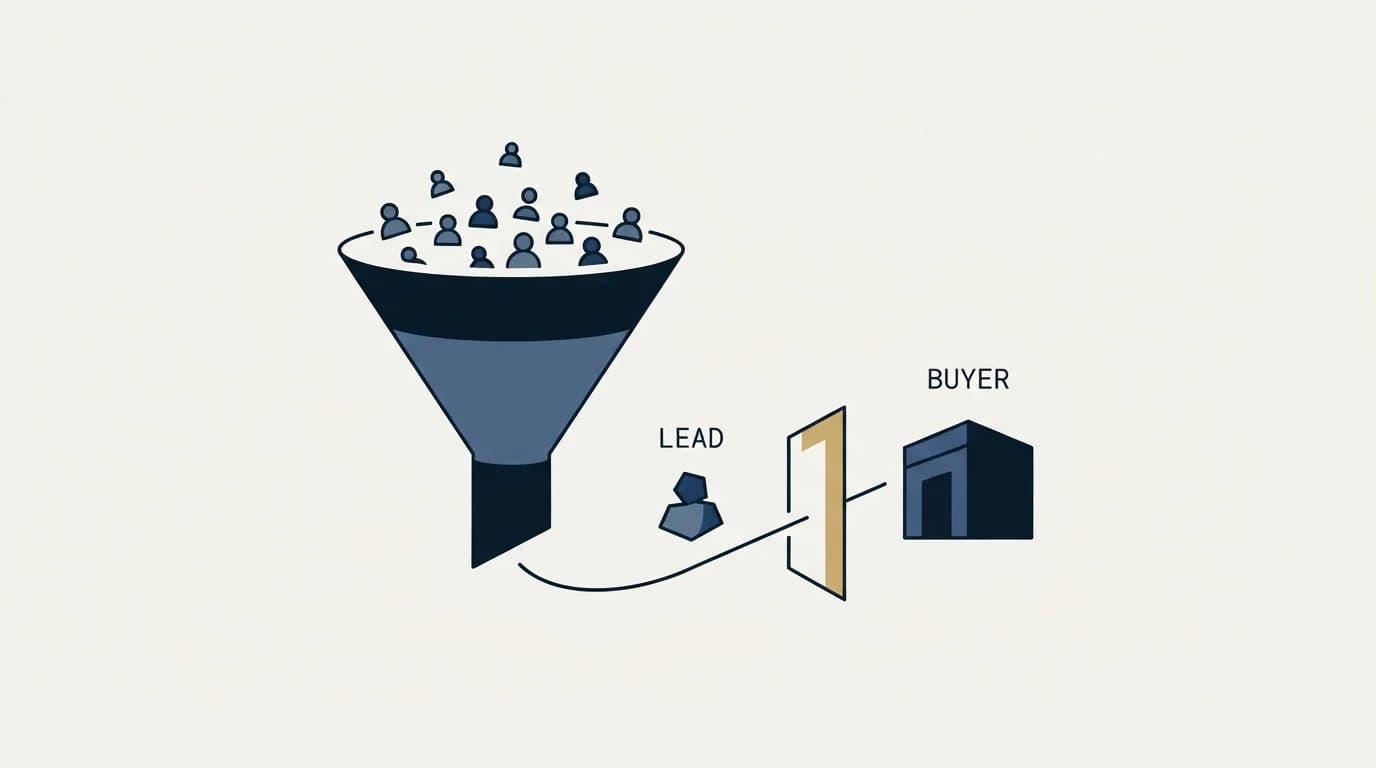
Here is the complication that consumer landing page advice cannot help with. Business purchases are made by groups, and the person who downloads a report is frequently an analyst, a coordinator or a junior manager doing early research on someone else's behalf.
That is not a bad lead. It is a lead that has been mislabelled, and the mislabelling is what produces the sales team's judgement that marketing sends rubbish. A researcher gathering options for a director is genuinely valuable, and treating them as a buyer who failed to buy wastes them.
Social proof on a landing page has to answer the same question, because a logo wall of companies unlike the visitor tells a buying group that this is sold to somebody else, while one named person in their own role at a company their size is the proof that travels.
Since almost every target account already has a supplier, selling against an incumbent explains how logistics lead generation must be built around switching windows rather than service claims.
Two adjustments follow. Capture something about the account rather than only about the person, because the account is the unit that eventually purchases. And define the handover so that a research-stage contact is treated as a route into an account rather than as a deal to be pursued or discarded. The state a buyer is in, and what each state can actually be asked for, is the framing in demand creation, capture and conversion.
Message match is the largest single lever
Most landing page underperformance is not on the landing page. It is in the gap between what brought the visitor and what the page says when they arrive.
If an ad, an email or a search result promises a specific thing, the page has to open with that specific thing, in similar language. When it opens with a general brand statement instead, the visitor spends their first two seconds checking whether they are in the right place, and a meaningful share decide they are not.
The practical test is to look at the source and the page side by side. Does the headline restate the promise the visitor clicked. Is the offer visible without scrolling. Is there anything above it competing for attention. Most pages fail at least one of those, and fixing it costs an afternoon.
Most published landing page conversion optimization advice arrives as an undifferentiated list, and the landing page optimization best practices worth running first are the two above: cut the fields you can infer from the email domain, and make the headline restate the promise that brought the visitor. Page speed, social proof placement and a single visible call to action are worth fixing after those, not instead of them.
That third test is what the phrase above the fold points at, and the fold is not a fixed line: it moves with the device, the browser window and the reader's own text size, so above the fold web design is a question about what the first screen commits to rather than a pixel measurement.
Navigation is the related question. A standalone landing page usually strips site navigation, and the reasoning is sound: every additional exit reduces the chance of completion. This is the clearest structural difference from a website page, which exists precisely to route people onward. Where site pages leak visitors and what to do about that is a separate problem, covered in lead generation website.
The traffic source changes what the page has to do
One page rarely serves every source well, because visitors arrive in different states and the page has to meet them where they are.
Found you while researching; needs to see you understand the problem
Comparing options right now; needs difference, fast
Borrowed credibility; needs the offer to be worth the click
Was not looking; needs a reason this is not a waste of time
The cold outbound row is the one most often handled badly. A visitor arriving from a message they did not ask for has the lowest prior trust of any source and the highest sensitivity to a mismatch. Sending them to a generic homepage or to a page whose offer is unrelated to what the message promised discards most of the work the message did.
The fix is not usually a new page. It is that the destination should continue the specific conversation the message started, and that the ask on the page should be no larger than the ask in the message. A message that offered a two-minute read should not land on a page demanding a demo request.
What happens after submit is usually the weakest part
Teams spend weeks on the page and minutes on the thing that follows it, and the ordering should be reversed.
Three failures recur. The promised asset arrives slowly or not at all, which is the fastest way to make a good first impression worthless. The lead reaches a system nobody is watching, so the response arrives days later, by which time the person has moved on. Or the response arrives quickly and is wildly disproportionate: somebody downloaded a checklist and receives a phone call about a procurement process.
- Yes: The promised asset is delivered immediately, on the page or by return
- Yes: The form asks only for what cannot be inferred from the email domain
- Yes: The headline restates the promise that brought the visitor here
- Yes: Submissions route to a named owner with a defined response window
- Yes: The response is proportionate to what was actually requested
- No: Budget and timeline are asked for in exchange for a piece of content
- No: Full site navigation sits across the top of a dedicated campaign page
Measure the right number
The last correction is to what gets reported. Conversion rate is a page metric and it is easy to improve in ways that make everything downstream worse, because removing fields and softening the offer both raise it.
There is a second reason to distrust the headline number, which is that page-level rates are frequently reported across sources that should never have been combined. A page fed by branded search and a page fed by cold traffic will show wildly different rates for reasons that have nothing to do with the page, and an average across both describes neither. Segment by source before drawing any conclusion, and be suspicious of any rate quoted without one.
The number that should govern the page is the rate of submissions that turn into qualified conversations, and the cost of producing one. That measure resists the easy optimisations, because a page that doubles its submissions while halving their quality shows up as flat rather than as a success. The ways cost per lead misleads when it is read in isolation are unpicked in cost per lead B2B, and the same tension appears from the vendor side in pay per lead ads.
What a landing page cannot do

Worth stating plainly, because it is the assumption underneath a lot of disappointment. A landing page converts demand that already exists. It has no mechanism for creating any. If the traffic reaching it is thin, the page is not the constraint and improving it will not change the total.
That is the point at which the question becomes how to reach people who are not currently looking, and outbound is one of the few answers with genuine access to that state. Our own practice there is one message per campaign, built on one premise, sent once. If a different premise is worth putting to the same account later, that is a separate campaign with its own reason to exist. A landing page fits that model well, as the destination that lets an interested reader act immediately in their own time, without requiring anything further from us.
If you would rather see a target list and a single message built against your own market before investing more in the page, see what a first campaign looks like.
Frequently asked questions.
Frequently asked questions- How many fields should a B2B lead generation form have?
- As few as the offer justifies. A short piece of content supports an email address and little else. A substantial tool or dataset supports more, because the visitor can see the value first. A demo justifies the most, since a qualification exchange is reasonable at that point. Everything else should be inferred from the email domain.
- Why are our landing page leads such poor quality?
- Usually because the page was given submissions as its target and nothing about what a submission should be worth. Broad offers with wide appeal produce large lists that never buy. An offer that only makes sense to somebody with the exact problem you solve produces a smaller list that converts, and using the thing is a better qualifier than any form field.
- What is message match and why does it matter so much?
- It is whether the page opens with the specific thing the ad, email or search result promised, in similar language. When it opens with a general brand statement instead, visitors spend their first seconds working out whether they are in the right place, and a meaningful share decide they are not. Checking it costs an afternoon.
- Should a landing page have site navigation?
- A dedicated campaign page generally should not. Every additional exit reduces the chance of completion, and that is the clearest structural difference from a website page, which exists precisely to route people onward. The two surfaces have opposite jobs, and giving a campaign page a site header quietly converts it into the second kind.
About the author.

Ben Carden is CRO at RevenueFlow, which builds and operates outbound revenue engines for B2B companies. Previously at Gartner Enterprise. Studied at London School of Economics.
Ben Carden · CRO
Connect on LinkedIn →Explore more.
Ready to scale your outreach?
We build GTM engines that book real meetings. See the receipts.
Related articles.
Two Agencies, One Target List: Who Owns Which Accounts
Two outbound suppliers on one market will contact the same companies unless the buyer splits it first. How to cut the list, run the exclusion feed and check the overlap.
HR Lead Generation: The Renewal Clock and Who Signs
An HR buyer who agrees with every word still cannot act outside their own renewal window. Which triggers are observable, and who signs.
IT Lead Generation: The Buyer Runs Your Playbook
Technology buyers evaluate outbound for a living, and their purchases carry a security review nobody in your meeting owns. Which triggers are real.
Allbound: Merging Inbound and Outbound
Allbound runs inbound and outbound as one motion. Merging them creates two decisions: what a signal may trigger, and who is credited when both touched the deal.
Deal Registration: Who Owns a Contested Deal
Deal registration lets a partner claim an opportunity before pursuing it. The policy is tested once, in public, on the first deal your direct team also wants.
Market Development Funds: What the Money Buys
MDF is discretionary marketing money a vendor grants its channel. The allocation model decides how much of it is ever claimed, and how much is unspent.