Lead Generation as a Service: What the Service Part Changes
Most vendors selling lead generation as a service have productised the scope and kept the price bespoke. What that trade buys you, and how to tell which half is fixed.
Lead generation as a service means a productised outbound engagement: published scope, tiered plans, standard onboarding, a defined role set rather than a named strategist, and a subscription that renews by default. In practice most vendors publish the scope and quote the price per client after a call, which behaves like a retainer when results dip.
Key takeaways
- Belkins publishes three named tiers with yearly appointment counts of 100+, 200+ and 30+, an inclusion list, and no rate anywhere on its plans page.
- SalesHive names the three variables that set a quote: team model, channel mix, and daily touch volume of 150+, 250+ or 500+, decided in one thirty-minute call.
- Component pricing is the only place published numbers appear reliably, because unbundling a platform licence from team and seats gives each line a defensible unit price.
- A productised page with a bespoke price behaves like a retainer the moment something goes wrong, so price the relationship on the quote mechanism rather than the tier names.
Reviewed and updated September 2, 2026
The Belkins pricing page is headed "Plans and pricing" and lays out three named packages side by side, each with a yearly appointment figure attached: Growth at 100+, Growth Plus at 200+, and a small-business package at 30+, above an Enterprise tier and a footnote listing what every package includes. It has a feature matrix. It has tier names. It carries no price, and it closes with an invitation to talk to an expert about which plan suits you.
Readers weighing those appointment figures against industry benchmarks should first read the lead generation statistics guide to see how such numbers get counted.
That page is the whole "as a service" question in one screen. The scope is productised. The price is not. Whether the rest of the engagement behaves like a product or like a retainer depends on which other parts fall on which side of that line, and the phrase itself will not tell you.
What the software word imports
"As a service" arrived from software, where it meant something precise: you rent access rather than buying a licence, the vendor operates it, the price is published, and the thing you get is identical to the thing your competitor gets. Borrowing it for a labour business imports five specific substitutions, and each one is a real trade rather than a naming choice.
A published fixed scope replaces a bespoke statement of work. You can read what is included before you speak to anyone. You cannot add something that is not on the list without leaving the tier.
Tiers replace a negotiated retainer. Comparison gets easier and the floor price usually drops, because the vendor is amortising one motion across many clients rather than designing one for you.
Standardised onboarding replaces a discovery phase. Launch happens in weeks instead of after a research project. The cost is that the questions asked during onboarding are the questions that fit most clients.
A defined role set replaces a named strategist. You get a seat with a job description attached to it. Continuity is the vendor's problem, which is genuinely valuable, and the person in the seat can change without anyone telling you.
Teams that still expect a strategist to shoulder everything will find what stays the client's responsibility laid out clearly, even under a defined role set.
A subscription that renews by default replaces a project that ends. Nobody has to re-sell you every quarter, which keeps the motion running through a slow month. It also means the default state of the relationship is continuing, and somebody on your side has to actively decide otherwise.
- Published tiers and a published price
- Fixed inclusion list
- Standard onboarding, days to weeks
- Renews by default
- You compare vendors on paper
- Named tiers, no published number
- Inclusion list is fixed and printed
- Price set by a call on your targets
- Pilot or notice period attached
- You cannot compare without two calls
- No tiers, scope written per client
- Discovery before a quote
- Named strategist owns the account
- Term negotiated per contract
- Comparison requires a scope document
The gain is procurement speed, the loss is adaptation
Productisation works because most clients are close enough to the median that one motion serves them. A vendor running one standard motion across many accounts learns faster, fixes deliverability problems once for everyone, and can quote in a day.
The cost lands entirely on the clients who are not near the median. A standardised motion is calibrated on the shape of the average engagement: an audience with enough volume for the standard list-building process, a buyer reachable through the standard channels, an offer that survives the standard copy structure. When your market does not behave that way, the standard motion produces standard activity and nothing else, and the productised model has removed the person whose job it was to notice.
That is the honest case for a retainer. The premium buys attention, and attention is what you need when the answer is not in the playbook. If your market is well-understood and your offer is proven, you are paying that premium for a service you will not use. The delivery models themselves, and who carries the risk in each, are laid out in our guide to B2B lead generation services, which is the taxonomy this article sits on top of rather than repeats.
The test: which half is actually fixed

Before you evaluate anything else, work out which parts of the offer are genuinely standardised and which are quietly set per client. The answer predicts what happens when results dip, because a vendor can only flex the parts that were never fixed.
Three vendors show the pattern clearly, and all three publish enough on their own pages to check.
Belkins publishes the tier ladder described above, with committed yearly appointment counts and an inclusion list covering a sales audit, addressable market work, manual lead research and validation, copywriting, appointment scheduling, no-show recovery and reporting. The scope is a product. The price is quoted.
Martal publishes a tier structure of its own, with per-tier monthly output ranges for its entry outbound tier, a stated contract duration of a three-month pilot campaign followed by a monthly subscription, and pricing described as a flat fee per month. The number itself is behind an inquiry. Its higher tiers move to a four-month pilot and a flat fee plus sales commission, which is a different commercial animal wearing the same tier ladder.
SalesHive publishes the most explicit version. Its pricing page reads "Three tiers. Two team options. One bill," states no setup fees and cancellation at any time with written notice, and then names the three variables that set your quote: team model, channel mix, and daily touch volume of 150 plus, 250 plus, or 500 plus. Every quote, it says, is built on your targets and your volume in one thirty-minute call.
- Depends: The price appears on the page, in a currency, without a call
- Yes: The inclusion list is printed and identical across clients
- Depends: Output is committed as a number rather than described as a range
- Yes: Onboarding has a stated length and a stated set of steps
- Depends: The term, the notice period and the renewal behaviour are printed
- Yes: Who does the work is a role with a description, not a named person
None of that makes a quoted price dishonest. Labour costs differ by market, and a vendor selling into both a twelve-person consultancy and a global manufacturer cannot publish one number without lying to one of them. The point is only that a productised page plus a bespoke price behaves like a retainer when something goes wrong, and you should price the relationship accordingly.
Where a real price list does appear
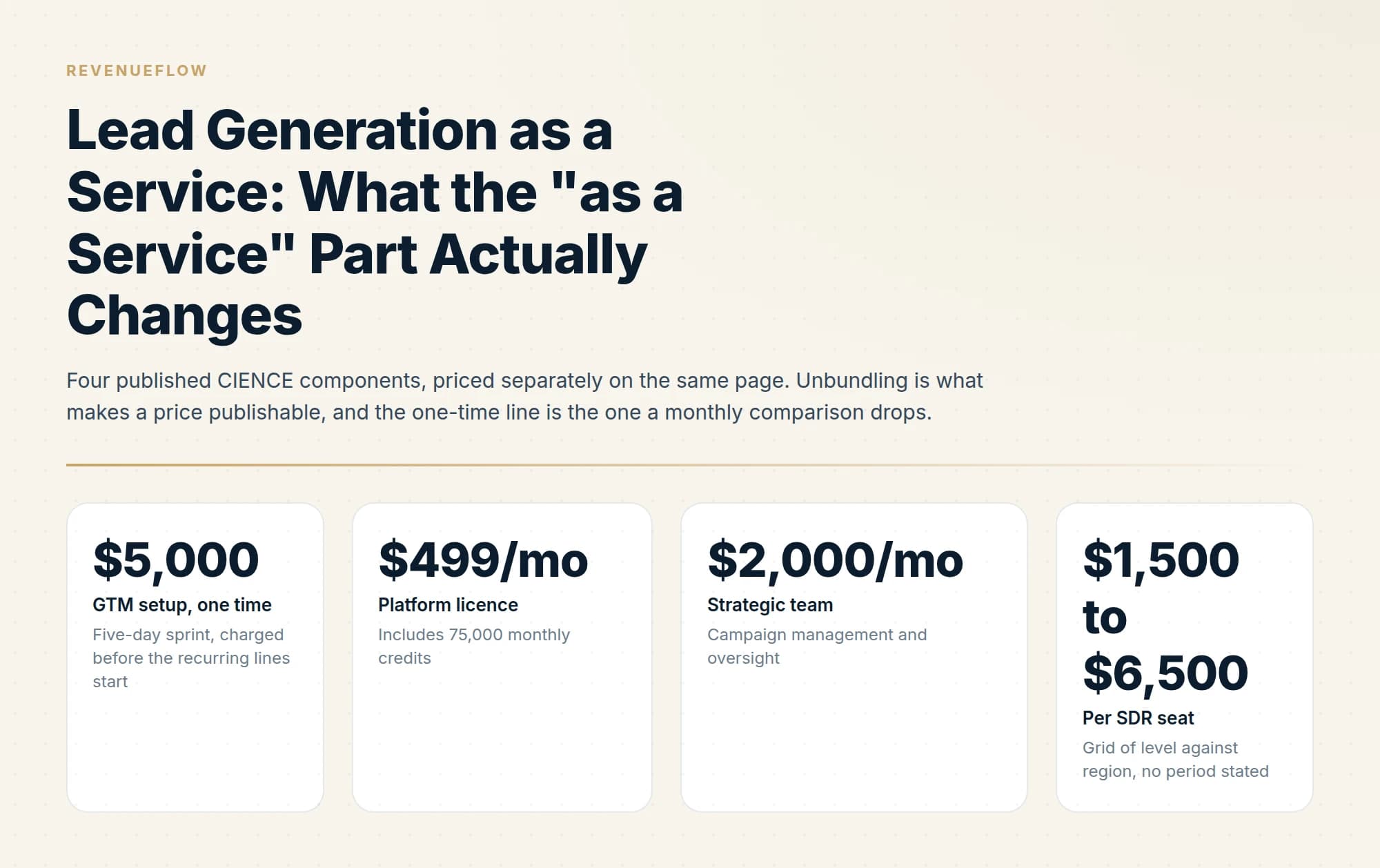
Component pricing is the one place the category genuinely resembles software, and CIENCE publishes the clearest example. Its pricing page separates a platform licence from the people running the motion: a graph8 platform licence listed at $499 a month including 75,000 monthly credits, a strategic team listed at $2,000 a month, and SDR capacity priced separately in a grid of seniority level against region, running from $1,500 for an offshore level one seat to $6,500 for a US level three seat. That grid carries no billing period, which is worth noticing on a page this specific about everything else. Sitting above the recurring lines is a one-time GTM setup at $5,000, delivered as a five-day sprint, and the page does the addition for you: $7,499 for the first month, all in, with SDR capacity quoted on top. Deeper build work is a separate menu again, with a readiness diagnostic at $1,000, credited in full against a build, and builds listed at $9,500 or $25,000 depending on complexity. Those figures are as CIENCE's pricing page displayed them on 12 August 2026. The page describes itself in its own copy as a rebuild of an earlier version, so it is worth re-reading before quoting it at anyone.
That first-month figure is the one to carry into a comparison. A published monthly rate invites you to multiply by twelve, and on this page that arithmetic misses a setup charge worth two and a half months of the recurring lines put together.
Five-day sprint, charged before the recurring lines start
Includes 75,000 monthly credits
Campaign management and oversight
Grid of level against region, no period stated
Unbundling is what makes publication possible. Once the platform, the team and the seats are separate line items, each one has a defensible unit price and the vendor no longer has to guess your shape before quoting. What you take on in exchange is assembly: deciding how many seats, at what level, against which motion, is now your judgment call, and a wrong answer costs a quarter. Component pricing is a service sold to a buyer who already knows what they need. The published ranges for the bundled alternative are in our lead generation agency cost breakdown.
The platform-plus-service hybrid

Several vendors now sell software with a managed layer on top, and the boundary between the two is the thing to pin down. SalesHive states it plainly on the same page: the full-service plans have its team running the whole motion, the platform stands on its own if you only want the software, and both are quoted on the same call. Instantly, coming from the software side, publishes plan prices directly, with a monthly and yearly toggle where the annual commitment carries the lower displayed rate.
Three questions decide whether a hybrid is safe to enter.
What happens to the data. Contacts, reply history and disposition notes accumulate inside the vendor's platform. Ask for the export format and whether it is available after the account closes, not just during the term.
What happens to the domains and inboxes. This is the expensive one. Sending domains take weeks to warm, and if the vendor bought and warmed them, leaving means starting cold somewhere else. Buying the domains yourself at the start and lending them for the duration costs nothing and removes the problem entirely.
What happens to the sequences and copy. Templates written under a managed tier are usually yours by contract and inaccessible in practice once the seat lapses. Export them while the seat is live.
What to ask before signing
Four questions separate the shapes, and all four can be asked in one email before any call.
Which parts of the scope are identical for every client on this tier, and which are set per client. What sets my price, and what would move it up a tier. What is the term, the notice period, and what renews automatically. And who owns the sending domains, the contact data and the copy at the end.
Questions about the file the supplier hands over belong on the same list, and checking a supplier rather than a delivered file names what each check actually proves.
A vendor selling a real product answers all four from the marketing page. A vendor selling a retainer answers them from a contract. Both can be the right purchase. The distinction between a booked appointment and a delivered lead, which changes what any of these tiers is actually promising, is in appointment setting versus lead generation, and the wider vendor field is surveyed in B2B lead generation companies.
The short version

"As a service" describes a packaging decision rather than a delivery method. It substitutes published scope for a bespoke statement of work, tiers for a negotiated retainer, standard onboarding for discovery, a role for a named person, and a default renewal for a defined end. Most vendors using the phrase have productised the scope and kept the price bespoke, which is defensible and is worth knowing, because a bespoke price means a bespoke relationship the moment something goes wrong. The vendors who genuinely publish numbers do it by unbundling, and unbundling moves the assembly decision onto you.
RevenueFlow is paid on attended meetings against criteria agreed in writing before launch, which puts the fixed part of the arrangement in the definition rather than in the tier. You can see what a campaign would look like for your market.
Vendor pricing and terms verified against the vendors' own pages in mid-2026. All are subject to change; confirm current terms directly before contracting.
Sources: Belkins plans and pricing, SalesHive pricing, Martal Group pricing, CIENCE pricing, Instantly pricing
Frequently asked questions.
Frequently asked questions- What does lead generation as a service actually mean?
- A productised outbound engagement rather than a bespoke one. The scope is published rather than written per client, plans are tiered rather than negotiated, onboarding follows a standard sequence, the work is done by a defined role set rather than a named strategist, and the arrangement renews by default instead of ending on a project date.
- Is lead generation as a service cheaper than an agency retainer?
- The entry price is usually lower, because the vendor amortises one standard motion across many clients instead of designing one for you. What you give up is adaptation. A standardised motion is calibrated on the median engagement, so a market that behaves differently gets standard activity and no one whose job is to notice.
- Why do so few lead generation vendors publish prices?
- Labour costs and market difficulty vary enough that one published number would be wrong for most buyers. Vendors who do publish numbers almost always unbundle first, pricing a platform licence, a management layer and individual seats as separate line items, because each of those has a defensible unit price on its own.
- What should I ask a lead generation service before signing?
- Which parts of the scope are identical for every client on the tier and which are set per client, what sets your price and what would move it up a tier, the term and notice period and what renews automatically, and who owns the sending domains, the contact data and the copy when the engagement ends.
About the author.

Ben Carden is CRO at RevenueFlow, which builds and operates outbound revenue engines for B2B companies. Previously at Gartner Enterprise. Studied at London School of Economics.
Ben Carden · CRO
Connect on LinkedIn →Explore more.
Ready to scale your outreach?
We build GTM engines that book real meetings. See the receipts.
Related articles.
B2B Lead Generation Companies by Pricing Model: 15 Vendors
Nine of fifteen B2B lead generation vendors publish a dollar figure and six publish none. The five pricing models behind the numbers, each figure cited to its page.
How Much Do Lead Generation Companies Charge: The Structure
A rate is one payment. The structure decides how many there are, when the first lands, what you owe if you leave early, and what you have to re-buy afterwards.
Lead Verification: What Each Check Actually Proves
Lead verification covers two different jobs. One asks whether a mailbox will accept mail, the other asks whether the person behind the row is real and lawful to contact.
5 ABM Campaign Examples and How Each One Is Built
Five worked account-based campaign examples, each built on the same five fields: account set, tier, plays in order, owner and handoff, and the exit condition.
Two Agencies, One Target List: Who Owns Which Accounts
Two outbound suppliers on one market will contact the same companies unless the buyer splits it first. How to cut the list, run the exclusion feed and check the overlap.
Last Outbound Agency Did Not Deliver: Locating the Failure
The leads were bad names a symptom and no stage. Four places an outbound engagement fails, the counts that separate them, and what to change in the next purchase.