How Much Do Lead Generation Companies Charge: The Structure
A rate is one payment. The structure decides how many there are, when the first lands, what you owe if you leave early, and what you have to re-buy afterwards.
Lead generation companies charge on a rate, and the rate is the smaller half of the answer. What decides your total is the billing period, whether anything is payable before launch, the minimum term and notice clause, which costs pass through and at what margin, and what you have to buy again after you leave.
Key takeaways
- SalesRoads prices from $11,950 for one SDR per four weeks, and four-week billing produces thirteen invoices a year rather than twelve.
- Cancel anytime with written notice is a rolling one-period liability, so diary the notice date at signature rather than when you want to leave.
- A setup fee that converts into later work differs materially from one that does not: CIENCE publishes a $1,000 readiness diagnostic credited in full against a build.
- Martal publishes a three-month pilot for its entry outbound tier and four months for its commission tiers, which is committed spend before any cancellation right exists.
Reviewed and updated September 21, 2026
Two vendors quote what looks like the same monthly figure. One runs a three-month pilot before the arrangement converts to a monthly subscription, so signing commits you to three periods whatever happens in the first one. The other charges no setup fee, holds its first invoice until you have approved the people and the messaging, and lets you cancel at any time with written notice. The rate on the page is identical. The amount of money genuinely at risk on the day you sign differs by a factor you cannot read off either quote.
That gap is the subject here. The published ranges for the category are already broken down in our lead generation agency cost guide, and how the billing unit allocates risk between the parties is covered in outsourced SDR pricing. What follows is the other half of the answer: when the money actually moves, what each payment is attached to, and what you are still paying for after you stop.
Searching for affordable lead generation services usually surfaces the two cheapest shapes on the market, per-hour freelance list building and pay-per-lead, and both move cost rather than removing it: one moves it onto your own team's time and the other onto a lead definition you did not write.
The unit is a calendar as well as a price
The billing unit sets a rate and it also sets a rhythm, and the rhythm is the part spreadsheets lose. SalesRoads prices its engagements per four weeks, from $11,950 for one SDR on its pricing page. Four-week periods produce thirteen invoices a year rather than twelve, which changes both the annual total and the cash-out dates every month for the whole engagement. The arithmetic for normalising that against a monthly quote is worked through properly in the pricing guide linked above, so it is not repeated here.
SalesRoads carries a second lesson at no extra charge. Its two programme cards list a fractional appointment-setting option starting at $6,950 per four weeks and a full SDR option starting at $9,500 per four weeks, while its pricing page charges $11,950 for one dedicated SDR over the same four weeks. Three published starting figures, two pages. None of them is wrong, they simply describe different configurations and different entry points, which is exactly why a "starts at" number is a filter for the vendor rather than a price for you.
A per-meeting unit changes the rhythm more than it changes the total. Invoices become variable and unforecastable, which is comfortable in a slow month and awkward when a good month lands in a quarter that had already been budgeted. Ask what a strong month looks like on that model, because the answer is a cash-flow question rather than a pricing one.
Money that moves before any work does
Four things commonly take money before a single message goes out, and they are quoted separately from the rate often enough that a headline comparison misses all four.
Setup and onboarding fees. Some vendors compete on their absence. SalesHive states no setup fees, ever, alongside no long-term contracts and cancellation at any time with written notice. Others charge for setup as a distinct product: CIENCE publishes a readiness diagnostic at $1,000, credited in full against a build, and separate build engagements at $9,500 and $25,000 depending on system complexity. A setup fee that converts into later work is a materially different thing from one that does not, and the conversion is the question to ask.
Per-person onboarding. Where the vendor is staffing seats, ramping a person can be its own line. CIENCE lists SDR onboarding and recruitment at $1,000 one-time per SDR. If your programme scales by adding seats, that line recurs every time you scale, which is not obvious from a monthly rate.
Staffing seats this way raises a broader question of team design, addressed in the demand generation team structure guide that diagnoses which function is actually constrained.
Advance billing. Whether the first period is invoiced in advance or in arrears decides whether you fund the ramp or the vendor does. Nobody hides this and almost nobody publishes it. SalesHive is unusually explicit about the sequencing in the other direction, stating that before your first invoice goes out you approve the people, the plan and every word.
Annual prepayment dressed as a monthly rate. Software pricing pages routinely display the annual-commitment rate as the headline. Instantly's pricing page carries a monthly and yearly toggle, and its bundle cards show a lower per-month figure next to a struck-through higher one with a saving flagged beside it. The number you remember from the page is often the one that requires twelve periods of commitment.
- At signatureSetup, onboarding or diagnostic fee
Ask whether it converts into later work or is consumed. Ask whether it is refundable if launch never happens.
- Before launchFirst period, in advance or in arrears
This decides who finances the ramp weeks. It is rarely on a pricing page and always in the contract.
- Per periodThe rate, on the vendor's calendar
Monthly, four-weekly or variable per outcome. Four-weekly means thirteen cash events a year.
- On scalingPer-seat or per-volume additions
Recruitment, onboarding and credit top-ups recur every time the programme grows.
- At noticeThe notice period, billed in full
Cancel anytime plus thirty days written notice is a thirty-day minimum liability at all times.
- After exitWhat you re-buy
Domains, warmed inboxes, platform seats and data you no longer have access to.
What you have actually committed to

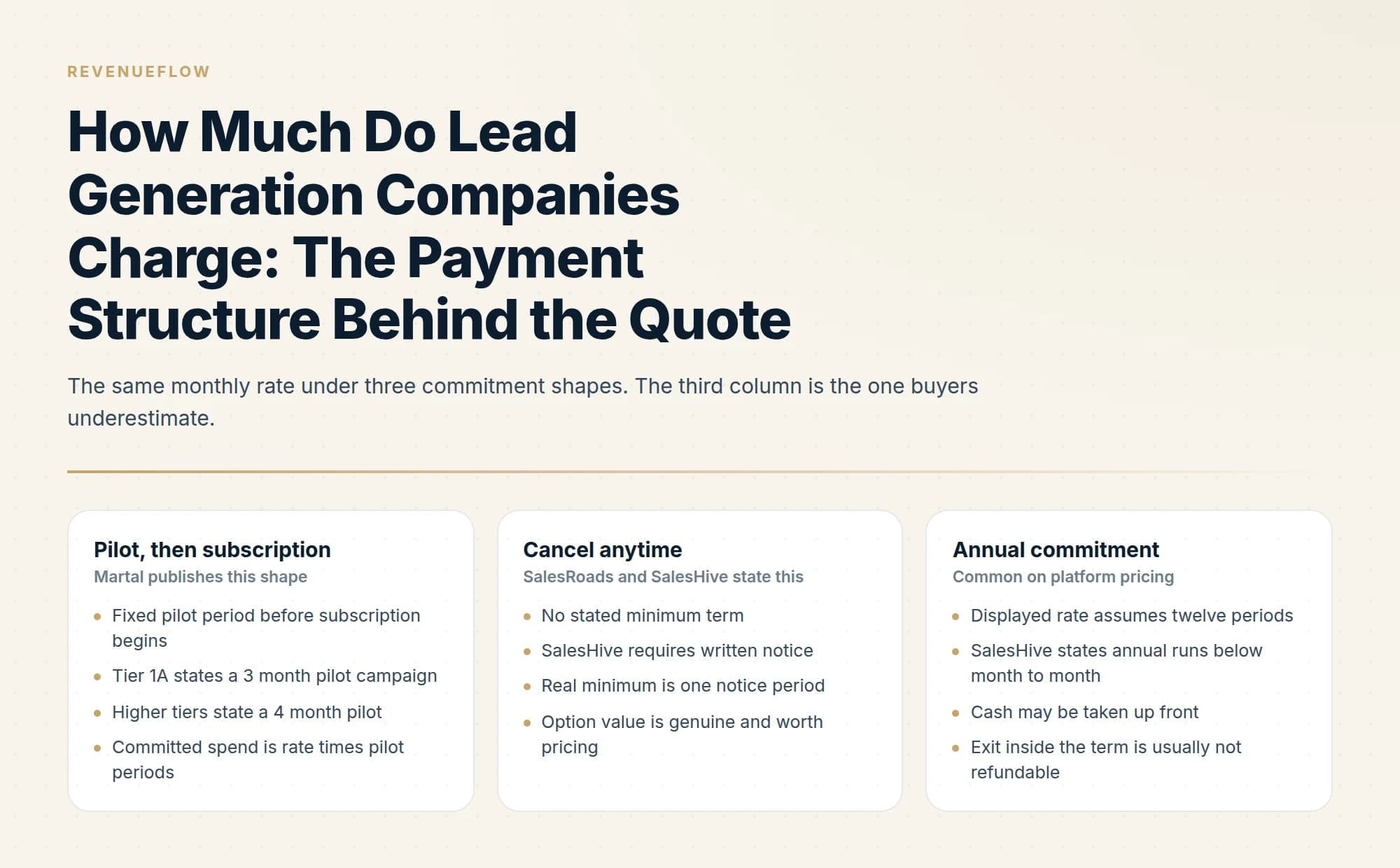
Commitment language on marketing pages is short and the contract behind it is not. Three shapes cover most of the market, and each one produces a different figure for total money at risk.
A separate contrast is whether the vendor sells a plain rate or a productised package with standard onboarding and default renewal, a distinction explored in what as a service actually changes.
- Fixed pilot period before subscription begins
- Tier 1A states a 3 month pilot campaign
- Higher tiers state a 4 month pilot
- Committed spend is rate times pilot periods
- Renews as a monthly subscription afterwards
- No stated minimum term
- SalesHive requires written notice
- Real minimum is one notice period
- Option value is genuine and worth pricing
- Diary the notice date at signature
- Displayed rate assumes twelve periods
- SalesHive states annual runs below month to month
- Cash may be taken up front
- Exit inside the term is usually not refundable
- Compare against the month-to-month rate, not the headline
Two clauses do most of the damage. The first is the notice period attached to a cancel-anytime promise: written notice means the arrangement always carries at least one further period of liability, so "cancel anytime" and "no minimum term" are not the same sentence. The second is auto-renewal, which converts a decision you would have made deliberately into one you make by forgetting. Put the notice date in a calendar on the day you sign, dated to fall before the window closes rather than on the day it does.
Pilots deserve a fairer reading than they usually get. Martal's published structure runs a three-month pilot campaign for its entry outbound tier and four months for the tiers that add sales commission, converting to a monthly subscription afterwards. A commission tier genuinely needs longer runway, because commission pays the vendor nothing until deals close. A pilot is a real minimum spend and it is also a real commitment from the other side.
Pass-throughs, and who marks them up
Data credits, email verification, sending domains and inboxes, and platform seats are all real costs that exist whoever runs the programme. What varies is whether they sit inside the fee, arrive at cost, or arrive with a margin on them.
The published examples sit at both ends. SalesHive describes one flat monthly fee covering the SDR team, the strategist, the AI platform, the data and the sending tools. Belkins frames tooling as included and quantifies it, stating that its retainer saves up to $10,000 annually on premium lead generation and marketing tools. CIENCE goes the other way and prices the components separately: a platform licence at $499 a month including 75,000 monthly credits, alongside a strategic team at $2,000 a month, with scaled credit tiers for higher volume.
Outside this category the same question often gets no answer at all, and where a quote-only platform's figures originate tracks each circulating number back to the page that carried it.
Neither approach is better. Bundled is simpler to buy and harder to audit. Unbundled is auditable and moves the volume-forecasting risk to you. The question that resolves it is what happens when volume goes up: whether credits are included to a cap, topped up at cost, or repriced, and who decides when the cap is reached.
When delivery misses

Every quote implies a level of output and almost none of them attaches a consequence to missing it. Ask directly what happens: a credit against the next period, rollover of undelivered output, a make-good month, or nothing at all. Nothing at all is a legitimate answer on a retainer, where you bought capacity rather than a result, and it is worth hearing said out loud.
On any outcome-based unit, the adjudication mechanics matter more than the rate. Who decides a meeting did not count, against what written standard, and how long do you have to say so. A vendor with no answer to the third question has effectively given you an unlimited window, which sounds generous and means the standard is unenforceable in both directions.
CIENCE publishes an unusual version of the outcome unit worth knowing about: it states that its per-meeting fee is calculated from the agreed ROI goal, typically a 4x ROI, using a campaign calculator. That derives the rate from your own economics rather than from a rate card, which makes the inputs you supply into the calculator the negotiation.
Our own practice is documented and simple to state. RevenueFlow is paid on attended meetings against criteria agreed in writing before launch: the company sits in the pre-approved audience, the participant has responsibility for or influence over the relevant area, the prospect agrees to a business conversation, the prospect attends and participates, and the prospect was not disclosed beforehand as an existing customer, active opportunity or suppressed account. Budget, timing, authority and immediate intent are deliberately excluded as billing conditions. Qualified prospects go straight onto the calendar rather than waiting in a review queue, and the client can cancel any booking. A held meeting counts unless it is flagged inside three business days with a reason that maps to the written criteria. What a defensible definition contains, and the five ways a loose one gets used, is in pay per appointment B2B.
Exit, and what you re-buy
The last payment in an engagement is usually the one you make to somebody else afterwards.
Sending domains and warmed inboxes are the expensive item. Warming takes weeks of low-volume sending, and a domain bought by the vendor typically leaves with the vendor, so the cost of exit is a cold start somewhere else. Buying the domains in your own name at the outset and lending them for the duration costs nothing and removes the whole problem.
Three more items belong on the same list. Contact data and reply history live inside the vendor's platform, so agree the export format and whether it survives account closure. Copy and sequences are usually yours by contract and inaccessible in practice once the seat lapses, so export them while it is live. And any platform seat the vendor was providing becomes a line on your own budget the day you leave.
- Yes: What is the billing period, and is the first one invoiced in advance
- Yes: What is payable before launch, and does any of it convert into later work
- Yes: What is the minimum term, the notice period and the renewal behaviour
- Yes: Which costs are passed through, at cost or with margin, and what happens above the cap
- Yes: What happens if output misses, and who adjudicates it inside what window
- Yes: Who owns the domains, the data and the copy on the last day
The short version

A rate tells you the size of one payment. The structure tells you how many payments there are, when the first one lands relative to any work, what you owe if you leave in month two, and what you have to re-buy afterwards. Four-week billing produces thirteen invoices a year, cancel-anytime with written notice is a rolling one-period liability, an annual headline rate is a prepayment, a setup fee that converts into work is different from one that does not, and pass-throughs behave differently the moment volume rises. Ask the six questions above in one email before anybody quotes you a number, because the answers change the total more than the rate does. What each major vendor publishes and deliberately leaves off the page is catalogued in appointment setting companies.
RevenueFlow is paid on attended meetings against criteria agreed in writing before launch, which puts the payment trigger and the standard in the same document. You can see what a campaign would look like for your market.
Vendor pricing and terms verified against the vendors' own pages in mid-2026. All are subject to change; confirm current terms directly before contracting.
Sources: SalesRoads appointment setting, SalesRoads pricing, SalesHive pricing, Martal Group pricing, CIENCE pricing, Belkins plans and pricing, Instantly pricing
Frequently asked questions.
Frequently asked questions- How much do lead generation companies charge?
- Published entry figures are rare and are floors rather than quotes. SalesRoads lists one SDR at $11,950 per four weeks and programme cards from $6,950. SalesHive and Martal publish scope but no rate. Belkins carries no rate on its plans page while showing a starter figure on its appointment setting page, which is why you check both. Treat any published number as an entry configuration.
- Do lead generation companies charge setup fees?
- Some do and some compete on not doing so. SalesHive states no setup fees, ever. CIENCE publishes setup as separate products, including a $1,000 readiness diagnostic credited in full against a build and builds at $9,500 or $25,000. Ask whether any upfront fee converts into later work or is simply consumed.
- What does cancel anytime actually mean in a lead generation contract?
- Usually cancel at any time subject to a written notice period, which means the arrangement carries at least one further billing period of liability at every point in its life. It is genuine option value and worth pricing, and it is not the same as no minimum term. Diary the notice date on the day you sign.
- What do I lose when a lead generation engagement ends?
- Most often the sending domains and warmed inboxes, which take weeks of low-volume sending to warm and typically leave with the vendor who bought them. Also contact data and reply history held in their platform, copy and sequences behind a lapsing seat, and any tooling the fee was covering. Buy the domains yourself at the start.
About the author.

Ben Carden is CRO at RevenueFlow, which builds and operates outbound revenue engines for B2B companies. Previously at Gartner Enterprise. Studied at London School of Economics.
Ben Carden · CRO
Connect on LinkedIn →Explore more.
Ready to scale your outreach?
We build GTM engines that book real meetings. See the receipts.
Related articles.
B2B Lead Generation Companies by Pricing Model: 15 Vendors
Nine of fifteen B2B lead generation vendors publish a dollar figure and six publish none. The five pricing models behind the numbers, each figure cited to its page.
Lead Generation as a Service: What the Service Part Changes
Most vendors selling lead generation as a service have productised the scope and kept the price bespoke. What that trade buys you, and how to tell which half is fixed.
Typeform Alternatives: Read the Response Meter First
Typeform meters responses with a hard ceiling and counts seats inside the plan. What Tally, Fillout, Formbricks and Jotform count instead, from their own pricing pages.
Lead Verification: What Each Check Actually Proves
Lead verification covers two different jobs. One asks whether a mailbox will accept mail, the other asks whether the person behind the row is real and lawful to contact.
PartnerStack Pricing: One Published Number
PartnerStack quotes its three platform plans and publishes the whole model for its self-serve product. What each tier gates, and the choice forced at the entry tier.
BrightTALK Pricing: What the Vendor Does Not Publish
Six BrightTALK surfaces carry no price at all. The $500 figure filling that gap is a 2022 scrape on a listing the vendor says it does not manage.