Done For You Lead Generation: What Cannot Be Handed Over
Done for you covers sourcing, infrastructure, copy and booking. Five inputs stay with you in every arrangement, and they are where these engagements actually fail.
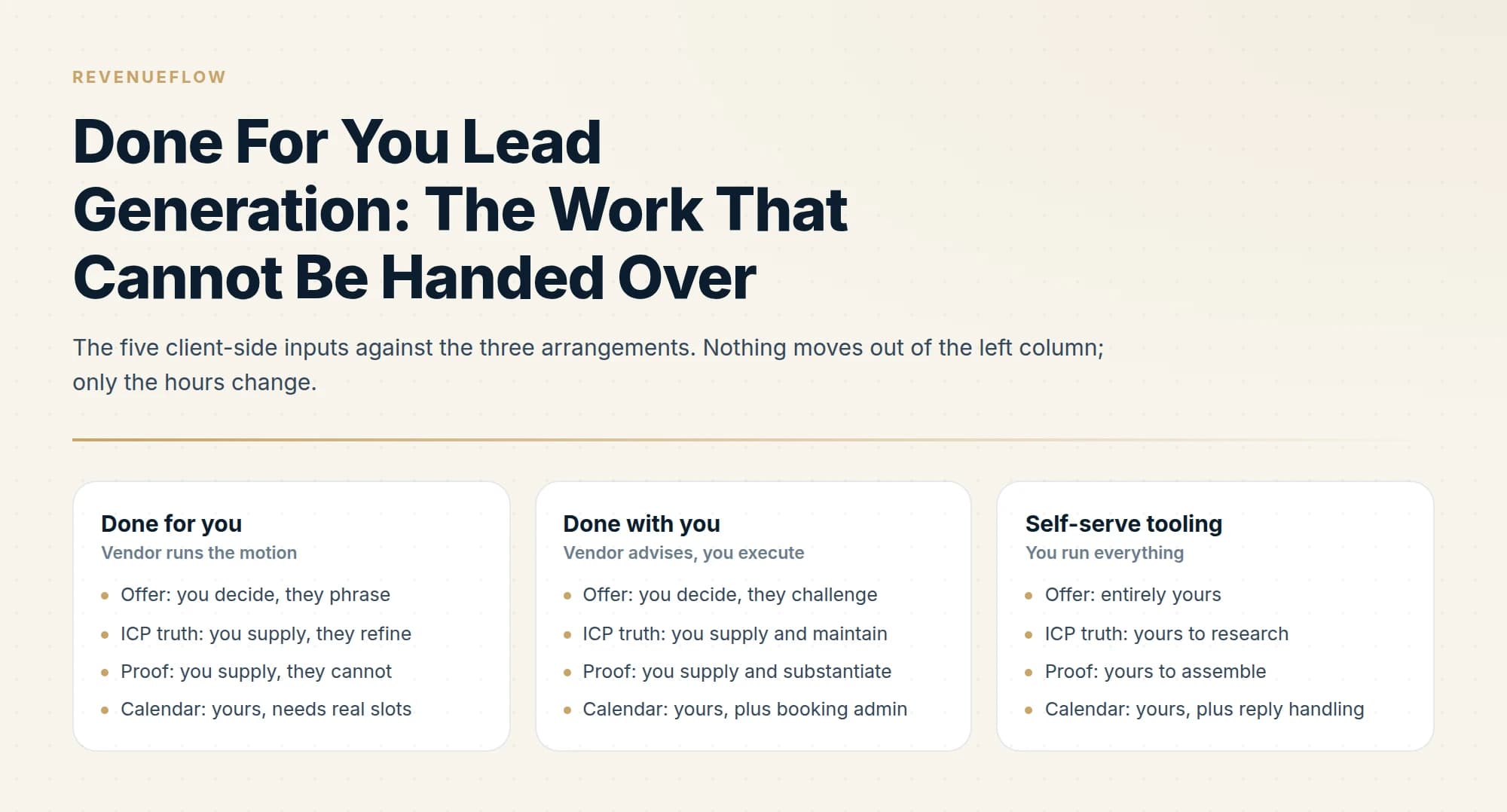
Done for you lead generation covers sourcing, verification, sending infrastructure, copy production, deliverability and booking. Five inputs stay on the client side in every arrangement: the offer, the truth about who buys, the proof the copy stands on, calendar availability, and a fast written verdict on meeting quality. Agree an owner for each before launch.
Key takeaways
- Belkins publishes an inclusion list covering audit, market sizing, lead research, copywriting, scheduling and no-show recovery, and nothing on it decides your offer, your proof or your calendar.
- The same five client-side inputs are required in done-for-you, done-with-you and self-serve arrangements; only the number of your hours changes.
- A quality verdict delivered after the next wave has sent cannot change anything, which is why the window matters as much as the standard it applies.
- The vendor's half is instrumented and the client's half is not, so an underperforming programme gets diagnosed from the only data anyone collected.
Reviewed and updated September 1, 2026
Belkins prints an inclusion list at the foot of its pricing page that applies to every package regardless of price: a full sales audit and strategy mapping, total addressable market calculation and buyer profile refinement, manual lead research and validation, transparent reports, copywriting and editing, appointment scheduling and no-show recovery, continuous data-driven fixes and tech support.
That is a genuinely complete description of the mechanical half of an outbound programme, and it is worth reading twice for what is absent from it. Nothing on that list decides what you sell, who actually buys it, what proof the copy can stand on, who is free on Thursday, or whether last week's meetings were any good. Those five things stay with you in every done-for-you arrangement ever sold, and they are where these engagements actually die.
The five inputs that never transfer
Buyers who ask how the process works are usually trying to find this line rather than the workflow diagram, because the workflow is broadly the same at every vendor and the seam is not.
Done for you is an accurate description of the work a vendor can perform without you in the room. It is silent about the inputs that work consumes, and the silence is not deceptive so much as structural: a vendor cannot supply them because they do not exist on the vendor's side of the wall.
Buyers frequently put this as no single vendor doing all of it across every channel, and the more useful reading is that the gap is not a vendor gap: the five inputs above stay with you whichever vendor you hire, and a supplier who claims to cover them is describing scope rather than capability.
The offer
The offer is a commercial decision: who this is for, what changes for them, what the first commitment is, and what it costs. A good copywriter can phrase it, sharpen it, and strip the hedging out of it. None of that invents it.
This is the input buyers most often assume is included, usually because "copywriting" appears on the scope list. Copywriting is the expression of an offer. If what you hand over is a description of your product and a request for meetings, the copy that comes back will be a description of your product and a request for meetings, written well.
ICP truth
Not the ICP slide. The real one, which lives in your closed-won data and in the heads of whoever has been selling for the last two years. Which segment closes fastest, which one churns, which job title actually signs, which deal you keep losing and to whom.
Vendor scope lists reflect this precisely if you read the verbs. Belkins offers buyer profile refinement, and refinement operates on something you supply. Martal's entry outbound tier commits to creating a curated list of pre-qualified leads on a weekly basis, which is list construction against criteria rather than discovery of the criteria.
A vendor can genuinely improve on what you hand over, and the improvement is bounded by what you hand over. Given a segment and a title, they will find better-fitting companies within it than you would have found yourself. Given a segment that is wrong, they will find excellent examples of the wrong companies, at volume, and the reporting will look healthy the entire time.
Proof
Copy that says anything specific has to stand on something specific: named customers, results you can substantiate, a reference who will take a call. A vendor cannot manufacture these, and should not, because an unsupportable claim in cold outreach is your legal exposure and your reputation rather than theirs.
If your honest proof position is thin, that is a strategic finding rather than a blocker, and the correct response is to build the campaign around the things you can substantiate. What you cannot do is hand the gap over and expect it to be filled.
Calendar coverage
Somebody has to take the meeting, within days rather than weeks. Vendors book onto your calendar and say so plainly: SalesRoads describes its final step as qualified appointments booked directly onto your calendar. The calendar is yours, and so is its availability.
Two seconds of thought about the mechanics makes the size of this obvious. A prospect who agrees to a conversation is at their highest interest in that moment, and every day between then and the meeting is decay. If your only available slot is sixteen days out, the vendor's sourcing quality is no longer the variable that decides your outcome.
Confirmations, reschedules and no-show recovery sit inside this input too, and they are ordinary two-way correspondence rather than outbound. Answering somebody who has already agreed to meet you is not a bump, and it is nothing like sending a second cold message to a person who ignored the first. We never do the second thing. The first is just doing your job.
The feedback loop
Somebody has to tell the vendor which meetings were good and why, inside a window short enough to change the next wave. This is the input people concede is important and then never staff.
The mechanics matter more than the intention. A judgment delivered six weeks later cannot change anything, because the wave it would have corrected has already been sent. A judgment delivered as a feeling ("that one was weak") cannot change anything either, because it does not map to a targeting or copy decision the vendor can act on. What works is a written standard agreed before launch, a named person who applies it, and a short fixed window.
Our own version is public practice: we are paid on attended meetings against criteria agreed in writing before launch, the client can cancel any booking, and a held meeting counts as qualified unless the client flags it inside three business days with a reason that maps to the written definition. A rejection that maps to the definition is valid. "The call went badly" is a real thing to feel and is not a criterion.
- Step 1Meeting happens
The vendor's half ends here. Everything before this point is genuinely outsourceable.
- Step 2Somebody judges it
Against the written standard agreed before launch, not against how the conversation felt.
- Step 3Somebody says so, quickly
Inside a fixed window measured in days. A verdict delivered after the next wave has sent cannot change it.
- Step 4The next wave changes
Targeting, angle or exclusion. This is the only mechanism by which the programme gets better.
The same five, in every arrangement

The usual framing puts done for you, done with you and self-serve tooling on a spectrum of how much work you do. That framing is misleading, because the five inputs above are required identically in all three. What actually varies is how many of your hours each input costs and how fast the loop closes.
The productised packaging behind these vendor tiers is examined in what the service label changes, covering published scope, standard onboarding and default renewal terms.
- Offer: you decide, they phrase
- ICP truth: you supply, they refine
- Proof: you supply, they cannot
- Calendar: yours, needs real slots
- Feedback: yours, on a fixed window
- Offer: you decide, they challenge
- ICP truth: you supply and maintain
- Proof: you supply and substantiate
- Calendar: yours, plus booking admin
- Feedback: yours, plus the analysis
- Offer: entirely yours
- ICP truth: yours to research
- Proof: yours to assemble
- Calendar: yours, plus reply handling
- Feedback: yours, plus the reporting
Read across any row and the input is present in all three columns. The right-hand columns simply add work rather than removing any. That is the argument for done for you when it applies, and it is a strong one: the mechanical half is a large, specialised, tool-heavy body of work, and buying it back is often the cheapest hour you will spend. The delivery models and who carries the delivery risk in each are set out in B2B lead generation services, and the cost side is in the lead generation agency cost breakdown.
What the vendor genuinely takes off your desk
That asymmetry is also the honest answer to how much effort is required from your own sales team: the vendor half is reported weekly and the client half is reported nowhere, so the hours below are real, small, and the ones that decide whether month three works.
None of this argues against buying. The mechanical half is substantial and specialised: sourcing and enriching a list, verifying addresses, standing up and warming a sending estate, authenticating domains, writing and rotating copy at volume, monitoring deliverability, triaging replies, and getting a booked meeting onto a calendar with a confirmation attached.
That work needs tooling, a warmed sending estate, and someone who has seen enough campaigns to recognise a deliverability problem before it becomes a blocklist entry. Most companies below a certain size cannot justify assembling it, which is the entire honest case for the category. What an agency actually does inside that half is broken down in our cold email agency guide.
Where outbound depends on vendors and calendars, organic search lead generation trades faster feedback for a payoff measured in months, judged against a criterion fixed before publishing.
The seam is clean and it always sits in the same place. The vendor owns everything up to the moment a real conversation is scheduled. You own the inputs that determine whether that conversation is worth having and whether the next one is better.
One asymmetry is worth naming because it distorts how these engagements get reviewed. The vendor's half is instrumented end to end: sends, deliveries, replies, bookings, all of it reported weekly. The client's half is invisible. Nobody produces a dashboard showing that copy approval took eleven days, that the first available slot was two weeks out, or that no verdict on last month's meetings ever arrived. So when a programme underperforms, the only measured half is the one that gets blamed, and both sides go looking for the answer in the reporting rather than in the seam.
A common reason given for abandoning an outsourced attempt is that it turned out to be too much work and too long a wait, and both halves usually trace to the client-side inputs above rather than to the vendor: the offer, the ICP truth, the proof, the calendar and the feedback loop are what the wait is actually waiting on.
Before you sign

Five questions, answered in writing by both sides before launch. None of them are about price.
- Yes: Who writes the offer, and who has final say on a claim
- Yes: Who buys and owns the sending domains, and who keeps them at the end
- Yes: Who takes the meetings, and how many slots exist per week
- Yes: Who adjudicates whether a meeting counted, against what written standard
- Yes: How fast you will respond to a copy approval or a data question
- Depends: What the vendor does when an input from your side is late
The last line is the one nobody writes down and the one that decides how the third month goes. Vendors publish their side of this reciprocity when they think about it: SalesHive states that before a first invoice goes out you approve the people, the plan and every word, and that all messaging is approved before a single touch goes out. Martal lists weekly meetings, weekly reports and quota setting inside its entry tier's published scope of work. Both are commitments the vendor is making, and both consume your calendar to fulfil.
Domain ownership deserves its own line for a reason unrelated to fairness. Sending domains take weeks to warm, and if the vendor bought them, leaving means leaving the warmed infrastructure behind and starting cold somewhere else. Buying them yourself at the start and lending them for the duration costs nothing and removes the problem.
The short version

Done for you is an accurate promise about a specific half of the work: sourcing, verification, infrastructure, copy production, sending, deliverability and booking. It is silent about the offer, the truth about who buys, the proof the copy stands on, the calendar slots, and the quality verdict that has to arrive fast enough to change the next wave. Those five stay with you in every arrangement on the market, so the useful question at signing is who owns each of them by name and how quickly each side answers the other. The distinction between a booked appointment and a delivered lead, which changes what you are being handed, is in appointment setting versus lead generation.
RevenueFlow is paid on attended meetings against criteria agreed in writing before launch, which puts the quality verdict in a written standard and a fixed window rather than in an argument. You can see what a campaign would look like for your market.
Vendor pricing and terms verified against the vendors' own pages in mid-2026. All are subject to change; confirm current terms directly before contracting.
Sources: Belkins plans and pricing, SalesHive pricing, Martal Group pricing, SalesRoads appointment setting services
Frequently asked questions.
Frequently asked questions- What does done for you lead generation actually include?
- Typically list sourcing and enrichment, email verification, sending domains and inboxes with warmup, copy production and rotation, deliverability monitoring, reply triage, and booking meetings onto your calendar. Published scope lists also commonly include a sales audit, market sizing, reporting and no-show recovery. The offer, the proof and the meeting slots stay with you.
- Why do done for you lead generation engagements fail?
- Usually on the client side rather than the mechanical side. Copy approval stalls, the calendar has no near-term slots so booked interest decays before the meeting, or nobody delivers a verdict on meeting quality fast enough to change the next wave. All three are invisible in vendor reporting, so the diagnosis lands on the half that was measured.
- Can a lead generation agency write my offer for me?
- They can phrase it, sharpen it and remove the hedging. They cannot decide it. The offer is a commercial choice about who it serves, what changes for them, what the first commitment is and what it costs. Hand over a product description and the returned copy will be a well-written product description asking for a meeting.
- Who should own the sending domains in a done for you engagement?
- You should, and you should arrange it at the start when it costs nothing. Sending domains take weeks to warm, so if the vendor bought and warmed them, ending the engagement means leaving that warmed infrastructure behind and starting cold elsewhere. Buying them yourself and lending them for the duration removes the switching cost entirely.
About the author.

Ben Carden is CRO at RevenueFlow, which builds and operates outbound revenue engines for B2B companies. Previously at Gartner Enterprise. Studied at London School of Economics.
Ben Carden · CRO
Connect on LinkedIn →Explore more.
Ready to scale your outreach?
We build GTM engines that book real meetings. See the receipts.
Related articles.
Lead Generation as a Service: What the Service Part Changes
Most vendors selling lead generation as a service have productised the scope and kept the price bespoke. What that trade buys you, and how to tell which half is fixed.
B2B Lead Generation Companies by Pricing Model: 15 Vendors
Nine of fifteen B2B lead generation vendors publish a dollar figure and six publish none. The five pricing models behind the numbers, each figure cited to its page.
How Much Do Lead Generation Companies Charge: The Structure
A rate is one payment. The structure decides how many there are, when the first lands, what you owe if you leave early, and what you have to re-buy afterwards.
Lead Verification: What Each Check Actually Proves
Lead verification covers two different jobs. One asks whether a mailbox will accept mail, the other asks whether the person behind the row is real and lawful to contact.
5 ABM Campaign Examples and How Each One Is Built
Five worked account-based campaign examples, each built on the same five fields: account set, tier, plays in order, owner and handoff, and the exit condition.
Two Agencies, One Target List: Who Owns Which Accounts
Two outbound suppliers on one market will contact the same companies unless the buyer splits it first. How to cut the list, run the exclusion feed and check the overlap.