SEO Lead Generation: What Organic Search Can and Cannot Do
Organic search reaches buyers who are already looking, on a horizon of months. Which queries are worth writing for, what the lag costs, and how to measure it.

SEO lead generation works by ranking for queries a buyer types on the way to a purchase, then giving them a next step on the page they land on. Its defining property is a feedback loop measured in months, so pages have to be judged against a criterion and a date fixed before publishing.
Key takeaways
- The phrase hides two problems: whether your buyers search at all, and whether your pages convert the traffic they already get. Only the second can be fixed this week.
- Sorting candidate queries by volume puts the least valuable pages first, because the tools report volume prominently and buying intent not at all.
- A page aimed at leads needs a written criterion and a date before it is published, because the lag makes a good decision and a bad one look identical for months.
- Search only reaches people who are already looking, so the share of a market it can reach depends on how established the category is.
Reviewed and updated October 1, 2026
SEO Lead Generation: What Organic Search Can and Cannot Do for a Pipeline
A B2B company decides that search is the answer to its pipeline problem. It commissions thirty articles, publishes them over a quarter, and waits. Six months later traffic is up, the form has produced a handful of enquiries, and nobody can say whether the programme is working or whether it needs another six months. The team is not doing anything wrong. It is measuring a slow channel on a fast channel's clock.
Search is a real source of B2B leads and it behaves unlike every other one. The thing that makes it valuable, that a page keeps working after you stop paying for it, is the same thing that makes it hard to run: the feedback loop is months long, so a bad decision and a good decision look identical for a long time. Almost everything worth knowing about using search for lead generation follows from that one property.
The two questions people are asking when they search for this
They come out as one phrase and they are separate problems.
The first is whether organic search can produce leads at all for a business like theirs. That is a question about the market: do the people who buy what you sell type anything into a search engine before they buy, and if so, what.
The second is how to turn traffic that already arrives into leads. That is a question about the site, and it has nothing to do with search engines. A page ranking first for a query nobody buys from is a traffic problem dressed as a success, and a page ranking first for a query full of buyers with no way to act on it is a conversion problem dressed as a search problem.
Tools built for that half of the problem have consolidated hard, and what replaced Drift for conversational marketing now sits with owners the ranking shortlists have not caught up with.
Keeping them apart matters because they have different owners, different timescales and different fixes. The first is answered by keyword research and takes a week. The second is answered by what happens on the page itself and can be fixed this afternoon.
- Answered by keyword research, in about a week
- Fails when nobody searches for the problem you solve
- Fixed by choosing different queries, or abandoning the channel
- Cheap to answer before committing a quarter
- Answered by reading the pages traffic already lands on
- Fails when the page has no next step a stranger would take
- Fixed this week, independent of any ranking
- Worth fixing first, because it changes what ranking is worth
Intent is the whole selection problem
The queries a market produces sort into a rough order by how close the searcher is to buying, and the ones near the top of that order are worth many times the ones near the bottom despite carrying a fraction of the volume.
Somebody typing the name of a category plus the word alternatives has a shortlist and a problem with their current vendor. Somebody typing a competitor's name plus pricing is doing diligence. Somebody typing a definitional phrase is learning, and may be a student. The first two are worth writing for even when the monthly volume is in the tens. The third is worth writing for only when you are also willing to accept that most of the people arriving will never buy anything.
This is where most B2B search programmes go wrong, and the mistake is understandable, because the tools report volume prominently and intent not at all. A keyword list sorted by volume puts the definitional heads at the top and the buying queries near the bottom, and a programme that works down that list from the top spends its first two quarters on its least valuable pages.
The correction is unglamorous: sort candidate queries by how plausibly a buyer types them on the way to a purchase, and let volume break ties rather than set the order.
What the lag actually costs you
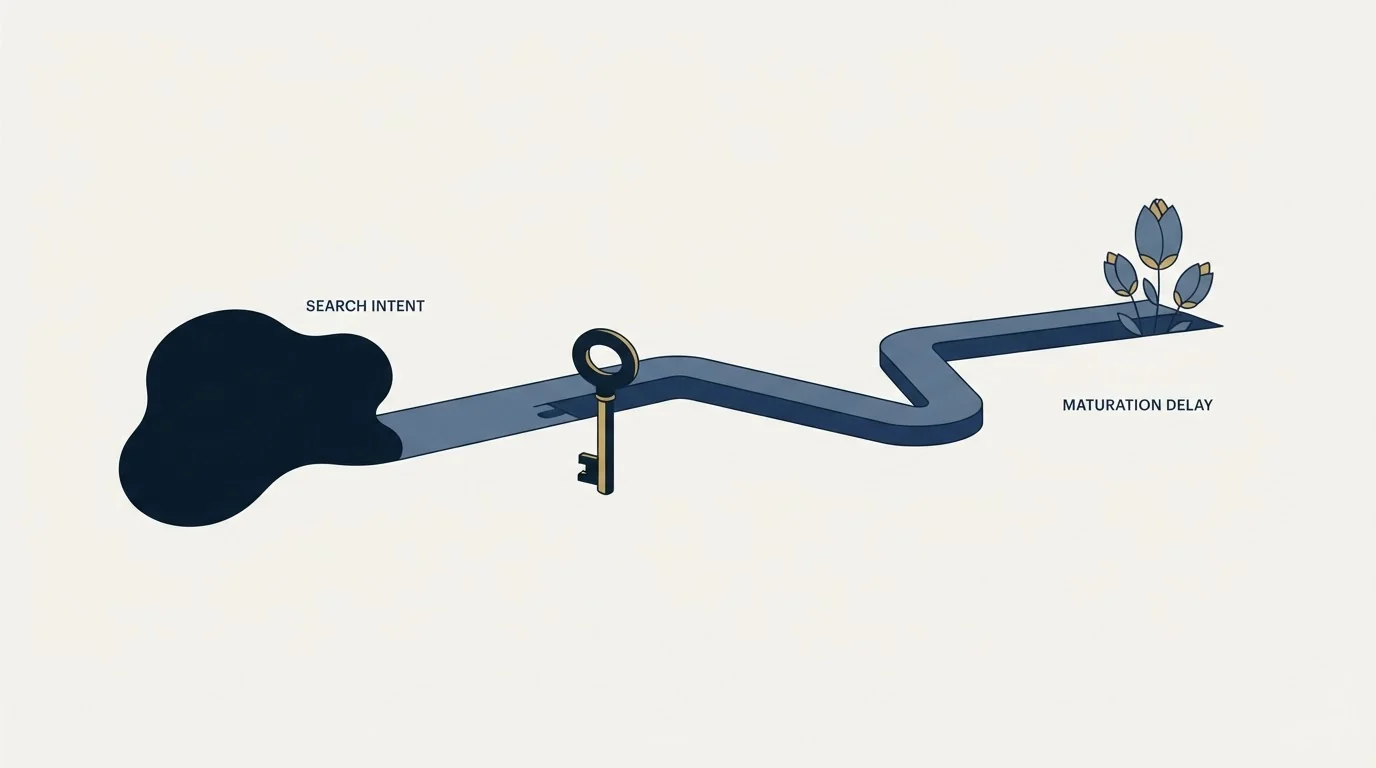
A new page does not rank the day it goes up, and the gap between publishing and knowing is the single most expensive property of the channel.
The practical consequence is that you cannot A/B your way to an answer. By the time a page has enough history to judge, the market, your offer and possibly your positioning have all moved, and the thing you are judging is not the thing you shipped. Teams respond to this in two ways and both are worse than the problem. Some rewrite pages every few weeks, which resets whatever signal was accumulating. Others treat every page as permanent and never revisit the ones that failed.
The workable middle is to decide in advance what a page is supposed to do, write the criterion down with a date on it, and hold both. A page targeting a buying query should be judged on enquiries rather than sessions, on a horizon you fixed before you published, and a page that misses on that horizon gets one deliberate revision rather than a rolling series of small edits.
- Yes: The query is one a buyer plausibly types on the way to a purchase, not just a high-volume phrase
- Yes: You can name the next step a stranger who finds it useful would take
- Yes: The page carries that next step above the point most readers stop
- Yes: You wrote down what result would count, and by when, before publishing
- Yes: Somebody owns the enquiries it produces and answers them the same day
- No: It is not a near-duplicate of a page you already have
The comparison with paid is not about cost per lead
The usual framing sets organic against paid on price, which flatters organic and hides the real difference. Paid click acquisition buys a visitor and stops the moment the budget stops. Organic buys an asset that keeps returning visitors and cannot be turned on when you need pipeline this quarter.
So they answer different questions. Paid answers whether a message and an offer work at all, in days, which makes it a research instrument as much as an acquisition channel. Organic answers what to build once you know. Running the second before the first is how companies spend two quarters ranking for a message that does not convert.
There is a specific and cheap trick in that ordering: the queries that convert in a paid account are the ones worth targeting organically, and you find them for the price of a small test rather than for the price of a year.
Where search stops, and what has to carry the gap

Organic search only reaches people who are already looking. That is its defining strength, because a searcher has declared a problem, and its defining limit, because a market is never all in that state at once and some of it never will be.
The size of that limit depends on how established the category is. If you sell something with an obvious name that buyers already shop for, search reaches a large share of the demand. If you sell something a buyer would not think to look for, search reaches the small slice who arrived at the category some other way, and the rest of the market has to be reached by going to them rather than waiting.
That is the honest place for outbound in this picture, and it is also why the two are complements rather than competitors: outbound reaches people who are not looking and can be turned up next week; search reaches people who are looking and cannot be hurried. A programme that runs only one of them has either no reach into the unaware market or no compounding asset.
For the agency that sells search work and needs accounts of its own, sales prospecting for SEO agencies covers where those accounts are enumerated from public signals and when to write.
Webinar audiences sit between those two states, and a video platform now inside Cvent's portfolio turns a shortlist question into one about somebody else's roadmap strategy.
Our own position on the outbound half is documented policy rather than inference: a campaign should carry one message, built on one premise, and be sent once. That constraint exists for the same reason the criterion-before-publishing rule exists here. If you change several things at once you cannot read the result.
- Step 1Fix the page
Make the pages traffic already reaches convertible, before earning more traffic
- Step 2Test the message
Use a fast channel to find out which framing produces replies at all
- Step 3Build on what converted
Target the queries that produced enquiries, not the ones with the volume
- Step 4Hold the horizon
Judge each page on the criterion and date you set before publishing
Measuring it without fooling yourself
Three numbers are usually reported for this channel and only one of them is worth much.
Sessions tell you the channel is alive and nothing else. Rankings tell you about a position that varies by person, place and device, which is why two people watching the same keyword disagree in good faith. Enquiries attributable to organic entry are the number that matters, and even that one needs its denominator stated, because a rate quoted without saying what it is a share of is not a measurement.
There is a second reading worth taking, and it is free. Look at which pages the enquiries actually entered on rather than which pages get the traffic, because on most B2B sites these are two different sets. The high-traffic pages tend to be the definitional ones written early, and the enquiries tend to arrive on the narrow pages nobody expected much from. That gap is the most useful thing the analytics will tell you in the first year, and it is usually visible long before any ranking report says anything interesting.
Attribution deserves less effort here than it usually gets. A B2B purchase that takes four months and involves three people will not resolve cleanly to one channel, and the effort spent forcing it to is better spent on the one question that does resolve: of the people who entered on an organic page and enquired, how many were the kind of buyer you wanted. That is answerable by reading the enquiries, and it is the check that catches a programme ranking beautifully for the wrong audience.
Where to start if you have nothing

Read the pages your existing traffic already lands on and find out whether a stranger who found one useful could do anything about it. Most B2B sites lose more here than they lose in rankings, and the fix costs a week rather than a quarter.
Then pick five queries a buyer plausibly types on the way to a purchase, ignoring volume entirely for the first pass. Write those five properly, decide before publishing what result would count and when you will look, and leave them alone until then.
The programme's whole value depends on doing this for long enough that the pages start compounding, which is the part nobody can shortcut. What you can control is that when you look in six months, the numbers you are looking at mean something.
And if the pipeline problem is this quarter's rather than next year's, search is the wrong instrument for it. That gap is what outbound is for, and it is answerable quickly: we can put a campaign in front of your market and you can read the replies on a date you set, while the pages you publish this month go on compounding behind it.
Frequently asked questions.
Frequently asked questions- How long does SEO take to generate leads?
- Long enough that you cannot judge it on a quarter, and the exact figure depends on the site, the competition for the queries and the length of the buying cycle. The practical response is not to wait for a number but to decide before publishing what result would count and when you will look, then hold both rather than revising the page every few weeks.
- Is SEO better than paid ads for lead generation?
- They answer different questions. Paid buys a visitor and stops when the budget stops, which makes it a fast way to find out whether a message and an offer work at all. Organic builds an asset that keeps returning visitors but cannot be turned up when you need pipeline this quarter. The useful order is paid to learn what converts, then organic to build on it.
- Which keywords actually produce B2B leads?
- The ones a buyer plausibly types on the way to a purchase rather than the ones with the largest volume. Category-plus-alternatives queries, competitor-plus-pricing queries and specific problem statements tend to carry buyers. Definitional phrases carry learners, including students, and are worth writing only if you accept that most arrivals will never buy.
- Why does my site get search traffic but no leads?
- Usually because the pages the traffic lands on give a stranger nothing to do. That is a site problem rather than a search problem, and it is worth fixing before earning more traffic, because it changes what every future ranking is worth. Check which pages your existing enquiries entered on: it is rarely the same set as the high-traffic pages.
About the author.

Ben Carden is CRO at RevenueFlow, which builds and operates outbound revenue engines for B2B companies. Previously at Gartner Enterprise. Studied at London School of Economics.
Ben Carden · CRO
Connect on LinkedIn →Explore more.
Ready to scale your outreach?
We build GTM engines that book real meetings. See the receipts.
Related articles.
On-Demand Webinars: What Changes When You Take the Date Away
A live webinar earns most of its value from the date. Removing it keeps the topic signal and the address, and loses the deadline, the burst and the room.
Drift Competitors: What Replaced It and What Each Costs
Drift is retired and drift.com now serves a Salesloft page. What the successors publish about price, who owns them now, and which one fits which job.
eWebinar Pricing: Two Meters and a Level That Moves
eWebinar does not ask you to pick a plan. Published webinars set the level and registrants set the overage, and the two directions do not move on the same schedule.
BrightTALK Pricing: What the Vendor Does Not Publish
Six BrightTALK surfaces carry no price at all. The $500 figure filling that gap is a 2022 scrape on a listing the vendor says it does not manage.
Goldcast Belongs to Cvent Now: The Buying Question
Cvent announced its Goldcast acquisition in December 2025 and completed its ON24 acquisition in April 2026. Two shortlist names, one owner, one live contract question.
Define Content Syndication: Two Purchases Behind One Word
One budget line, two different purchases. Republication buys reach; lead syndication buys contact records produced by a download. The deliverable tells you which.