Pay per Click Lead Generation: Where the Incentives Diverge
Buying clicks leaves every conversion step below the click on your side of the ledger. What that does to budgeting, where PPC wins, and where it stalls.
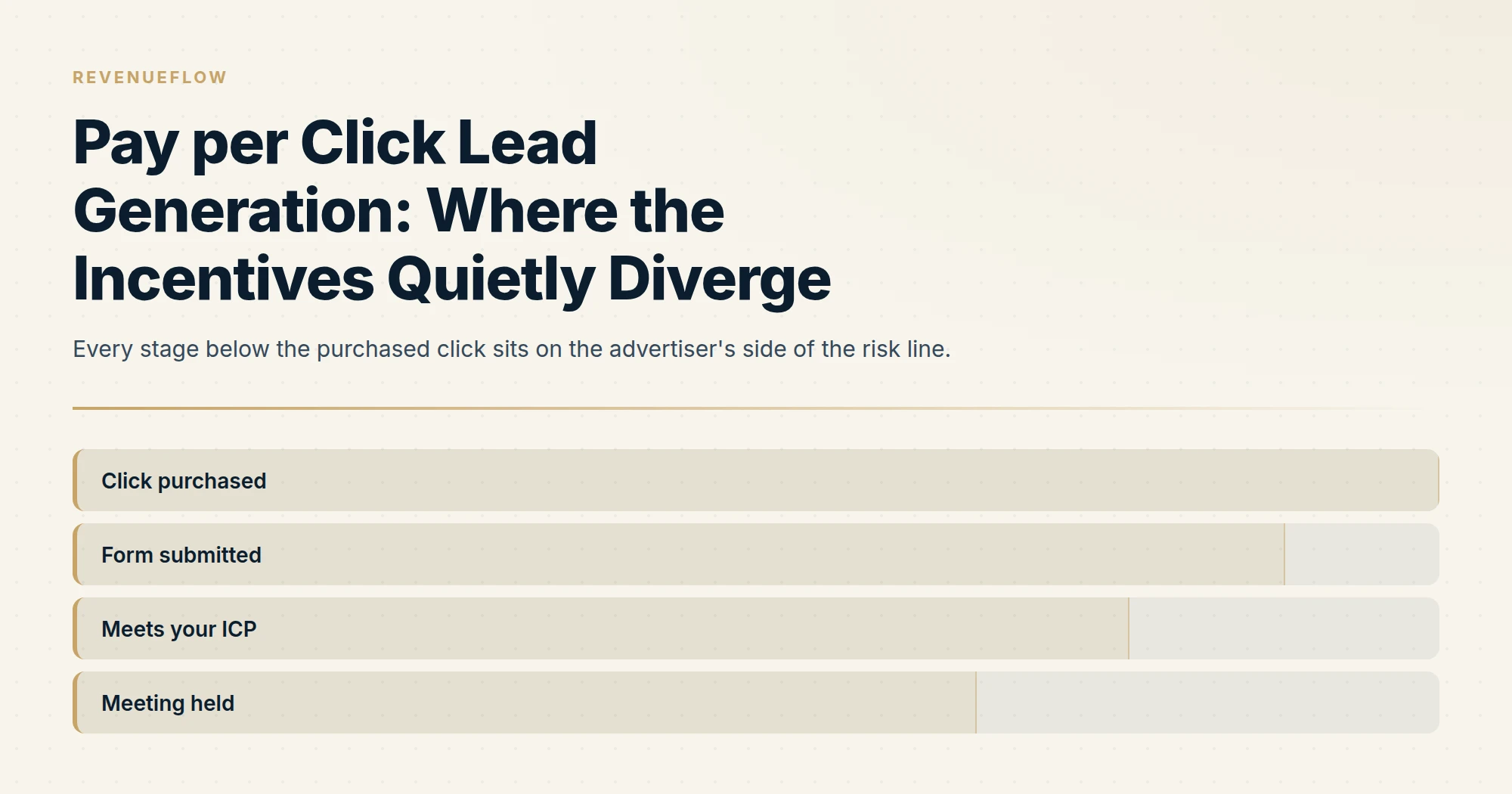
Pay per click lead generation bills you per ad interaction, so you carry every conversion step after the click: click to form, form to qualified, qualified to held meeting. It suits categories where buyers already search and cycles are short. Under a meeting-priced model the supplier carries those steps, which works only when qualification is defined in writing first.
Key takeaways
- Google defines cost-per-click bidding as paying for each click on your ads, so the charge lands regardless of who clicked or what happens next.
- Cost per held meeting is multiplicative across four stages, so a one point drop in form conversion can move it by a third on identical spend.
- Google Ads uses a default 30-day conversion window, and conversions after it are never recorded, which truncates what a long B2B cycle can teach the bidding system.
- A meeting-priced model moves list quality, message performance and no-show risk to the supplier, and depends entirely on a qualification standard agreed before launch.
Reviewed and updated September 1, 2026
You bid on a phrase like outsourced SDR pricing, someone clicks your ad, and the platform bills you for that click. Google states the mechanic plainly: cost-per-click bidding means you pay for each click on your ads, and CPC pricing is sometimes known as pay-per-click (Google Ads Help). The charge lands the same way whether the click came from a VP of Sales at a 400-person manufacturer, a student writing a coursework assignment, or a competitor reading your landing page.
That single sentence contains the whole risk structure of pay per click lead generation, usually shortened to PPC lead generation. You are buying attention at the top of a chain, and every conversion step below the click stays on your side of the ledger.
What the money actually buys
The unit of purchase is an ad interaction. Google's help documentation describes max CPC as the most you will typically be charged for a click, with the amount actually charged, the actual CPC, often coming in lower (Google Ads Help).
The price of that click is set by an auction that reruns constantly. Google describes the ad auction as a process that decides which ads are eligible to appear and in which order, running every time an ad appears, with position determined by Ad Rank: a combination of bid amount, the quality of your ads and landing page, the Ad Rank thresholds, the competitiveness of the auction, the context of the person's search, and the expected impact of assets and other ad formats (Google Ads Help). The same page notes that a competitor bidding higher than you can still lose position to higher-quality ads and landing pages.
Quality is measured and surfaced back to you. Quality Score is scored 1 to 10 at the keyword level from three components: expected clickthrough rate, ad relevance, and landing page experience, each rated against other advertisers whose ads showed for the exact same search over the last 90 days. Google is explicit that Quality Score is a diagnostic tool and is not itself an input in the ad auction (Google Ads Help).
Two things follow from that for a B2B buyer. Your landing page is part of what you are graded on, so page work is a media cost and not an optional extra. And your unit cost is not yours to set. It moves with what competitors are willing to pay for the same intent, which means a category getting more crowded raises your input price without anything changing on your side.
The four handoffs you own after the click
Paid social and display advertising sit on the same economics as search: you are buying a click and inheriting every handoff after it, and the lead form on the ad platform moves the leak rather than removing it.
A click is roughly four steps away from a conversation with a buyer, and you carry the risk on all four.
Billed on the interaction, regardless of who clicked
Depends on your page, offer and form length
Depends on who the keyword attracted
Depends on speed of follow-up and whether they show
Each stage has its own failure modes, and they compound multiplicatively. A page that converts a little worse and a keyword set that attracts slightly less relevant traffic do not add up, they multiply, and the cost per held meeting moves faster than either input suggests.
Here is an illustration with inputs chosen to make the arithmetic visible. These are not observed rates from any account, ours or a client's, and you should replace every number with your own.
Take 1,000 clicks at $12 each, so $12,000 of media. Suppose 4 percent of those clicks submit a form. That is 40 leads at $300 each. Suppose half of those leads match your ICP on company size and role. That is 20 qualified leads at $600 each. Suppose 60 percent of the qualified ones actually accept and attend a meeting. That is 12 held meetings, and your true cost per held meeting is $1,000 rather than the $300 the platform's cost-per-lead column implies.
Now move one input. Hold everything else and drop the form conversion rate from 4 percent to 3 percent. You get 9 held meetings from the same $12,000, and the cost per held meeting moves from $1,000 to roughly $1,333. A single percentage point of page performance moved your real acquisition cost by a third. That sensitivity is the defining budgeting feature of the channel.
Budgeting for a unit you cannot bank
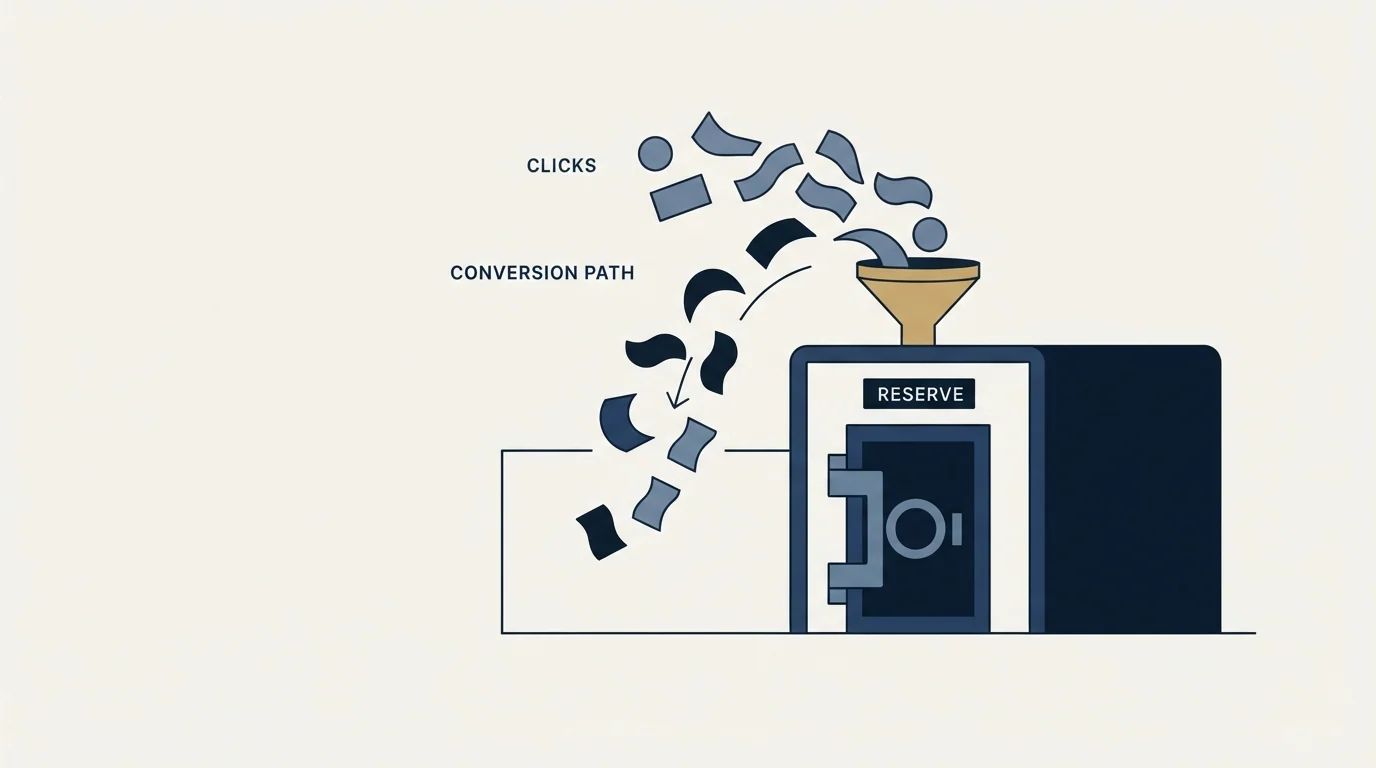
Most PPC budgets are set as a monthly media number, which is a budget for clicks. The thing the business needs is meetings, and the exchange rate between the two is a live variable that changes with competitor bidding, seasonality, page performance, and whoever is answering the inbound.
Three practical consequences.
First, budget the whole chain rather than the media line. Landing page work, form logic, routing, and speed of response are all part of the cost of a meeting sourced this way, and leaving them off the budget does not remove them from the cost.
Second, expect a learning period on the way in. Google notes that frequent manual adjustments to budgets, targets or conversion goals reset a standard 7 to 14 day learning period and delay optimisation (Google Ads Help), which means the first few weeks of spend are partly the price of finding out what your real numbers are.
Third, hold a downstream number, not a form-fill number. If the only metric on the dashboard is cost per lead, the channel will optimise itself toward cheap forms, and cheap forms in B2B are usually cheap because they are attracting the wrong people. The distinction between a form fill and a sales-ready conversation is worth being precise about, and MQL versus SQL is the same argument in reporting language.
Where pay per click genuinely earns its place
PPC is excellent at one specific job: capturing demand that already exists and is being expressed as a search right now. When a buyer types a phrase that describes your product, being on that result is worth paying for, and the cost is bounded by an auction rather than by a headcount.
- Yes: Buyers already search for the category in words you can bid on
- Yes: The consideration cycle is short enough to fit inside your reporting window
- Yes: A single person can start the purchase without convening a committee
- Yes: You can answer an inbound form within minutes, not next business day
- Yes: Your landing page and offer can be iterated weekly
- Yes: You need to defend your own brand terms from competitors
- No: The category is new and nobody is searching for it yet
- No: Your buyer list is a named set of 300 accounts
Brand defence deserves a specific mention. If competitors bid on your company name, the clicks you buy back are cheap relative to their value, and the decision is closer to insurance than to lead generation.
Local and services businesses with immediate need are the other clean fit. Someone searching for an emergency service is not going to be nurtured into readiness, they are ready, and the only question is who appears.
Where it stalls on considered B2B purchases
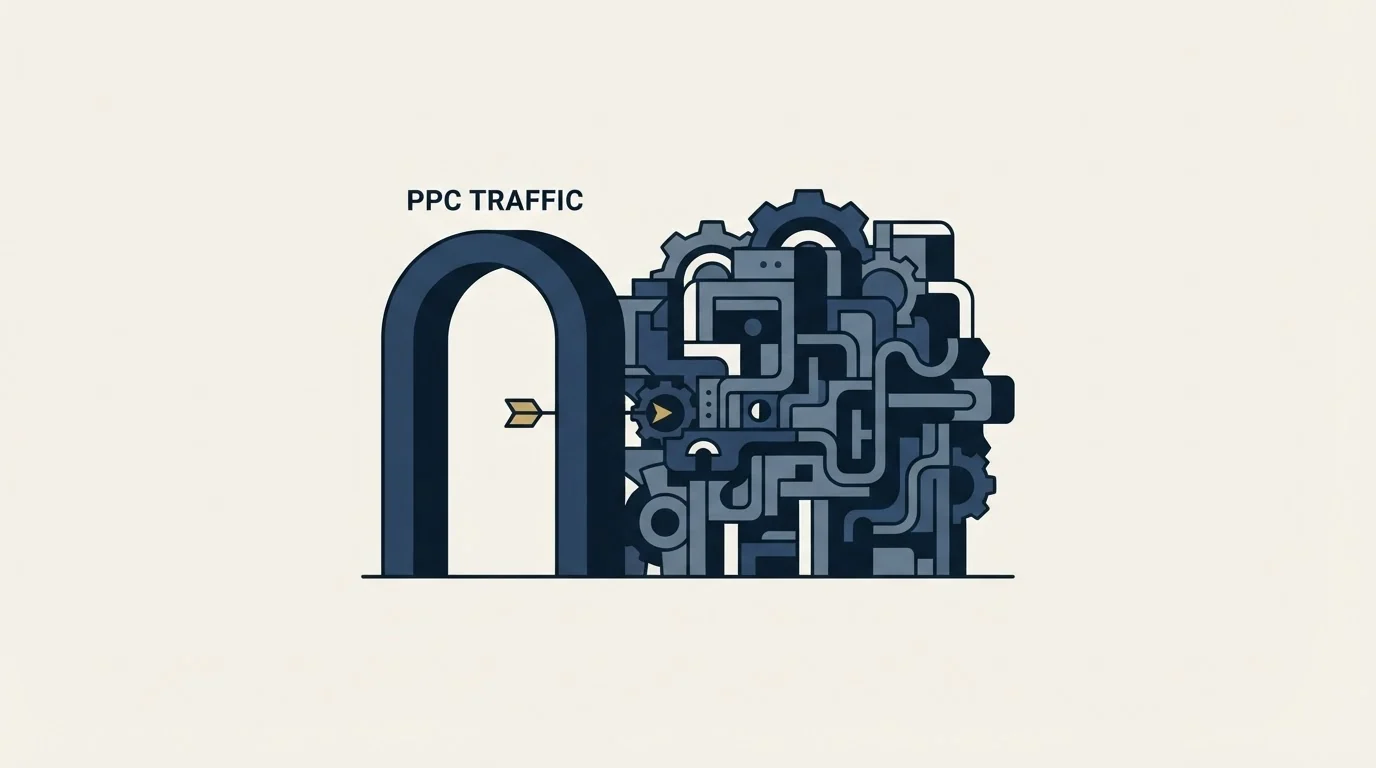
The trouble starts when the purchase is considered, the buying group is large, and the search volume for the problem is thin.
- Buyers describe the need in searchable words
- Short path from problem to purchase
- One or two people involved in the decision
- Volume is large enough for the auction to be a market
- A form fill is a meaningful step toward a sale
- The problem has no obvious search phrase
- Months between first interest and a decision
- Five to ten people touch the decision
- Total searchable volume is a few hundred a month
- A form fill is often a researcher gathering options
Four failure patterns show up repeatedly in that right-hand column.
Volume runs out before budget does. In a narrow category, the entire monthly search volume for your buying intent can be exhausted by a modest budget. Adding money then buys looser keywords, which buys worse traffic, and average lead quality falls precisely as spend rises.
The auction prices in your competitors' funnels, not yours. If a competitor monetises the same click through a self-serve product with an immediate payback, they can outbid you rationally forever. Your ceiling is set by their economics.
The conversion window and the sales cycle disagree. Google Ads uses a default 30-day conversion window, and conversions that happen after the window closes are not recorded (Google Ads Help). A six-month enterprise cycle produces revenue the platform never sees, so the optimisation loop learns from a truncated version of your business.
The platform optimises to the signal you give it. If the conversion you report is a form fill, the bidding system will get very good at producing form fills. That is the system working as designed, and it is why feeding a downstream signal back matters more than any bid adjustment.
None of this makes PPC a bad channel. It makes it a channel whose fit depends on the shape of your demand, which is a different question from the one most vendor comparisons answer. If you are weighing it against outbound options, appointment setting versus lead generation covers the difference in what actually gets delivered.
How the risk sits differently when you pay per meeting
The honest comparison here is about risk allocation rather than which channel is better. Under a click-priced model, the vendor or platform is paid on delivery of traffic, and the advertiser absorbs everything between the click and the conversation. Under a meeting-priced model, the invoice attaches to a held conversation, so the supplier absorbs list quality, message performance, reply handling and no-shows, and only gets paid when a buyer actually sits down.
That shift only works if the qualifying definition is written before anything launches, because otherwise the argument moves from where risk sits to what counts. RevenueFlow runs a five-point standard in the MSA, and all five must hold: the company is in the pre-approved audience and meets the agreed ICP criteria, the participant has responsibility for or influence over the relevant business area, they agree to a relevant business conversation, they attend and participate, and they were not disclosed as an existing customer, active opportunity or suppressed account before outreach. Budget, timing, decision authority and immediate intent are explicitly not billing conditions, because those are outcomes of the conversation rather than tests of whether the right conversation happened. We book qualified prospects straight onto the calendar with no pre-booking review hold, the client can cancel any booking, and a held meeting counts unless it is flagged within three business days with a reason that maps to the written definition. If you want the mechanics of that commercial shape, pay per appointment B2B walks through it, and ideal customer profile covers the definition work that has to happen first.
We do not run paid ads, so treat the above as a description of where the risk sits rather than a recommendation to switch. Plenty of companies should run both: PPC to harvest the demand that already exists, and outbound to reach the accounts that will never type the query.
Teams weighing pay per click against event spend can see how a comparable cost per meeting logic plays out in conference lead generation economics.
Running PPC lead generation without misleading yourself

If you are running the channel, four habits separate the accounts that work from the ones that quietly burn budget.
Report a downstream conversion back to the platform, not the form fill. Offline conversion import exists for this, and it is the difference between optimising toward volume and optimising toward the accounts you want.
Measure cost per held meeting and cost per opportunity alongside cost per lead, and put all three on the same review. The gap between them is the number that tells you whether the keywords are attracting buyers or researchers.
Instrument lead quality by keyword and by campaign, not just by account. Averages hide the two or three phrases that are doing all the damage.
Separate brand from non-brand in every report. Brand terms convert at rates that will flatter a blended number and hide the performance of everything else.
For teams comparing the cost base of paid media against an outsourced human channel, lead generation agency cost sets out how those models are usually priced. And if you would rather see what a pay-per-meeting motion looks like against your own ICP before committing to anything, we build a free campaign you can inspect end to end.
Pricing and features verified as of mid-2026. Verify current terms with the vendor before relying on them.
Frequently asked questions.
Frequently asked questions- Is PPC good for B2B lead generation?
- It works well where buyers already search for the category in words you can bid on, the consideration cycle is short, and one person can start the purchase. It struggles where the problem has no obvious search phrase, five to ten people touch the decision, or monthly search volume is a few hundred. Fit depends on the shape of your demand rather than on industry.
- What is the difference between paying per click and paying per meeting?
- Paying per click buys an ad interaction, so the advertiser absorbs page conversion, lead quality, follow-up speed and no-shows. Paying per meeting attaches the invoice to a held conversation, so the supplier absorbs those steps and is paid only when a buyer attends. The second model requires a written qualification definition, because otherwise the dispute moves to what counts.
- Why does my cost per lead look fine while pipeline does not move?
- Because the bidding system optimises toward whatever conversion you report to it. If that conversion is a form fill, it will get efficiently good at producing form fills, and cheap B2B form fills usually come from people outside your ICP. Import a downstream event such as qualified or closed-won as an offline conversion so the optimiser chases the stage that matters.
- How much should we budget for PPC lead generation?
- Budget the whole chain rather than the media line, because landing page work, form logic, routing and speed of response all sit between the click and a meeting. Expect the first weeks to partly buy information: Google notes that frequent changes to budgets, targets or conversion goals reset a standard 7 to 14 day learning period and delay optimisation.
About the author.

B2B cold email experts helping companies generate qualified leads through done-for-you outreach campaigns.
RevenueFlow Team
Explore more.
Ready to scale your outreach?
We build GTM engines that book real meetings. See the receipts.
Related articles.
Win Rate Benchmarks: Which Figures State a Population
A catalogue of the published average sales win rates, sorted by whether the page names the population behind its own number. Most do not.
Cold Calling for PPC Agencies: What You Can See First
A paid media prospect is partly readable before the call and has already been told by the platform what to do when a stranger rings about its ads.
Sales Kickoff Agendas: Five Published, Session by Session
Five publishers print a sales kickoff agenda. They agree on four blocks and disagree on session length, rehearsal and where the agenda comes from.
Sales Cycle Length Benchmarks: What Each Figure Counts
The published B2B sales cycle benchmarks, sorted by what each page says it counted. The same number means two different things in two of them.
Sales Enablement Charters: What the Published Ones Ask For
Six publishers set out what a sales enablement charter should contain. Five describe a document nobody can check, and one writes a definition with inspection in it.
Sales Comp Plan Design: What the Publishers Prescribe
Four publishers set out how to design a sales compensation plan. Here are their procedures, their components, and which of their ratios carry a population.