Sales Comp Plan Design: What the Publishers Prescribe
Four publishers set out how to design a sales compensation plan. Here are their procedures, their components, and which of their ratios carry a population.
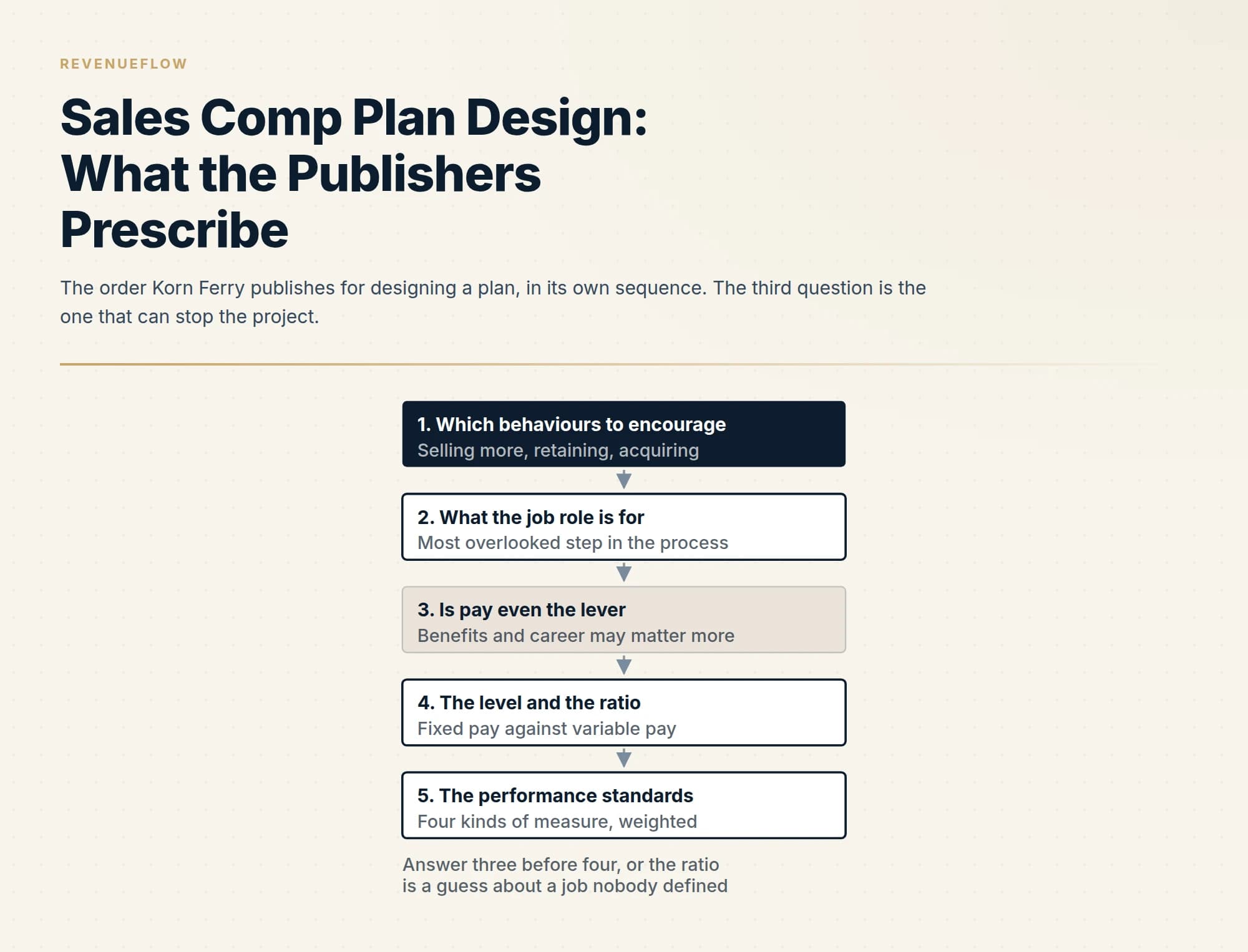
The published design procedures agree on an order: name the behaviours, define the role, decide whether pay is the lever at all, then set the ratio and the measures. The components are base, variable, threshold, accelerators, crediting and written terms. Most published ratios are design rules rather than measurements.
Key takeaways
- Korn Ferry publishes five questions in order and puts the role definition and the is-pay-the-lever question ahead of the fixed-to-variable ratio.
- Alexander Group publishes a ceiling of no more than three measures, result measures only, documented crediting at one point in time, and written terms.
- WorldatWork publishes the same list and calls it centre-practice guidelines rather than rules, on the ground that they are not rigid or non-voidable.
- Only one published ratio in this set is a measurement, and it is a range for one role in one industry drawn from a single consultancy database.
Reviewed and updated September 20, 2026
Four organisations publish a procedure for designing a sales compensation plan, and the most interesting thing about the four documents is that one of them spends its length arguing that the other three are describing guidelines rather than rules. That argument is the useful one, because almost every published design rule in this field is stated as though it were a law and then quietly broken by the same consultancy in the next article.
What follows is what the publishers actually prescribe, taken from their own pages: the questions they say to answer in order, the components they say a plan is made of, and the ratios they print, with the population behind each figure or a plain statement that there is none. The argument about how to design a plan for your own team, starting from the behaviour you are willing to pay for, is this site's own and is made in the incentive plan for a sales team, which this page does not repeat.
The published design procedures
Korn Ferry publishes five questions, in order, in a piece dated 8 October 2022. The first is what behaviours the plan needs to encourage, on the grounds that "A sales compensation plan is there to incentivize a seller for certain behaviors, such as selling more product, retaining current customers, or acquiring new customers." The second is the objectives of the job role, which the page calls one of the most critical elements in the design process and often one of the most overlooked. The third asks whether compensation is even the right lever, given that benefits, career progression and work content may matter more to the seller. The fourth is the level of compensation and the fixed-to-variable ratio. The fifth is the performance standards, which the page divides into four kinds: financial or production measures, strategic measures, activity measures and subjective or judgment measures, with the last used sparingly and with less weight.
Alexander Group publishes seven rules, first posted in September 2008 and last modified on 10 October 2024, under the heading of compensation simplicity. Its diagnosis is blunt: "Incorrect performance measures are the most common cause of sales compensation complexity." Its remedies are a shared set of corporate design principles so that plan architecture is alike from job to job, a hard ceiling on measures, result measures rather than compliance measures, the right formula engine for the territory shape, documented crediting rules, and written terms.
WorldatWork publishes the counter-argument. Its Workspan Daily piece on breaking the rules, dated 24 March 2022 and carrying an editor's note that the monthly sales compensation column comes from the Alexander Group, accepts the same principles and then refuses to treat them as binding, writing that "Designing an effective sales compensation program is a challenge" before adding that the accepted principles "are not rigid, nor non-voidable rules." It renames them centre-practice guidelines, defined as the choice many others would make, and distinguishes that from best practice, which would imply every other choice is inferior.
The components, and what each publisher says each is for
The component list is stable across the four. Performio's primer, dated 16 July 2024, describes a plan as consisting of "two main parts, which are collectively known as the pay mix", base salary and incentive pay, and warns that "Commissions and incentives are often the largest variable expense for sales-driven organizations, which means that they can waste a lot of money very quickly if set up incorrectly."
Alexander Group's pay-mix guidebook, whose metadata dates it to June 2014 with a modification on 30 March 2026, defines the ratio precisely: "Pay mix is the ratio of base salary to the target total compensation (TTC) and target incentive to the TTC." So a plan quoted as sixty forty means sixty per cent of target total compensation is base and forty per cent is the target incentive, and the target is only reached at goal.
Around those two parts sit the mechanics. Korn Ferry groups them and says where the risk is: "Payout formulas, payment terms, caps, thresholds and modifiers are where the rubber meets the road in sales compensation plan design", and defines the first of them plainly, since "A threshold is a minimum performance level required for receiving compensation payouts."
Alexander Group adds the two components that only show up when something goes wrong. On crediting: "Document crediting rules to avoid misunderstandings", with the credit timing assigned at one point rather than split between booking and invoice. On documentation: "Fully documented terms and conditions ensure that sales personnel and sales management have the same understanding of rules affecting the plan." Written terms are not only good practice in some places; in California a commission agreement has to be in writing with its computation method set out, which is covered separately in California sales commission law.
The ratios, and which of them carry a population
This is where a reader looking for a number has to be careful, because the published ratios come from four different kinds of evidence and the pages rarely say which.
Ratios published as a design rule. Korn Ferry states a rule rather than a measurement: "When a seller has less influence and a less assertive role, the mix is typically weighted more towards base pay, for example a 70/30 base/incentive", and where the job demands high skill, competition is strong and the sale is harder, the page says to aim for a mix of fifty fifty. Those are prescriptions derived from the influence argument, not observations of a market.
Ratios published as an illustration of a principle. The same guidebook uses the same logic and names roles: a direct sales representative responsible for prospecting, qualifying and closing may sit at sixty forty, while an overlay technical specialist providing expertise during the sale may sit at eighty twenty. The guiding principle it recommends writing down is that "Pay Mix is based on the role's degree of persuasion/influence in the sales process and aligned to market benchmarks to recruit and retain top talent." Its method is to "Group jobs by level of persuasion and influence on the purchasing decision", with the top group being jobs of highest persuasion, "such as the named account manager". Below that sits a medium band, where "This group includes jobs with medium levels of individual persuasion" and the examples are the overlay product specialist and the global account manager who relies on a team to complete a sale, and then a lower band, where "This group includes jobs with lower levels of persuasion, such as the channel manager" and the business development role that does not close.
Ratios published from a stated dataset. The same consultancy's piece on setting pay mix with a structured approach, whose own page metadata dates it to March 2013 with a modification on 13 November 2024, reports a real distribution from its own database of digital advertising sales companies, and the spread is the finding: pay mix benchmarks for the account manager role there range from fifty-eight forty-two to ninety-five five. One role, one industry, and a range wide enough that any single published number for it would have been wrong for most of the population it came from.
Ratios published as trending examples. The Workspan Daily column above prints a short list of current practice and is explicit that it is not a rule, stating that "there are no fixed/calculation rules about setting pay mix" before offering its examples: "Account managers have a pay mix around 65/35; hunters 50/50; and strategic account managers 75/25 or 80/20." It attributes the pattern to the influence of the sales role rather than to a survey, and no population is given for the word trending.
Figures published with no population at all. WorldatWork's Workspan Daily piece of 27 March 2025 on pay-for-performance plans reports that an Alexander Group sales compensation trends survey "found 71% of polled organizations are emphasizing this approach in their comp plans". The page names the source and the finding; it states no sample size, no industry mix and no period. It is a real figure from a named survey, and it is not a number you can compare your own plan against.
Figures published behind a form. WorldatWork India's own page on designing a sales compensation plan that delivers results is a registration wall for a case-study session, not an article. Whatever population sits behind it is not readable from outside, and nothing from it is quoted here.
States what it is
- A design rule. Korn Ferry ties the ratio to how much influence the seller has over the sale, and says so.
- A stated dataset. Alexander Group reports a range for one role in one industry from its own database, and the range is wide.
No stated population
- No population. A trends-survey share of polled organisations, with no sample, no industry mix and no period stated.
- Behind a form. A registration wall for a session, so the population is unreadable from outside.
Where the publishers say their own rules bend
The measure guidelines are the ones every publisher repeats and the ones WorldatWork explicitly relaxes. Alexander Group states the ceiling as a rule: "As a rule, sales compensation plans should have no more than three measures." It states the selection rule as "Sales management should select performance measures that sales representatives can affect", which rules out corporate measures, and it says to "Use result measures such as sales revenue, gross margin dollars or units sold", with compliance left to supervision rather than to pay.
WorldatWork lists the same set and then says it is adaptable, writing that "Traditional measuring guidelines such as using no more than three measures, only output measures, no activity or input measures, only measures the seller can influence, no corporate measures and avoid MBOs (management by objectives) are adaptable in some instances." Its position is that "Following the preferred center-practice guidelines is always the better choice except in select cases", which is a considerably weaker claim than a rule and a more honest one.
The other WorldatWork piece gives the levers for moving a plan towards pay for performance, and they are worth reading as a list of what a designer actually turns: eligibility, where the instruction is to "Place more jobs with persuasion on an at-risk sales compensation plan"; pay mix, by putting more pay at risk; accelerators; thresholds; measures, where it says to "Use financial-focused metrics versus activity, non-financial ones"; measurement, by preferring individual to team metrics; and crediting, where it says to "Use crediting rules that align to financial results (bookings or revenue versus pipeline)."
- No more than three measures in a plan
- Only measures the seller can affect, so no corporate measures
- Result measures such as revenue, gross margin dollars or units sold
- Compliance handled by supervision rather than paid for
- Crediting rules documented, at one point in time
- The same list, described as centre-practice guidelines
- Adaptable in some instances rather than rigid
- Preferred except in select cases, which the designer names
Where we differ from standard practice
Two of the published levers point at prospecting, and that is where our own policy diverges from the market's.
Activity measures are the first. Korn Ferry names them as one of four legitimate measure types, to be used where the organisation is chasing milestones, the cycle is long, or other criteria are hard to measure. In outbound prospecting the activity measure usually bought is a touch count across a multi-message sequence, and the problem with paying for it is mechanical rather than philosophical: anything entirely inside the seller's control can be produced on demand, so the number always arrives and stops carrying information.
Our documented policy is one message per campaign, with no bumps and no thread replies, and where an audience does not answer, the next approach is a separate campaign built on a different premise. A repeat message reaches the people who already saw the first one and chose not to reply, and the reputation cost of that lands on the sending domain across everything else it sends. A plan written around that motion pays on what the campaign produced rather than on how many times it was sent, which is the same argument, one level up, that the publishers make when they say to pay on result measures rather than on activity.
The second is that meetings are qualified against criteria agreed in writing before launch, which is the same discipline Alexander Group applies to crediting: settle the definition that decides payment before the work starts rather than arguing about it afterwards. What the plan sits on top of, and why a plan can never be better than the quota underneath it, is worked through in the sales quota.
What to take from the published procedures
Answer the third question before the fourth. Korn Ferry puts the role definition and the question of whether pay is the right lever ahead of the ratio, and a ratio chosen before either is a guess about a job nobody has described.
Take the persuasion principle and write it down. Both consultancies converge on the same rule, that the depth of variable pay should track how much the role actually persuades the buyer, and Alexander Group's argument for writing it as a principle is that otherwise every leader sets their own and the organisation ends up with pay inequity for similar performance.
Treat every published ratio as a claim about a population until the page names one. The most useful number in this whole set is the range, not the midpoint: one role in one industry running from fifty-eight forty-two to ninety-five five is the honest shape of the evidence, and any single figure taken from it would describe almost nobody. Where a pay figure comes from a salary aggregator rather than a compensation publisher, it is not used here at all.
And take the ceiling on measures seriously, while remembering who publishes it. The three-measure rule is a consultancy's rule; the professional body that certifies the discipline calls the same list adaptable. Both can be read at once: start at three, and when you go past it, know that you are departing from centre practice on purpose. How the components fit together into one document is set out in sales commission, and what the earning figure at the top of it actually promises is in OTE in sales.
The short version
Four publishers set out how to design a sales compensation plan. Korn Ferry publishes five questions in order, with the role definition and the is-pay-the-lever question ahead of the ratio. Alexander Group publishes seven rules aimed at simplicity, including no more than three measures, result measures only, documented crediting and written terms. WorldatWork publishes the same list and calls it centre-practice guidelines rather than rules. Performio and Salesforce publish the component definitions.
The ratios they print come from four different kinds of evidence, and only one of those is a measurement: a range for one role in one industry, drawn from one consultancy's own database, running from fifty-eight forty-two to ninety-five five. The widely repeated share of organisations emphasising pay for performance comes from a named survey with no sample size on the page, and the professional body's own design session is behind a registration form.
If the constraint on the plan turns out to be that there are too few qualified conversations for anyone to be paid on, see what a first campaign produces against your market, with the qualification criteria agreed in writing before anything sends.
Frequently asked questions.
Frequently asked questions- What are the components of a sales compensation plan?
- The publishers agree on a short list. Base salary and target incentive together make the pay mix, stated as a ratio of each to target total compensation. Around them sit the payout formula, the payment terms, a threshold that sets the minimum performance before anything pays, accelerators above target, crediting rules that say when and to whom a sale is credited, and written terms and conditions.
- What pay mix should a sales role have?
- Both consultancies here answer with a principle rather than a number: the depth of variable pay tracks how much the role persuades the buyer. Korn Ferry weights the mix towards base where the seller has less influence and towards variable where the job is harder. Alexander Group groups jobs by persuasion, with a named account manager at the top and channel or development roles lower.
- How many measures should a sales compensation plan have?
- Alexander Group publishes the rule as no more than three, on the ground that additional measures dilute and confuse the performance message, and adds that measures should be results the seller can affect rather than corporate or compliance measures. WorldatWork publishes the same list and calls it adaptable in some instances, which is a weaker claim than a rule.
- Are published sales compensation ratios reliable benchmarks?
- Only where the page says what population produced them, and most do not. The ratios in this set split four ways: design rules derived from an influence argument, illustrations of a principle, one real distribution from a stated database, and a survey share with no sample size published. Treat any single figure as a claim about a population until the page names one.
About the author.

B2B cold email experts helping companies generate qualified leads through done-for-you outreach campaigns.
RevenueFlow Team
Explore more.
Ready to scale your outreach?
We build GTM engines that book real meetings. See the receipts.
Related articles.
Win Rate Benchmarks: Which Figures State a Population
A catalogue of the published average sales win rates, sorted by whether the page names the population behind its own number. Most do not.
Sales Kickoff Agendas: Five Published, Session by Session
Five publishers print a sales kickoff agenda. They agree on four blocks and disagree on session length, rehearsal and where the agenda comes from.
Sales Cycle Length Benchmarks: What Each Figure Counts
The published B2B sales cycle benchmarks, sorted by what each page says it counted. The same number means two different things in two of them.
Sales Enablement Charters: What the Published Ones Ask For
Six publishers set out what a sales enablement charter should contain. Five describe a document nobody can check, and one writes a definition with inspection in it.
SDR Outsourcing for Commercial Insurance Agencies
What an outsourced sales development team may legally say for a commercial insurance agency, how it may be paid, and the expiration-date calendar it has to work.
Cold Calling for Chemical Companies: Who Picks Up
A chemical cold call rarely arrives first. It reaches a formulator who has already been comparing suppliers on a screen, for one of three published reasons.