Drift Competitors: What Replaced It and What Each Costs
Drift is retired and drift.com now serves a Salesloft page. What the successors publish about price, who owns them now, and which one fits which job.
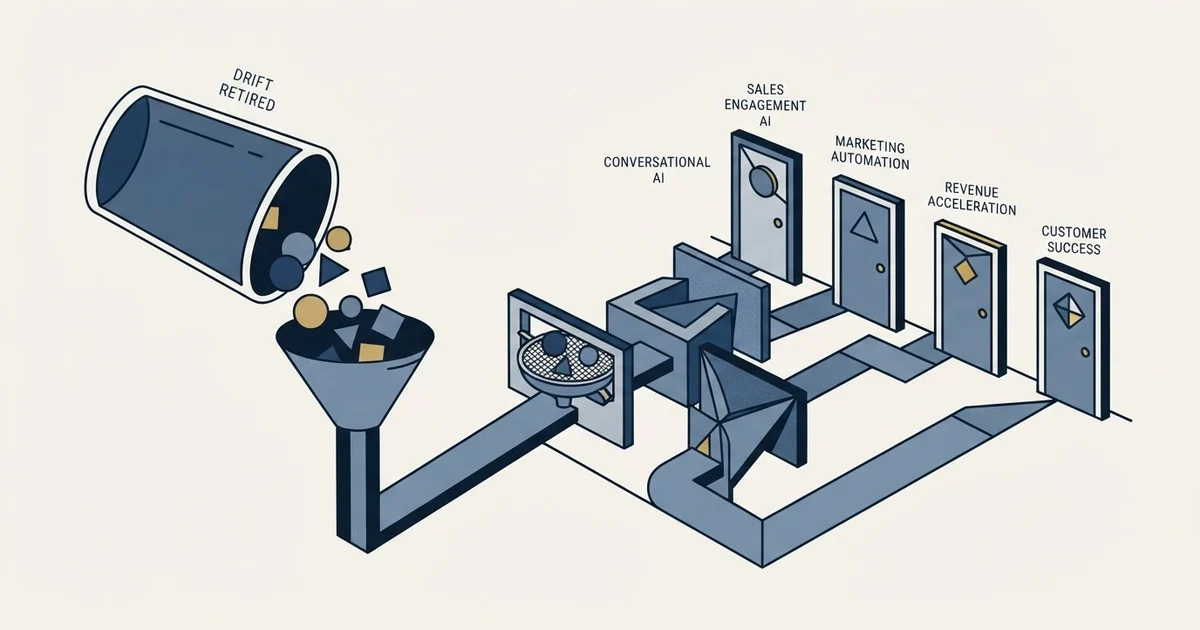
Drift is no longer sold under its own name. Salesloft states on its own Drift page that it has transitioned to 1mind, and drift.com/pricing returns a 404. The practical replacements split by job: routing and scheduling tools publish rates, the AI agent products quote, and the messenger option is a customer service platform.
Key takeaways
- drift.com now serves Salesloft's chat agents page and drift.com/pricing returns HTTP 404, so Drift has no pricing surface of its own as of 2 September 2026.
- Salesloft names 1mind as the successor on its own Drift page, and 1mind publishes no rate, range or plan name anywhere on its homepage.
- Qualified's own newsroom carries a December 2025 headline announcing Salesforce signed a definitive agreement to acquire it, and its pricing page publishes tiers without figures.
- Chili Piper is the option publishing a rate card, starting at $1,250 a month for routing and scheduling with up to 15 seats included.
Reviewed and updated September 2, 2026
Type drift.com into a browser today and a Salesloft page loads. The apex now serves Salesloft's chat agents page and declares that page as its canonical address, and the www hostname answers with a 334 byte redirect stub pointing at salesloft.com/platform/drift. Both were fetched on 2 September 2026. Anyone arriving at a Drift comparison list is researching a product that its owner has stopped selling under that name, and most of the lists still rank it as a live option.
That changes the question. The useful comparison is no longer Drift against a field. It is what a team running conversational marketing should move to, given that the category has consolidated hard since Drift changed hands, and given that two of the obvious answers have themselves been bought.
What Drift is today, from Salesloft's own pages
On salesloft.com/platform/drift, under a heading reading "A new era in conversational AI", Salesloft states that it has "transitioned from Drift to 1mind". The same page's own description says the company has moved from Drift to partner with 1Mind for real time visitor engagement. That is the vendor stating the position on the URL that carries the product's name, which is the only place worth reading it.
Two details qualify it. The Salesloft navigation still offers "Log in to Drift" beside logins for Salesloft, Clari Forecast, Conversations and Groove, so existing Drift accounts still exist and still authenticate. And the product's own pricing surface is gone rather than moved: drift.com/pricing answers HTTP 301 to salesloft.com/platform/drift/pricing, and that destination returns HTTP 404. Salesloft has kept the route and removed the page at the end of it.
Salesloft's help centre still hosts an article titled "Drift - Pricing FAQ", last modified 12 March 2025. It describes a plan roster of Free, Premium, Advanced and Enterprise, states that "All Drift plans come with one (1) included seat.", says seats cannot be added on the Free plan, and states that "Teams on the Premium plan can purchase additional seats. The seat is billed annually." It publishes no rate on that article as fetched on 2 September 2026, and it then refers the reader to the pricing page, which is the page that now 404s. A support article outliving the surface it points at is a reasonable summary of the product's status.
Salesloft's own platform pricing has moved the same way. On 2 September 2026 salesloft.com/pricing answered HTTP 307 and sent the request to salesloft.com/see-it-live, a page titled "Talk to Sales" that carries no currency figure at all. What the pricing URL itself carried when it last served a page of its own is recorded in our read of Salesloft's pricing page, and the short version is a capability list, a customer count and a form where a rate would be. The company has now removed the intermediate step and sends the pricing query straight to the sales conversation.
One further piece of Drift history belongs in a replacement decision, and it is not a pricing fact. The Drift application's OAuth tokens were the route into several companies' Salesforce tenants in August 2025, and the incident accounts are unusually specific about what a connected sales tool can read once it is installed. That story, and the procurement questions it produces, sit in the Cloudflare account of the Salesloft Drift incident.
- March 2025The Drift pricing FAQ freezes
Salesloft's help centre article on Drift pricing records its last modification, describing four plans and a one seat inclusion, and pointing at a pricing page.
- December 2025Salesforce agrees to acquire Qualified
Qualified's own newsroom carries the headline announcing that Salesforce signed a definitive agreement to acquire it, and its pages now carry a 2026 Salesforce copyright line.
- September 2026Drift is retired as a name
drift.com serves Salesloft's chat agents page, drift.com/pricing returns 404, and Salesloft's Drift page states the transition to 1mind.
The successor Salesloft names
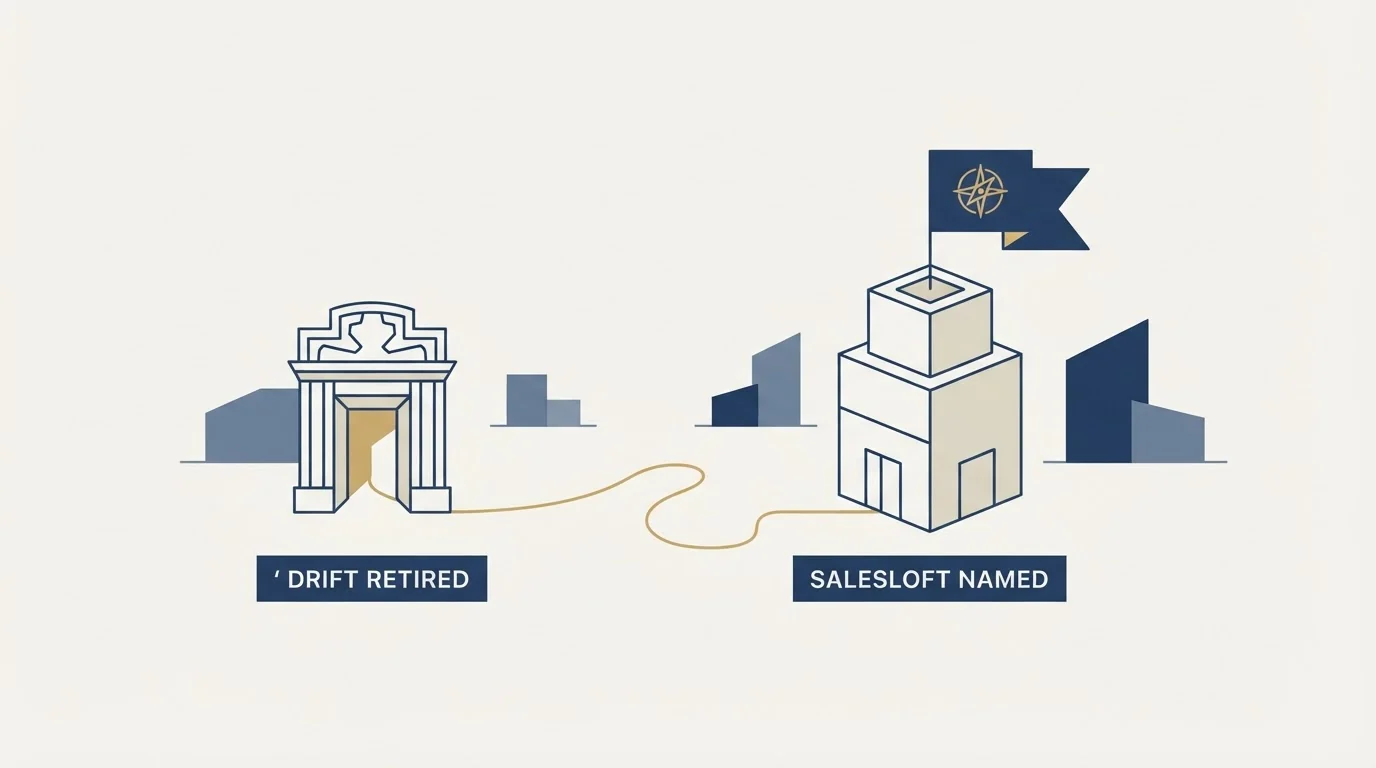
The vendor's own answer is 1mind, and it is the first place to look precisely because Salesloft is pointing its installed base there.
1mind publishes no price anywhere on its homepage as fetched on 2 September 2026. The calls to action are "Talk Revenue with Us" and "Talk to a Superhuman", and there is no rate, no range and no plan name in the served page. Its named customers include HubSpot, ZoomInfo, Pipedrive, Winning by Design, Alteryx, Graylog and Experity, which is a business to business go to market list rather than a general software list, and that matters more than the absence of a price when you are working out whether a product is aimed at you.
1mind's homepage also carries head to head claims against Drift, including a line reading "77.6% win rate vs. 53.6% on Drift" and a claim of a higher average deal size. Those are the vendor's own marketing claims about its product against a competitor, made by the party with an interest in the answer, and they belong in an evaluation as claims rather than as findings.
The path that Salesforce now owns
Qualified is the other name that appears on every Drift alternatives list, and its ownership changed too. Its own newsroom carries "Salesforce Signs Definitive Agreement to Acquire Qualified" under December 2025, and its pages now carry "Copyright 2026 Salesforce, Inc." in the footer with a Salesforce Tower address. Its own footer links comparison pages titled Qualified vs. Drift and Qualified vs. 1mind, which is a fair map of who it thinks it is competing with.
Qualified publishes no price on its pricing page as fetched on 2 September 2026. The page was read twice, once through a plain fetch and once through a headless browser render, and a scan for any currency figure found none on either render. What sits there instead is tier structure: named tiers, one card reading "Everything in Enterprise, plus" above a feature list, a block headed "All plans include" covering agent tooling, account segmentation, Salesforce integration, reporting and routing, and a form button reading "Schedule a demo".
For a team already standardised on Salesforce, the acquisition is the fact that decides the shortlist rather than any feature. For a team that is not, an unpriced product owned by the CRM vendor it does not use is a harder purchase to justify than it was a year ago.
The routing half, priced in public

Chili Piper covers the part of Drift that mattered most to sales teams, which was catching a hand raiser and getting them onto a calendar, and it is one of the two options here with a rate card on the page.
As published on its pricing page on 2 September 2026, its Routing and Scheduling product "Starts at $1,250 /Month" with "Up to 15 seats included, $45/seat/mo after that." and 45,000 AI credits included per year. The same page lists its Experiences product at $3,500 a month with up to 30 seats included, additional seats at $50 per seat per month and "150,000 credits included per year". Chili Piper's pricing page lists a standalone scheduling licence, ChiliCal, at "$12 / user / month" with a stated "Minimum 200 seats". And it publishes term discounts on that page of 15, 25 and 40 percent for two, three and four year contracts.
Chili Piper states that entry point in its own page title, which reads "Plans Starting at $15K/Year", so the floor is a real number to compare against and a very different shape from a per seat chat tool. What Chili Piper does not sell is a general purpose messenger. It is routing, scheduling and chat journeys aimed at inbound conversion, so a team replacing Drift's support side as well as its sales side is buying two things.
The messenger path, and the buyer it actually serves

Intercom appears on every list, and of the four options here its pricing page sets out the fullest rate card. It also comes with a caveat that belongs in front of the figures rather than after them.
Its plan ladder, as published on its pricing page on 2 September 2026 with the billing control set to annual, runs Essential at $29 per seat per month, Advanced at $85 per seat per month and Expert at $132 per seat per month. On that page the Essential card carried a struck through $29 beside a $19 figure under a banner reading "New customer offer: Save 35% on Essential plan", so the $29 on the page is the list rate and the $19 on the page is a promotion live at the moment of the fetch; re-read on 2 September 2026 the offer had gone and the card showed $29 alone. The same page meters its Fin AI agent separately at "From $0.99 per Fin outcome" with "No seat costs" and a stated "Minimum monthly commitment applies (e.g. 50 outcomes)". Intercom's pricing page lists Copilot as an add on at $29 per agent per month billed annually, or $35 billed monthly. Intercom's pricing page lists a Pro add on at $99 a month, and Proactive Support Plus at $99 a month including 500 messages. Its own answers on that page put WhatsApp, SMS, email campaigns and phone on usage charges.
The caveat comes from Intercom's own pages. Every named role on intercom.com/customers is a support or customer experience role, and a vocabulary count over that page returns one go to market term against 126 support terms. Its own page at intercom.com/sales is titled as omnichannel customer service software. Intercom sells customer service first, and a revenue team buying it for conversational marketing is buying a support platform and using a slice of it. That is a legitimate choice and it is a different purchase from the one Drift was sold as.
- Named plans with rates on the page
- Seat inclusions and overage rates stated
- Usage meters named with their units
- A budget can be built before the first call
- Named tiers and what each adds
- A capability list common to all plans
- No figure on either render of the page
- A demo booking form as the next step
- No plan names in the served page
- No rate, range or starting figure
- Named customers rather than named tiers
- Contact routes as the only next step
The comparison that actually decides it
Drift did three jobs that most buyers now have to source separately, and the shortlist depends entirely on which of the three you were using it for.
Anyone who arrived after comparing Drift against HubSpot was asking about the first and third of those jobs, and HubSpot answers one of them: its own CRM product page lists live chat among the free features and publishes a free chatbot builder, so the widget is covered while the conversational qualification Drift was bought for is not.
If it was catching inbound hand raisers and booking them, the routing and scheduling products are the direct replacement and their rates are on their own pages. If it was conversational qualification driven by an AI agent, 1mind and Qualified are the two the incumbents point at, and neither puts a rate on the surface a buyer can read, so both purchases start with a call. If it was a general messenger sitting on the site and in the product, that is a customer service platform purchase, and the honest framing is that you are buying a support tool with a marketing surface attached.
A fourth answer is worth naming because it is common and rarely stated: some teams that lost Drift did not replace it. Site chat earns its place when there is enough qualified traffic to make a real time conversation likely, and a team whose pipeline is built outbound often finds the widget was catching a handful of conversations a month that a form would have caught anyway. The tool inventory question and the wider category are covered in sales engagement platforms, and the specific question of whether a chatbot earns its keep for lead capture is worked through in chatbot lead generation.
- Depends: Which of the three jobs were you actually using Drift for, and do you still need all three
- Depends: Does the successor publish a rate you can build a budget from, or does the evaluation start with a qualification call
- Depends: If the product is now owned by a CRM vendor, does that CRM match the one you run
- Yes: What does the integration read from your CRM, and can the scope be narrowed at install
- Yes: Who inside your company owns the periodic review of connected applications
- Depends: How much qualified traffic does the site actually carry, and is a real time conversation likely on it
The consolidation running through all of this is the pattern to take away. Drift went to Salesloft and was retired in favour of a partner product. Qualified was acquired by Salesforce. Salesloft itself now shares a login menu with Clari Forecast and Groove, a merger this site reads in what the Clari and Salesloft combination changes for a buyer. A category that carried a dozen independent vendors a few years ago now routes through a small number of platform owners, and the practical consequence for a buyer is that the product you choose is likely to be an input to somebody's platform strategy within the contract term. Asking what happens to your data, your integration and your support level in that event is an ordinary procurement question and the answer is a fact about the vendor.
Where this sits against how we run outbound
Our own scope is stated as policy rather than as a result. We run outbound on email and LinkedIn, our sending sits on our own infrastructure, and our campaign shape is one message, sent once, with no bumps and no thread replies. A conversational tool is an inbound instrument and it answers a different question from the one outbound answers, so the two are not substitutes and a team can reasonably run both.
The reason that distinction matters here is budget order. A published entry point in the low tens of thousands a year for inbound routing is a serious commitment for a company whose site does not yet carry the traffic to justify it, and the sequencing question is whether demand exists to be caught. If the honest answer is that the pipeline is thin rather than badly routed, see what a campaign built for your market produces before you buy something to catch visitors who are not arriving yet.
Pricing and product status verified against each vendor's own pages as of 2 September 2026. Vendor pricing and ownership both move; verify current terms with the vendor before relying on them.
Sources: Salesloft Drift page, Drift pricing FAQ, 1mind, Qualified pricing, Qualified newsroom, Chili Piper pricing, Intercom pricing, Intercom customers
Frequently asked questions.
Frequently asked questions- Is Drift still available to buy?
- Not under its own name. Salesloft's page at salesloft.com/platform/drift states that the company has transitioned from Drift to 1mind, drift.com redirects into Salesloft, and drift.com/pricing returns a 404. Existing accounts still authenticate, because the Salesloft login menu still offers a Drift option, but there is no public purchase path for it.
- What did Drift cost before it was retired?
- Salesloft's help centre still hosts a Drift pricing article last modified in March 2025. It names four plans, Free, Premium, Advanced and Enterprise, states that all plans include one seat, and says Premium teams can buy extra seats billed annually. It publishes no rate, and the pricing page it refers readers to now returns a 404.
- Which Drift alternative publishes its prices?
- Chili Piper does. Its pricing page lists routing and scheduling from $1,250 a month with up to 15 seats included and $45 per seat per month beyond that, an Experiences product from $3,500 a month, and a standalone scheduling licence at $12 per user per month with a 200 seat minimum. Intercom also publishes a full per seat ladder.
- Should a business to business team use Intercom instead?
- It depends what you used Drift for. Intercom publishes complete rates and a metered AI agent, but its own customers page carries support and customer experience roles almost exclusively, and its solutions page is titled as omnichannel customer service software. Buying it for conversational marketing means buying a support platform and using a slice of it.
About the author.

Ben Carden is CRO at RevenueFlow, which builds and operates outbound revenue engines for B2B companies. Previously at Gartner Enterprise. Studied at London School of Economics.
Ben Carden · CRO
Connect on LinkedIn →Explore more.
Ready to scale your outreach?
We build GTM engines that book real meetings. See the receipts.
Related articles.
B2B Database: What to Test Before You Pay
Total record count is the number every vendor leads with and the one that predicts least. The test that replaces it takes a day and settles the purchase.
On-Demand Webinars: What Changes When You Take the Date Away
A live webinar earns most of its value from the date. Removing it keeps the topic signal and the address, and loses the deadline, the burst and the room.
Lead Forensics Alternatives: The Ones That Publish a Price
Lead Forensics names two plans and publishes no figure. Snitcher, Leadfeeder, Leadinfo, Albacross and RB2B all publish a volume ladder you can read.
Lead Verification: What Each Check Actually Proves
Lead verification covers two different jobs. One asks whether a mailbox will accept mail, the other asks whether the person behind the row is real and lawful to contact.
Typeform Alternatives: Read the Response Meter First
Typeform meters responses with a hard ceiling and counts seats inside the plan. What Tally, Fillout, Formbricks and Jotform count instead, from their own pricing pages.
Foleon Pricing: No Published Price, a 24-Month Term
Foleon publishes no rate on its plans page and publishes the whole commitment behind it. The term, the notice window and what happens to the Docs after.