Chatbot Lead Generation: Which Part of Qualifying It Owns
Qualifying a visitor is four separable jobs, and a chatbot is good at two of them. Most implementations fail by handing it the ones requiring judgment.
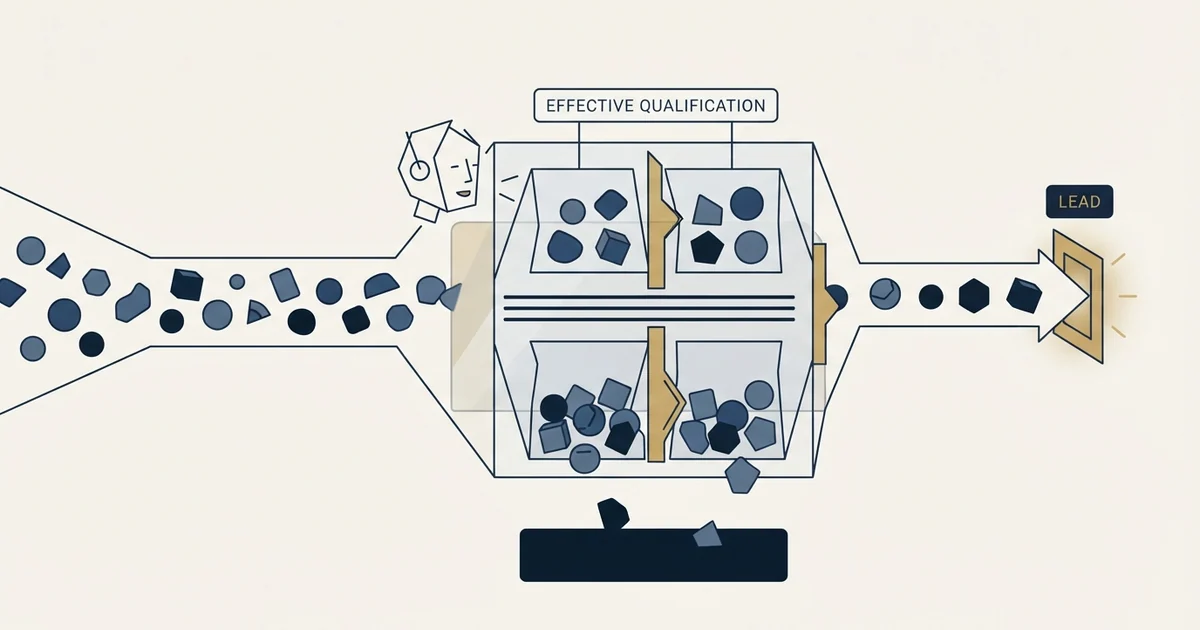
A chatbot can answer documented questions, route enquiries, book meetings and cover hours nobody works. It cannot exercise commercial judgment or handle objections. Most of its measurable value comes from a fast handoff to a person rather than from the conversation, so the response owner matters more than the bot.
Key takeaways
- A bot that gates an answer behind an email field selects for people who were already buying, which raises its conversion rate while shrinking the funnel.
- The speed advantage belongs to the handoff rather than to the conversation, so an unowned response process defeats a sophisticated bot.
- A qualifying question earns its place only when the answer changes what happens next, which rules out budget and timeline on a first visit.
- Language models removed the failed-to-match failure mode without changing the two limits that matter: a bot must not make claims and must not decide who deserves a human.
Reviewed and updated September 1, 2026
Chatbot Lead Generation: Which Part of Qualifying a Visitor It Can Own
A company adds a chatbot to its pricing page. The bot opens with "Hi there, how can I help today?", and the visitor types a real question about whether the product handles multi-entity accounting. The bot replies that it would love to connect them with the team and asks for a work email.
That interaction converted a person who wanted an answer into a person who has been asked to pay for one. Some of them pay it. Most close the tab, and the analytics record a chat session with no conversion, which reads as a targeting problem rather than as what it was.
The useful question about chatbots is not whether they work. It is which specific job in the qualification process a bot can actually own, because the answer differs sharply by job and the failure above comes from giving it one it cannot do.
Four jobs hiding inside one word
"Qualifying a visitor" is shorthand for four separable tasks, and a chatbot's competence varies enormously across them.
- Answering a documented factual question
- Routing to the right team or page
- Booking a meeting on a live calendar
- Capturing context the visitor volunteers
- Covering hours nobody is working
- Asking two or three qualifying questions
- Distinguishing a buyer from a candidate or vendor
- Triaging urgency
- Recognising a named existing account
- Deciding whether a deal is worth pursuing
- Handling a technical objection
- Negotiating or discussing price flexibility
- Pretending to be a person
- Interrogating before giving anything
The pattern across the columns is that a bot does well at tasks with a checkable answer and badly at tasks requiring a judgment call, which is unsurprising. What gets missed is the third column's last two rows, because both are choices about posture rather than capability, and both are where most implementations go wrong.
Answer first, ask second
The single highest-leverage decision in a chat implementation is whether the bot gives before it takes.
A widget that answers the question and then offers a next step converts a materially different population than one that gates the answer behind a form. The gated version selects for people who were already going to buy, which is why it can show a respectable conversion rate while shrinking the top of the funnel. The number looks fine and the pipeline does not.
There is also a straightforward reason to prefer answering: a visitor asking a specific product question on a pricing page has told you more about their intent than any qualifying question would extract. They have named the thing that would stop them buying. A bot that captures that sentence and routes it to a human has done more useful work than one that collected a job title.
The response-time win is real, and it belongs to routing

The strongest genuine argument for chat is speed. A visitor who is interested right now is more reachable right now than they will be tomorrow, and that decay is steep in the first hour.
Worth being precise about where the win comes from, though, because it is usually attributed to the conversation and it mostly comes from the handoff. The bot's contribution is that it noticed someone, captured context, and got a human involved before the moment passed. The conversational part is the wrapper.
That matters practically because it tells you where to spend the effort. A sophisticated bot with a slow or unowned handoff performs worse than a plain one that reliably pings a person who is actually available. The step nobody owns is the same failure the B2B site leak points piece identifies for forms, and adding chat on top of an unowned response process just adds a faster way to reach the same silence.
Because that captured context often gets pushed into a CRM automatically, avoiding duplicate HubSpot contact records becomes the next integration detail worth checking.
- Yes: A named person owns responses during business hours, with a target response time
- Yes: The bot answers documented questions rather than gating them behind an email field
- Yes: Out-of-hours behaviour is explicitly designed, not left as a default greeting
- Yes: It can hand off mid-conversation without the visitor repeating themselves
- Depends: It is scoped to pages where a buyer question is plausible
- No: It presents itself as a human
- No: It opens with how can I help on every page including the careers page
The two or three questions worth asking, if you ask any
The middle column above works only under a tight scope, so it is worth naming what belongs in it.
A question earns its place if the answer changes what happens next. Company size changes routing when you have separate teams. Whether someone is an existing customer changes everything and is cheaply checkable. A current-tooling question changes which specialist should take the call. Each of those has an operational consequence, so asking costs the visitor something and buys them something.
A question fails when the answer only feeds a scoring model the visitor never sees. Budget, timeline and authority are the classic three, and they are the ones most likely to be asked by a widget and least likely to be answered honestly by a stranger who has not decided they want to talk to you. A visitor typing a number into a budget dropdown on a first visit is guessing, and a guess recorded as data is worse than no data.
Two questions is a reasonable ceiling before an answer has been given. After the bot has been useful, people will tell you considerably more, which is the practical argument for the ordering in the previous section.
Where a chatbot sits on the autonomy ladder
Chat is the oldest and narrowest instance of a broader question about which parts of a revenue workflow can be handed to software that acts on its own. That question is worked through properly in which parts of the lead generation workflow an AI agent can actually own, and the category boundaries between an agent, a copilot and a scripted workflow are drawn in AI sales agent.
The chatbot-specific reading is that a widget sits at the low end of that ladder by design, and that this is a feature. It operates on one surface, with a bounded set of inputs, in a context where the human it is standing in for is usually available within minutes. Those constraints are what make the failure modes survivable: a bot that gets confused on a pricing page annoys someone who can be recovered by a person that afternoon.
The risk arrives when a widget is quietly promoted up the ladder, typically by being given latitude to make claims or to decide who is worth a human. Both are judgment tasks, both were in the third column, and neither becomes safe because the underlying model got better at prose.
What changed with language models, and what did not

The generational shift is real. A model-backed bot can answer an unanticipated question from your documentation instead of failing to match a decision-tree branch, which removes the most visible old failure mode.
Two things did not change.
It still cannot be trusted to make claims. A bot that will improvise about pricing, roadmap, security posture or comparative performance will eventually state something untrue to a prospect, in writing, with your name on it. The constraint that matters is scoping it to sourced answers and having it decline clearly rather than guess, and that is a configuration decision rather than a model capability.
And it still cannot do the judgment column. A model is more fluent at asking qualifying questions, which makes a bad idea more pleasant rather than better; a visitor who does not want to be qualified by a widget does not want it more because the widget writes well.
Where chat fits against the rest of the programme
Chat is a conversion mechanism, not a demand source. It works on traffic you already have, which puts a hard ceiling on it: a site with three hundred monthly visitors will not be rescued by a chat widget, and the arithmetic says so before you install anything.
So it belongs in the same category as the rest of your site conversion work rather than in the channel mix. If the problem is that not enough of the right people arrive, chat cannot help, and the honest options are the ones that reach people directly. Our own position on that half is that a campaign carries one message built on one premise and is sent once, which puts the burden on having a genuine reason to write rather than on contact volume. A chatbot is the mirror image of that discipline: it handles the people who arrived on their own, and it should be judged only on what it does with them.
The practical division: measure chat against visitors who reached the page, never against pipeline targets, and compare it to the form it replaced rather than to your outbound numbers.
Measuring it honestly

Three numbers, and one trap.
Engagement rate tells you whether the invitation is well-placed. Answer rate, the share of conversations where the visitor got what they asked for, tells you whether the scope is right. Handoff rate and time tell you whether the operational half exists.
The trap is judging chat on conversations-to-meetings alone, because that number improves when you gate harder. A bot that refuses to help anyone until they book will show an excellent conversion rate on a much smaller number of conversations, and by the metric it looks like a win. Always read it alongside the total number of visitors who engaged at all, or the rate will reward exactly the behaviour that shrinks the funnel.
The short version
A chatbot can answer documented questions, route, book, and cover the hours nobody works. It cannot exercise commercial judgment, and it should not gate an answer behind an email field, because doing so selects for people who were already buying and hides the loss in a healthy-looking conversion rate. Most of the value comes from a fast handoff to a person rather than from the conversation, so the owner and the response time matter more than the bot. Judge it against the traffic you have, since it converts demand rather than creating it.
Once the handoff becomes a booking rather than a chat transcript, the decision shifts to which automated reminders and follow ups actually fire, a question Calendly's workflow triggers answers in detail.
If the problem is that too few of the right people arrive in the first place, we can put a campaign in front of your market instead.
Frequently asked questions.
Frequently asked questions- Do chatbots actually generate leads?
- They convert traffic you already have rather than creating demand, so a site with a few hundred monthly visitors will not be rescued by one. Where traffic exists, the gains come from answering real questions immediately and getting a person involved before interest decays. Judge a chatbot against the form it replaced, never against outbound numbers.
- Should a chatbot ask for an email before answering a question?
- No. Gating the answer converts a person who wanted help into a person being charged for it, and most close the tab. The ones who pay were largely going to buy anyway, so the conversion rate looks healthy while the top of the funnel quietly shrinks. Answer first, then offer a next step.
- What qualifying questions should a chatbot ask?
- Only ones whose answers change what happens next, and at most two before you have given something useful. Company size can change routing, existing-customer status changes everything, and current tooling can decide which specialist takes the call. Budget, timeline and authority fail the test, because a stranger guesses at them and a recorded guess is worse than no data.
- Can an AI chatbot replace an SDR?
- Not for the judgment work. A model-backed bot handles unanticipated questions from your documentation, which removes the old decision-tree failure, but it still cannot decide whether a deal is worth pursuing or handle an objection. It also must be scoped to sourced answers, because a bot that improvises about pricing or security will eventually put something untrue in writing.
About the author.

B2B cold email experts helping companies generate qualified leads through done-for-you outreach campaigns.
RevenueFlow Team
Explore more.
Ready to scale your outreach?
We build GTM engines that book real meetings. See the receipts.
Related articles.
Sales Automation Software for Small Business: Four Buys
One search returns four unrelated products, and on at least one vendor's published plan list the automation is gated above the tier a small team buys.
Calendly API: What You Can Automate and What You Cannot
Read access runs on any plan, webhooks need a paid one, and programmatic deletion is Enterprise-only. The scope decision that quietly breaks integrations, first.
Sybill: The Credit Meter Is the Number to Model
Sybill meters by credits per week rather than by seat, and its pricing page carries three different figures for the same two plans. Both facts change the model.
Circleback: The Automations Are the Product, Not the Notes
Circleback publishes real prices and an unusually wide automation surface. What the notes contain matters less than where they land and who maintains the rules.
Calendly Workflows: Seven Triggers and One Boundary
Calendly Workflows fire automated email and text on seven published triggers. The limits that catch people out, and the line between correspondence and bumping.
Fathom AI Note Taker: What It Records and Where Notes Land
Fathom records, transcribes and summarises calls, and hides a conversation intelligence product on its upper tier. What it publishes, and the decisions to make first.