Sales Prospecting for SEO Agencies: Four Public Signals
How an SEO agency builds its own prospect list from signals Google documents: the index check, position, core update dates and site moves, under the warning owners read.
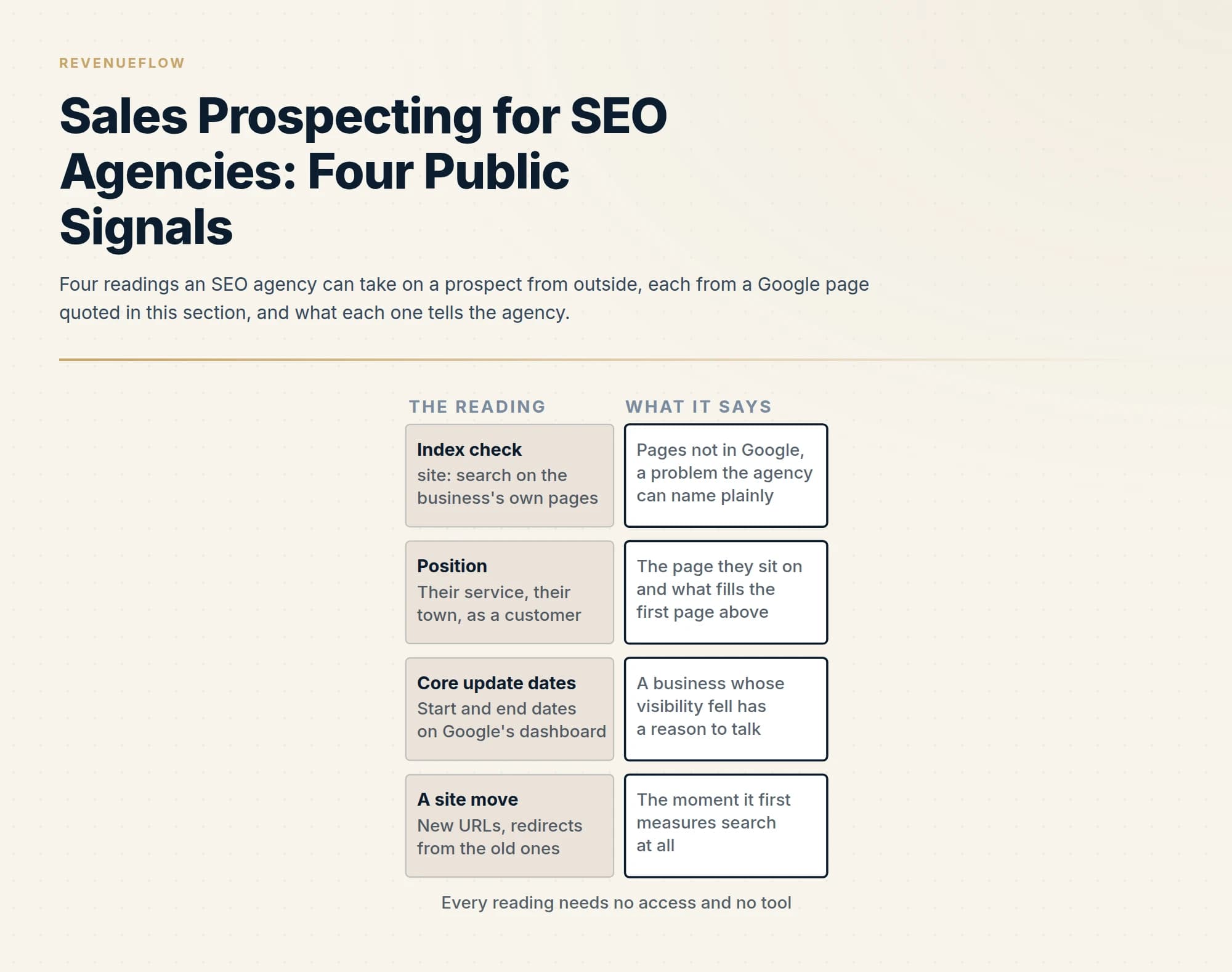
An SEO agency prospects from four public readings Google documents: a site: search showing which pages are indexed, the page a business sits on for its own service and town, the published dates of a core update, and a visible site move. Each is a checkable reason to write, built to be the opposite of the warning Google gives owners.
Key takeaways
- Google's help page for the page indexing report tells owners of sites under 500 pages to use a site: search instead of the report, and the same operator lets an agency check a prospect's indexing from outside.
- Google's core updates page says it makes such changes several times a year, publishes their start and end dates, and recommends waiting a full week after one completes before assessing a site; that week is the agency's window.
- Google Search Central's Do you need an SEO? page, updated 5 June 2026, tells owners to be wary of agencies that email out of the blue and says no one can guarantee a number one ranking, so the message has to be built from checkable readings.
- Nine of the ten pages answering this query are written for agencies; none enumerates where accounts come from as public signals, and the practitioner thread reports prospects arriving with heavy scepticism about SEO as a service.
Reviewed and updated September 21, 2026
An SEO agency has one advantage over every other seller that prospects cold: the thing it sells is visible from outside. A staffing firm cannot see a prospect's open roles until they are posted, and a software vendor cannot see a prospect's spreadsheet. An agency can type a business's service and town into Google, read the first page, and know in a minute whether that company has a search problem and roughly what kind. The trouble is that the prospect has been told, by Google itself, to distrust anyone who says so.
This page is prospecting for the SEO agency, or the freelancer, building its own list of accounts: where the accounts are enumerated from public signals, which dated events make one of them worth writing to this month, and what a legitimate agency can say given the warning its prospect has already read. It is written for the agency, not for a vendor selling to agencies. The general method of prospecting, the difference between a filter and a signal, lives in B2B prospecting and sales prospecting. What to say on the phone once the list exists is cold calling scripts for SEO agencies. Every outside page below was fetched on 21 September 2026 and is dated where it publishes a date.
What a search for this returns, and who it is for
Nine of the ten pages that answer this query are written for the agency: two how-to-sell-SEO guides from agencies (Pronto Marketing, Nightwatch), three get-SEO-clients guides from outreach software vendors, a practitioner thread on SEO sales calls, a link-building agency's tips page and a Quora thread; the other two are noise. None of the nine describes where an agency's accounts come from as a set of public, checkable signals, which is the part of prospecting that decides everything after it.
Where the accounts are enumerated
The cheapest reading is the index check. Google's help page for the page indexing report tells small site owners they do not need the report at all: "If your site has fewer than 500 pages, you probably don't need to use this report", and it points them instead to a plain search operator. Its instruction reads "See a sample of pages from your site that Google knows about", followed by the site: syntax (page indexing report help, as fetched). The operator works for a stranger as well as for the owner, so a business whose key pages return nothing on it has a problem the agency can name without a tool or a login.
The second reading is position. Search the prospect's service in its town the way a customer would; note the page the business appears on and what occupies the first page above it. The practitioner thread on SEO sales calls, posted to r/DigitalMarketing on 5 September 2025, describes the same preparation from the agency side: one agency owner says the prep is "digging into their site, checking traffic trends, and spotting low-hanging opportunities" (the thread). Another reply puts the list-building rule in four words, "Learn EVERYTHING about your prospect", and lists what that means: "Trends in sale volume? Certain seasonality nuances? A new competitor in the space."
The third reading is the date of a core update. Google's page on core updates, last updated 10 December 2025, says "Several times a year, Google makes significant, broad changes to our search algorithms and systems", and tells a site owner who sees a drop to "Check the Search Status Dashboard and take note of the start and end date of the core update" (Google Search's core updates). Those dates are public. Every business whose visibility fell across them is, for a few weeks, a business with a reason to talk.
The fourth is a site move. Google's guide to moving a site with URL changes, last updated 20 August 2026, describes the period after a migration in one sentence: "Ideally the traffic on the old site will go down, while on the new site the traffic goes up" (site moves with URL changes). A redesign or a domain change is visible from outside, in the new URLs and the redirects from the old ones, and it is the moment a business is most likely to measure search at all.
A job posting for a marketing role sits beside these four and needs no quotation: it says the budget conversation has already happened. The live guide to lead generation for marketing agencies covers why evidence that a company is already investing in the area beats any firmographic filter, and that argument applies to search work with full force.
The trigger calendar
The core update is the one with a published clock. Google's core updates page recommends patience to site owners: "We recommend waiting at least a full week after a core update completes before analyzing your site", and it separates a small move in position, which it says needs no drastic action, from a large one, which it says deserves a deeper assessment. Read from the agency's side, that is the calendar. During a rollout nobody can tell what happened; in the week after it ends, the owners who lost ground are the ones Google has told to assess their site, and an agency that writes then, about a drop it can show, arrives while the question is live.
The site move runs on the business's own clock rather than Google's, which makes it a stronger trigger and a rarer one: the tell is a domain or a URL structure that changed, and a business in that state has a search question open by construction.
The third clock belongs to the client's own trade. The thread's advice to learn a prospect's seasonality is the agency's calendar in disguise: whichever trade the agency serves has a season in which its owners decide, and an agency that specialises, which Pronto Marketing's guide (last updated 27 August 2024) calls "a great weapon in your SEO sales arsenal", inherits that trade's calendar and can write to every account in it in the same month (how to sell SEO services).
The prospect has already been warned
Search is the one trade where the platform the seller works on has written a page for the seller's prospects. Google Search Central's page "Do you need an SEO?", last updated 5 June 2026, tells business owners: "Be wary of SEO firms and web consultants or agencies that email you out of the blue." It says "No one can guarantee a #1 ranking on Google." And on the audit an agency might offer, it says "An SEO audit should be about giving you realistic estimates of improvement, and an estimate of the work involved" (Do you need an SEO?).
The Federal Trade Commission's guide to scams that target small businesses adds the second warning, in its section on listing and advertising scams: "Scammers try to fool you into paying for nonexistent advertising or a listing in a phony business directory", sometimes by saying the call is only to confirm the business's information (Scams and Your Small Business, as fetched).
Neither page is a rule that binds an agency the way a licensing statute binds a producer; they are the reader's prior. The consequence for prospecting is that the message has to be built so that it cannot be mistaken for the thing the owner was warned about, which means building it from the readings above. A first message that says what the agency saw on a search it ran, gives an estimate of work rather than a position, and claims no relationship with Google is legible as a professional's note precisely because the warning describes its opposite. The same constraint on the phone is why the scripts page opens by saying what the caller is not.
May carry
- The search the agency ran, and the page the business appeared on
- A realistic estimate of improvement and of the work involved
- An offer to send Google's own page for business owners
- One reason for writing this month, dated
May not carry
- A guaranteed ranking or a position
- Any claim of a relationship with Google
- A drop the agency cannot show
- Advertising or a directory listing to pay for
The email rules themselves are the hub's job: the federal commercial email rule and the calling rules are quoted in what cold calling is and which rules apply and its neighbours, and nothing here is legal advice.
What owners say against it
The objections are on record in the agency's own forum. The thread's opening post describes prospects who "show up to the call with 80% scepticism about getting SEO as a service", and who arrive asking about optimisation for AI and voice search instead. The replies split on how to handle it. One agency owner argues for listening and for showing where a site is losing leads before saying anything about method; another says to address the AI question immediately rather than let it sit.
Nightwatch's agency guide names the same objection in its table of contents, a section on handling the claim that AI is replacing SEO, and it frames the preparation the same way the thread does: "Nail down your scope of services and ideal client profile before you start prospecting" (how to sell SEO services to clients). Pronto's guide lists what makes a difficult client, and the first item is that they expect overnight results.
Read together, the objections are versions of one question, whether the agency can show its work before being paid, and a list built from the four readings answers it in the first line.
Where prospecting sits, and when it is the wrong play
Cold prospecting is rarely an agency's first source of work. The live guide to lead generation for digital agencies sets out why referral-led shops discover they need outbound in the quarter it is too late to start it, and the practical answer there, building the channel while referrals still work, applies to search agencies without change. Past clients and lapsed conversations come first; they need no new list.
Three cases make cold prospecting the wrong play for an SEO agency. A shop at capacity gains nothing from a list. An agency that cannot say for which kind of business and which kind of search problem it is the right choice will write a message that reads like the warning, and the credibility trap the marketing-agencies guide describes will close on it. And an agency that has not run the search before writing has nothing to say that a stranger could not have said.
The Google page quoted above warns owners about unsolicited email, and the scripts page quotes Google's separate warning about the phone, so both channels start behind. RevenueFlow runs email and LinkedIn for clients and does not cold-call; our campaigns carry one message each, with no follow-up bumps, which in this trade is a feature: an owner who has been warned about persistence is not persuaded by it.
Three openers, each on a reading
Each opener below is one message, sent once, to one person, on email or LinkedIn; each rests on a page quoted above, names no real recipient and makes no claim about results. The businesses, towns and services in them are invented for illustration.
The first is built on the index check from Google's page indexing help, and it is for the owner of a business whose service pages do not appear on a site: search.
{{first_name}}, we ran a site: search on {{domain}} this morning and the pages for {{service}} did not come back, which usually means Google has not indexed them. Google publishes the check itself, so you can repeat it in ten seconds. If it is useful, we will send one page on what usually causes it and what the fix takes, with an honest estimate of the work. No ranking promise, from us or anyone.
The second is built on Google's core update dates and its advice to wait a full week before assessing a site.
{{first_name}}, Google's update that ended on {{end_date}} moved a lot of local service pages, and Google's own guidance is to wait a week and then look at the site as a whole. That week is up. We searched {{service}} in {{town}} today and {{business}} is on page {{page_number}}. If you would like the before-and-after we recorded, reply and we will send it, with what we think the work involves.
The third is built on Google's site-move guide and is for a business that has just changed its domain.
{{first_name}}, {{business}} moved to {{new_domain}} this month, and the old address still answers for the {{service}} pages. Google's own migration guide says traffic on the old site should fall as the new one rises. The redirect map from that search and what Google says to watch during a move fit on one page, yours if useful. No relationship with Google, no guarantees.
To: the owner of an invented local service business
Google's update that ended on a published date moved a lot of local service pages, and Google's own guidance is to wait a week and then look at the site as a whole. That week is up. 1
We searched the service in the town today and the business is on page three. 2
If you would like the before-and-after we recorded, reply and we will send it, with what we think the work involves. 3
- 1The trigger is a date Google published and a week Google itself asked owners to wait; nothing here is the agency's opinion.
- 2The reading is a search the owner can repeat, so the claim is checkable before any reply.
- 3The offer is an estimate of the work, which is what Google's own page says an audit should be; no position is promised.
The short version
An SEO agency can enumerate its prospects from public signals that Google documents: the index check, the position on a customer's search, the dated core updates and the visible mechanics of a site move, each a reason to write the owner can verify. The prospect has been warned by Google and the FTC about callers and emailers who claim rankings and relationships, so the message is built to be the opposite of the warning: a search the agency ran, an estimate of the work, and no promise. Past clients come before any cold list. If the list and the first message are the part you would rather hand over, see what a first campaign would target.
Frequently asked questions.
Frequently asked questions- Where does an SEO agency find companies to prospect?
- From readings anyone can take without access. A site: search shows whether a business's key pages are indexed at all. Searching the business's own service in its own town shows the page it sits on and what fills the first page above it. Google publishes the dates of its core updates, and a site that moved to new URLs is visible in its redirects. A job posting for a marketing role says the budget exists.
- When is the best time to contact a business about SEO?
- The week after a core update finishes rolling out is the clearest window, because Google's own page tells owners who saw a drop to wait a full week and then assess their site as a whole. A site move or redesign is a second window, on the business's own clock. Beyond those, the trade the agency specialises in has its own season, and the prospect's seasonality is worth learning before writing.
- What can an SEO agency say in a first message without sounding like a scam?
- What it saw on a search it ran, an estimate of the work, and no promise. Google's page for business owners warns them about unsolicited email from agencies, says no one can guarantee a number one ranking, and describes an audit as realistic estimates of improvement and of the work involved. A message built from a checkable reading, with no Google relationship claimed, is the opposite of that warning.
- Is cold prospecting the right way for an SEO agency to grow?
- Rarely as the first source. Referral-led agencies discover they need outbound in the quarter it is too late to start it, so the channel is best built while referrals still work, and past clients and lapsed conversations come before any cold list. A shop at capacity, or one that cannot say which kind of business and search problem it is right for, should not build a cold list yet.
About the author.

B2B cold email experts helping companies generate qualified leads through done-for-you outreach campaigns.
RevenueFlow Team
Explore more.
Ready to scale your outreach?
We build GTM engines that book real meetings. See the receipts.
Related articles.
Sales Prospecting for Consulting Firms: Find the Event
Prospecting for a consulting firm: where triggers are published by practice, who inside the firm reads them, why alumni and referrals come first, when to skip it.
Sales Prospecting for Utilities: Read the Filings First
Prospecting utilities from the proceedings that announce their spend: rate cases, resource plans and procurement decisions, who owns each, and the supplier gate.
Sales Prospecting for Energy Companies: The Regulator's List
Prospecting for a retail energy supplier, broker or efficiency seller: the eligible customer list, the state's choice map, building grades, the triggers and the licence.
Sales Prospecting for Health Systems: The Public Record
Where health systems are written down in public: the Medicare cost report, the facility list a non-profit system files, and the two gates that follow qualification.
B2B Lead Lists for Aviation Companies: Build or Buy
Aviation is one of the few industries whose accounts are published by its regulator, which changes what is worth buying and what is worth downloading yourself.
B2B Lead Lists for Travel Agencies: Registers and Gaps
The travel trade is written down in state consumer protection registers, not industry directories, and an exemption inside one decides who is missing from your file.