Sales Prospecting for Consulting Firms: Find the Event
Prospecting for a consulting firm: where triggers are published by practice, who inside the firm reads them, why alumni and referrals come first, when to skip it.
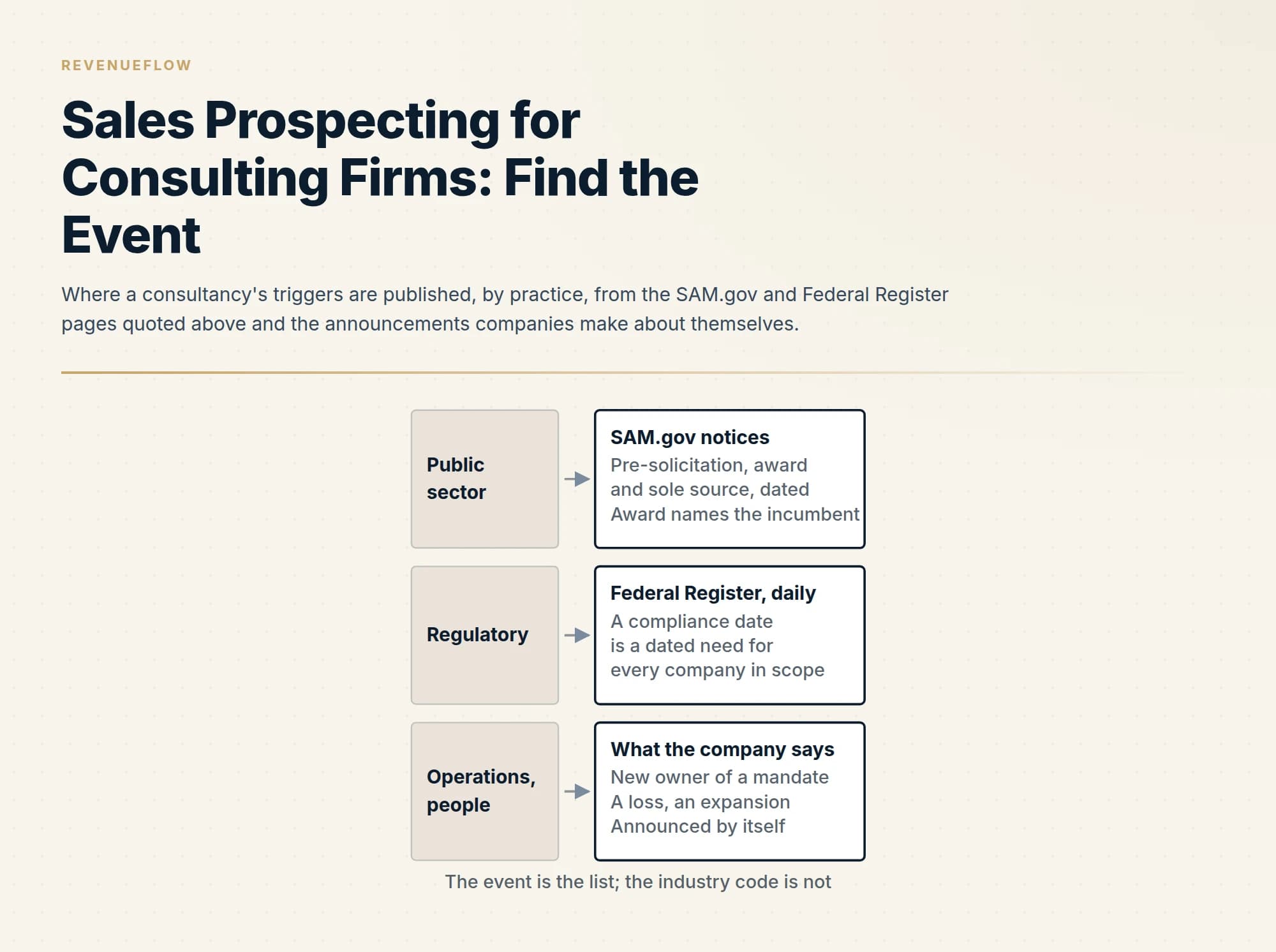
A consultancy prospects by trigger, because a company in the right industry has no need until something changes. A government practice reads SAM.gov's dated procurement notices, a regulatory practice reads rules and compliance dates in the Federal Register, and others read what companies announce. Former clients, alumni and referrers come first; the cold list is for accounts nobody can introduce.
Key takeaways
- SAM.gov describes its contract opportunities as procurement notices from federal contracting offices, including pre-solicitation, solicitation, award and sole source notices, each a dated need for a public-sector practice.
- FirmsConsulting, from a senior partner's seat, describes the default of earning the right to serve a client over two years and says most firms do not have that cycle, which is why the trigger matters.
- Consultport tells the independent consultant that prospecting is on them and to start with a written ideal client persona; the persona is the filter and the trigger is what makes a company a prospect this month.
- Salesmate's consulting sales process says firms often rely too heavily on referrals, which are valuable but not enough, so the honest order is relationships first and the cold list second.
Reviewed and updated September 21, 2026
A consultancy's prospect list is short and it is never a firmographic. A hundred manufacturers of the right size are a hundred companies with no reason to hire a consultant this quarter; the three of them that changed their chief operating officer, lost a contract or fell under a new rule are the list. Prospecting for a consulting firm is the work of finding the event, because the event is the only thing that makes an engagement buyable before the client has gone looking.
This page is prospecting for the consulting firm: the partner, the business developer or the independent consultant building the firm's own list of accounts. It is written for the people inside the firm, not for vendors selling to consultancies. It covers where a consultancy's accounts are enumerated, which is by trigger rather than by industry code; who inside the firm does the prospecting and why the split matters; alumni and referrals as the honest first source; the calendar; the channel mix; and when cold prospecting is the wrong play. The general method, a filter against a signal, is in sales prospecting and is not repeated; cold email for the same reader is the consulting cold email guide. Every outside page below was fetched on 21 September 2026 and is dated where it publishes a date.
What a search for this returns
Six of the readable results address the consultancy prospecting its own clients: Consultport's guide for the independent consultant, Salesmate's eight-stage consulting sales process, FirmsConsulting's account of building a strategy from a senior partner's seat, a LinkedIn post and a video, and a consulting forum thread on selling for a consulting firm that refused every fetch from here. Salesmotion's guide to IT consulting prospecting is written for a vendor selling into consultancies, a different reader, and three results are sales-consulting service pages, which sell consulting rather than describe finding clients for it. None of the six names where the triggers are published.
Where a consultancy's accounts are enumerated
A consultancy cannot enumerate its market from a database, because a company in the right industry at the right size has no need until something changes. What it can enumerate is the change, and several of the publishers of change are public bodies with dated notices.
The public-sector practice has the cleanest source. SAM.gov states what it holds: "Contract opportunities are procurement notices from federal contracting offices. Anyone interested in doing business with the government can use this system to search opportunities. Opportunities include pre-solicitation notices, solicitation notices, award notices, and sole source notices" (SAM.gov contract opportunities, as fetched). For a firm with a government practice, the pre-solicitation notice is the earliest public form of a need, the award notice names the incumbent to displace, and every notice carries a deadline.
The regulatory practice has the daily journal. The Federal Register site describes itself as a version of "the daily Federal Register" (Federal Register, as fetched), and a rule with a compliance date is a dated need for every company inside its scope; a consultancy whose practice is a regulation builds its list from the rule's own definition of who it covers.
The operations and people practices read organisational change. FirmsConsulting, writing from a senior partner's experience on 17 September 2020, describes the alternative to trigger-led prospecting and its cost: a firm can "build relationships with them, win the right to serve them or to earn the privilege to serve them over two years, that is fine. But usually, you do not have that cycle" (FirmsConsulting). The two-year relationship build is the default of the trade, and the trigger is the only thing that shortens it: a new owner of a mandate, a public loss, an expansion, each announced by the company itself in its own news, and each a fact a first message can name.
Who does the prospecting, and why the split matters
The live page on sales strategy for professional services sets out the four models of who sells at a professional firm, from the seller-doer who both wins and delivers the work to the business developer who hands a closer-doer the meeting; it is linked and not restated. What prospecting adds to that choice is a question of hours. Reading procurement notices, the daily register and company announcements is work for a researcher or a junior, with the partner ruling on fit at the end, and a firm that has a partner do the reading has bought the most expensive research desk in the building.
The independent consultant has no split to make. Consultport's guide opens on the fact: "As a consultant employed by a consulting firm, you wouldn't need to worry about prospecting or closing sales. But when you're an independent consultant, the work of prospecting and onboarding new clients is on you", and its first step is to "Create an Ideal Client Persona", because "you need to know who you should sell to and who actually needs your services" (Consultport, page modified 19 December 2025). The persona is the filter; the trigger is still what makes a company on the persona a prospect this month.
| Firm | Who reads the triggers | Who takes the meeting |
|---|---|---|
| Independent consultant | The consultant, against a written client persona | The consultant |
| Seller-doer firm | A researcher or junior, with the partner ruling on fit | The partner who will do the work |
| Business developer model | The business developer, by practice | The closer-doer the developer hands it to |
Alumni and referrals first, and honestly
Every source above agrees on the first list. Salesmate's process page says "Consulting firms often rely too heavily on referrals. Referrals are valuable, but they are not enough if you want consistent business growth" (Salesmate, as fetched), and the live guide to lead generation for professional services firms is built on the same limit. The honest order follows from it. Former clients whose champion has moved, alumni of the firm who now sit in client organisations, and the professionals who refer, accountants and lawyers and lenders, are the warm list, and they need no trigger because the relationship is the trigger. The cold list is built for the accounts nobody in the firm can introduce, from the events above, and it is worked second.
The relationship is the trigger; no event needed.
Accountants, lawyers and lenders who see the change before it is announced.
Procurement notices, rules with dates, announced changes: the cold list.
The default of the trade, and the cycle most firms do not have.
The calendar
A consultancy's calendar is borrowed from its clients and its sources. A procurement notice carries its own deadline, and a practice built on SAM.gov works to the dates in the notices rather than to a quarter. A rule carries its compliance date, and the list built from it has a natural end. A private company's budget runs to its own fiscal year, and the calling page for this reader sets out how the client's year-end decides when a budget conversation can land; for prospecting, the point is simpler, that the list is refreshed on the clients' calendars and not the firm's. A firm that pulls its triggers once a quarter has decided that its clients change once a quarter.
The channel mix
The written channel fits the trigger-led list, because a trigger is a fact the buyer can check and a first message can carry it. Consultport warns the independent consultant about the alternative on social platforms: "You cannot just send random people messages in order to sell your services. In fact, you may get blocked or barred from using a particular platform as some users may report your intrusion", and says that an independent management consultant is "more likely to find your prospects on LinkedIn than on Instagram or TikTok" (Consultport, page modified 19 December 2025). The phone is the calling page's subject; the referral introduction is the warm list's channel and needs none of this.
RevenueFlow runs email and LinkedIn for clients, one message per campaign with no follow-up bumps, so the reason to write has to be a dated event, which is what a trigger-led consulting list supplies. We do not cold-call.
When cold prospecting is the wrong play
Three cases. The firm whose warm list is unworked: a consultancy that has not written to its former clients and alumni in a year has no business building a cold list. The firm without a practice narrow enough to name a trigger: a generalist cannot say which rule, which notice or which change makes a company its prospect, and FirmsConsulting's two-year relationship build is the only route left. And the firm at capacity: a partner who cannot take a new engagement this quarter should not be reading notices for one.
Three openers, each on a fetched fact
Each opener below is one message, sent once, to one person; each rests on a page quoted above, names no real recipient and makes no claim about results. The firms and organisations in them are invented for illustration.
The first is built on SAM.gov's description of its notices and is for a programme director at a federal contracting office's prime contractor.
{{first_name}}, the pre-solicitation notice for {{programme}} was posted this month, and the award notice on the previous contract named the incumbent. We run one practice, transition planning for incumbents and challengers on federal programmes, and the question we would ask before the solicitation drops is whether the transition plan is written yet. If a thirty-minute conversation with the partner who leads that practice is useful, name a day.
The second is built on the Federal Register as the journal of rules with dates and is for a compliance lead at a company inside a new rule's scope.
{{first_name}}, the rule published on {{date}} puts {{company}} inside its scope, with a compliance date in {{month}}. Our regulatory practice works only on that rule, and the partner who leads it will take the call personally. Would twenty minutes before the end of the quarter help you decide what has to be true by the date, or is that already mapped?
The third is built on FirmsConsulting's two-year cycle and is for a former client's champion who has moved to a new company.
{{first_name}}, congratulations on the move to {{company}}. When we worked together at {{former_company}} the engagement took two years to earn and six weeks to deliver, and the new role usually inherits the same problem in a new shape. If it does, the partner you worked with will take the call; if it does not, this is the only note.
The short version
A consultancy prospects by trigger, because a company in the right industry has no need until something changes. The public sector practice reads SAM.gov's dated notices, the regulatory practice reads the daily register's rules and their compliance dates, and the operations and people practices read what companies announce about themselves. Who does the reading follows from who sells at the firm, and a partner reading notices is an expensive desk. Former clients, alumni and referring professionals come first; the cold list is for the accounts nobody can introduce, and a firm without a practice narrow enough to name a trigger should not build one. If building that list is the part you would rather hand over, see what a first campaign would target.
Frequently asked questions.
Frequently asked questions- How do consulting firms find new clients?
- Mostly through relationships first: former clients whose champion has moved, alumni of the firm now inside client organisations, and the accountants, lawyers and lenders who refer. Beyond that, by trigger rather than by industry code. A public-sector practice reads dated procurement notices on SAM.gov, a regulatory practice reads rules with compliance dates in the Federal Register, and other practices read what companies announce about themselves.
- What is a trigger event for a consulting firm?
- A change that makes an engagement buyable before the client has gone looking. A pre-solicitation notice is the earliest public form of a government need and an award notice names the incumbent to displace. A new rule's compliance date is a dated need for every company in its scope. A new owner of a mandate, a public loss or an expansion is a change the company announces itself. A generalist cannot name its trigger and cannot build the list.
- Who should do prospecting at a consulting firm?
- It follows from who sells. The independent consultant has no split to make and does it alone, against a written client persona. In a seller-doer partnership a researcher or junior reads the notices and announcements and the partner rules on fit, because a partner reading procurement notices is the most expensive research desk in the building. In the business developer model the developer reads by practice and hands the meeting to the closer-doer.
- When should a consulting firm not do cold prospecting?
- When its warm list is unworked: a firm that has not written to its former clients and alumni in a year has no business building a cold list. When it has no practice narrow enough to name a trigger, because a generalist cannot say which rule, notice or change makes a company its prospect, and only the two-year relationship build is left. And when its partners are at capacity, because nobody should read notices for an engagement they cannot take.
About the author.

B2B cold email experts helping companies generate qualified leads through done-for-you outreach campaigns.
RevenueFlow Team
Explore more.
Ready to scale your outreach?
We build GTM engines that book real meetings. See the receipts.
Related articles.
Sales Prospecting for SEO Agencies: Four Public Signals
How an SEO agency builds its own prospect list from signals Google documents: the index check, position, core update dates and site moves, under the warning owners read.
Sales Prospecting for Utilities: Read the Filings First
Prospecting utilities from the proceedings that announce their spend: rate cases, resource plans and procurement decisions, who owns each, and the supplier gate.
Cold Calling for Consulting Firms: The Partner's Hour
Cold calling for a consulting firm: who it dials and who picks up, why partner-led economics argue against the phone, the client's fiscal year, and when to skip it.
Sales Prospecting for Energy Companies: The Regulator's List
Prospecting for a retail energy supplier, broker or efficiency seller: the eligible customer list, the state's choice map, building grades, the triggers and the licence.
Sales Prospecting for Health Systems: The Public Record
Where health systems are written down in public: the Medicare cost report, the facility list a non-profit system files, and the two gates that follow qualification.
B2B Lead Lists for Aviation Companies: Build or Buy
Aviation is one of the few industries whose accounts are published by its regulator, which changes what is worth buying and what is worth downloading yourself.