Lead Generation for Professional Services Firms: Beyond Referrals
For accounting, law, consulting and engineering advisory firms: the channels the vertical's research ranks, how panel buyers choose, solicitation rules and three openers.
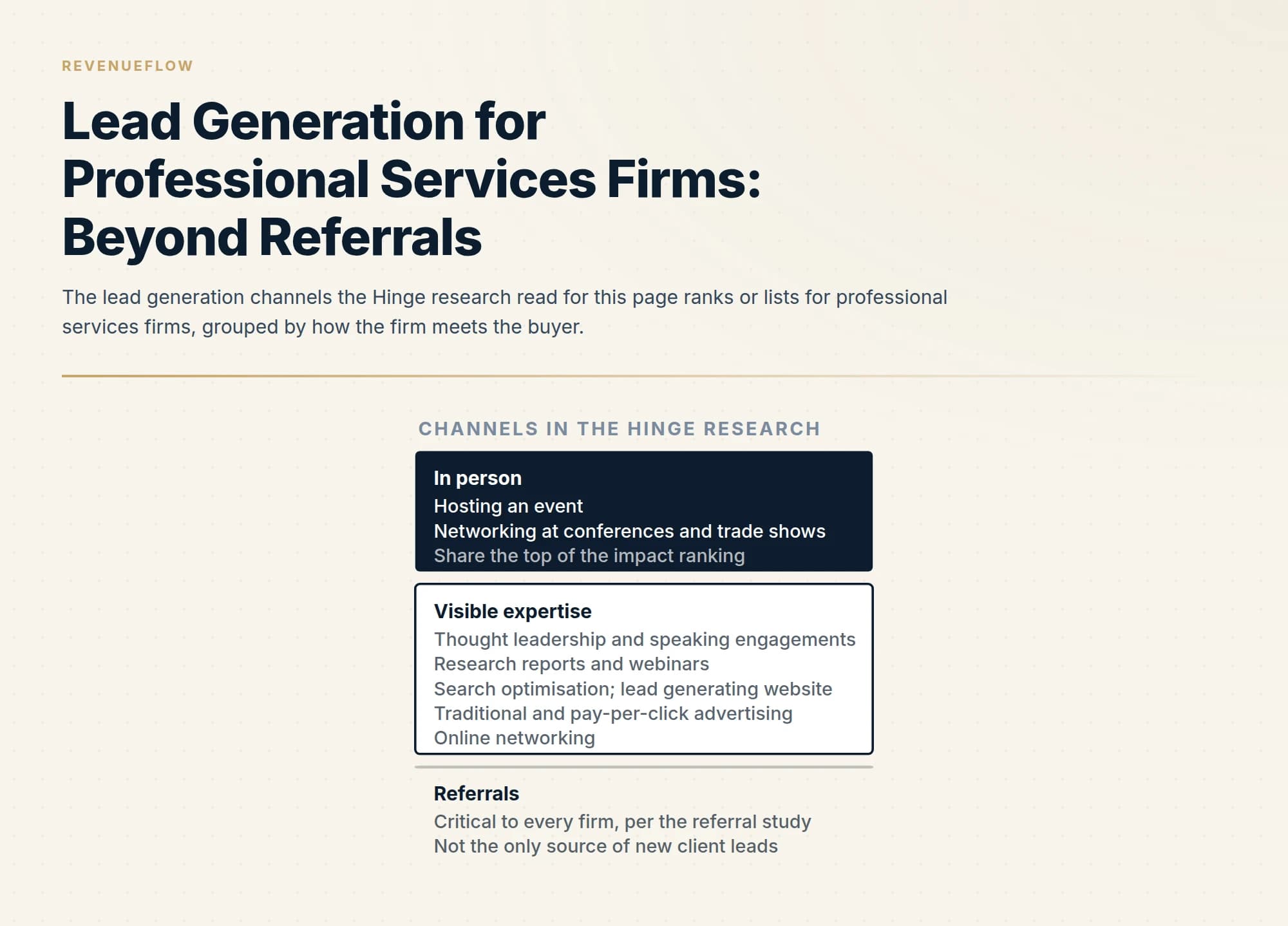
Professional services firms generate leads through a mix the vertical's own research ranks: hosting events and conference networking first, then visible expertise such as research, speaking and search, all on top of referrals. Large buyers choose through panels held for several years, so the target is the next invitation list, and licensed firms must read their regulator's solicitation rules first.
Key takeaways
- Hinge's 2026 High Growth Study summary, published 13 January 2026 from 495 firms, reports median growth of 9.9 percent, the lowest since 2018, and High Growth firms spending 12 percent of revenue on marketing against 5 percent for No Growth firms.
- In that study hosting an event shares the top of the impact ranking with networking at conferences and trade shows, with traditional advertising and social media thought leadership tied behind them.
- Thomson Reuters guidance for in-house lawyers, dated 13 December 2023, says panel counsel stays on a panel for several years and that invitation lists should always include smaller, regional or boutique firms.
- The State Bar of Texas reviews lawyer advertisements and solicitation communications under Part VII of its disciplinary rules, and a lawyer seeking preapproval submits the material not fewer than thirty days before first dissemination.
Reviewed and updated September 18, 2026
Lead Generation for Professional Services Firms: Beyond Referrals
Picture a forty-person engineering advisory firm whose work has always arrived by referral. A long-standing client is acquired, the new owner already has a panel of advisers, and a fifth of the firm's revenue leaves with one signature. The partners agree they need leads. Then the meeting stalls, because nobody in the room has ever generated one, and two of them are not sure the word belongs in a professional firm at all.
This page is for that firm: an accounting, law, consulting or engineering advisory practice that wants new clients and is working out which channels produce them. It is written for the firm doing the lead generation, not for companies selling to such firms. The outbound argument for this reader, including conflicts, partner time and the build-or-buy decision, is already made in outbound for professional services and is not repeated here; this page is the wider picture of channels, buyers, timing and rules. Everything below was fetched on 18 September 2026 from the vertical's own research, a regulator and the buyers' own guidance.
What the vertical's own research says is happening
The Hinge Research Institute studies professional services firms every year. Its summary of the 2026 High Growth Study, published on 13 January 2026, covers 495 firms representing almost 85 billion dollars in combined revenue. It reports that the median growth rate has cooled to 9.9 percent, the lowest since 2018, which it calls the end of easy growth, and that nearly one-third of firms believe AI is disrupting their businesses. The firms it classes as High Growth raised marketing investment from 10 percent of revenue in the previous report to 12 percent, more than doubling the 5 percent spent by No Growth firms.
The same summary says what those faster firms track. They are much more likely to track advertising and search visibility, while No Growth firms focus on client retention and lead sources. Hinge's reading is that struggling organisations are preoccupied with protecting existing business while the faster firms are learning what drives new revenue.
The channel mix, as the vertical measures it
Hinge's impact ranking for 2026 has two channels sharing the top place: hosting an event, which appears at the top for the first time, and networking at conferences and trade shows. Traditional advertising is in the top three, tied with social media thought leadership. High Growth firms, it says, run a hybrid networking strategy across live events and social media, and also invest in thought leadership, speaking engagements, search optimisation and blogging.
Lee Frederiksen of Hinge set out the online half on 5 February 2026 in a list of ten techniques: search optimisation, which he now extends to answers given by AI platforms, pay-per-click advertising, a lead generating website, online networking, webinars, research reports and video among them. Two of his observations are specific to this vertical. Most professional services websites, he writes, are not designed to generate leads, and many are jargon-filled and firm-centric. And research reports work twice, as lead generators and as credibility, and can be produced in partnership with a trade association to share the cost.
On referrals the vertical is unambiguous. Hinge's referral marketing study, of 1,168 participants, opens by saying nothing is more critical to a professional services firm's success than referrals. Frederiksen's point is about the ceiling: many professionals, he writes, still hold the mistaken belief that the only way to generate new client leads is through referrals and networking.
Direct outreach is absent from that ranking, and that is worth saying plainly. In this vertical it works as a way to start the conversations the other channels then carry, which is the argument of the outbound page linked above.
Who buys, and how the buyers say they choose
Hinge's strategy guidance states the basis of choice: most professional services clients are buying expertise, it is the top criterion in most provider searches, and some form of expertise is overwhelmingly what tips the final selection, with trust alongside it.
For larger buyers the choosing is formal, and the buyers publish how they do it. Writing for in-house lawyers on Thomson Reuters' legal site on 13 December 2023, Sterling Miller describes the request for proposals as a way to find the best firms for a problem or to create a panel of go-to law firms that can handle most of a company's outside legal work. Once selected, he writes, panel counsel is on the panel for several years. To build the invitation list he tells in-house teams to ask colleagues and other in-house lawyers for recommendations, to research online, and always to include smaller, regional or boutique firms. His four core questions cover the experience of the team that will actually do the work, the firm's legal strategy, its staffing strategy and its project management strategy.
Intapp, a software vendor to professional firms, wrote on 14 July 2020 that clients send RFPs to increase predictability, transparency and control over fees, and asked why they would introduce a more complex process with more decision makers. It named the people inside a firm who handle RFPs: the chief marketing or business development officer, an RFP specialist, and the chief administrative, operating or executive officer.
Timing: the panel term is the calendar
The practical consequence of a panel held for several years is that a large buyer's panel work is closed to new firms at any given moment, and opens at the review. A firm's lead generation towards such buyers is aimed at the invitation list, before the RFP exists, because a firm that is not invited does not get to answer the four questions. Visibility in the channels above is how a firm gets recommended or found in the online research Miller describes.
Smaller buyers without panels choose on a trigger, and the triggers and seasons for one profession are set out in accounting lead generation. This page does not give fiscal dates for the vertical as a whole, because we fetched no source that states them.
The rules that reach a firm's outreach
Licensed professions regulate how their members advertise and solicit, state by state, and the rule reaches a lead generation message directly. The State Bar of Texas is an example we could fetch. Its Advertising Review Department reviews attorney and law firm advertisements and solicitation communications as required by Part VII of the Texas Disciplinary Rules of Professional Conduct. Preapproval is not required, the Bar says, but it encourages lawyers to file advertisements and solicitation communications for approval before disseminating them, and under Rule 7.04(c) a lawyer who wants preapproval submits the material not fewer than thirty days before first dissemination. A finding of compliance is binding in favour of the submitting lawyer. For a law firm in that state, thirty days is a line in the campaign plan.
Other states and other professions publish their own rules. The American Bar Association's model rule page and the AICPA's code could not be fetched on the day of writing, so they are not summarised here; a firm should read its own regulator's current text. Separately, the Federal Trade Commission's CAN-SPAM guide says the Act makes no exception for business-to-business email and requires accurate header information, subject lines that are not deceptive, a valid physical postal address and an opt-out honoured within 10 business days. None of this is legal advice.
What the vertical itself says gets in the way
The first obstacle is inside the firm. Hinge's strategy guidance says that one of the most loaded words in many firms is sales, that for many professionals the term conjures up unethical manipulation and unbecoming practices, and that in many firms it is never used. The second is the referral ceiling Frederiksen describes. The third comes from the buyer: Miller tells in-house teams to exclude copies of the lawyers' firm bios, which he says generally contain very little information that matters, and to write questions that get useful information versus generic marketing. Intapp adds that law firms met the RFP itself with reluctance and caution when it arrived.
- Yes: The firm's own regulator's advertising and solicitation rules have been read
- Yes: Where preapproval is offered, the thirty days are in the plan
- Yes: The message shows the experience of the team that will actually do the work
- Yes: The website explains what problems the firm solves, without jargon
- No: A copy of a firm bio as the proof of expertise
- No: Generic marketing where the buyer asked for useful information
When direct lead generation is the wrong play
It is the wrong play towards a buyer whose work sits with a panel that was selected last year; the term runs for several years and the useful activity is visibility before the next review. It is the wrong play while the firm's website is what Frederiksen calls an anti-lead generator, because every channel lands there. It is the wrong play for a regulated firm that has not read its own solicitation rules. And it is a poor substitute for referrals, which the vertical's own study calls critical; it is an addition to them. Our own motion, where it fits, is email and LinkedIn, one message per campaign and no bump sequences. The general terms are defined in outbound lead generation and B2B lead generation, and firms that market to other firms have a closer cousin in lead generation for marketing agencies.
Three openers a firm could send
Each rests on one fetched source. The firms and facts in them are invented for illustration, and none claims a result.
From an employment law boutique to a general counsel
If you review your outside counsel panel in the next year, we would like to be on the invitation list. Two paragraphs on the three lawyers who would do your work, and how we staff a matter, are below. No brochure attached. 1
From a consulting firm to a finance director
We surveyed finance leaders in regional logistics firms about month-end close this spring and have written up what they said. Would you like the report? There is nothing to fill in. 2
From an engineering advisory firm to a trade association director
Your members keep asking about the new inspection regime. We would host a half-day seminar for them this autumn with your association as co-host, and share the research behind it. Is that worth a conversation? 3
- 1Built on the Thomson Reuters guidance: the invitation list includes boutique firms, the first question is the experience of the team, and firm bios are to be excluded.
- 2Built on Frederiksen's point that research reports are lead generators and build credibility.
- 3Built on hosting an event sharing the top of Hinge's impact ranking, and on research produced in partnership with a trade association.
Running it
Keep the referral base and measure it. Fix the website first. Choose two channels from the ranking that the partners will actually sustain, usually one in person and one that makes expertise visible. For panel buyers, find out when the panel was last set and aim at the next invitation list. Read the firm's own solicitation rules before anything is sent, and put any preapproval window in the plan. How to judge an outside provider is covered in qualified lead generation services.
If the constraint is starting conversations with the right buyers, RevenueFlow books qualified meetings for professional services firms on a pay-per-meeting basis, by email and LinkedIn, with the qualification criteria agreed in writing before launch.
Growth, spending and channel findings per the Hinge Research Institute's 2026 High Growth Study summary, 13 January 2026, 495 firms; online techniques per Hinge, 5 February 2026; referral study of 1,168 participants and strategy guidance per Hinge; panel and RFP practice per Sterling Miller for Thomson Reuters, 13 December 2023, and Intapp, 14 July 2020; solicitation review per the State Bar of Texas; email rules per the FTC's CAN-SPAM guide. All fetched 18 September 2026.
Sources: 5 Key Takeaways from the 2026 High Growth Study, Hinge, Top 10 Online Lead Generation Techniques for Professional Services, Hinge, Referral Marketing Study, Hinge, Sales and Marketing Strategy for Professional Services, Hinge, Generating Good RFPs and Building a Basic Law Firm Panel, Thomson Reuters, Survey: Are RFPs for Legal Services on the Rise, Intapp, Advertising Review, State Bar of Texas, CAN-SPAM Act Compliance Guide, FTC
Frequently asked questions.
Frequently asked questions- How do professional services firms generate leads?
- Through a mix, according to the vertical's own research. Hinge's 2026 High Growth Study, covering 495 firms, ranks hosting an event and networking at conferences and trade shows as the highest-impact techniques, followed by traditional advertising and social media thought leadership. Faster-growing firms add speaking, research reports, webinars and search optimisation. Referrals remain critical, but Hinge's Lee Frederiksen calls relying on them alone a mistaken belief.
- How do large companies choose law firms and other advisers?
- Often through a formal request for proposals. Thomson Reuters guidance of 13 December 2023 describes in-house teams building an invitation list from recommendations and online research, asking four core questions about the team's experience, strategy, staffing and project management, and selecting a panel that then holds most of the work for several years. A firm outside the panel acts before the next invitation list is built.
- Are there rules on how a law firm can solicit clients?
- Yes, and they differ by state. The State Bar of Texas, for example, reviews attorney advertisements and solicitation communications under Part VII of the Texas Disciplinary Rules of Professional Conduct. Preapproval is not required, but a lawyer who wants it submits the material not fewer than thirty days before first use, and a finding of compliance is binding in the lawyer's favour. Read your own regulator's text; this is not legal advice.
- When is outbound lead generation wrong for a professional services firm?
- When the buyer's work sits with a panel selected last year, because the term runs for several years; when the firm's website cannot explain what problems it solves, since every channel lands there; and when a regulated firm has not read its own solicitation rules. It also does not replace referrals, which the vertical's own study of 1,168 participants calls critical. It adds to them.
About the author.

B2B cold email experts helping companies generate qualified leads through done-for-you outreach campaigns.
RevenueFlow Team
Explore more.
Ready to scale your outreach?
We build GTM engines that book real meetings. See the receipts.
Related articles.
Lead Generation for Telecommunications Companies: Four Lead Sources
For carriers, ISPs, UCaaS providers and MSPs: the installed base, the advisor channel, dated outbound and the funded network map as lead sources, with FCC rules.
Lead Generation for Material Handling Companies
How a forklift dealer, racking maker or integrator finds plants with a dated reason to talk: OSHA evaluation cycles, dealer consolidation, MHI show rosters.
Merchant Services Cold Calling Scripts: The Honest Version
Six call scripts for merchant services agents and ISO reps, built around what the FTC alleged about this exact call: no affiliation claim, no rate before a statement.
Appointment Setting for 3PL Companies: Fit Before the Calendar
For 3PLs, warehousing operators and brokers wanting shipper meetings: the five fit gates, the bid calendar, contract terms, the trade's rules and three openers.
LinkedIn Outreach for Machine Shops
How a job shop or CNC machine shop uses LinkedIn to win OEM work: the four buyer titles, the RFQ gate, the ISO, AS9100 and ITAR facts, and LinkedIn's own rules.
Sales Outsourcing for SaaS Companies: What to Hand Over
For SaaS companies weighing an outside sales team: what the industry's own survey found, what a third party cannot hold in a software sale, and what can go out.