Lead Generation for Material Handling Companies
How a forklift dealer, racking maker or integrator finds plants with a dated reason to talk: OSHA evaluation cycles, dealer consolidation, MHI show rosters.
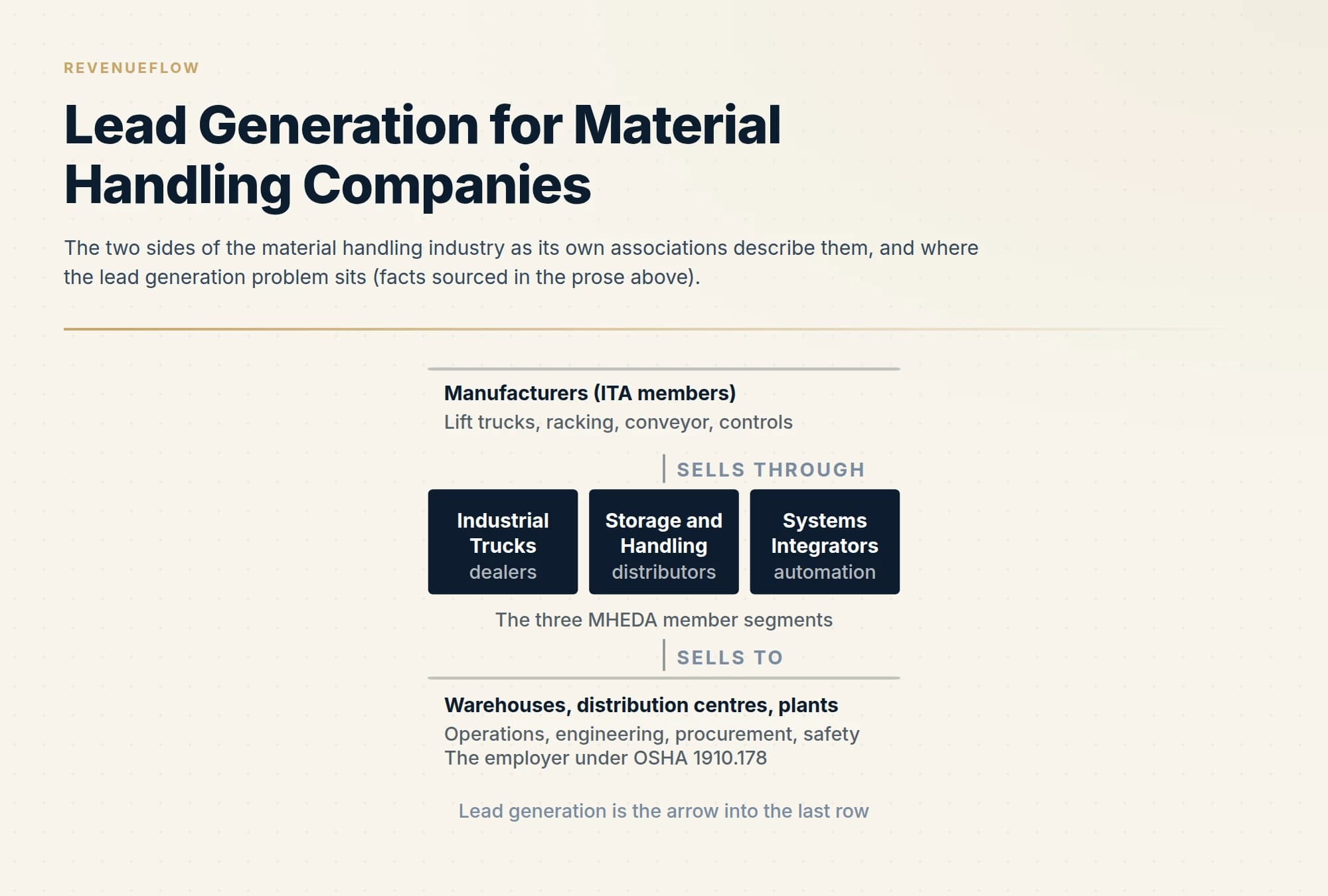
A material handling company generates leads by building its list around public, dated reasons: the three-year operator evaluation cycle in OSHA 1910.178(l), dealer consolidation reported by MHEDA, automation announcements and the ProMat and MODEX rosters. It writes to operations, engineering, procurement and safety titles by email and LinkedIn, one message per campaign, with OEM-owned accounts suppressed first.
Key takeaways
- MHEDA sorts its distributor members into Industrial Trucks, Storage and Handling and Systems Integrators, while ITA admits only manufacturers, whose members represent more than 85 percent of the North American forklift market; lead generation is the arrow from the distributors to the plant.
- OSHA 29 CFR 1910.178(l) requires the employer to train every operator before they drive and to evaluate each operator at least once every three years, a dated obligation on the buyer's side that makes a training or fleet conversation legitimate.
- ProMat 2027 in Chicago carries more than 1,200 exhibits and 200 sessions, MODEX runs in Atlanta on 3 to 5 April 2028 and Las Vegas on 18 to 20 October 2028, and MHEDA's October reports and conferences mark the dealer calendar.
- CAN-SPAM makes no exception for business-to-business email, LinkedIn's User Agreement prohibits automation and scraping, and accounts owned by the OEM or assigned to another dealer belong on the suppression list before the first send.
Reviewed and updated September 18, 2026
The Material Handling Equipment Distributors Association sorts its members into three businesses, Industrial Trucks, Storage and Handling, and Systems Integrators, and its home page, read on 18 September 2026, says the association exists to help all three "learn, collaborate, and boost your bottom line" (mheda.org). Across the aisle, the Industrial Truck Association admits only manufacturers, tells visitors on its own site that "If you're not a manufacturer or you don't represent one" they cannot join, and says its manufacturing members represent more than 85 percent of the forklift market in North America (indtrk.org, read 18 September 2026). That split, makers on one side and the distributors and integrators who sell to the plant on the other, is the whole shape of lead generation in this vertical.
This page is written for the second side: a forklift or lift-truck dealer, a racking or conveyor maker with its own sales team, or an integrator, wanting a steady flow of qualified conversations with warehouses, distribution centres and plants. It is not written for a company selling software or services to warehouses; that reader has cold email for warehousing, and a freight or 3PL provider's own pipeline is covered in logistics lead generation. Where your OEM also sells direct into the plants you call on, the channel-conflict rules in manufacturing lead generation apply and are not repeated here. Every fact below comes from a page fetched on 18 September 2026 and is cited where it appears.
Who buys, and who signs
The person who wants a new fleet, a mezzanine or a sortation line is rarely the person who signs for it. On the buyer's side the operational owner is a warehouse or DC manager, the technical owner is a plant or industrial engineer, and the signature sits with a VP of operations, with procurement arriving once the specification exists. Scube, an industrial marketing agency whose page ranks for this phrase, names the same set, "warehouse managers, logistics directors, operations managers, and procurement officers" (scubemarketing.com, read 18 September 2026); its market-size figures are third-party estimates and are not repeated here.
The safety or EHS manager is the fourth title. Under OSHA's powered industrial truck standard, 29 CFR 1910.178(l), the employer "shall ensure that each operator has successfully completed the training required by this paragraph" before that person operates a truck, and "An evaluation of each powered industrial truck operator's performance shall be conducted at least once every three years" (osha.gov, read 18 September 2026). That obligation belongs to your customer, it is dated by the customer's own records, and it is why a safety manager takes a call from a dealer about training or refresher evaluations. A list that carries the operations, engineering, procurement and safety titles for each account, rather than one contact per site, is the first thing a programme in this vertical needs.
Where the money and the calendar come from
Material handling spend is capital spend on the plant's calendar, and two public calendars anchor it. MHEDA's own event list for the coming weeks, read on 18 September 2026, carries the Q4 ITR Economic Report on 1 October, the 2026 Parts and Service Management Conference on 8 October and the 2027 Material Handling Business Trends on 15 October, and its news feed the same day led with a dealer acquisition, "Wolter Acquires Flatley Dock Systems, Expanding Dock and Door Services", and a durable-goods orders release (mheda.org). On the manufacturer side, ITA's annual meeting runs 23 to 26 September 2026 in Phoenix (indtrk.org).
The buying shows are MHI's. ProMat 2027, which MHI bills as "the largest manufacturing and supply chain event of 2027", carries more than 1,200 exhibits, 200 educational sessions and three keynotes in Chicago, with its Industry Night on Tuesday 20 April (promatshow.com, read 18 September 2026). MODEX then moves to Atlanta on 3 to 5 April 2028 and adds a Las Vegas edition on 18 to 20 October 2028 (modexshow.com, read 18 September 2026). For a dealer the shows matter twice: the buyers who walk them are evaluating, and the exhibitor list is a public roster of every competitor and OEM.
The triggers that make an email legitimate
A material handling lead is a plant with a dated reason to talk, and the reasons are mostly public.
A documented safety obligation. The three-year evaluation cycle in 1910.178(l)(4)(iii) is a clock every fleet runs on, and the standard also requires refresher training when an operator is observed operating unsafely, has an accident or near miss, or is assigned a different type of truck (osha.gov). OSHA's forklift topic page, read the same day, highlights a 2025 fact sheet on lithium-ion battery safety for facilities that use and charge those batteries (osha.gov), which is a dated hook for any dealer selling electric conversions or charging infrastructure.
Consolidation in your own channel. When MHEDA's news feed reports one dealer acquiring another's dock and door business, every account in that territory is about to meet a new service organisation. Those accounts are a legitimate list for a competing dealer, and the news item is the reason to write.
Automation capex announcements. MHEDA's own segmentation puts Systems Integrators beside the truck and storage businesses, and its membership page describes that segment as "Streamlining operations with automation, software and more" (mheda.org, read 18 September 2026). A public announcement of an automated DC is a signal for the racking, conveyor and truck businesses that sit around the automation.
The show roster. ProMat's exhibitor directory and MODEX's are public. A plant whose engineers registered is not visible to you; a competitor who exhibited is.
What is not on this list is a bought "intent" feed. MHI's economic-impact report, commissioned from Oxford Economics and published on 28 October 2020, counted nearly 1.6 million jobs supported by the industry in 2018 (mhi.org, read 18 September 2026); the job is to find the few hundred plants with a dated reason, not to rent a list of all of them.
Channel reality for a dealer
The buyers above are reachable by email and on LinkedIn; the question is how the first conversation with a new account starts. We run email and LinkedIn, on Email Bison and in-house tooling for email and HeyReach for LinkedIn, one message per campaign, and treat the phone as something a dealer's inside team may add rather than something we run.
Two rules touch every message. The FTC's CAN-SPAM guide states that the Act "makes no exception for business-to-business email", so a dealer's commercial email carries the same obligations as anyone else's: honest header and subject, identification as an advertisement where required, a physical address, and a working opt-out honoured promptly (ftc.gov, read 18 September 2026). On LinkedIn, the User Agreement's section 8.2 prohibits using "software, devices, scripts, robots or any other means or processes" to scrape the service and bypassing its access controls, and LinkedIn's help centre says accounts using tools that automate activity "risk having their accounts restricted or shut down" (linkedin.com, read 18 September 2026). A dealer's LinkedIn programme is therefore a person, sending one message to each plant contact, and never a second message to someone who ignored the first: that second message lands under the one they passed over and reads as a bump. If a dealer's inside team also calls, the FTC's Telemarketing Sales Rule guide says "Most phone calls between a telemarketer and a business are exempt from the TSR" (ftc.gov, read 18 September 2026), which is a statement about federal coverage, not a licence; state rules sit beside it, and none of this is legal advice.
| Channel | Rule that touches it | What it asks of the sender |
|---|---|---|
| CAN-SPAM Act (FTC guide) | Honest headers, an address, an opt-out that is honoured; no B2B exception | |
| User Agreement 8.2, prohibited software page | No automation, scraping or bypassing limits; a person sends each message | |
| Phone (if your team adds it) | FTC Telemarketing Sales Rule guide | Most B2B calls are outside the federal rule; state rules apply separately |
| The buyer's own obligation | OSHA 29 CFR 1910.178(l) | Nothing of you; it is the dated reason a safety manager takes the meeting |
Three openers with the source beside them
Each opener below is grounded in a page fetched on 18 September 2026, names no real recipient, carries no contact details and claims nothing about results.
On the evaluation clock. Every forklift operator on your floor is due a documented performance evaluation at least once every three years under 1910.178(l), and the fleets we see tend to have a cluster of dates falling in the same quarter. If yours are bunching up this winter, we run the evaluations and the refresher training on site, and we can do the paperwork the way an inspector wants to read it. Source: the OSHA standard text (osha.gov). Legitimate because the obligation is the recipient's, it is dated, and the offer is the obligation itself.
On a dealer acquisition. MHEDA's news this week reported Wolter acquiring Flatley Dock Systems. If your dock and door service was on the Flatley side, the next twelve months will decide whether the new organisation keeps your response times. We service docks and doors in your region and would rather earn a comparison now than after a failure. Source: the MHEDA news feed (mheda.org). Legitimate because the change is public, dated and affects the recipient's service, not because the sender says so.
On battery conversion. OSHA published a fact sheet in 2025 on lithium-ion battery hazards in facilities that use and charge them. If you are moving part of the fleet from lead-acid, the charging room and the fire plan change before the trucks do; we lay that out in a one-page site check before anyone quotes a truck. Source: OSHA's powered industrial trucks topic page (osha.gov). Legitimate because it points at the regulator's own publication and offers the buyer a check, not a sale.
To: EHS manager at a distribution centre; Subject: the three-year evaluation dates on your fleet
Every operator is due a documented performance evaluation at least once every three years under 1910.178(l). 1
The fleets we see tend to have a cluster of dates falling in the same quarter. 2
We run the evaluations and refresher training on site and do the paperwork the way an inspector wants to read it. Worth a look at your dates? 3
- 1Opens on the recipient's own obligation, cited to the standard, not on the sender.
- 2An observation about how the clock behaves, stated as what we see, with no figure attached.
- 3The offer is the obligation itself, and the ask is a look at dates, not a demo.
What a lead is, and how it is counted
A dealer's pipeline dies on the definition of a lead as often as on the list. Before a campaign starts, write down what a qualified meeting is: the account is a warehouse, DC or plant in your service area, the person owns operations, engineering, procurement or safety for that site, they agreed to a specific conversation about equipment, service or training, they attended, and they were not already a customer or an open quote. Budget, timing and decision authority are deliberately left out of that definition, because the moment they become billing conditions every invoice becomes an argument about whether the plant "really" had budget.
That definition also protects the relationship with your OEM. A national account handled by the manufacturer, or an account assigned to another dealer under your dealer agreement, belongs on the suppression list before the first send. The programme's job is net-new conversations in the territory you are entitled to work.
When this is the wrong play
Lead generation by email and LinkedIn is the wrong play in four situations a dealer will recognise. When the accounts you want are national accounts the OEM handles directly, a cold email from the dealer creates a conflict, not a lead. When your dealer agreement assigns the plant to another distributor, the same applies, and the manufacturer's own site is the place to confirm the map before anyone writes. When the buyer is already at ProMat or MODEX with a shortlist, the exhibitor floor is the meeting, and an email the week before the show competes with several hundred others. And when the plant has no dated reason, no evaluation cycle coming due, no expansion, no change in its channel, a message is a brochure, and brochures are what the CAN-SPAM opt-out link is for.
The route-based service call remains the dealer's strongest channel for accounts it already has. This page is about the accounts it does not have yet, and the number of those with a dated reason in any quarter is small enough to write to one at a time.
The short version
A material handling company sells into a plant where the operations manager wants the equipment, the engineer specifies it, the VP signs and procurement arrives late, and where the safety manager carries a dated obligation under OSHA 1910.178(l) that makes a training or fleet conversation legitimate on its own. The list is built from public triggers: evaluation cycles, dealer consolidation reported by MHEDA, automation announcements and the ProMat and MODEX rosters. The channels are email and LinkedIn, under CAN-SPAM and LinkedIn's own rules, one message per campaign and no second message to a plant that ignored the first. If your territory has more dated reasons than your inside team can write to, RevenueFlow books qualified meetings on a pay-per-meeting basis, against a definition of qualified agreed in writing first.
Regulatory and association facts on this page are taken from the issuing regulator's or association's own page, read on 18 September 2026, and summarised rather than reproduced. Rules change and vary by state; this is not legal advice, and a dealer should confirm its obligations, and its dealer agreement, before running a programme.
Sources: MHEDA home, MHEDA value of membership, Industrial Truck Association, OSHA 29 CFR 1910.178, OSHA powered industrial trucks, ProMat 2027, MODEX, MHI publications, Scube, lead generation for material handling companies, FTC CAN-SPAM guide, FTC Telemarketing Sales Rule guide, LinkedIn prohibited software and extensions
Frequently asked questions.
Frequently asked questions- Who should a material handling dealer target at a warehouse or plant?
- Four titles, not one. The warehouse or distribution centre manager owns the operational need, the plant or industrial engineer specifies the equipment, a VP of operations signs, and procurement arrives once a specification exists. The safety or EHS manager sits beside them, because OSHA 1910.178(l) puts operator training and a three-year performance evaluation on the employer, which gives that person a dated reason to talk to a dealer about training and fleet changes.
- What triggers make a plant a legitimate lead for material handling equipment?
- Public, dated ones. The three-year evaluation cycle and refresher-training conditions in OSHA 1910.178(l), OSHA's 2025 lithium-ion battery fact sheet for facilities converting fleets, dealer consolidation reported in MHEDA's news feed, public announcements of automated distribution centres, and the exhibitor rosters of ProMat and MODEX. Each gives the sender a reason the recipient can check, which is what separates a lead from a brochure.
- Can a dealer automate LinkedIn outreach to warehouse managers?
- LinkedIn's User Agreement, section 8.2, prohibits software, scripts or robots that scrape the service or bypass its access controls, and LinkedIn's help centre says accounts using tools that automate activity risk restriction or closure. A dealer's LinkedIn programme is therefore a person sending one message to each contact. We also never send a second LinkedIn message to someone who ignored the first, because it lands under the ignored one and reads as a bump.
- When is outbound lead generation the wrong play for a material handling company?
- When the target is a national account the manufacturer handles directly, when your dealer agreement assigns the plant to another distributor, when the buyer is already walking ProMat or MODEX with a shortlist, or when the plant has no dated reason to talk. In each case a cold email creates a conflict or a brochure rather than a lead. The dealer's route-based service call remains the strongest channel for accounts it already holds.
About the author.

B2B cold email experts helping companies generate qualified leads through done-for-you outreach campaigns.
RevenueFlow Team
Explore more.
Ready to scale your outreach?
We build GTM engines that book real meetings. See the receipts.
Related articles.
Appointment Setting for Material Handling Companies
Appointment setting in material handling starts with whose appointment it is: dealer territories, the ProMat and MODEX calendar, and OSHA's dated duties.
LinkedIn Outreach for Machine Shops
How a job shop or CNC machine shop uses LinkedIn to win OEM work: the four buyer titles, the RFQ gate, the ISO, AS9100 and ITAR facts, and LinkedIn's own rules.
Outbound Sales for Web Development Companies: A Guide
Outbound for a web shop starts from the prospect's own public site: what it runs on, how it performs and whether a dated accessibility duty applies.
Appointment Setting for Food Distributors
How a foodservice distributor opens accounts its routes do not reach: independents, chains and institutions, the FDA traceability rule as the opener, the DSR handoff.
LinkedIn Outreach for Software Development Companies
LinkedIn outreach for development firms: buyers are saturated with capacity pitches, LinkedIn prohibits the usual playbook, and public signals earn a reading.
SDR Outsourcing for Insurtech Companies
What an outsourced SDR team must be able to say for an insurtech: the buyer function, the enrollment and trade-press calendar, the licence question, the security review.